
The choice between 2-ply and 3-ply carbonized payslip books is determined by the number of physical, contemporaneous copies your business requires for its payroll records. If your office workflow only needs one copy for the employee and one for the company’s internal files, a 2-ply book is the most efficient choice. However, if your accounting department, external auditors, or labor compliance officers require an independent physical copy, a 3-ply book is necessary to avoid the tedious task of manual photocopying. Selecting the correct format prevents unnecessary supply costs, reduces filing bulk, and ensures compliance with your internal record-keeping or external auditing requirements.
Understanding how these forms function and how they impact your daily administrative operations is key to making an informed purchase. By evaluating your distribution paths, storage constraints, and printing hardware, you can select the paper format that keeps your payroll cycle running smoothly and securely.
How 2-Ply and 3-Ply Carbonized Forms Work
Carbonless copy paper, often referred to as NCR (No Carbon Required) paper, relies on a chemical reaction to transfer written or printed text from the top sheet to the sheets below without the need for messy blue or black carbon sheets. The physical structure of these forms is divided into distinct layers, or plies. A 2-ply carbonized payslip book consists of an original top sheet and one duplicate copy underneath, creating a two-part set. A 3-ply book adds an intermediate sheet, resulting in an original and two duplicate copies per set.
Products mentioned in this guide
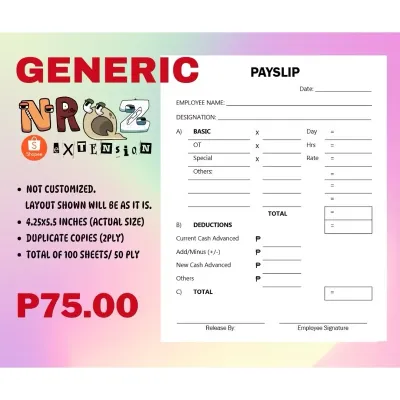
Prices are valid at publication and may change. Please refer to the product page for the latest price.
To achieve this transfer, the paper is treated with specialized chemical coatings. The underside of the top sheet is coated with microcapsules containing colorless dye, a layer known as Coated Back (CB). The top side of the bottom sheet is coated with a reactive clay, known as Coated Front (CF). In a 3-ply setup, the middle sheet must perform both roles; it is coated with clay on the front to receive the image from the top sheet, and microcapsules on the back to pass the image to the bottom sheet, a configuration known as Coated Front and Back (CFB). When a pen or the pin of an impact printer applies pressure to the top sheet, the microcapsules rupture, releasing the dye to react with the clay and creating a sharp, permanent image on the copies below.
To help offices organize their distribution and filing systems, manufacturers use standard color coding for each ply. Typically, the original top sheet is white, which is standard for the primary recipient. In a 2-ply book, the duplicate is often yellow or pink. In a 3-ply book, the standard sequence is usually white for the original, yellow for the duplicate, and pink for the triplicate. This color-coded system allows administrative staff to instantly identify where each copy should be routed without needing to read the fine print on every page.
Mapping Your Payroll Distribution and Archiving Needs
To determine which configuration fits your office, you must map out your exact payroll distribution path. The primary copy of any payslip is always designated for the employee, providing them with a clear, written breakdown of their wages, deductions, and net pay. In the Philippines, maintaining transparent payroll communication is essential for fostering trust and ensuring compliance with local labor standards. The second copy is traditionally retained by the employer as an archive to verify that payment was made and to serve as a reference during internal audits or tax filings.

While a 2-ply book perfectly satisfies this basic employee-employer dynamic, certain business structures require a third physical copy. For instance, if your company utilizes an external accounting firm, they may require a physical copy of every payslip to reconcile monthly books. Similarly, if your workforce is unionized, or if you have a dedicated human resources department that operates independently from your finance team, a third copy ensures that all relevant parties receive their documentation simultaneously. Having a 3-ply book ready during the payroll run prevents the administrative bottleneck of having to share or scan a single file across multiple departments.
Physical storage constraints and environmental factors also play a major role in this decision. Storing paper records in tropical climates requires careful planning, as high humidity can cause paper to absorb moisture, leading to curling, mold, or sheets sticking together over time. Storing 3-ply books increases the physical volume of your archives by 50% compared to 2-ply books. Over several years, this extra paper can quickly crowd filing cabinets and storage boxes, requiring more physical office space and higher spending on climate-controlled storage solutions to preserve the legibility of the carbonless chemical transfer.
Furthermore, the administrative time required to separate, sort, and file extra copies each payroll cycle should not be underestimated. Staff must manually tear out, sort, and file each sheet from the book. If your office does not actually utilize the third copy, choosing a 3-ply book results in wasted paper that must eventually be shredded and discarded, adding unnecessary steps to your administrative workflow and increasing your environmental footprint.
Comparing Workflow Impact and Supply Costs
The operational differences between 2-ply and 3-ply setups extend to physical handling and long-term supply budgets. Because of the additional paper layer and chemical coatings, 3-ply books are significantly thicker and heavier than their 2-ply counterparts. This added bulk means that a standard box of office supplies can hold fewer 3-ply books, increasing shipping and handling efforts. For manual payroll processing, staff handling thick 3-ply books may find them more cumbersome to write on, requiring firmer pressure to ensure the ink transfers clearly to the final pink sheet.
From a financial perspective, purchasing office supplies requires a careful look at the cost per transaction in ₱. While a 3-ply book carries a higher unit price in ₱ due to the extra manufacturing steps and materials, it can actually save money in specific workflows. If your office currently uses 2-ply books but manually photocopies every slip to satisfy a third department’s record-keeping needs, you are spending extra on copier toner, electricity, paper, and staff labor. In this scenario, switching to a 3-ply book eliminates the photocopying bottleneck entirely, making it the more economical choice despite the higher initial purchase price.
To help visualize these trade-offs, the table below outlines the key differences between the two configurations:
2-Ply vs 3-Ply Payslip Book Comparison
| Feature | 2-Ply Setup | 3-Ply Setup |
|---|---|---|
| Number of Copies | Original + 1 duplicate | Original + 2 duplicates |
| Standard Color Coding | White (original), Yellow or Pink (duplicate) | White (original), Yellow (duplicate), Pink (triplicate) |
| Storage Footprint | Slimmer profile, takes up less filing cabinet space | Thicker profile, requires more physical storage volume |
| Relative Cost in ₱ | Lower cost per book and per individual transaction | Higher cost per book, but eliminates photocopying expenses |
| Primary Use Case | Simple employee-employer payroll distribution | Multi-departmental tracking, external audits, or union records |
| Pressure Sensitivity | Requires standard writing pressure for clear transfer | Requires firmer writing pressure or high-impact print heads |
Checking Paper Quality and Printer Compatibility
Before purchasing carbonized payslip books in bulk, it is essential to verify their physical specifications and compatibility with your office equipment. Carbonless paper requires physical pressure to activate the chemical transfer, meaning standard laser or inkjet printers cannot be used to print multiple plies simultaneously. Instead, offices rely on dot-matrix or impact printers. The pins of the print head must strike the paper with sufficient force to rupture the microcapsules through all three layers. If the paper weight is too heavy or the printer’s impact setting is too light, the third copy of a 3-ply slip may be faint or illegible.
Binding types also dictate how well these books integrate with your daily office routine. Glued edges allow for quick, clean tearing, but the adhesive can weaken in high tropical humidity, causing pages to fall out prematurely if the books are handled roughly. Stitched or spiral bindings keep the employer’s copies securely bound within the book for permanent archiving, while perforated lines allow the employee’s copy to be detached easily. If your office uses automated continuous feed printers, you must ensure the carbonized forms are configured as continuous tractor-feed sheets rather than individual bound books.
To ensure quality and avoid bulk purchasing errors, always perform a manual test with a sample sheet before committing to a large order. Write on the top copy with a standard ballpoint pen using normal writing pressure, then inspect the final ply to verify that the transfer is sharp, legible, and free of smudging. Check that the paper fibers are strong enough to resist tearing along the feed holes of your printer, and verify that the physical dimensions of the book match your standard filing envelopes and storage trays.
Final Decision Guide for Your Office
Use this condition-based framework to guide your office’s purchasing decision:
Choose 2-Ply if:
- Your payroll workflow only requires two physical copies: one for the employee and one for the central company archive.
- You want to minimize physical storage space and reduce paper waste in your filing cabinets.
- You are operating on a tighter office supply budget and want to keep the cost per transaction in ₱ as low as possible.
Choose 3-Ply if:
- Your business structure requires separate physical copies for HR, accounting, and the employee.
- You are subject to regular external audits or union agreements that mandate independent, physical record-keeping across multiple departments.
- You want to eliminate the administrative time and equipment costs associated with manually photocopying 2-ply slips.
Verify first if:
- Your office printers (such as dot-matrix models) have adjustable impact settings capable of printing clearly through three layers of paper.
- The physical dimensions of the payslip books match your filing cabinets, envelopes, or printer paper paths.
Frequently Asked Questions (FAQ)
Can I use a standard laser or inkjet printer for carbonized payslip books?
No, standard laser and inkjet printers are not compatible with multi-ply carbonized payslip books. Carbonless paper relies on physical pressure to rupture the microscopic chemical capsules that transfer ink to the lower plies. Laser printers use heat and static electricity to fuse toner to the paper, while inkjet printers spray liquid ink onto the surface. Neither of these methods provides the physical impact necessary to activate the chemical transfer. To print multiple plies of a carbonized payslip simultaneously, you must use an impact printer, such as a dot-matrix printer, or fill out the forms manually with a ballpoint pen.
How should carbonized payslip books be stored to prevent accidental transfer?
To maintain the quality and usability of carbonized payslip books, they must be stored in a cool, dry environment away from direct sunlight, high temperatures, and heavy pressure. In tropical climates with high humidity, paper can absorb moisture, which may degrade the chemical coatings and cause the sheets to stick together. Additionally, you should avoid stacking heavy boxes or office supplies on top of the books, as excessive physical pressure can prematurely rupture the microcapsules, causing dark smudges or faint transfers before the pages are even used. Always store the books flat on shelves or in filing cabinets where they are protected from friction and environmental extremes.
Community discussion
Share your experience or ask a question. Comments are reviewed before publication.