
An A5 plastic envelope is a compact, highly portable storage tool designed to hold A5-sized papers, which measure 148 mm by 210 mm. However, the envelope itself is intentionally manufactured with larger dimensions to ensure that documents slide in and out smoothly without bending at the edges. Whether you are organizing school handouts, keeping track of travel receipts, or protecting your favorite journal from tropical humidity, understanding how these dimensions work is key to choosing the right folder.
Understanding A5 Dimensions for Plastic Envelopes
To understand how an A5 plastic envelope fits your items, you must first look at the standard A5 paper size. Internationally, A5 paper measures exactly 148 millimeters by 210 millimeters, which is approximately 5.8 inches by 8.3 inches. This size is exactly half of a standard A4 sheet.
While the paper size is fixed, the physical outer dimensions of an A5 plastic envelope are always larger than the paper itself. Manufacturers must include extra space along the edges to accommodate the heat-sealed seams, zippers, or snap buttons. A typical flat A5 plastic envelope usually measures around 170 millimeters by 240 millimeters on the outside. This extra margin prevents the corners of your papers from crumpling when you slide them inside.
Products mentioned in this guide
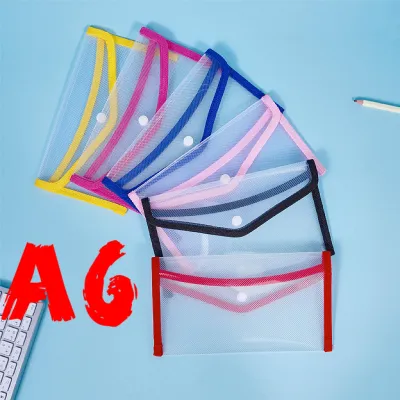
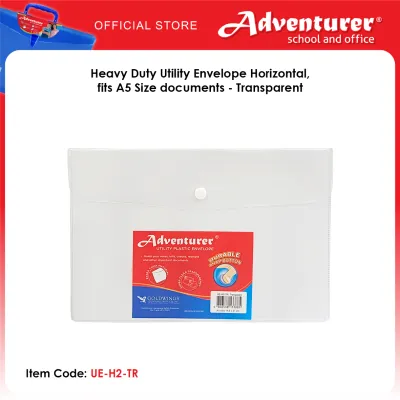
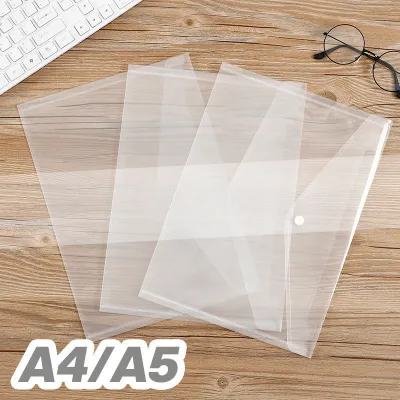
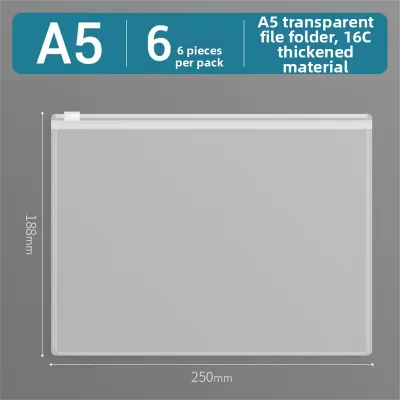
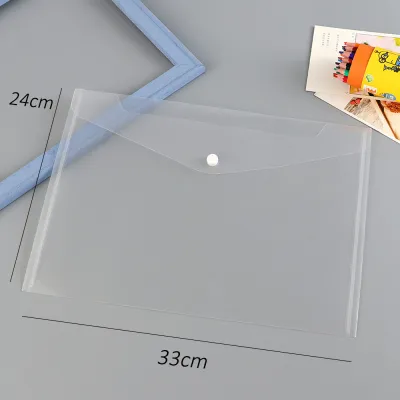
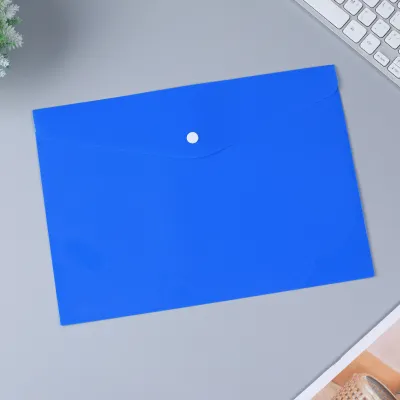
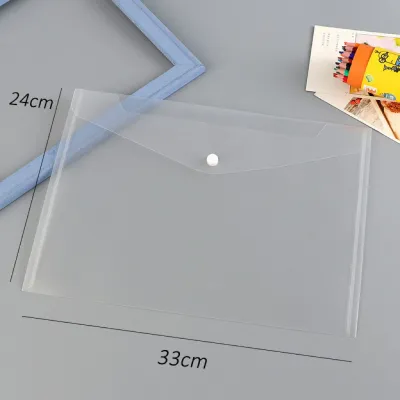
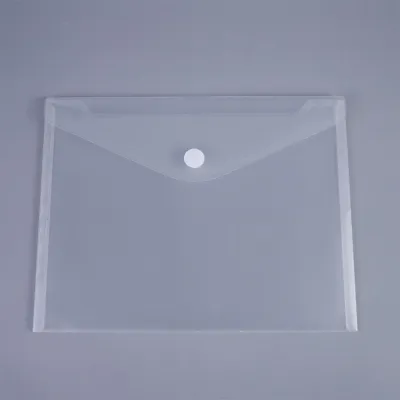
Prices are valid at publication and may change. Please refer to the product page for the latest price.
Because of this design, you must differentiate between the outer dimensions and the inner usable dimensions. The outer dimensions represent the total footprint of the envelope, which is important if you plan to store the envelope inside a small bag or drawer. The inner usable dimensions represent the actual space available for your documents.
When shopping for stationery, always check the product specifications for these inner measurements. Relying solely on the “A5” label can lead to frustration, as some brands design their envelopes with very tight margins that only fit a few loose sheets of paper, while others offer a more generous cut.
What Documents and Everyday Items Fit Inside?
An A5 plastic envelope is highly versatile, making it a popular choice for students, professionals, and home organizers. Several standard paper items fit perfectly inside these envelopes without any folding. This includes standard A5 notebooks, bullet journals, half-letter size papers, and A4 documents that have been folded precisely in half.

Beyond standard paper, these envelopes are excellent for securing small, loose items that easily get lost in a larger bag. You can comfortably store passports, bank books, receipts, flashcards, sticky notes, pens, and compact calculators. Keeping these items grouped together in a single envelope helps maintain an organized workspace or school bag.
However, certain items will not fit and can damage the envelope if forced inside. Unfolded A4 documents, legal-size folders, and thick textbooks are too large for an A5 envelope. Attempting to stuff these items inside will stretch the plastic, warp your documents, or split the welded seams.
The overall capacity of the envelope depends heavily on whether it is a flat design or has an expandable gusset. Flat envelopes are best suited for a few loose sheets of paper or a single thin notebook. If you need to store bulkier items, look for an envelope with an expandable bottom or sides. In humid climates like the Philippines, keeping your documents sealed in these plastic envelopes helps protect them from moisture damage, but overstuffing can compromise the seal and expose your items to the air.
How to Measure Your Items for a Perfect Fit
To ensure your items fit comfortably inside an A5 plastic envelope, take a few minutes to measure them before making a purchase. Use a standard ruler or tape measure to find the exact width, height, and thickness of the items you plan to store. If you are storing a stack of papers or multiple items, measure the entire stack together at its thickest point.
It is important to account for bulk when using flat envelopes. A flat envelope has no natural depth, so when you insert a thick item, such as a 15-millimeter-thick planner, the plastic must stretch outward. This physical expansion pulls the sides of the envelope inward, which reduces the effective width and height available for your documents. A thick item requires a much larger envelope than a flat sheet of the same paper size.
If your measurements are very close to the inner limits of an A5 envelope, or if you are storing rigid items that cannot bend, it is wise to size up. Moving up to a B5 envelope (176 mm by 250 mm) or an A4 envelope provides the extra breathing room needed to prevent damage to your items and the envelope itself.
Always aim to leave a small margin of error of about 10 to 15 millimeters on all sides. This clearance ensures that you can insert and retrieve your documents quickly and smoothly without putting unnecessary stress on the plastic seams or the closure mechanism.
Material and Closure Specs That Affect Usability
Beyond basic dimensions, the material and closure type of a plastic envelope play a major role in how well it protects your documents. Common closure types include snap buttons, slide zippers, and hook-and-loop fasteners. Snap buttons are secure and ideal for flat storage, but they can create a localized bulge. Slide zippers offer excellent protection against dust and moisture, though the zipper track itself slightly reduces the usable opening width. Hook-and-loop closures are highly adjustable but can wear out over time or catch on delicate fabrics.
The thickness and transparency of the plastic also affect usability. Plastic thickness is typically measured in microns or millimeters, with thicker materials (such as 0.18 mm or higher) offering better structural support and durability. Clear plastic allows you to identify the contents of the envelope at a glance, which is highly convenient for quick retrieval. Frosted or opaque designs, on the other hand, provide privacy for sensitive documents like bank statements or personal identification.
When evaluating quality, pay close attention to the edge welding and corner reinforcement. High-quality envelopes feature double-welded or reinforced edges that resist splitting when the envelope is filled to capacity. Weak seams are the most common failure point for plastic stationery.
Finally, if you plan to store important documents, photographs, or artwork for a long time, verify that the plastic is acid-free and archival-safe. Standard plastics can release harmful chemicals over time, especially in warm, humid environments. This can cause printed ink to lift off the paper and stick to the inside of the envelope, permanently ruining your documents. Archival-safe polypropylene prevents this chemical reaction, keeping your files safe for years.
Frequently Asked Questions (FAQ)
Can I fit a standard A4 paper in an A5 plastic envelope without folding?
No, you cannot fit an unfolded A4 sheet inside an A5 plastic envelope. An A4 sheet measures 210 mm by 297 mm, which is exactly twice the size of an A5 sheet. To store A4 paper in an A5 envelope, you must fold it precisely in half. If you need to keep your A4 documents flat and crease-free, you should use an A4-sized plastic envelope instead.
Are all A5 plastic envelopes the exact same size?
No, A5 plastic envelopes are not all the same size. While they are all designed to hold A5 paper, manufacturers use different outer dimensions, seam allowances, and closure styles. Some envelopes are cut very close to the standard A5 paper size, while others are made significantly larger to accommodate thicker notebooks or multiple files. Always check the exact millimeter measurements provided in the product description before buying.
Will an A5 envelope fit inside a standard A4 binder or folder?
Yes, an A5 plastic envelope will easily fit inside a standard A4 binder, folder, or filing drawer. Because an A5 envelope is roughly half the size of an A4 sheet, it is an excellent tool for organizing smaller loose items—such as receipts, flashcards, or sticky notes—within a larger A4-based filing system. Some A5 envelopes even come pre-punched with holes along the side, allowing them to be clipped directly into multi-ring binders.
Community discussion
Share your experience or ask a question. Comments are reviewed before publication.