
Choosing the right paper size is the first step toward creating an efficient workflow, whether you are preparing a corporate report, printing school handouts, or organizing a personal journal. While A4 and Letter sizes serve as the standard formats for official documents, academic submissions, and high-volume office printing, B5 bond paper has emerged as a highly practical middle ground for notebooks, loose-leaf planners, and portable note-taking. Selecting between these sizes requires looking beyond simple surface area to consider how each format fits onto a crowded desk, slides into a commuter bag, or behaves inside a standard desktop printer.
Understanding Paper Dimensions: B5, A4, and Letter Compared
To make an informed choice, you must first understand the physical measurements and regional standards that define these three common paper formats. Paper sizes are not universally identical, and confusing one standard for another can lead to ill-fitting binder refills or misaligned print jobs.
The most common standard document size in the Philippines and across North America is the US Letter size. It measures exactly 215.9 mm by 279.4 mm (8.5 by 11 inches). This format is slightly wider and shorter than A4 paper, which is the international standard (ISO 216) used throughout most of the world. A4 paper measures 210 mm by 297 mm (8.27 by 11.69 inches). Because A4 is narrower and taller, documents formatted for Letter size may experience clipped margins or awkward page breaks when printed on A4, and vice versa.
Products mentioned in this guide
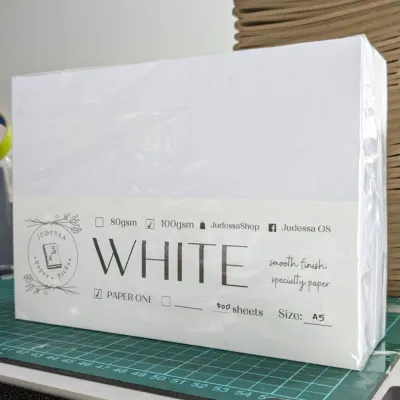
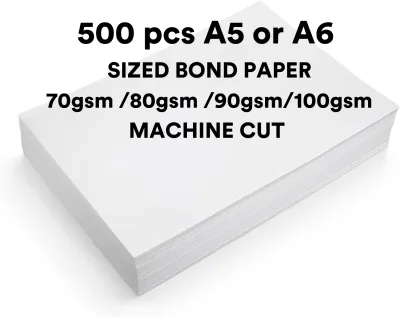
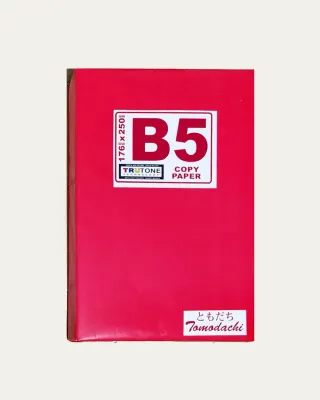
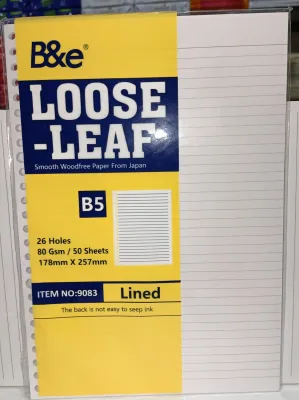
Prices are valid at publication and may change. Please refer to the product page for the latest price.
B5 paper occupies a distinct category, offering a more compact footprint that sits comfortably between a full-sized document and a pocket notebook. However, B5 is unique because two competing standards exist in the market. The international standard, ISO B5, measures 176 mm by 250 mm (6.93 by 9.84 inches). Meanwhile, the Japanese Industrial Standard, known as JIS B5, is slightly larger, measuring 182 mm by 257 mm (7.17 by 10.12 inches). JIS B5 is the format most commonly found in popular Asian stationery brands, loose-leaf systems, and school notebooks.
These dimensional differences directly impact the aspect ratio and layout of your pages. A4 and ISO B5 share the same √2 (approximately 1.414) aspect ratio, meaning that when you fold an A4 sheet in half, it retains the exact same proportions as an A5 sheet. This mathematical consistency makes scaling documents up or down straightforward. US Letter paper, with an aspect ratio of approximately 1.29, does not scale with the same geometric symmetry. When writing or printing, these ratios dictate how much margin space you must leave to maintain a balanced, readable layout. A wider Letter page allows for longer horizontal text lines, whereas a taller A4 page accommodates more lines of text per sheet, and a compact JIS B5 page forces a more concise, highly structured layout that is easy to scan visually.
Matching Paper Sizes to Your Primary Tasks
Aligning your paper selection with your daily routine prevents unnecessary frustration and ensures your documents remain organized. Each size excels in specific environments, depending on whether your primary task involves digital printing, archival storage, or manual handwriting.

For professional environments, desktop printing, and formal submissions, standard office sizes are practically mandatory. Offices, government agencies, and educational institutions rely on standardized filing systems, folders, and binders designed specifically for A4 or Letter sheets. Attempting to use non-standard sizes for official correspondence can lead to storage difficulties, as smaller sheets can easily slip out of sight or get damaged inside larger folders.
Conversely, for daily handwriting, journaling, and academic note-taking, smaller formats offer significant ergonomic advantages. Writing on a massive A4 or Letter sheet requires a large, clear desk space, which is rarely available in crowded lecture halls, busy cafes, or during a daily commute. A mid-sized sheet like B5 fits easily on small desks, lapboards, or side tables, allowing you to write comfortably without constantly shifting your notebook or bumping into nearby objects.
Storage and organization systems also differ dramatically between these formats. Standard filing cabinets, plastic document sleeves, and multi-ring binders are widely manufactured to accommodate A4 and Letter papers. Finding a dedicated three-ring binder for B5 paper can be challenging in standard office supply stores, as B5 loose-leaf systems typically utilize specialized multi-ring binders (such as 26-ring systems) that are more common in specialized stationery shops.
A4 and Letter for Printing and Official Documents
Standard office printers and copiers are engineered around the physical dimensions of A4 and Letter paper. Most desktop printers sold in the market feature input trays with adjustable plastic guides designed to lock securely into the Letter or A4 positions, ensuring the paper feeds straight through the roller mechanism.
Using non-standard sizes like B5 in a printer configured for A4 or Letter can introduce several technical complications. If the software print settings do not match the physical paper loaded in the tray, the printer may attempt to apply default margins, resulting in clipped text, misaligned headers, or uneven margins. Furthermore, feeding smaller sheets through a printer without properly adjusting the physical tray guides increases the risk of paper jams, as the sheets can skew or twist as they pass over the internal rollers.
The universal availability of storage accessories is another reason why A4 and Letter remain dominant. Standard clear sheet protectors, expanding files, and cardboard archive boxes are sized precisely to protect these standard sheets from dust, moisture, and physical wear. If you are archiving tax documents, legal contracts, or academic theses, sticking to A4 or Letter ensures your records will remain flat, unbent, and easily retrievable for years to come.
B5 for Notebooks, Journals, and Daily Handwriting
For those who prefer the tactile experience of pen on paper, B5 bond paper offers an exceptional balance of writing area and portability. It provides roughly 30% less surface area than an A4 sheet, making it light enough to carry in a small backpack or tote bag without sacrificing the space needed for detailed diagrams, mind maps, or extensive paragraphs.
The B5 format has become a staple in student culture and creative circles, largely due to its integration into loose-leaf systems and campus notebooks. These systems allow users to rearrange pages, insert printed handouts, and organize subjects within a single binder. Because B5 is designed primarily for handwriting, manufacturers often optimize this paper for ink performance. High-quality B5 bond paper is frequently formulated to resist feathering and bleed-through, which are common issues when using liquid ink, gel pens, or fountain pens.
When selecting B5 paper for handwriting, the interaction between the paper surface and your writing instrument is critical. Unlike standard utility copy paper, premium B5 loose-leaf paper often features a smoother finish that reduces friction on pen tips. This smoothness prevents fiber buildup on fine gel pen tips and allows fountain pen nibs to glide effortlessly across the page. Additionally, the paper’s sizing—the chemical treatment applied during manufacturing to control absorbency—is often adjusted to ensure that ink dries quickly enough to prevent smudging, even in humid tropical climates. Because smoothness, bleed resistance, drying speed, and water resistance depend on the exact combination of paper fibers and ink chemistry, you can perform a simple trial by drawing a series of heavy ink lines on a single sheet and observing how long the ink takes to dry, checking the reverse side for any feathering or bleed-through before committing to a bulk purchase.
Practical Checks Before Buying Bond Paper
Before purchasing a ream of bond paper or a pack of loose-leaf refills, performing a few practical checks can save you from costly purchasing mistakes and incompatible setups.
First, verify your printer’s physical specifications and software capabilities. Open your printer’s user manual or check the manufacturer’s website to confirm the minimum and maximum paper dimensions supported by the paper feed tray. While almost all modern printers can handle A4 and Letter, some budget models have restricted tray guides that cannot slide narrow enough to hold B5 paper securely. Additionally, check your word processing or design software to ensure it includes a pre-configured B5 layout option (either JIS B5 or ISO B5) to avoid manual margin calculations.
Second, if you are purchasing B5 paper for a loose-leaf binder, pay close attention to the hole-punch configuration. Standard B5 loose-leaf paper designed for Japanese-style binders typically features 26 holes. This is entirely incompatible with standard Western 2-ring, 3-ring, or 4-ring binders. Check the ring spacing and ring capacity of your existing binder cover before buying refills. If you have a standard 3-ring binder, you will need to look specifically for Letter-sized or A4-sized paper pre-punched with 3 holes, as finding a 3-hole punch tool for B5 paper can be exceedingly difficult.
Third, confirm the paper weight, which is measured in grams per square meter (GSM). For general double-sided printing and heavy ink usage, a paper weight of 80 GSM or higher is recommended. Standard 70 GSM bond paper is suitable for quick drafts and single-sided printing, but it is highly susceptible to show-through (where text is visible on the reverse side) and bleed-through when used with wet gel pens or highlighters. In high-humidity environments, lighter papers also tend to absorb moisture from the air more rapidly, causing them to become limp and prone to multi-sheet feeding or jamming in printers.
Finally, always inspect the packaging for exact millimeter dimensions rather than relying solely on a generic “B5” label. Because of the difference between JIS B5 (182 x 257 mm) and ISO B5 (176 x 250 mm), buying the wrong variant can result in paper that sticks out of your binder cover or fails to fit into pre-aligned plastic sleeves. A quick check of the dimensions printed on the label will guarantee a perfect fit for your existing stationery system.
Decision Framework: Which Size Should You Choose?
To finalize your decision, evaluate your primary daily activities and choose the paper size that minimizes friction in your workflow.
Choose A4 or Letter if:
- Your primary tasks involve printing official business documents, legal contracts, or academic papers that must comply with strict institutional formatting guidelines.
- You rely heavily on standard office printers, high-speed copiers, and automated document feeders that are optimized for standard paper dimensions.
- You require widely available, low-cost storage solutions like standard filing cabinets, clear folders, and three-ring binders.
- You want to purchase paper in bulk reams (typically 500 sheets) at a lower cost per sheet from local office supply stores, where prices are highly competitive and fit standard school or office budgets.
Choose B5 if:
- You are a student, writer, or journaler who prioritizes portability and wants a notebook or binder that fits comfortably on small desks and inside daily carry bags.
- You prefer using loose-leaf systems that allow you to customize, rearrange, and expand your notes across different subjects.
- You use gel pens, rollerballs, or fountain pens and want paper that is specifically engineered to handle liquid inks without feathering or bleeding through the page.
- You enjoy the aesthetic and tactile feel of specialized Asian stationery systems, which offer highly structured layouts, grid patterns, and smooth writing surfaces.
Verify first if:
- You have a mixed-use workflow where you plan to print digital templates onto B5 paper using a home printer; ensure your printer guides and software settings support this size before purchasing.
- You are buying refills for an existing binder; count the rings and measure the cover dimensions to ensure compatibility with either JIS B5 or ISO B5 standards.
- You live in a highly humid region; store your open paper packs in a dry, sealed container or drawer to prevent the sheets from absorbing moisture, which can lead to printing errors and ink feathering regardless of the paper size you choose.
Frequently Asked Questions (FAQ)
Can I print B5 bond paper on a standard home printer?
Yes, you can print on B5 bond paper using most standard home printers, provided the printer’s input tray guides can adjust to the narrower width of B5. Before printing, you must physically adjust the plastic paper guides in the printer tray so they hug the edges of the B5 paper snugly, preventing the sheets from feeding at an angle. Additionally, you must open your computer’s print dialog or page setup menu and change the paper size setting to B5 (ensuring you select either JIS B5 or ISO B5 to match your physical paper). Failing to update the software settings will cause the printer to apply margins intended for larger paper, resulting in misaligned or cut-off text.
Is B5 the same size everywhere?
No, B5 paper is not the same size everywhere, as there are two primary standards used globally. The international standard is ISO B5, which measures 176 mm by 250 mm. However, in the stationery market—especially for notebooks, loose-leaf refills, and school supplies originating from Japan or other parts of Asia—the Japanese Industrial Standard (JIS) B5 is far more common, measuring 182 mm by 257 mm. Because JIS B5 is slightly larger than ISO B5, refills and binders designed for one standard will not fit properly in covers designed for the other. Always check the exact millimeter measurements printed on the packaging to ensure compatibility with your existing binders and covers.

Community discussion
Share your experience or ask a question. Comments are reviewed before publication.