
Selecting the right calendar stickers 2026 setup is the foundation of an organized year. Whether you are using a premium imported notebook, a locally crafted planner, or a blank bullet journal, calendar stickers offer an efficient way to structure your days without the tedious task of hand-drawing every grid and date. However, the sheer variety of sticker formats can make the selection process overwhelming. Choosing the wrong style can lead to cluttered pages, misaligned grids, or ruined paper.
To build a functional, visually pleasing setup, you must balance your aesthetic goals with the physical limitations of your planner. The perfect sticker format integrates seamlessly with your notebook’s paper weight, page size, and layout. By understanding how different formats behave on paper, you can design a highly personalized tracking system that keeps you motivated throughout 2026.
How to Choose the Right Calendar Stickers for Your Planner
Planner Compatibility Before purchasing any calendar stickers 2026 sets, you must measure your planner’s existing dimensions. Grid and dot-grid notebooks typically feature standard spacings of 3mm, 3.7mm, or 5mm. A sticker designed for a 5mm grid will spill over the edges of a compact 3.7mm grid planner, causing unsightly overlaps or forcing you to crop the sticker manually. Measure the total width and height of your planner’s monthly or weekly spreads using a precise ruler. Compare these measurements with the physical dimensions listed on the sticker packaging. If you are using a standard A5, B6, or A6 notebook, look for stickers explicitly labeled for those sizes, but always verify the exact millimeter measurements to account for varying margin widths.
Products mentioned in this guide
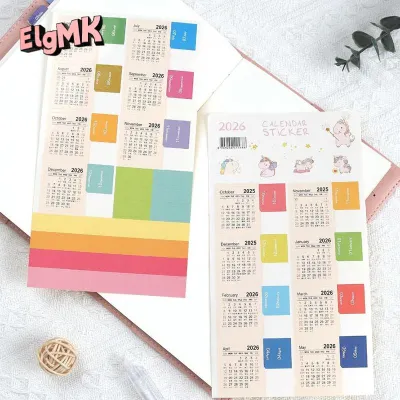
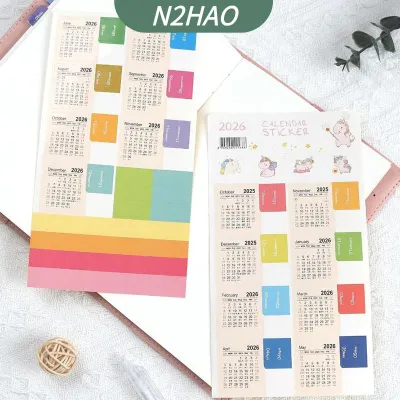
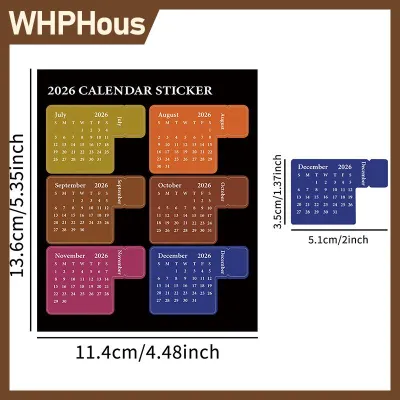
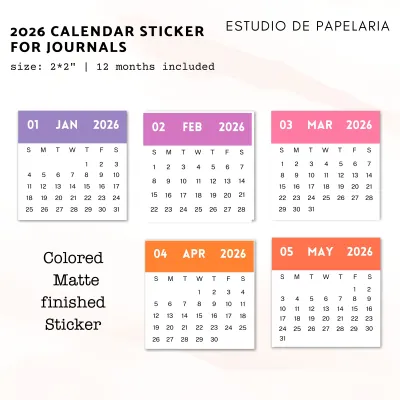
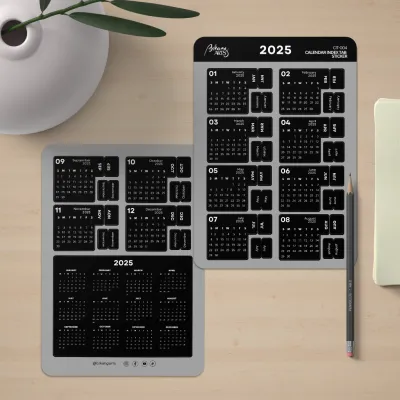
Prices are valid at publication and may change. Please refer to the product page for the latest price.
Planning Style Alignment Your everyday planning habits dictate whether you need a highly functional setup or a creative canvas. Functional planners prioritize legibility, clean lines, and rapid information retrieval. If you use your planner to track professional deadlines, academic schedules, or family appointments, you will benefit from pre-aligned monthly sheets or minimalist date indicators that keep clutter to a minimum. Conversely, if you view your planner as a memory keeper, scrapbook, or creative outlet, your system should accommodate decorative elements. Creative journaling thrives on die-cut sticker sets, colorful washi tapes, and themed illustrations that allow you to color-code different areas of your life while adding visual interest to your pages.
Adhesive and Paper Considerations The physical interaction between sticker adhesive and planner paper is a critical factor that many planners overlook. Premium planner papers, such as ultra-thin 52 gsm Tomoe River paper or standard 80 gsm wood-free paper, react differently to adhesives. Permanent adhesives form an immediate, aggressive bond with paper fibers. If you misalign a permanent sticker, attempting to peel it up will almost certainly tear the page or cause severe ‘ghosting’—where the paper becomes thin and translucent. If you prefer to adjust your layouts, look for repositionable or low-tack adhesives. These allow you to lift and place the sticker multiple times without damaging the underlying page, though they may lose their stickiness over time if exposed to dust or natural finger oils.
Best Calendar Stickers 2026 Formats for Different Planning Styles
Monthly Sheet Stickers for Minimalist Layouts
Ideal For: Minimalist planners, busy professionals, and students who want a complete monthly overview set up in seconds. These stickers are best suited for standard blank notebooks or undated planners where you want to establish a traditional grid layout without drawing it by hand.

Advantages: Monthly sheet stickers offer unmatched convenience. Because the entire month’s grid—including the days of the week, dates, and borders—is printed on a single, continuous adhesive sheet, you only need to peel and align one large sticker per month. This eliminates the risk of crooked individual dates and saves significant setup time during your monthly migration. They provide a clean, uniform look that matches professional office environments and minimalist design sensibilities.
Limitations: The primary drawback of monthly sheet stickers is their rigid structure. Because they are pre-printed as a single block, they offer zero layout flexibility. If your planner’s page size or grid pattern does not align perfectly with the sticker’s dimensions, the sheet may cover essential page numbers, margins, or pre-printed headers. Additionally, they add a noticeable layer of thickness to a single page, which can cause an uneven writing surface on the reverse side of the sheet.
Die-Cut Sticker Sets for Creative Journaling
Ideal For: Scrapbookers, memory keepers, and creative journalers who enjoy dedicating time to decorating their spreads. These sets are perfect for those who use their planners as a creative outlet and want to match their calendar layouts with seasonal or aesthetic themes.
Advantages: Die-cut sticker sets provide individual, beautifully illustrated date numbers, month headers, and coordinating decorative elements. This format offers incredible creative freedom, allowing you to scatter dates across a free-form collage, align them along a vertical timeline, or integrate them into complex scrapbooking layers. They often feature curated color palettes and artistic illustrations that make it easy to maintain a cohesive theme throughout your planner without needing advanced drawing skills.
Limitations: Applying die-cut stickers is a slow, meticulous process. Peeling and placing 31 individual date stickers, along with headers and decorative accents, requires excellent hand-eye coordination and a significant time investment. For busy individuals, this high-maintenance setup can quickly become a chore, leading to abandoned planning routines. Furthermore, the individual die-cut pieces can easily be lost or damaged if they are not stored carefully in a dedicated sticker book or folder.
Washi-Style Calendar Stickers for Flexible Customization
Ideal For: Planners who use non-standard notebook sizes, custom bullet journal layouts, or those who appreciate a rustic, textured, and handmade aesthetic. It is highly suited for travelers and individuals who like to modify their layouts on the go.
Advantages: Washi-style stickers, made from traditional Japanese rice paper, are exceptionally thin, semi-translucent, and highly forgiving. They feature low-tack adhesives that make them easily repositionable without tearing even the most delicate planner papers. You can tear washi calendar strips by hand for a soft, textured edge, or cut them precisely with scissors for a clean look. Their semi-translucent nature allows them to blend beautifully with the underlying page, creating a seamless, integrated appearance that does not add bulk to your planner.
Limitations: Washi paper is inherently fibrous and porous, which can limit your writing options. Many standard gel pens and water-based markers will feather or smudge on washi paper, requiring you to use specific oil-based ballpoint pens or permanent fine-liners. Additionally, some washi calendar tapes are sold as blank grids or simple day-of-the-week strips, meaning you must still write the numerical dates manually, which adds an extra step to your setup process.
Pre-Printed Date Stickers for Quick Functional Setup
Ideal For: Bullet journalists, functional planners, and users of undated weekly or daily planners who want to quickly date their pages without the effort of hand-writing numbers.
Advantages: Pre-printed date stickers consist of small, individual numbers (usually from 1 to 31) printed on tiny circular, square, or transparent backing sheets. They are incredibly versatile because they do not come with a pre-defined grid. You can place them at the top of daily pages, in the corners of weekly columns, or within a custom-drawn monthly matrix. They provide a highly consistent, professional typographic look to your dates while allowing you to design whatever underlying structure best fits your workflow.
Limitations: Because these stickers provide only the raw numbers, they offer no structural support. You must still draw your own grids, lines, or columns to organize your tasks and appointments. Placing 31 tiny stickers precisely in a row or grid can also be tedious, and if your alignment is slightly off, the final layout can look messy and disorganized.
Quick Comparison: Calendar Sticker Formats at a Glance
To help you quickly identify the ideal format for your 2026 planning routine, the table below summarizes how each option performs across key decision dimensions.
| Format | Best Planning Style | Application Time | Customization Level | Ideal Planner Type |
|---|---|---|---|---|
| Monthly Sheets | Minimalist / Functional | Very Fast (1-2 mins) | Low (Fixed Grid) | Blank Notebooks, Undated Planners |
| Die-Cut Sets | Creative / Decorative | Slow (15-30 mins) | High (Individual Placement) | Bullet Journals, Memory Keepers |
| Washi-Style | Flexible / Aesthetic | Moderate (5-10 mins) | High (Tearable & Repositionable) | Non-Standard Sizes, Custom Layouts |
| Pre-Printed Dates | Functional / Hybrid | Moderate (5-10 mins) | Medium (Numbers Only) | Undated Weekly/Daily Planners |
When using this table, cross-reference your chosen 2026 planner brand with your realistic time commitment. If you use a structured planner with pre-printed layouts, pre-printed date stickers or thin washi-style elements will complement the existing grids without adding bulk. If you prefer a blank canvas like a standard dot-grid journal but have limited time to set up your monthly spreads, monthly sheet stickers will save you hours of preparation over the course of the year.
What to Check Before Buying 2026 Calendar Stickers
Size Verification Before finalizing your purchase of calendar stickers, you must conduct a physical size check. Do not rely solely on product photos on online marketplaces, which can be deceptive. Measure the exact width and height of the boxes in your planner’s monthly spread. If you are buying a full-sheet monthly sticker, ensure that the entire sheet’s outer dimensions are at least 5mm smaller than your planner’s page size to allow for margins. For individual date stickers, verify that the diameter of the sticker (such as 8mm or 10mm) fits comfortably within your planner’s daily grid squares without covering adjacent text or lines.
Adhesive Safety in Humid Climates For planners living in tropical, high-humidity environments like the Philippines, adhesive choice is a major durability factor. High humidity and ambient heat can cause cheap synthetic adhesives to degrade, turn gummy, or bleed oils into your planner pages. Over time, this can ruin the paper fibers, cause pages to stick together, or make the ink on the reverse side bleed through. To protect your planner, look for stickers labeled as ‘acid-free,’ ‘archival-safe,’ or ‘repositionable.’ These adhesives use stable, water-based acrylic compounds that resist breakdown in warm climates, ensuring your planner remains intact for years to come.
Material and Pen Compatibility The material of your calendar stickers determines what writing instruments you can use. Stickers generally fall into two categories: matte paper and glossy vinyl.
- Matte Paper Stickers: This material behaves similarly to standard planner paper. It is highly compatible with water-based inks, gel pens (such as the Zebra Sarasa or Pilot G2), and water-based brush pens (such as Tombow Dual Brush Pens). The ink absorbs quickly into the paper fibers, resulting in fast drying times and minimal smudging.
- Glossy Vinyl Stickers: This material is water-resistant and highly durable, but it has a non-porous surface. Standard gel pens, fountain pens, and water-based markers will not absorb into glossy vinyl; instead, the ink will pool on the surface and smudge instantly when touched. If you choose glossy stickers, you must use oil-based ballpoint pens, permanent fine-liners, or dedicated multi-surface markers.
To verify compatibility before committing to a layout, perform a simple smudge test on a scrap piece of the sticker backing or an unused corner sticker. Write a small line with your preferred planner pen, wait five seconds, and gently run your finger over the ink to check for smearing or bleeding.
Frequently Asked Questions (FAQ)
Can I use physical calendar stickers in a digital planner?
Physical calendar stickers are designed specifically with physical adhesives for paper planners and cannot be directly applied to digital screens. To use calendar stickers in a digital planning app on a tablet, you must purchase digital planner stickers. These are typically delivered as individual PNG files with transparent backgrounds or as pre-cropped sticker books compatible with specific note-taking applications, allowing you to copy, paste, resize, and crop them digitally without any physical wear.
How do I remove calendar stickers without tearing the planner page?
To remove a stubborn calendar sticker without tearing your planner page, you must work slowly and use the correct technique. Never pull the sticker straight up, as this concentrates the pulling force and tears the paper fibers. Instead, peel the sticker back slowly at a very low, flat angle, keeping the peeled portion as close to the page surface as possible. If the adhesive is permanent or has bonded strongly due to heat, you can gently warm the sticker using a hairdryer on a low, cool-to-warm setting for a few seconds to soften the adhesive before peeling. Always check your planner’s paper tolerance first, and avoid using heat on synthetic or plastic-coated pages.
Do I need to buy new calendar stickers every year?
Whether you need to buy new stickers depends entirely on the format you choose. Pre-dated calendar sheets and specific yearly overview sets are printed for a precise calendar year, meaning your calendar stickers 2026 sets cannot be reused for subsequent years because the days of the week and dates will no longer align. However, if you invest in undated date numbers (1-31), blank grid templates, or blank washi-style calendar strips, you can reuse these assets year after year. You will simply need to write in the days of the week or align the starting date manually to match the new calendar year.
Community discussion
Share your experience or ask a question. Comments are reviewed before publication.