
Choosing the ideal gel pen is a highly personal decision that directly impacts your daily productivity, writing comfort, and the legibility of your notes. Deli has established a diverse catalog of writing instruments designed to cater to various writing habits, paper types, and professional environments. Finding the best Deli gel pen for your specific needs requires looking beyond basic aesthetics to evaluate how a pen’s mechanics, tip design, and ink formulation interact with your daily tasks.
The mechanical design of a gel pen is the first major decision point. Retractable, or click-style, pens offer unmatched convenience for fast-paced environments like lecture halls or busy offices, allowing you to deploy the tip with a single hand. Capped pens, conversely, provide a more secure seal around the writing tip, which significantly reduces the risk of the ink drying out during long periods of inactivity. Your choice between these two styles should reflect how frequently you pause during writing sessions and whether you tend to lose pen caps.
Tip size and ink characteristics also play critical roles in your writing experience. A fine tip, such as a 0.5mm needle or bullet tip, is excellent for drawing precise lines and writing small, dense characters without crowding the page. A broader 0.7mm tip delivers a richer, more continuous flow of ink, making it ideal for bold signatures, quick headings, and individuals with larger handwriting styles. Because gel ink is water-based, its drying speed can vary, meaning that finding the perfect match often depends on matching the pen to the specific paper thickness and texture you use daily.
Products mentioned in this guide
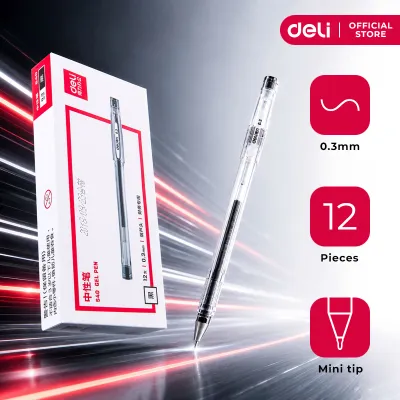
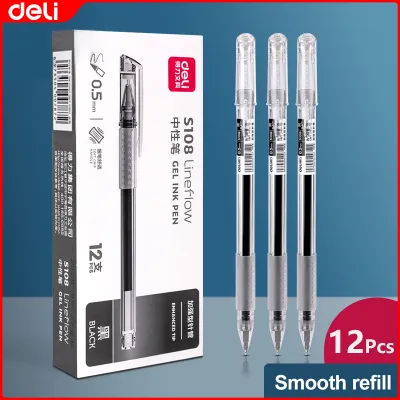
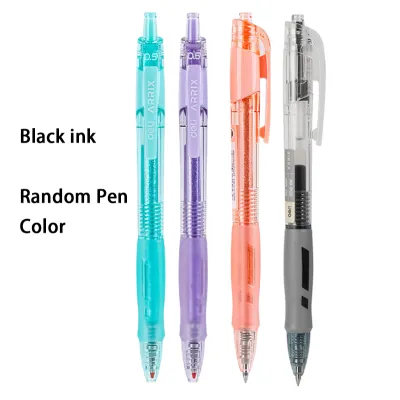
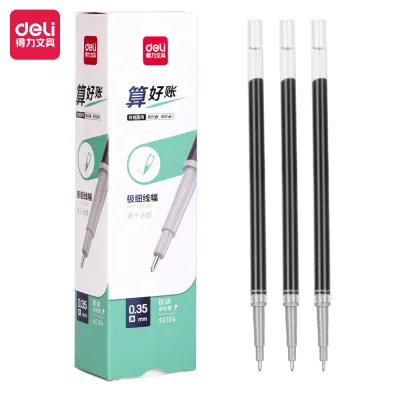
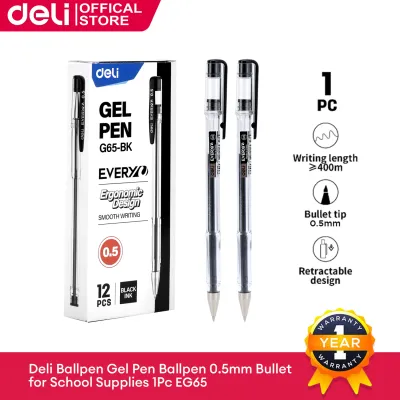
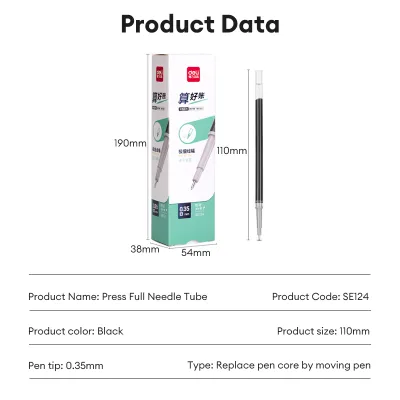
Prices are valid at publication and may change. Please refer to the product page for the latest price.
Ultimately, the best way to choose a Deli gel pen is to match its specific design features to your primary writing tasks. Whether you are compiling extensive school notes, jotting down rapid office memos, or signing official documents, understanding these core specifications will help you select a pen that feels natural in your hand and performs consistently on the page. Practical testing on your preferred paper remains the most reliable method to verify smoothness, bleed resistance, and drying times before committing to a bulk purchase.
Key Specifications to Check on Deli Gel Pen Packaging
When shopping for Deli gel pens in stationery shops or through online marketplaces, the packaging serves as your primary guide to the pen’s performance characteristics. Understanding how to read these labels ensures you select a model that aligns with your writing preferences and avoids common frustrations like smudging or rapid ink depletion.
Tip Size and Shape Indicators
The tip size is always prominently displayed on Deli packaging, usually ranging from ultra-fine 0.35mm to bold 0.7mm options. For general note-taking and daily writing in standard ruled notebooks, 0.5mm is the most widely recommended size as it balances legibility with ink conservation. You should also look for illustrations or text indicating whether the pen uses a needle tip or a bullet tip. Needle tips consist of a slender, straight tube that holds the writing ball, providing a clearer view of the paper for precise alignment and ruler work, while bullet tips feature a sturdier, conical shape designed to withstand heavier writing pressure without bending.
Ink Properties and Formulations
Standard gel ink is formulated by suspending pigments in a water-based gel, which provides a smooth glide but is not inherently waterproof. If your daily work involves signing official documents, contracts, or keeping permanent archives, look specifically for terms like “pigment ink,” “water-resistant,” or “archival safe” on the Deli packaging. These specialized inks contain colorants that chemically bind to the paper fibers, preventing the text from bleeding or dissolving if the paper is exposed to moisture, sweat, or accidental spills.
Grip Material and Ergonomics
Analyzing the grip specifications on the packaging can save you from hand strain during long writing sessions. Look for descriptions indicating a “soft grip,” “rubberized grip,” or “TPE (thermoplastic elastomer) sleeve.” These materials cushion your fingers and provide friction, which prevents your hand from slipping and reduces the amount of squeezing force required to hold the pen. If you prefer a lightweight pen and do not write for extended periods, a hard plastic barrel with a molded grip pattern may suffice, offering a sleeker profile and easier cleaning.
Refill Compatibility and Model Codes
To ensure long-term cost efficiency and reduce plastic waste, check the packaging for refill compatibility indicators. Deli frequently prints specific refill codes (such as S760 or generic gel refill standards) on both the outer box and the pen barrel itself. Verifying that a pen body accepts standard, widely available refills allows you to keep using a comfortable pen casing indefinitely, saving you money in Philippine Pesos (₱) over time compared to buying entirely new pens when the ink runs dry.
Recommended Deli Gel Pen Profiles for Specific Writing Tasks
Different writing scenarios demand different pen characteristics. By matching the physical design and ink properties of a Deli gel pen to your specific daily routine, you can maximize writing comfort and ensure your work remains neat and legible.

For Long Study Sessions and Extensive Note-Taking
Students and researchers who spend hours transcribing lectures or drafting summaries require a pen designed to minimize physical fatigue and streamline the writing process. For these demanding tasks, retractable Deli gel pens are highly recommended because they eliminate the distraction of handling a separate cap and can be operated instantly with one hand.
- Ergonomic Cushioning: Look for pens featuring contoured rubberized grips that distribute pressure evenly across your index finger and thumb, preventing the formation of painful calluses.
- Ink Monitoring: Select models with transparent plastic barrels or clear ink windows, allowing you to monitor the remaining ink level so you are never caught unprepared during an exam or timed writing session.
- Tip Stability: A sturdy 0.5mm bullet tip is ideal for this scenario, as it tolerates varying angles of hand movement and maintains a consistent line weight even when you write quickly.
For Quick Office Memos and Left-Handed Writers
In a fast-paced office environment, notes must be jotted down rapidly during phone calls or meetings without the risk of smudging the text. This need for speed and immediate neatness is especially critical for left-handed writers, whose hands naturally glide over the freshly written line as they move from left to right across the page.
- Quick-Drying Ink: Prioritize Deli pens labeled with quick-dry or rapid-dry ink technology, which utilizes a highly volatile solvent base that evaporates almost instantly upon contact with the paper.
- Low-Viscosity Flow: The pen should feature a high-precision ball mechanism that delivers ink smoothly with minimal drag, ensuring that the pen writes immediately without skipping, even during rapid, cursive strokes.
- Smudge Verification: Before purchasing in bulk for your office, test a single pen on your standard office copy paper by writing a quick sentence and immediately wiping your finger across it to verify that the ink sets within one to two seconds.
For Archiving and Important Document Signatures
Official records, contract signatures, and legal documentation require a level of permanence that standard dye-based gel inks cannot provide. When your writing must stand the test of time and resist environmental damage, your choice of pen must prioritize ink chemistry over all other features.
- Pigment-Based Ink: Ensure the Deli packaging explicitly states that the pen uses pigment-based ink, which is highly resistant to fading caused by UV light exposure and will not run if the paper becomes damp.
- Bold 0.7mm Tips: For signing important documents, a slightly broader 0.7mm tip is often preferred because it creates a authoritative, solid line that is easy to scan and photocopy clearly.
- Dedicated Storage: Keep these specialized archival pens separate from your daily draft pens in a dedicated pencil case or desk drawer to ensure they are preserved solely for official tasks and do not run out of ink prematurely.
How to Test and Maintain Your Deli Gel Pens
Proper care and testing of your writing instruments can significantly extend their lifespan, prevent unexpected ink failures, and ensure you get the best possible performance out of every pen.
Performing a Paper Compatibility Test
Before committing to a specific Deli gel pen for your daily notes, it is essential to test how the ink behaves on the exact paper types you use. Gel ink performance is highly dependent on paper density and surface treatment.
- Select Your Test Papers: Gather samples of your common writing surfaces, such as standard 70gsm copy paper, lined school pad paper, and thicker 80gsm+ notebook pages.
- Draw Test Patterns: Write a series of close parallel lines, tight circles, and a few sentences using normal writing pressure.
- Check for Bleed-Through: Inspect the reverse side of the paper to see if the ink has soaked through the sheet (bleeding) or created a visible shadow (ghosting) that would make writing on both sides difficult.
- Observe Feathering: Look closely at the edges of your written lines under good lighting; if the ink spreads outward like tiny spiderwebs, the paper is too absorbent for that specific gel formulation.
Storing Pens in Tropical Climates
The tropical climate of the Philippines, characterized by high relative humidity and significant temperature shifts between air-conditioned offices and hot outdoor environments, can affect the viscosity of gel ink. To maintain consistent performance, store your Deli gel pens horizontally when not in use, which keeps the ink column stable and prevents air bubbles from forming at either end of the cartridge. If horizontal storage is not possible, store them tip-down to keep the ballpoint lubricated, and always ensure that capped pens are clicked firmly shut and retractable pens are fully retracted to prevent the water-based gel from drying out in dry, air-conditioned draft zones.
Safe Troubleshooting for Clogged Tips
If a Deli gel pen begins to skip or stops writing entirely, the issue is often a minor clog caused by dried ink or paper fibers lodged around the writing ball. You can safely resolve this by scribbling gentle, circular patterns on a scrap piece of rough paper or a clean rubber eraser to dislodge the debris. Alternatively, you can dip the metal tip of the pen into a cup of warm water for five to ten seconds to dissolve any dried gel obstructing the ball. Never expose the pen to open flames, lighters, or harsh chemical solvents, as these can easily melt the plastic tip housing, destroy the internal seals, and permanently ruin the pen.
Frequently Asked Questions (FAQ)
Are Deli gel pens suitable for fountain pen-friendly paper?
While Deli gel pens perform exceptionally well on a wide variety of paper types, highly coated or non-absorbent papers designed specifically for fountain pens may cause extended drying times. Because fountain pen-friendly paper is engineered to resist ink absorption to prevent feathering, water-based gel inks will sit on top of the coated surface rather than sinking in immediately. If you are using these premium papers, it is highly recommended to test a small, inconspicuous corner of the page first and allow an extra few seconds of drying time before touching the written text to prevent accidental smearing.
Can I use standard refills in all Deli gel pen bodies?
You should not assume that all Deli gel pen refills are universally interchangeable across different pen models. Deli manufactures several distinct pen series, and these often utilize different barrel internal diameters, spring placement ridges, and tip lengths. To avoid purchasing incompatible refills, always check the specific model or refill code printed on the original ink cartridge or the product packaging. When shopping for replacements, matching these exact alphanumeric codes ensures a perfect fit and prevents issues like tip wobbling, spring misalignment, or the inability to retract the pen.
How long does a standard Deli gel pen last with daily use?
The lifespan of a Deli gel pen depends heavily on the tip size, your writing pressure, and the absorbency of the paper you write on. A 0.7mm tip pen will deplete its ink reservoir significantly faster than a 0.5mm tip pen because the larger ball allows a greater volume of gel to flow onto the page. Additionally, highly textured or absorbent papers draw more ink out of the cartridge with every stroke. To keep track of your ink consumption and avoid running out of ink unexpectedly, it is best to choose Deli models that feature transparent barrels or clear ink windows so you can visually monitor the physical ink level over time.

Community discussion
Share your experience or ask a question. Comments are reviewed before publication.