
Quick Answer: Which Calculator Fits Your Major?
Selecting the right scientific calculator for college in the Philippines is a decision that directly impacts your academic performance and exam readiness. If you are choosing between the canon f789sga ii calculator and the widely used CASIO fx-991 series (such as the ClassWiz or CW models), your decision should be guided by your specific college major, your budget, and the regulations of your university or licensing board.
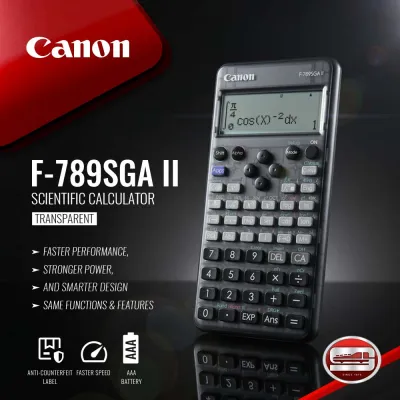
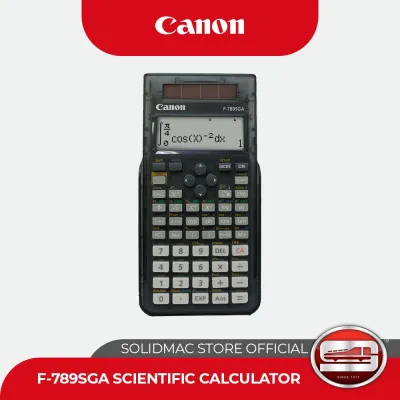
Choose the Canon F-789SGA II if you are looking for a highly capable, budget-friendly calculator that easily handles standard scientific functions. It is an exceptional fit for students majoring in nursing, general sciences, business administration, or liberal arts. This model offers an eco-friendly build and robust computational power without the premium price tag, making it a reliable companion for general education mathematics and introductory statistics.
Choose the CASIO fx-991 series if you are enrolled in engineering, physics, actuarial mathematics, or advanced chemistry. The high-resolution screens and advanced processing speeds of the CASIO models (especially the fx-991EX ClassWiz or the newer fx-991CW) make them the preferred standard for complex, multi-step calculations. These models excel in handling large matrices, spreadsheet tasks, and high-density statistical tables.
Products mentioned in this guide
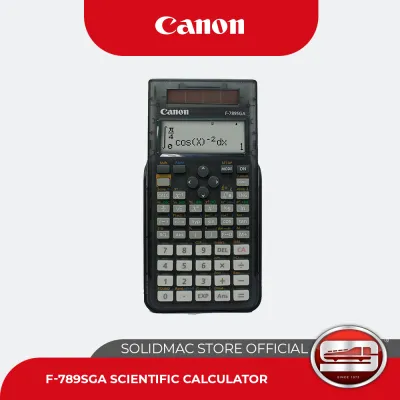
Prices are valid at publication and may change. Please refer to the product page for the latest price.
Before making your final purchase, verify the calculator guidelines in your course syllabi and the rules of local examination boards. While both options are non-programmable, specific academic departments or national licensing bodies may restrict certain models or features during major examinations.
Display Technology: Canon F-789SGA II Calculator vs. CASIO High-Resolution Screens
How a calculator displays complex mathematical expressions directly affects how quickly and accurately you can solve problems during timed exams. The display technology of the canon f789sga ii calculator relies on a high-contrast dot-matrix screen that supports a natural textbook display. This system renders fractions, square roots, derivatives, and integrals exactly as they appear in your textbooks, reducing input errors and helping you track your calculations step-by-step.

In contrast, the CASIO fx-991 series—particularly the fx-991EX ClassWiz and the newer fx-991CW—features a high-resolution LCD screen. This upgrade provides a significantly higher pixel density, resulting in much smoother mathematical symbols, crisper text, and the ability to display more lines of data simultaneously. When working with large tables or multi-variable statistics, the CASIO screen allows you to view more information at a single glance without constant scrolling.
User interface design also differs notably between these two brands. The Canon F-789SGA II utilizes a traditional, menu-driven navigation system where functions are accessed via numeric key shortcuts. This system is highly efficient once you memorize your most-used key sequences. CASIO, on the other hand, has transitioned toward an icon-based home menu on the ClassWiz and a simplified, catalog-based interface on the fx-991CW. This modern layout feels intuitive to students accustomed to smartphones, though it may require a brief learning curve if you are transitioning from older high school calculator models.
When studying under the varied lighting conditions of Philippine classrooms—ranging from bright fluorescent bulbs in air-conditioned lecture halls to natural daylight in open-air rooms—screen legibility is critical. The CASIO high-resolution screen offers adjustable contrast levels, which helps minimize glare and eye strain. While the Canon display is highly readable under standard conditions, its lower resolution can make complex subscripts and small exponents slightly harder to distinguish at extreme viewing angles.
Function Sets: Standard Scientific vs. Advanced Engineering Tools
Calculus, Statistics, and Complex Numbers
Both the Canon F-789SGA II and the CASIO fx-991 series are equipped to handle the core mathematical demands of college coursework. Each calculator features dedicated modes for numerical integration, numerical differentiation, and complex number calculations. For foundational courses in algebra, trigonometry, and introductory calculus, either model will perform these operations with high precision.
For statistics and data analysis, both devices allow you to input multi-variable data sets to calculate standard deviations, variances, and various regression models (such as linear, logarithmic, and exponential regressions). The Canon F-789SGA II easily manages these tasks, providing a solid foundation for business and health science majors who need to interpret statistical data without manual formula derivation.
However, the CASIO fx-991 series often displays statistical variables in a comprehensive list format, allowing you to view multiple results—such as the mean, sum, and standard deviation—on a single screen. Additionally, CASIO models generally feature slightly faster processing speeds. When executing iterative calculations, such as finding the numerical integral of a complex function, the CASIO models typically return results with less processing delay.
Advanced Features: Matrices, Vectors, and Spreadsheets
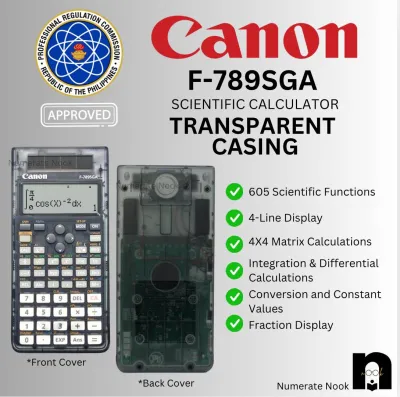
For engineering and advanced mathematics majors, the ability to process matrices and vectors is a critical requirement. The Canon F-789SGA II is highly competitive in this category, supporting matrix and vector calculations up to 4×4 dimensions. This is a significant advantage for linear algebra and structural analysis courses, especially considering the calculator’s accessible price point.
The CASIO fx-991 series also supports 4×4 matrix and vector calculations, but it pairs this capability with a more streamlined data entry interface. The high-resolution screen makes editing matrix elements straightforward, reducing the likelihood of inputting an incorrect value in a large system of linear equations. Furthermore, the CASIO models feature advanced equation solvers that can handle simultaneous linear equations with up to four unknowns, as well as polynomial equations up to the fourth degree.
A standout feature of specific CASIO models, such as the fx-991EX and fx-991CW, is the built-in spreadsheet function. This tool allows you to perform basic spreadsheet operations, such as entering formulas and auto-filling columns, directly on the calculator. This is incredibly useful for engineering economy classes or laboratory data logging where a computer is not permitted.
While the Canon F-789SGA II lacks a native spreadsheet function, it compensates with an extensive library of 79 built-in physical constants and 172 metric conversion values. These pre-programmed figures are highly beneficial for chemistry and physics students who need to quickly recall values like Planck’s constant or convert units during fast-paced laboratory sessions. You should carefully review your upcoming course syllabi to determine whether a spreadsheet tool or a deep library of physical constants will be more useful for your studies.
Exam Compliance: PRC Board Exams and University Policies
University Classroom and Quiz Rules
Before purchasing any calculator, you must ensure it complies with your university’s academic integrity policies. Most colleges and universities in the Philippines permit non-programmable scientific calculators for daily quizzes, prelims, and final examinations. Because both the Canon F-789SGA II and the CASIO fx-991 series are classified as non-programmable, they are generally accepted in standard classroom settings.
However, individual professors and academic departments retain the authority to set stricter rules. In foundational mathematics courses, some instructors may temporarily ban calculators that feature advanced equation solvers or matrix functions to ensure students master manual calculation methods. Always consult your course syllabus or ask your instructor directly during the first week of classes to confirm if your chosen model is permitted.
PRC Board Exam Restrictions
The Professional Regulation Commission (PRC) enforces strict guidelines regarding the use of calculators during national licensure exams, such as those for Civil Engineering, Electrical Engineering, Accountancy, and Nursing. The PRC strictly prohibits programmable calculators, graphing calculators, and any devices with communication capabilities to maintain exam integrity.
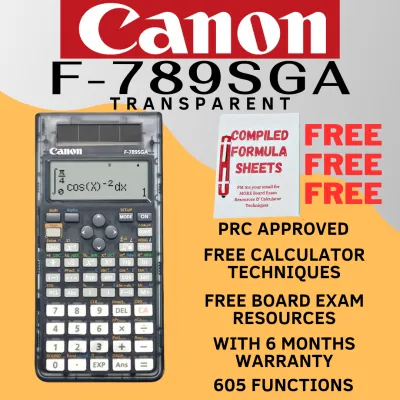
Historically, the PRC has maintained a specific list of allowed calculator models for professional examinations, which is updated periodically through official memorandums. The Canon F-789SGA II has traditionally been a highly reliable choice for board exams, as it offers a comprehensive feature set while consistently remaining on the PRC’s approved non-programmable calculator list.
High-end CASIO models, particularly those in the fx-991 series, occasionally face intense scrutiny from exam proctors. Because of their advanced features, high-resolution screens, and visual similarity to some restricted or programmable models, proctors may inspect them closely before the exam begins. To avoid any last-minute stress on exam day, you must check the most recent PRC official advisory for your specific board exam to verify that your exact calculator model is fully approved.
Build, Power, and Daily Usability
College calculators must be durable enough to withstand the daily wear and tear of campus life. Both the Canon F-789SGA II and the CASIO fx-991 series utilize dual power systems, combining a built-in solar panel with a primary battery. This dual-power configuration ensures that your calculator will not lose power during a critical exam, as the solar panel automatically takes over or assists the battery under sufficient ambient light.
In terms of physical protection, the CASIO fx-991 series typically comes with a slide-on hard plastic cover. This cover provides excellent protection for the screen and keys when the calculator is packed inside a crowded backpack. The Canon F-789SGA II features a sleek, hard slide-on case that fits tightly over the body, keeping the device slim and easy to slip into a binder or a small pencil case.
The key layout and tactile feedback of these calculators also differ. CASIO keys are widely recognized for their distinct, color-coded groupings and responsive tactile feedback. The keys are spaced to minimize accidental double-presses, which is highly beneficial during fast-paced calculations. The Canon F-789SGA II offers a slightly more compact layout with keys made from high-quality plastic. Additionally, the Canon model is partially manufactured using recycled materials from Canon copiers, making it an appealing option for environmentally conscious students.
When commuting in the Philippines, high humidity and sudden rain showers are common daily challenges. It is wise to store your calculator in a dry, protective sleeve inside your bag. Sweat from hands during long exams in non-airconditioned rooms can occasionally make keypads slippery; both models handle this well with matte-finished key surfaces, but periodic cleaning with a dry microfiber cloth is recommended to maintain optimal key responsiveness.
Price and Value: Budget vs. Premium Ecosystem
When evaluating the financial aspect, the Canon F-789SGA II stands out as a highly cost-effective option in the Philippine market. Typically priced in the range of ₱1,000 to ₱1,300, it delivers roughly 90% of the functionality found in premium scientific calculators for a highly accessible price. This makes it an attractive choice for students who need a dependable calculator but prefer to allocate their budget toward textbooks and other essential school supplies.
The CASIO fx-991 series generally commands a higher price, typically ranging from ₱1,600 to ₱2,200 depending on the specific model (such as the fx-991EX or fx-991CW). This premium price is justified by the brand’s dominant position in STEM education, its superior high-resolution display, and a massive ecosystem of online tutorials, student forums, and textbook integration. If you are pursuing a highly technical degree, the convenience of finding step-by-step CASIO tutorial videos for your specific engineering formulas is a valuable asset.
Because of CASIO’s popularity, counterfeit calculators are highly prevalent on online marketplaces and informal retail stalls. Counterfeit units often suffer from poor build quality, inaccurate calculation results, and unreliable solar panels. To protect yourself from purchasing a fake device, follow these buying guidelines:
- Purchase from Authorized Retailers: Buy only from established physical stationery stores, official brand websites, or verified flagship stores on online marketplaces.
- Check the Holographic Sticker: Genuine CASIO calculators feature a distinctive holographic security sticker on the packaging.
- Verify the Warranty Card: Ensure your purchase includes an official local warranty card from the authorized distributor.
- Perform a Diagnostic Test: Authentic calculators allow you to run built-in diagnostic routines (usually accessed by holding down specific key combinations like SHIFT + 7 + ON simultaneously) to verify the screen and internal software version.
Final Checklist Before You Buy
To ensure you make the right choice for your college journey, use this quick four-step verification checklist before completing your purchase:
- Analyze Your Course Requirements: Review your major’s curriculum. If you require advanced matrix calculations, equation solvers, or spreadsheet functions, prioritize the CASIO fx-991 series. If your courses focus on general science, nursing, or business math, the Canon F-789SGA II is an excellent fit.
- Verify Exam Regulations: Check your university's calculator policy and the latest PRC official advisory for your target board exam to confirm that your chosen model is fully permitted.
- Evaluate Your Budget: Determine if the high-resolution display and extensive online tutorial support of the CASIO justify the price premium, or if the cost-effective, feature-rich Canon F-789SGA II better suits your financial plan.
- Confirm Authenticity: Ensure you are purchasing from an authorized physical stationery store or a verified flagship online store to avoid counterfeit products and secure a valid manufacturer warranty.
Both the Canon F-789SGA II and the CASIO fx-991 series are exceptional, non-programmable scientific calculators. By carefully matching their unique features to your academic requirements and budget, you will secure a reliable tool that will support you all the way to graduation.
Community discussion
Share your experience or ask a question. Comments are reviewed before publication.