
Choosing the right scientific calculator can determine your comfort, speed, and success during critical academic semesters and professional licensure examinations. The decision between the Canon F-789SGA transparent edition and the CASIO fx-991ES Plus often comes down to a balance of aesthetic preference, specific functional requirements, and strict regulatory compliance. Both devices are highly capable tools designed to handle complex mathematics, but they approach the task with different design philosophies and feature sets.
For many students and reviewees in the Philippines, this choice is not merely about which device looks better on a study desk. It is about finding a reliable partner that can handle the pressure of timed exams while adhering to the strict rules of local testing centers. While one model leans into a modern, eye-catching aesthetic with a robust set of built-in formulas, the other relies on a time-tested display system and a layout that has become the standard in classrooms worldwide.
Before making a purchase, you must evaluate how each calculator performs across several key areas: exam compliance, calculation capabilities, physical build, and overall value for money. By examining these factors closely, you can select the device that best aligns with your academic goals and ensures a smooth, disruption-free testing experience.
Products mentioned in this guide
Prices are valid at publication and may change. Please refer to the product page for the latest price.
Quick Verdict: Which Calculator Should You Buy?
The Canon F-789SGA transparent edition and the CASIO fx-991ES Plus serve slightly different user profiles, making the “best” choice highly dependent on your specific academic path and immediate testing requirements. The Canon F-789SGA transparent edition offers a budget-friendly, visually distinctive option that excels in general scientific calculations and provides a vast library of built-in constants and conversions. It is an excellent choice for students who want a reliable, stylish device for high school and general college courses without breaking the bank.
Conversely, the CASIO fx-991ES Plus is a powerhouse designed for complex mathematical environments. It features CASIO’s renowned Natural V.P.A.M. system, which displays expressions exactly as they appear in textbooks, making it highly intuitive for advanced calculus, engineering, and statistical analysis. While it typically carries a higher price tag, its standardized layout and widespread adoption make it a highly practical tool for rigorous technical programs.
Ultimately, your decision must be guided by the specific regulations of your field of study. If you are preparing for a professional licensure exam, verifying the exact rules of your governing board is the most critical step. A calculator is only useful if you are permitted to bring it into the examination room, making compliance the ultimate deciding factor.
Board Exam Compliance in the Philippines
For aspiring professionals in the Philippines, the Professional Regulation Commission (PRC) enforces strict guidelines regarding the calculators permitted in licensure examinations. These rules are designed to prevent academic dishonesty by banning programmable models, graphing calculators, or devices with expandable memory. Because these regulations are updated periodically, choosing a calculator requires careful cross-referencing with the latest official memorandums.

Both the Canon F-789SGA and the CASIO fx-991ES Plus are classified as non-programmable scientific calculators, which generally places them within the acceptable category for most exams. However, the specific board of examiners for each profession—such as Civil Engineering, Mechanical Engineering, Electrical Engineering, Accountancy, or Nursing—retains the authority to issue its own list of prohibited and allowed models. What is permitted for a nursing exam may be strictly banned for an engineering exam.
In recent years, certain advanced non-programmable models have faced scrutiny or temporary bans due to their ability to store formulas or perform matrix calculations that proctors feel bypass the testing objectives. For instance, engineering boards often update their lists of allowed calculators to ensure a level playing field. If you bring a model that does not appear on the explicitly approved list for your specific exam, proctors have the right to confiscate the device at the door, leaving you to perform complex calculations by hand.
To safeguard your investment and your exam performance, always consult the official PRC website or your review center’s latest advisory before purchasing. Do not rely on general advice from online forums or past examinees, as rules can change between exam seasons. Checking the exact model codes—including any regional suffixes—is the only way to guarantee your calculator will be allowed inside the testing center.
Functions and Calculation Capabilities
When comparing the mathematical power of these two devices, the differences lie in how they handle complex inputs and the sheer number of built-in features. The CASIO fx-991ES Plus is equipped with 417 functions, utilizing the Natural V.P.A.M. (Visually Perfect Algebraic Method) display system. This technology allows fractions, exponents, logarithms, derivatives, and integrals to be entered and displayed exactly as they are written in textbooks, reducing input errors and making it much easier to verify your steps during a high-pressure exam.
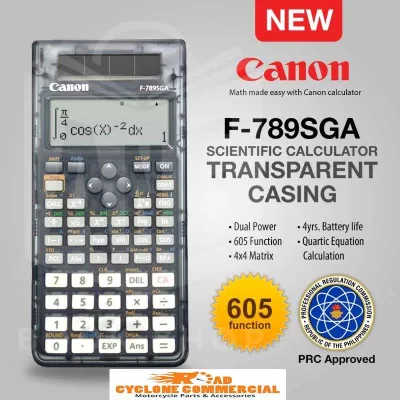
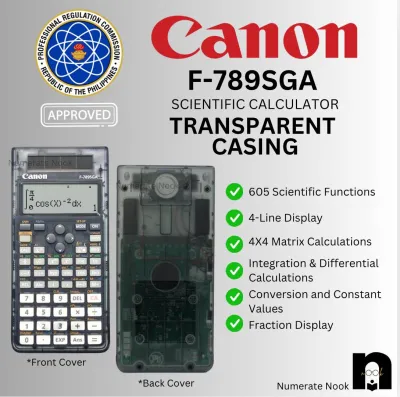
The Canon F-789SGA counterbalances this with an impressive array of 605 functions, including 79 built-in scientific constants and 172 metric conversions. This extensive internal library is incredibly useful for physics and chemistry students who need quick access to standard values without memorizing them. However, the Canon’s display system, while clear and multi-line, does not always render complex fractional equations with the same visual fluidness as CASIO’s natural display, which can require a brief adjustment period for users accustomed to textbook formatting.
For advanced engineering courses, calculus-heavy programs, and complex statistical analysis, the CASIO fx-991ES Plus is often preferred because of its intuitive equation solver, matrix calculations, and vector operations. The visual clarity of its natural display minimizes the cognitive load of tracking nested parentheses, allowing you to focus entirely on the problem-solving logic. The Canon F-789SGA is highly capable in these areas as well, but its input method can feel slightly more traditional, requiring more careful keystroke planning.
Reliability during long exam sessions is another critical factor to consider. Both calculators feature dual-power systems, utilizing a solar panel on the face of the device alongside a backup button battery. This design ensures that the calculator remains functional even in dimly lit examination rooms. Before your exam, it is wise to check the battery compartment and ensure the backup cell is fresh, as relying solely on solar power under poor testing center lighting can lead to faded displays or slow processing times.
Design, Build Quality, and Display of the Canon F-789SGA Transparent
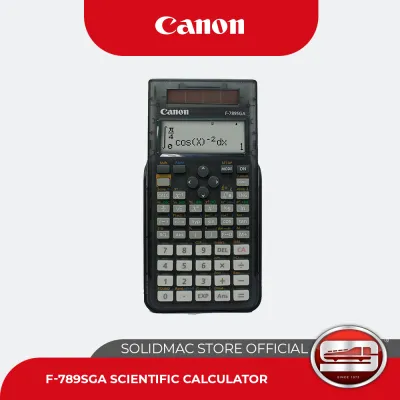
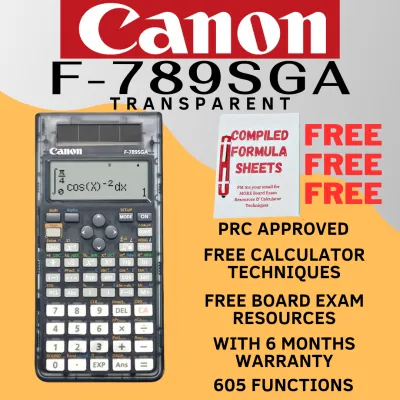
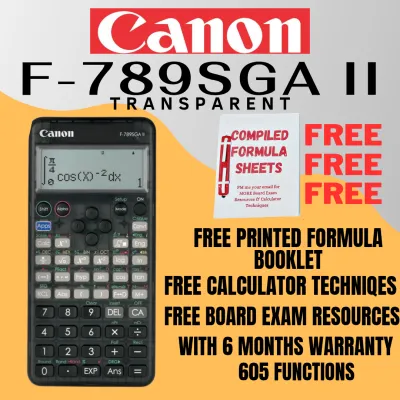
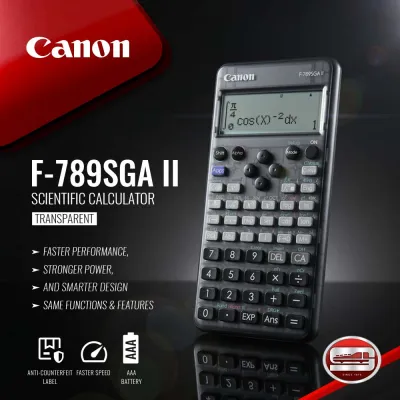
The physical design of these two calculators represents a clear contrast in style and utility. The Canon F-789SGA transparent edition is a striking device, featuring a completely clear casing that reveals the internal circuitry, resistors, and motherboard. This unique aesthetic appeal has made it incredibly popular among students who want to stand out or simply appreciate the industrial design of their study tools.
However, using a transparent plastic device in the tropical, humid climate of the Philippines requires some practical considerations. Over time, clear plastics can be susceptible to yellowing when exposed to ultraviolet (UV) light, and sweat or oils from your hands can show up more prominently on a clear surface than on matte plastic. Additionally, clear casings can show hairline scratches more easily if the device is tossed loosely into a backpack alongside keys and metal pens. Keeping the calculator in a protective sleeve or drawer when not in use is highly recommended to preserve its pristine clarity.
In contrast, the CASIO fx-991ES Plus features a traditional, solid matte-grey build that is highly resistant to daily wear and tear. It comes with a rugged, slide-on hard case that provides excellent protection against drops, scratches, and accidental key presses while packed in a bag. The ergonomic layout of the CASIO is the result of decades of refinement, featuring color-coded shift keys and a highly tactile button configuration that many students find familiar and comforting.
Screen readability and tactile feedback are essential for minimizing input errors during rapid calculation sessions. The CASIO screen offers high contrast with adjustable levels, ensuring digits are legible under various lighting angles, while its key travel provides a distinct click that confirms a successful press. The Canon F-789SGA also offers solid tactile feedback and a clear 10+2 digit display, but the button spacing and key travel feel slightly different. If possible, visit a physical store to test the button layouts of both models, as muscle memory and finger comfort can significantly influence your typing speed and accuracy.
Price Comparison and Value for Money
In the Philippine market, pricing plays a significant role in determining which calculator offers the best value. Generally, the Canon F-789SGA is positioned as a highly competitive, budget-friendly alternative. It offers an expansive feature set and a unique transparent design at a price point that is often lower than its CASIO counterpart, making it an attractive option for students managing tight academic budgets.
The CASIO fx-991ES Plus typically commands a premium price due to its established reputation, advanced Natural Display technology, and widespread recommendation by university professors and review centers. While it requires a larger initial investment, many students view this premium as a worthwhile trade-off for the familiarity of the interface and the peace of mind that comes with using an industry-standard tool.
Because of the high demand for these calculators, the local market has seen a rise in counterfeit devices, particularly on online marketplaces and informal retail stalls. Counterfeit calculators often look remarkably similar to genuine models but suffer from poor build quality, inaccurate calculation algorithms, slow processing speeds, and unreliable solar panels. Using a fake calculator during an exam is a massive risk, as the device can freeze, output incorrect answers, or fail entirely under pressure.
To ensure you are purchasing a genuine product, always buy from official brand stores, authorized physical stationery retailers, or reputable online sellers. When verifying authenticity, check for high-quality packaging with official holographic security stickers, crisp and perfectly aligned screen printing on the keys, a solid and balanced weight, and a clear, high-contrast LCD screen. Many genuine CASIO calculators also feature a built-in QR code verification system that can be accessed via the calculator’s menu to confirm its authenticity online.
How to Make Your Final Decision
To choose the right calculator for your academic journey, you must weigh your budget, your field of study, and the regulatory constraints of your future career. Use this structured decision framework to guide your purchase:
- Choose the Canon F-789SGA if:
- You are working with a strict budget and want the maximum number of built-in functions for your money.
- You appreciate a unique, modern aesthetic and want to see the inner workings of your device through a clear casing.
- Your coursework focus is on general science, business, or high school mathematics where complex textbook-style formatting is not a daily requirement.
- Choose the CASIO fx-991ES Plus if:
- You are studying engineering, advanced calculus, or physics, where a Natural Display is essential for entering complex formulas accurately.
- You prefer a traditional, rugged build with a protective slide-on hard case that can withstand daily transport.
- You want a highly standardized device that matches the tutorials, textbook examples, and review center methods used by your instructors.
- Verify first if:
- You are preparing for a specific PRC licensure exam. Always cross-reference the official, current list of permitted calculators for your board before committing to either model.
Investing in the right calculator is an investment in your academic and professional future. Take the time to understand the tools at your disposal, choose the one that fits your workflow, and enter your next exam room with absolute confidence in your equipment.
Frequently Asked Questions (FAQ)
Is the Canon F-789SGA transparent edition prone to yellowing?
Like many clear consumer electronics, the transparent polycarbonate casing of the Canon F-789SGA can experience yellowing over time if subjected to prolonged exposure to direct sunlight and UV radiation. In the humid, tropical environment of the Philippines, sweat, oils from your hands, and ambient heat can also contribute to surface discoloration. To maintain the crystal-clear look of your calculator, store it in a protective sleeve, a dedicated pencil case, or a desk drawer away from direct sunlight when you are not actively studying.
Can I use these calculators for the CPA or Engineering board exams?
While both the Canon F-789SGA and the CASIO fx-991ES Plus are non-programmable scientific calculators, their eligibility varies strictly by the specific professional board. The PRC frequently updates its list of allowed calculators to maintain exam integrity, and boards like Accountancy (CPA) often have much stricter limitations than Engineering boards. Before purchasing either device for a licensure exam, always download the most recent memorandum from the official PRC website or consult your review center to confirm that your exact model code is permitted.
Community discussion
Share your experience or ask a question. Comments are reviewed before publication.