
Quick Answer: Which Calculator Should You Choose?
Selecting the right scientific calculator is one of the most critical decisions for students and board exam reviewees in the Philippines. The choice between the canon f-789sga and the CASIO fx-991ES Plus often comes down to specific mathematical requirements, interface familiarity, and budget. Both devices are highly capable, non-programmable scientific calculators designed to handle advanced mathematics, engineering formulas, and statistical analyses without violating exam guidelines.
For most users, the decision can be simplified by looking at a few key factors:
- Choose the Canon F-789SGA if you require advanced matrix capabilities (up to 4×4 matrices), a larger library of built-in scientific constants and metric conversions, and a highly cost-effective price point. It is an exceptional tool for advanced engineering students who want to maximize their calculation efficiency within a strict budget.
- Choose the CASIO fx-991ES Plus if you prefer the classic, highly intuitive CASIO key layout that you likely used throughout high school. It is the industry standard, meaning most local professors, review centers, and peers use it, making it much easier to follow along with classroom tutorials and exam shortcut guides.
Ultimately, both calculators are excellent investments. However, before finalizing your purchase, you must verify the specific calculator guidelines of your educational institution or the Professional Regulation Commission (PRC) to ensure your chosen model is permitted for your specific course or board exam.
Products mentioned in this guide
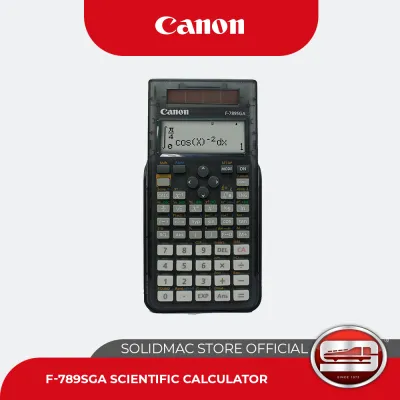
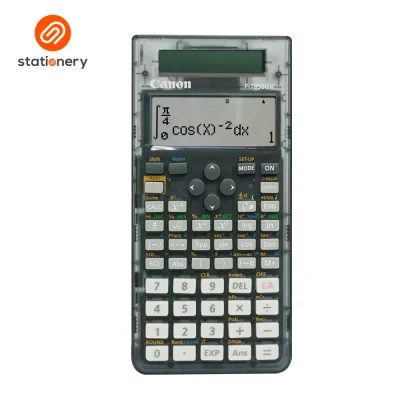
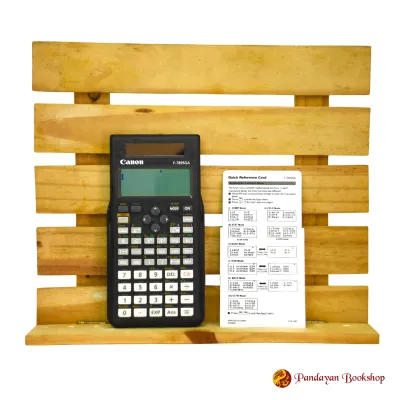
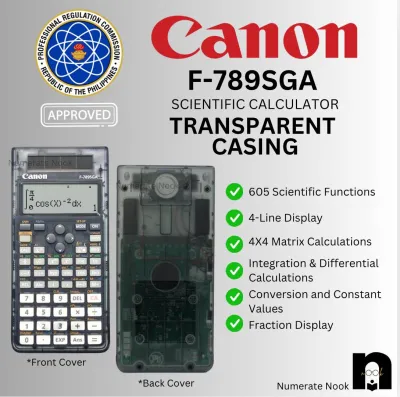
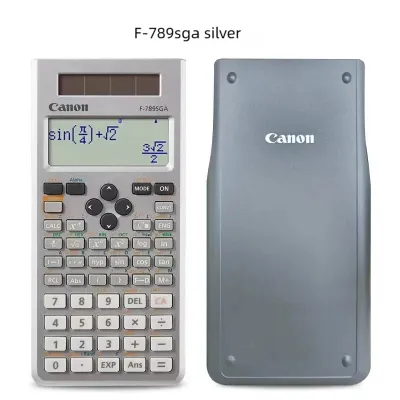
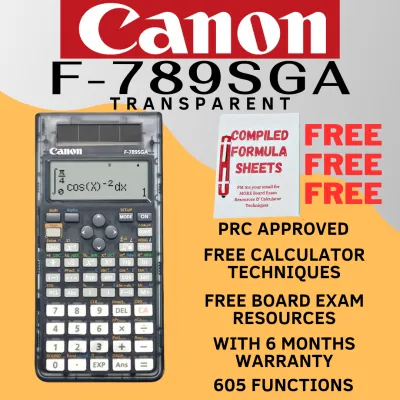
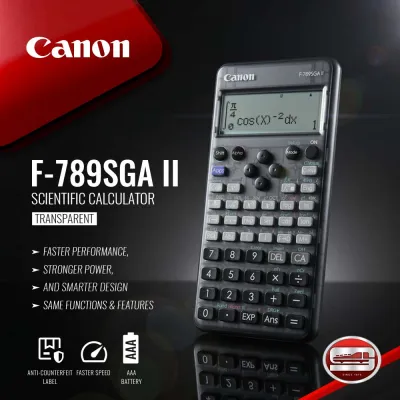
Prices are valid at publication and may change. Please refer to the product page for the latest price.
Head-to-Head Feature Comparison
To understand how these two models perform in high-pressure academic and exam environments, it is helpful to look at their technical specifications side by side. While both calculators are designed for advanced scientific computations, they differ significantly in their internal processing capabilities, function counts, and physical designs.

| Feature / Specification | Canon F-789SGA | CASIO fx-991ES Plus (2nd Edition) |
|---|---|---|
| Display Type | Textbook Natural Display (Dot Matrix) | Natural V.P.A.M. (Dot Matrix) |
| Power Source | Dual Power (Solar and Battery) | Dual Power (Solar and Battery) |
| Key Function Count | 605 Functions | 417 Functions |
| Matrix Calculations | Up to 4×4 Matrices | Up to 3×3 Matrices |
| Vector Calculations | Up to 3 Dimensions | Up to 3 Dimensions |
| Equation Solver | Quadratic, Cubic, Simultaneous (up to 4 unknowns) | Quadratic, Cubic, Simultaneous (up to 3 unknowns) |
| Scientific Constants | 79 Built-in Constants | 40 Built-in Constants |
| Metric Conversions | 172 Built-in Conversions | 40 Built-in Conversions |
| Protective Case | Hard Slide-on Cover | Hard Slide-on Cover |
While both calculators offer the essential tools needed for algebra, trigonometry, calculus, and statistics, the Canon F-789SGA provides a higher sheer number of functions and larger matrix capacities. However, the CASIO fx-991ES Plus counters this with a highly refined menu navigation system that many users find more straightforward to operate under timed conditions.
Display, Interface, and Navigation
The display quality and menu navigation of a scientific calculator directly impact your speed and accuracy during exams. Both the Canon F-789SGA and the CASIO fx-991ES Plus feature high-resolution dot-matrix screens designed to render complex fractions, derivatives, integrals, and algebraic expressions exactly as they appear in standard textbooks. This natural display format eliminates the need to decipher complicated single-line syntax, reducing input errors.
When comparing screen technologies, the CASIO fx-991ES Plus utilizes the Natural V.P.A.M. (Visually Perfect Algebraic Method) system. This interface is highly regarded for its crisp contrast and logical layout. When entering a complex fraction or an integration limit, the cursor moves smoothly, and the screen adjusts the font size dynamically to keep the expression readable. The Canon F-789SGA features a similar textbook display style that is equally clear, though some users note that its default font thickness and character spacing differ slightly from the classic CASIO aesthetic.
In terms of mathematical capacity, the Canon F-789SGA holds a distinct advantage for advanced coursework. It can compute 4×4 matrices, which is a massive benefit for civil, electrical, and mechanical engineering students in the Philippines who frequently encounter four-variable systems in structural analysis or circuit design. The CASIO fx-991ES Plus is limited to 3×3 matrices, meaning students must resort to manual reduction techniques or alternative numerical methods when faced with larger systems. Furthermore, the Canon model can solve simultaneous linear equations with up to four unknowns, whereas the CASIO model maxes out at three.
Menu navigation on both devices relies on a central directional pad (D-pad) to scroll through history and edit input values. The CASIO system is exceptionally streamlined; pressing the “MODE” key brings up a numbered list of calculation environments (such as COMP, CMPLX, STAT, BASE-N, EQN, MATRIX, VECTOR, and TABLE), making transitions between topics incredibly fast. The Canon F-789SGA uses a similar menu structure, but because it packs 605 functions—including 79 scientific constants and 172 metric conversions—some menus require more scrolling or multi-step key combinations to access specific commands. If you value a simpler, faster menu structure, the CASIO is highly intuitive, but if you require deep functional capacity, the Canon is superior.
Power Source, Build, and Ergonomics
Long-term reliability and physical comfort are essential when spending hours solving problems in a humid study room or a packed exam hall. Both calculators employ a dual-power configuration, combining a solar panel with a backup button battery. This dual-power setup ensures that the calculator remains fully operational even in dimly lit classrooms or during sudden power fluctuations. The solar panel handles the primary power load under adequate lighting, while the internal battery seamlessly takes over in low-light environments, protecting your active calculations from sudden shutdowns.
In terms of physical build, the tropical climate of the Philippines requires materials that can withstand high humidity and sweat. The Canon F-789SGA is notable for its environmentally friendly construction, incorporating recycled materials from Canon product manufacturing into its plastic casing and hard cover. The outer shell has a slightly textured, matte finish that provides a secure grip even when your hands are damp. The keys are made of durable plastic with clean, high-contrast printed labels. The tactile feedback of the Canon keys is firm, requiring a deliberate press to register, which helps prevent accidental double-taps during rapid calculations.
The CASIO fx-991ES Plus (particularly the popular 2nd Edition) features a sleek, ergonomic design with rounded edges that fit comfortably in the hand. The keys are spaced widely to accommodate fast typing, and the “SHIFT” and “ALPHA” keys are color-coded in high-visibility yellow and red to match their corresponding secondary functions on the keyboard. This color-coding is highly effective for building muscle memory, allowing you to execute complex operations without constantly searching the key face. The key travel on the CASIO is slightly softer and springier than the Canon, which many students find more comfortable for prolonged typing sessions.
Both models come equipped with a durable, slide-on hard protective cover that shields the screen and keyboard from scratches, dust, and impact when tossed into a crowded backpack. The Canon cover fits snugly and slides off smoothly, while the CASIO cover includes molded rubber feet on the back, keeping the calculator stable and preventing it from sliding around on smooth wooden or plastic school desks.
Exam Compliance: How to Verify Rules for Philippine Tests
For Filipino students, purchasing a scientific calculator is not just about features; it is also about legality. The Professional Regulation Commission (PRC) maintains strict guidelines regarding the types of calculators permitted in licensure examinations, such as the Civil Engineering, Mechanical Engineering, Electrical Engineering, Chemical Engineering, and Certified Public Accountant (CPA) board exams. These rules are designed to prevent academic dishonesty by banning calculators that are programmable or have data-storage capabilities.
Both the Canon F-789SGA and the CASIO fx-991ES Plus are generally classified as non-programmable scientific calculators. They do not possess text-storing memories, graphing screens, or wireless communication features, which typically makes them eligible for standard academic use. However, the PRC periodically updates its list of allowed calculator models, and these lists can vary significantly between different professional boards. For instance, some boards may allow a wide range of scientific calculators, while others restrict examinees to a very specific, pre-approved list of models.
To ensure you do not purchase a device that will be confiscated at the testing center door, follow these verification steps:
- Check the Official PRC Website: Always refer to the latest official PRC resolutions or memorandums regarding the list of allowed calculators for your specific board exam. Do not rely on outdated blog posts or forum advice.
- Consult Your University Syllabus: Many local universities, especially top engineering and science departments, enforce their own calculator restrictions for departmental exams to prepare students for the board exams. Check with your professors or review your course syllabus before buying.
- Inspect the Device Specifications: Ensure the calculator does not have a QWERTY keyboard, graphing capabilities, or any ports for external memory cards or data transfer cables. These features are automatic grounds for disqualification in almost all proctored exams.
- Ignore "Exam Approved" Packaging Labels: Calculator manufacturers often print "Exam Approved" or "Board Approved" on their packaging. This is a general marketing claim and does not guarantee compliance with the specific, localized rules of the PRC or your university.
On the day of your exam, make sure your calculator is clean, free of any written notes or formulas on the protective cover, and has fresh batteries installed alongside its solar panel. Being fully aware of local compliance rules will save you from unnecessary stress and ensure you can focus entirely on your exam performance.
Pricing and Finding Authentic Units in the Philippines
When shopping for a scientific calculator in the Philippines, pricing and authenticity are major considerations. Due to the high demand among students and reviewees, counterfeit calculators are highly prevalent in the local market, particularly on unauthorized online listings and in busy discount shopping districts. Purchasing a counterfeit unit can lead to inaccurate calculations, poor screen contrast, fragile buttons, and sudden device failure during a critical exam.
In terms of market positioning, the Canon F-789SGA is highly competitive, typically retailing between ₱950 and ₱1,300. This makes it an incredibly cost-effective alternative given its massive 605-function library and 4×4 matrix capabilities. The CASIO fx-991ES Plus (and its updated 2nd Edition) generally carries a slight premium due to the brand’s long-standing legacy and dominant market share, with prices usually ranging from ₱1,100 to ₱1,600 depending on the retailer.
To ensure you are purchasing a genuine, high-quality unit, keep the following sourcing and verification tips in mind:
- Buy from Authorized Retailers: Purchase your calculator from established physical school supply stores, national bookstore chains, or the official flagship stores of Canon and CASIO on major online e-commerce platforms. Avoid purchasing from third-party sellers offering prices that seem unusually low (e.g., ₱300 to ₱500), as these are almost always counterfeit.
- Verify the Packaging and Holograms: Authentic CASIO calculators sold in the Philippines typically feature an official hologram sticker on the packaging and a QR code that can be scanned to verify authenticity on the manufacturer's website. Genuine Canon calculators come in high-quality packaging with clear, crisp printing and include an official local warranty card.
- Inspect the Physical Build Quality: Counterfeit calculators are often noticeably lighter than genuine models because they use cheaper internal components and thinner plastics. Check the print quality on the keys; on fake units, the letters may be slightly misaligned, blurry, or easy to scratch off with a fingernail.
- Perform a Diagnostic Self-Test: Most genuine scientific calculators have a built-in diagnostic mode. For example, on many CASIO models, pressing the SHIFT, 7, and ON keys simultaneously initiates a screen diagnostic test that displays all LCD segments and allows you to test key responsiveness. If the calculator does not respond to these diagnostic commands, or if the screen contrast remains extremely poor even in direct light, the unit is likely a counterfeit.
By investing in an authentic unit from a reputable seller, you secure a reliable tool that will perform accurately throughout your academic journey and professional board exams.
Final Verdict: Choose Based on Your Specific Needs
When choosing between the Canon F-789SGA and the CASIO fx-991ES Plus, there is no single “best” option; instead, the right choice depends on your specific academic requirements, physical preferences, and exam regulations. Both calculators are highly reliable, dual-powered, and packed with the essential mathematical tools needed to solve complex problems.
To finalize your decision, use the following structured framework:
Choose the Canon F-789SGA if:
- You are an advanced engineering or mathematics student who frequently works with large matrices (up to 4×4) and simultaneous equations with four unknowns.
- You want to maximize your value for money, as the Canon model offers 605 functions at a highly competitive, budget-friendly price point.
- You regularly use scientific constants and metric conversions, preferring to have a massive library of 79 constants and 172 conversions built directly into the device.
- You prefer a firm, tactile key press and appreciate an environmentally conscious build utilizing recycled materials.
Choose the CASIO fx-991ES Plus if:
- You are already accustomed to the classic CASIO keyboard layout and want to rely on established muscle memory during fast-paced exams.
- Your professors, classmates, or review center instructors primarily use CASIO calculators, making it easy to follow along with step-by-step keystroke tutorials.
- You prefer a highly intuitive, streamlined menu navigation system that allows you to switch between calculation modes with minimal scrolling.
- You value a softer, springier key response and want a device with widely spaced keys for rapid typing.
Before checking out, remember to:
- Cross-reference the approved calculator list of the Professional Regulation Commission (PRC) if you are preparing for a local professional board exam.
- Consult your university's student handbook or department syllabus to confirm that your chosen model complies with classroom rules.
- Purchase only from authorized stationery retailers or official brand stores to avoid the risks associated with counterfeit units.
Ultimately, both the Canon F-789SGA and the CASIO fx-991ES Plus are outstanding scientific calculators that will serve as dependable academic partners. Assess your personal ergonomics, check your institutional guidelines, and choose the tool that best supports your path to academic and professional success.
Community discussion
Share your experience or ask a question. Comments are reviewed before publication.