
Choosing the right scientific calculator is one of the most critical decisions a student in the Philippines can make, directly impacting daily classroom performance, high-stakes university exams, and professional licensure board examinations. The choice often comes down to a classic matchup: the distinctive Canon F-789SGA, particularly famous for its transparent casing, and the widely established lineup of CASIO scientific calculators. While CASIO has long been the default standard in many local high schools and universities, the Canon F-789SGA offers a compelling alternative with its unique aesthetic, robust feature set, and dual-power system. Deciding between them requires looking beyond brand popularity to evaluate specific design elements, functional capabilities, curriculum alignment, and the strict guidelines set by local examination boards.
To make an informed choice, you must assess your specific academic track, whether you are navigating general high school mathematics or tackling advanced engineering and accounting courses. A calculator is not merely a tool for basic arithmetic; it is an investment in your academic workflow that must remain reliable under tropical humidity, survive years of being tossed into school bags, and comply with strict exam rules. By comparing the physical build, mathematical functions, exam compatibility, and long-term value of the Canon F-789SGA against CASIO’s diverse offerings, you can select the precise device that aligns with your educational journey and budget.
Design, Display, and Build Quality
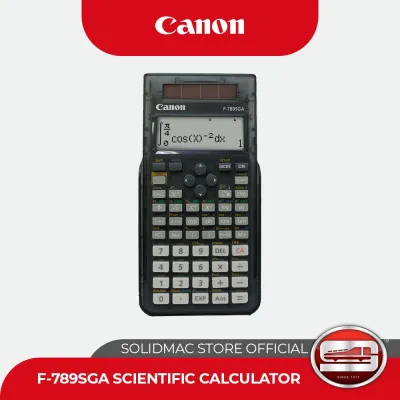
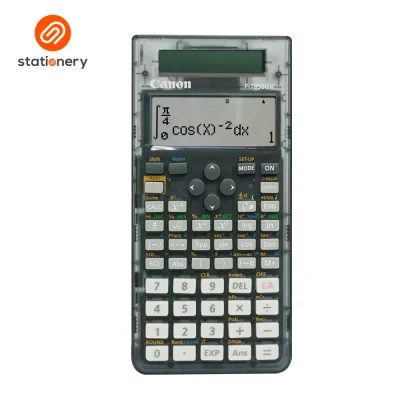
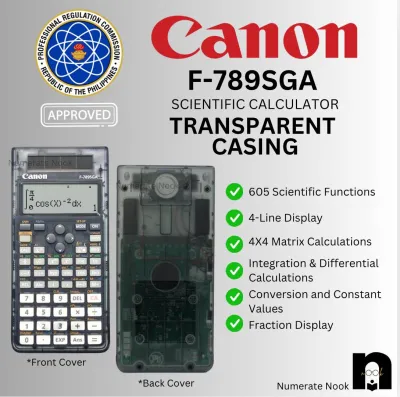
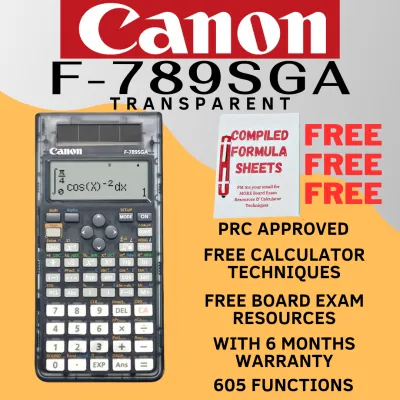
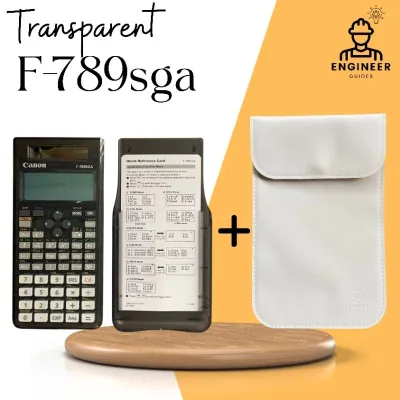
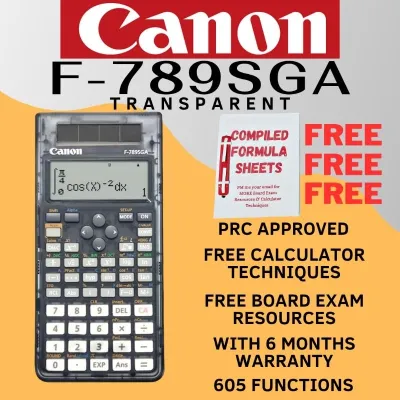
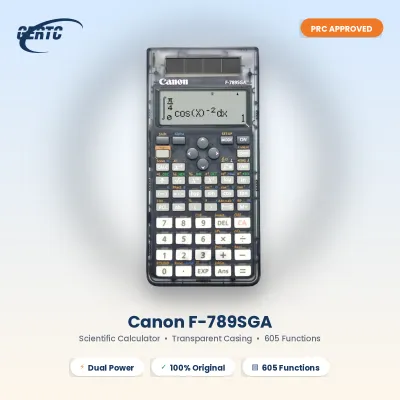
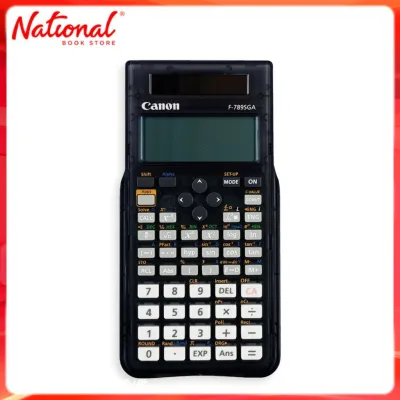
The physical design of a scientific calculator affects both its usability during long study sessions and its survival in a student’s daily routine. The Canon F-789SGA stands out immediately due to its transparent casing, a design choice that is both visually striking and highly practical. This clear shell allows you to see the internal circuitry, capacitors, and battery placement, giving it a modern, high-tech aesthetic that appeals to science and engineering enthusiasts. Beyond the visual appeal, a transparent body can be advantageous in strict academic environments where invigilators inspect devices for hidden cheat sheets or unauthorized modifications, as the clear plastic leaves no room for concealed papers inside the main housing.
Products mentioned in this guide
Prices are valid at publication and may change. Please refer to the product page for the latest price.
In contrast, CASIO scientific calculators typically feature classic opaque bodies, usually in matte black, grey, or white, depending on the specific model series. While these traditional designs lack the unique flair of a transparent shell, they are highly optimized for professional and academic environments. CASIO’s matte finishes are excellent at resisting fingerprint smudges and minor scratches that accumulate over years of use. Both brands utilize high-quality, impact-resistant plastics designed to withstand the occasional drop from a classroom desk, but the visual distinction remains a primary deciding factor for students who want their stationery to stand out.
Display technology is another critical area of comparison, as screen readability directly impacts your speed and accuracy during timed exams. The Canon F-789SGA features a high-resolution liquid crystal display that supports natural textbook display format, meaning fractions, exponents, surds, and derivatives are shown exactly as they appear in standard Philippine textbooks. This reduces the cognitive load of translating flat, single-line formulas into complex mathematical structures. CASIO models, particularly those in the ClassWiz series and advanced scientific lines, also utilize high-resolution dot-matrix displays with natural textbook layouts, often boasting high contrast levels that remain legible even under the harsh fluorescent lighting of local lecture halls or during late-night study sessions under low-light conditions.
When evaluating build quality, the tactile feedback of the keys is a vital consideration for rapid data entry. The Canon F-789SGA is designed with responsive, low-profile keys that offer a distinct click when pressed, helping you confirm inputs without looking down constantly. CASIO calculators are legendary for their key durability and layout consistency, featuring color-coded keys that separate basic arithmetic from advanced scientific functions. Both brands include protective slide-on hard covers to shield the screen and keyboard from keys, pens, and other sharp objects inside a crowded school bag. It is wise to check that the slide cover fits snugly and does not slip off easily, as a loose cover can lead to accidental key presses that drain the battery or damage the display during transit.
Mathematical Functions and Academic Features
The academic utility of a scientific calculator is defined by its internal programming and the variety of mathematical operations it can perform. The Canon F-789SGA is a powerhouse in this regard, packed with hundreds of built-in functions that cover everything from basic trigonometry and logarithms to advanced statistical analysis. It is designed to handle complex matrix calculations, vector analysis, and equation solving, making it highly suitable for college-level STEM courses. The inclusion of physical constants and metric conversion formulas directly on the device or its cover allows students to quickly retrieve essential values without memorizing extensive tables.

CASIO’s lineup is highly segmented, meaning the functions you get depend heavily on the specific model tier you choose. Entry-level CASIO models focus primarily on core scientific functions like trigonometric ratios, permutations, combinations, and basic statistics, which are perfect for junior and senior high school curricula. However, if you require advanced features like numerical integration, differentiation, matrix operations, or base-n calculations, you must look at CASIO’s mid-to-high-tier models. When comparing the Canon F-789SGA to a CASIO model, it is crucial to cross-reference their official specification sheets to ensure the CASIO model you are considering actually matches the advanced equation-solving and matrix capabilities that come standard on the Canon F-789SGA.
For students taking advanced mathematics, physics, or engineering courses, the ability to solve systems of linear equations and quadratic formulas quickly is indispensable. The Canon F-789SGA excels in these scenarios, offering intuitive menus that guide you through inputting coefficients and retrieving real or complex roots. CASIO’s advanced models offer similar capabilities, often with multi-line displays that let you view entire matrices or systems of equations simultaneously. If your coursework involves heavy statistical modeling, verify how easily each calculator handles two-variable statistics, regression analysis, and probability distributions, as a user-friendly menu structure can save precious seconds during a difficult exam.
Ultimately, the best way to choose is to align the calculator’s feature set with your specific syllabus. If you are a high school student focusing on algebra and geometry, a standard scientific calculator from either brand will serve you perfectly. However, if you are entering a university program in engineering, architecture, or mathematics, you will need the advanced calculus, matrix, and vector functions found in the Canon F-789SGA or CASIO’s upper-tier models. Always check the exact function count and menu navigation style, as some students find Canon’s menu logic more intuitive, while others prefer the traditional CASIO key combinations they have used since junior high school.
Exam Approval and Curriculum Compatibility
Before purchasing any scientific calculator, you must verify its compliance with the strict regulations of local educational institutions and national testing bodies. In the Philippines, the Professional Regulation Commission (PRC) maintains a strict list of allowed calculator models for various professional licensure examinations, including engineering, CPA, and board exams. Because these rules are updated periodically to prevent academic dishonesty, relying on outdated forum posts or general assumptions can result in your calculator being confiscated at the testing center. You must consult the latest official PRC resolutions to confirm whether the Canon F-789SGA or your specific CASIO model is currently permitted.
The primary reason certain calculators are banned from standardized tests is the inclusion of programmable memory or Computer Algebra Systems (CAS). Calculators that allow you to store text files, formulas, or custom programs, or those that can perform symbolic algebra rather than numerical calculations, are almost universally prohibited in exam rooms. Both the Canon F-789SGA and standard CASIO scientific calculators are non-programmable, which generally makes them safer choices for high school exams, college midterms, and college entrance tests. However, individual universities and specific professors often have their own classroom policies, so it is always best to check your course syllabus on the first day of class.
Curriculum compatibility also extends to how lessons are taught in the classroom. Because CASIO has been the dominant brand in Philippine schools for decades, many mathematics textbooks, teacher lesson plans, and online tutorial videos are designed specifically around CASIO key sequences. If you choose the Canon F-789SGA, you may occasionally need to translate these instructions, as the button labels and menu paths for functions like standard deviation or matrix input can differ slightly. While this is easy to overcome with a quick look at the Canon user manual, students who prefer to follow their teacher’s step-by-step keystrokes exactly may find a CASIO model more convenient for daily classroom learning.
To ensure a smooth academic experience, make it a habit to consult your academic adviser, subject professors, or senior students in your department before making a final purchase. Ask them which models are traditionally accepted in your specific department and whether any upcoming curriculum changes might affect calculator policies. Investing in a calculator that is fully approved for both your university coursework and your future professional board exam ensures that you can use the same familiar device throughout your entire academic and early professional career, building muscle memory that will serve you well under exam pressure.
Price, Availability, and Long-Term Value
When evaluating the financial aspect of your purchase, it is important to look beyond the initial retail price and consider the long-term value, durability, and operational costs. The Canon F-789SGA is generally positioned as a premium scientific calculator, but it often represents excellent value because it includes advanced features—such as matrix calculations and equation solvers—that are typically reserved for CASIO’s higher-priced models. When comparing prices at local stationery stores or online marketplaces, ensure you are comparing the Canon F-789SGA against a CASIO model with equivalent functional capabilities, rather than an entry-level CASIO model that lacks advanced math features.
Power management is a critical factor in long-term reliability, especially in a tropical climate like the Philippines where high humidity can accelerate battery degradation and cause leakage. The Canon F-789SGA features a dual power system, utilizing both a solar panel and a backup button battery. This hybrid setup ensures that the calculator remains operational under normal classroom lighting without draining the battery, and it guarantees that the device will not suddenly die during an exam even if you are sitting in a dimly lit corner of the room. Many CASIO models also offer dual power, but some entry-level and mid-range models rely solely on a single AAA or button battery, which requires periodic replacement and carries a higher risk of acid leakage if left unused for long periods.
Market availability and the risk of counterfeit products are major concerns for Filipino students. Because CASIO is incredibly popular, the local market is flooded with cheap, counterfeit CASIO calculators that look nearly identical to the genuine products but suffer from poor build quality, inaccurate calculations, and rapid battery drain. To protect your investment, always purchase your calculator from authorized office supply chains, reputable department stores, or official brand stores on major ecommerce platforms. While the Canon F-789SGA is less commonly counterfeited due to its unique transparent design, buying from official channels is still essential to secure a valid manufacturer’s warranty and ensure you are receiving a genuine, reliable device.
Consider also the availability of replacement parts and user communities. Because CASIO is so widely used, finding replacement slide covers, battery compartment doors, or user guides is incredibly easy, and there is a vast community of students and educators online who can help you troubleshoot specific calculation errors. The Canon F-789SGA, while highly respected, has a smaller user base, meaning you will rely more heavily on the official printed manual or Canon’s digital support resources. Weighing these factors of price, power source, authenticity, and community support will help you determine which brand offers the best overall value for your budget.
Final Verdict: Choosing the Right Calculator for Your Needs
The decision between the Canon F-789SGA and a CASIO scientific calculator ultimately depends on your aesthetic preferences, functional requirements, and academic environment. If you value a unique, modern aesthetic, the Canon F-789SGA’s transparent body is an outstanding choice that stands out in any classroom. Furthermore, if you need a highly capable, dual-powered calculator that offers advanced matrix, vector, and calculus functions at a competitive price point, the Canon F-789SGA provides exceptional value without requiring you to pay a premium for a top-tier brand name.
On the other hand, a CASIO scientific calculator is the ideal choice if you prefer to align with the standard tool used by the vast majority of Filipino students and educators. Choosing CASIO ensures that you can easily follow along with your teacher’s step-by-step keystrokes, troubleshoot formula inputs with your classmates, and find abundant learning resources online. Additionally, if your specific university department or professional licensing board has a highly restrictive whitelist that explicitly names specific CASIO models while omitting other brands, sticking to the tried-and-tested CASIO lineup is the safest path to avoid any exam-day complications.
Before making your final purchase, take the time to verify the exact rules of your school, college, or target professional board exam. Check the physical feel of the buttons if you can visit a physical stationery store, and compare the warranty terms offered by local distributors. Whichever brand you choose, purchasing a genuine, high-quality scientific calculator is a step toward academic success, providing you with a reliable partner to help you solve complex problems and achieve your educational goals.
Frequently Asked Questions (FAQ)
Is the Canon F-789SGA allowed in Philippine board exams?
The allowance of specific calculator models in Philippine professional board exams is determined solely by the Professional Regulation Commission (PRC). Because the PRC updates its list of permitted and prohibited calculators periodically to maintain exam integrity, you must check the latest official PRC resolutions and advisory announcements before your exam date. Do not rely on historical lists or general retail claims, as rules can change, and bringing an unapproved calculator can lead to immediate disqualification at the testing center.
Can I use a CASIO calculator with a transparent cover?
Yes, while most CASIO scientific calculators feature opaque plastic bodies, they are designed to be used with protective slide-on hard covers. Many students purchase aftermarket transparent slide covers or use the clear protective covers that come with specific CASIO models to protect the screen and keys. Ensure that any cover you use is completely free of written formulas, notes, or stickers, as exam invigilators will inspect both the calculator body and its cover for unauthorized materials before allowing you into the examination room.
Which calculator is better for engineering students?
Engineering students require a calculator that can handle complex numbers, matrix algebra, vector calculations, numerical integration, and equation solving. Both the Canon F-789SGA and high-tier CASIO models (such as those in the ClassWiz series) offer these advanced capabilities. You should review your specific engineering department’s syllabus and the PRC guidelines for your engineering board exam to see if one brand is preferred or explicitly required, and choose the model that offers the most intuitive menu navigation for your daily coursework.
Community discussion
Share your experience or ask a question. Comments are reviewed before publication.