
If you are trying to decide between the Casio AX-120ST and a Casio scientific calculator, the most important detail to understand is that they belong to entirely different product categories. The Casio AX-120ST is a desktop business calculator built for rapid financial calculations and high-volume data entry, while Casio’s scientific calculators—collectively known as the fx-series—are complex mathematical tools designed for students, engineers, and scientists. Choosing the right model is not about finding which device is objectively superior, but rather about matching the specific tool to your daily tasks and environment.
Understanding this fundamental distinction prevents costly purchasing mistakes. Buying a desktop model for a chemistry class will leave you unable to compute basic trigonometric functions, while bringing a complex scientific calculator to a busy retail counter will slow down your transactions due to its small, dense keys. By examining the design philosophies, core features, and practical applications of both options, you can easily identify which Casio calculator fits your specific academic or professional workflow.
The Core Difference: Why the AX-120ST Is Not a Scientific Calculator
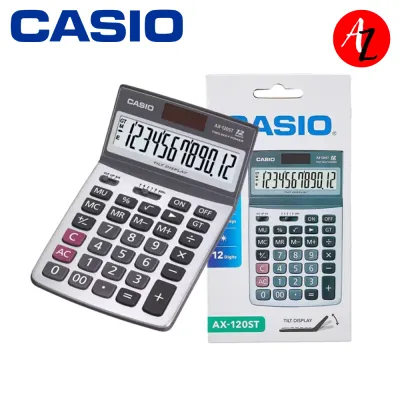
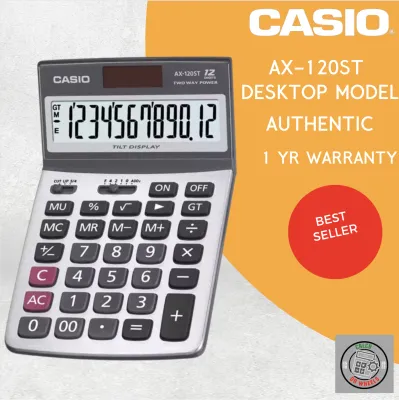
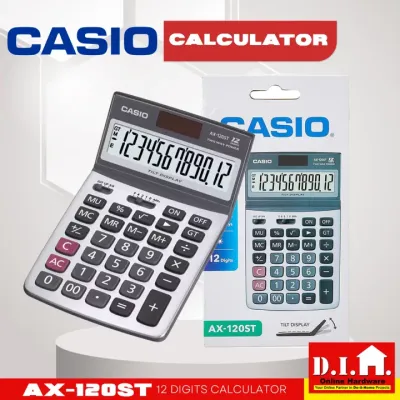
The primary source of confusion for many buyers is the assumption that all digital calculators perform similar tasks. In reality, Casio designs its product lines for highly specialized environments. The Casio AX-120ST is a dedicated desktop business calculator, optimized for accounting, retail, and general office administration. It features a simplified keyboard layout focused almost exclusively on basic arithmetic, percentage calculations, and business-specific functions like tax rates and mark-ups.
Products mentioned in this guide
Prices are valid at publication and may change. Please refer to the product page for the latest price.
In contrast, Casio’s scientific calculators belong to the world-renowned fx-series, which includes popular models like the fx-991CW, fx-570ES Plus, and the entry-level fx-82MS. These devices are engineered to handle advanced mathematics, engineering formulas, and statistical analysis. They contain pre-programmed algorithms for solving algebraic equations, calculus integration, vector dimensions, and trigonometric ratios, none of which are possible on a standard desktop business model.
Because these two types of calculators serve entirely different cognitive tasks, they do not compete in the same space. The AX-120ST is designed for speed, comfort, and physical stability on a flat desk. The fx-series is designed for portability, analytical versatility, and compliance with academic and professional testing standards. Recognizing this division is the first step toward making an informed purchase.
Casio AX-120ST: Built for Business and High-Volume Data Entry
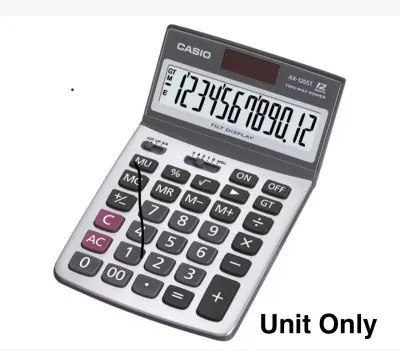
The Casio AX-120ST is a workhorse for commercial environments where speed and physical durability are paramount. Its physical design immediately sets it apart from portable models. The calculator features a robust metal faceplate that resists the daily wear and tear of active office spaces, warehouses, and retail counters. It sits flat on a desk with rubber feet to prevent sliding, and its large, tilted liquid crystal display (LCD) ensures that the 12-digit readouts are clearly visible from various viewing angles under bright office lights.

Ergonomics play a massive role in the design of the AX-120ST. The keys are large, widely spaced, and contoured to fit the fingertips, which supports rapid touch-typing without looking at the device. Additionally, the keyboard incorporates a key rollover feature. This mechanical capability ensures that if you press a second key while still releasing the first, both inputs are registered accurately, preventing missed keystrokes during high-speed data entry.
The functional layout of the AX-120ST is tailored specifically for financial transactions. It includes dedicated tax calculation keys (TAX+ and TAX-), which allow business owners and accountants to instantly apply or subtract value-added tax (VAT) from a subtotal. The mark-up (MU) key simplifies profit margin calculations, while the Grand Total (GT) key automatically aggregates the results of multiple independent calculations. It also features a highly practical “Check & Correct” function, allowing users to step backward and forward through up to 300 calculation steps to verify entries and correct errors without starting over.
Power reliability is another major benefit of this desktop model. The AX-120ST utilizes a dual-power system, drawing energy from a built-in solar panel under normal lighting conditions and seamlessly switching to a small backup battery in dimmer environments. This dual-power design ensures that the calculator is always ready for use, making it an incredibly dependable tool for retail cashiers, administrative assistants, and warehouse inventory managers who need to process transactions and invoices quickly.
Casio Scientific Calculators (fx-Series): Built for STEM and Academics
Casio’s fx-series scientific calculators are designed to assist students and professionals working within Science, Technology, Engineering, and Mathematics (STEM) disciplines. Unlike the business-oriented AX-120ST, scientific models are built to process multi-variable equations and complex formulas. They serve as essential companions in high school algebra classes, university engineering lecture halls, and laboratory research environments.
One of the defining features of modern Casio scientific calculators, particularly the ClassWiz and ES Plus series, is the Natural Textbook Display. This high-resolution dot-matrix screen displays fractions, exponents, logarithms, derivatives, and square roots exactly as they appear in printed textbooks. This visual layout is incredibly helpful for students, as it reduces the risk of input errors and makes it much easier to interpret complex mathematical expressions.
The computational power of the fx-series is vast. Even entry-level scientific models can perform trigonometric functions, coordinate conversions, and basic statistical calculations. Advanced models, such as the fx-991CW, offer specialized modes for matrix algebra, complex number calculations, vector analysis, spreadsheet generation, and numerical integration or differentiation. These tools allow users to bypass tedious manual calculations and focus on understanding the underlying scientific concepts.
Because they are designed for students and mobile professionals, fx-series calculators prioritize portability and protection. They are lightweight, slim, and shaped to fit comfortably in a hand, a pencil case, or a backpack pocket. Each model comes with a durable, slide-on hard case that shields the delicate screen and dense keypad from physical damage, dust, and moisture. The key layout is highly compact and utilizes multi-function keys accessed via SHIFT and ALPHA modifiers, which requires a learning curve but packs hundreds of functions into a highly portable frame.
Head-to-Head Comparison: Office Desktop vs. Academic Scientific
To help you visualize how these two categories differ, the table below contrasts the physical, functional, and environmental characteristics of the Casio AX-120ST against the Casio fx-series scientific calculators.
| Feature/Dimension | Casio AX-120ST (Desktop Business) | Casio fx-Series (Scientific) |
|---|---|---|
| Primary Environment | Offices, retail shops, warehouses, home desks | Classrooms, laboratories, engineering field sites |
| Keypad Layout | Large, widely spaced, numeric-focused keys | Compact, dense layout with multi-function keys |
| Display Type | Single-line, 12-digit tilted LCD with fixed segments | Multi-line, high-resolution dot-matrix display |
| Core Functions | Arithmetic, VAT taxes, mark-up, 300-step check | Trigonometry, calculus, statistics, equation solving |
| Portability | Heavy, flat desktop footprint; best kept on a desk | Slim, pocket-sized with protective slide-on hard case |
| Memory System | Basic independent memory (M+, M-, MRC, GT) | Multi-variable memory (A-F, X, Y, M) and formula storage |
| Power Source | Two-way power (Solar + Battery backup) | Battery-only or solar-assisted depending on model |
| Exam Compliance | Prohibited in most academic and board exams | Specific models approved for academic and board testing |
This comparison highlights how the two devices serve opposite design goals. The AX-120ST prioritizes physical comfort and rapid numerical entry, making it perfect for repetitive, straightforward calculations. The fx-series sacrifices large keys and physical desk stability to provide massive computational versatility and portability, allowing you to solve complex, multi-step mathematical problems anywhere.
Decision Guide: Which Casio Calculator Fits Your Daily Tasks?
Choosing the correct Casio calculator comes down to identifying the specific tasks you perform most frequently. By matching your daily responsibilities to the strengths of each device, you can ensure that you purchase a tool that simplifies your work rather than complicating it.
Choose the Casio AX-120ST if:
- Your daily tasks are centered around business administration, bookkeeping, or retail sales.
- You regularly calculate value-added taxes, profit margins, or invoice totals.
- You need to perform high-speed touch-typing and require large, tactile keys that prevent input mistakes.
- You prefer a stable, tilted display that sits permanently on your office desk or checkout counter.
- You want the ability to quickly review and correct past entries using a physical step-through feature.
Choose a Casio Scientific Calculator (fx-series) if:
- You are a student enrolled in high school or university math and science courses.
- Your work involves engineering, physics, statistics, chemistry, or advanced financial modeling.
- You need to solve quadratic equations, perform trigonometric calculations, or analyze statistical data sets.
- You require a highly portable device that fits easily into a backpack and comes with a protective cover.
- You are preparing to take standardized academic exams or professional licensure board exams.
Consider owning both if:
- You manage a technical business, such as an engineering firm or a construction company, where you need a comfortable desktop calculator for daily administrative tasks and a scientific calculator for checking technical blueprints and design calculations.
If you are purchasing a calculator specifically for academic testing in the Philippines, always consult the official guidelines of your school or the relevant professional regulatory board before buying. Standardized exams have strict rules regarding which calculator models are permitted in testing centers to ensure fairness and prevent unauthorized data storage.
Frequently Asked Questions (FAQ)
Can I use the Casio AX-120ST for board exams or university tests?
No, the Casio AX-120ST is generally prohibited in academic exams and professional board examinations in the Philippines. Standardized testing boards, such as the Professional Regulation Commission (PRC), enforce strict policies regarding calculator usage. These exams typically require specific, non-programmable scientific calculators to ensure all examinees have access to the same mathematical functions without the ability to store unauthorized notes. Because the AX-120ST is a desktop business model that lacks scientific functions and has a large, non-standard form factor, it does not comply with examination guidelines. Always check the official, updated list of allowed calculators provided by your school or exam board before your test date.
Does the AX-120ST have memory functions like a scientific calculator?
No, the memory system on the Casio AX-120ST is designed for basic business arithmetic rather than advanced mathematical storage. The AX-120ST features standard independent memory keys (M+, M-, and MRC) along with a Grand Total (GT) key, which are ideal for keeping running tallies of sales, invoices, or simple expense lists. It cannot store algebraic variables, formulas, matrices, or statistical data sets. Scientific calculators in the fx-series contain dedicated multi-variable memory registers (typically labeled A, B, C, D, E, F, X, Y, and M) that allow users to store specific numerical values and recall them within complex, multi-step formulas. If your work requires storing variables or working with algebraic formulas, a scientific calculator is necessary.
Community discussion
Share your experience or ask a question. Comments are reviewed before publication.