
Quick Answer: Which Casio Calculator Fits Your Academic Needs?
When deciding between the Casio fx-570ES PLUS and the Casio fx-991ES PLUS, many students and parents assume that the higher model number translates to superior mathematical capabilities. In reality, both of these highly popular scientific calculators share the exact same internal logic board, processing engine, and library of 417 mathematical functions. Your choice between them does not depend on their math performance, but rather on how they are powered and the physical protection they offer in your daily school routine.
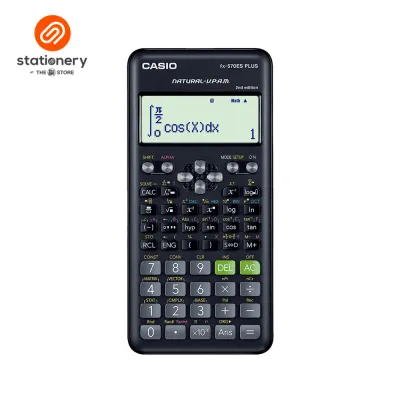
For students on a tight budget who need a reliable calculator for general science and math classes, the Casio fx-570ES PLUS is an excellent, cost-effective choice. It relies solely on a standard AAA battery, which is easy to replace but requires monitoring. On the other hand, if you are entering a rigorous multi-year program like engineering, architecture, or accountancy, the Casio fx-991ES PLUS is the superior long-term investment. Its dual-power system (solar panel and backup battery) provides unmatched reliability during high-stakes exams, and it typically comes with a durable slide-on hard case to withstand the daily wear and tear of a student’s backpack.
Core Math Functions: Why the Internal Specs Are Identical
A common misconception when browsing school supplies is that the Casio fx-991ES PLUS can solve more complex equations or perform faster calculations than the Casio fx-570ES PLUS. This is entirely incorrect. Both devices belong to Casio’s renowned ES PLUS series and are built on the identical mathematical architecture. Whether you are solving a basic algebraic fraction or executing a complex definite integral, both calculators will deliver the exact same result in the same amount of time.
Products mentioned in this guide
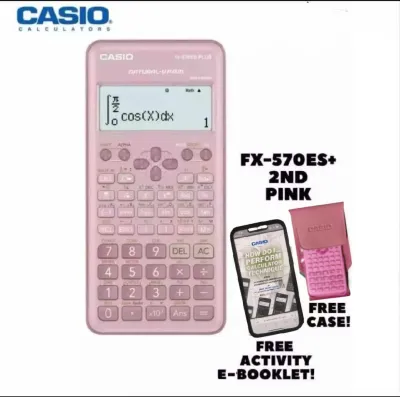
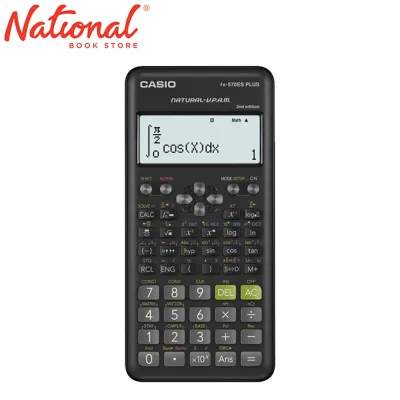
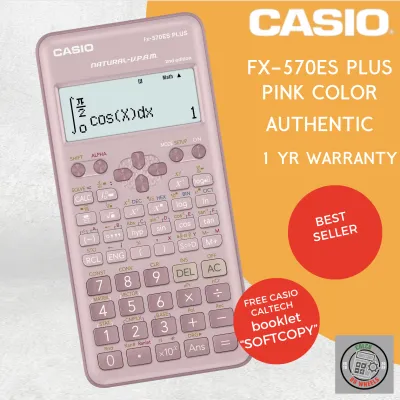
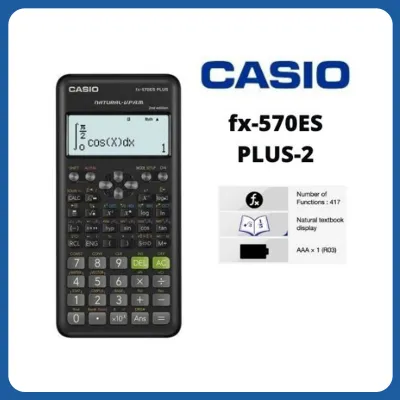
Prices are valid at publication and may change. Please refer to the product page for the latest price.

At the heart of both models is Casio’s Natural V.P.A.M. (Visually Perfect Algebraic Method) display technology. This feature is a massive advantage for senior high school STEM students and university undergraduates. It allows the calculator to display fractions, exponents, logarithms, square roots, and calculus symbols exactly as they are written in textbooks. This visual consistency reduces input errors and helps students better understand the structure of their mathematical formulas, especially during time-pressured exams where a misplaced parenthesis can mean the difference between passing and failing.
Both calculators come equipped with 417 built-in functions, which easily cover the curriculum requirements of senior high school STEM tracks and university programs. These advanced capabilities include:
- Calculus Calculations: Numerical integration and differentiation, allowing you to solve area-under-the-curve and rate-of-change problems without manual derivation.
- Matrix and Vector Algebra: Support for up to 3×3 matrices and 3-dimensional vector calculations, which are essential for advanced physics and structural engineering courses.
- Equation Solving: A built-in solver for simultaneous linear equations (up to three unknowns), quadratic equations, and cubic equations.
- Complex Numbers: Arithmetic operations, polar-rectangular conversions, and argument calculations for electrical engineering and advanced algebra.
- Scientific Constants and Metric Conversions: Dozens of pre-programmed physical constants (like the speed of light or universal gas constant) and unit conversion pairs, saving precious seconds during chemistry and physics tests.
Because the internal processing power and function lists are identical, neither calculator will limit your academic progress. An engineering student can solve the most demanding thermodynamics or structural analysis problems just as easily on the fx-570ES PLUS as they can on the fx-991ES PLUS.
Power Source and Reliability: The Main Hardware Difference
While the mathematical capabilities are identical, the way these two calculators manage power is the most critical difference you must consider before purchasing. This hardware distinction directly impacts how reliable the device will be over years of academic use, especially when you are sitting in a warm classroom or taking an intensive professional board exam.
fx-991ES PLUS: Dual Power (Solar + Battery)
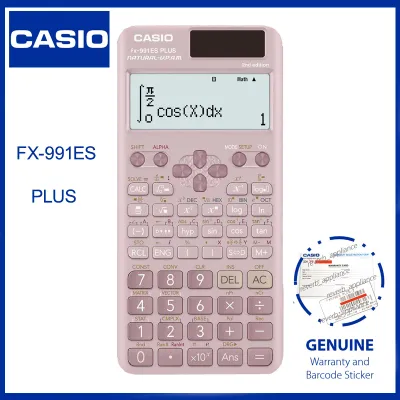
The standout feature of the Casio fx-991ES PLUS is its “Two-Way Power” system, which combines a built-in solar panel with a small button-cell backup battery (typically an LR44). Under normal lighting conditions—whether you are sitting next to a window in natural sunlight or under standard fluorescent classroom lights—the calculator runs entirely on solar energy. This preserves the internal battery, extending its lifespan to several years of daily use.
This dual-power architecture serves as an essential fail-safe mechanism. If you are taking a major exam, such as a university midterm or a licensure test, the last thing you want to worry about is a dead battery. With the fx-991ES PLUS, as long as there is enough ambient light to read your exam paper, the calculator will remain operational, even if the internal backup battery is completely drained. It is important to note, however, that the solar panel requires a reasonable level of light to activate; in extremely dim environments, the calculator will seamlessly switch to drawing power from the backup battery.
fx-570ES PLUS: Battery Only
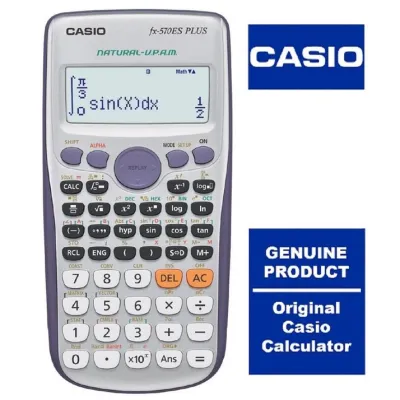
In contrast, the Casio fx-570ES PLUS operates solely on battery power, utilizing a single standard AAA battery. While Casio’s internal components are exceptionally power-efficient—meaning a single high-quality alkaline battery can last for many months of standard use—you are entirely dependent on that single power source.
Relying on a single battery introduces a few practical considerations for students:
- No Solar Backup: If the AAA battery dies in the middle of a high-stakes exam, the calculator will shut down immediately, leaving you with no way to solve complex formulas unless you have a spare battery and a small screwdriver on hand to open the battery compartment.
- Battery Replacement Convenience: On the positive side, AAA batteries are incredibly common. If your calculator runs out of power during a late-night study session, you can easily buy a replacement at any local convenience store or supermarket. You do not need to search for specialty watch batteries like the LR44.
- Monitoring Battery Life: Because there is no solar panel to shoulder the load, you must actively monitor the display contrast. If you notice the numbers on the screen fading or the calculator lagging when executing complex matrix operations, it is a clear warning sign that you need to replace the AAA battery immediately.
Physical Design, Build, and Included Accessories
Beyond the power source, the physical design and the accessories included in the retail packaging differ between these two models. These factors play a significant role in how well the calculator survives the daily commute, crowded lecture halls, and humid tropical climates.
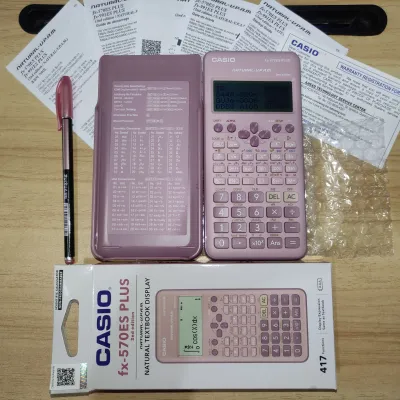
The most notable physical difference lies in the protective casing. The Casio fx-991ES PLUS almost always includes a rigid, slide-on hard cover. This plastic case is designed to clip securely over the front of the calculator when it is not in use. It provides excellent protection for the sensitive liquid crystal display (LCD) and prevents the plastic keys from being accidentally pressed or damaged when the calculator is tossed into a backpack filled with heavy textbooks, water bottles, and umbrellas.
Conversely, the Casio fx-570ES PLUS is often packaged differently depending on the specific retail batch or regional distributor. In many cases, it does not include the same heavy-duty slide-on hard cover, or it may come with a simpler, flexible soft pouch. Without a rigid hard case, the LCD screen is more vulnerable to pressure damage—such as when a heavy textbook presses against the screen inside a tightly packed school bag. If you choose the fx-570ES PLUS, it is highly recommended to purchase a separate padded pouch or handle the device with extra care to avoid cracking the display.
In terms of dimensions, weight, and general ergonomics, the two calculators are nearly identical. Both feature the classic Casio curved body, which fits comfortably in one hand, and a highly responsive plastic keyboard. The key layout is identical, meaning that if you learn how to use one model, you can transition to the other instantly without any learning curve. The keys are labeled with clear, color-coded text (yellow for shift functions, red for alpha functions) that remains legible even after years of continuous finger friction.
Price and Value: Does the fx-991ES PLUS Justify the Cost?
When shopping at local bookstores or browsing online marketplaces, you will notice a clear price gap between these two models. The Casio fx-991ES PLUS commands a noticeable price premium over the fx-570ES PLUS. To determine if this extra cost is justified, you must weigh the upfront investment against your specific academic timeline and budget.
The price difference essentially pays for three key hardware upgrades:
- The Solar Panel Integration: The physical solar cell and the dual-power circuitry that manages the transition between solar and battery power.
- The Slide-On Hard Case: A durable, custom-fit plastic cover that significantly extends the physical lifespan of the calculator.
- Exam-Day Peace of Mind: The invaluable security of knowing your calculator will not die in the middle of a critical test due to a sudden battery failure.
To analyze the value proposition, consider your academic path. If you are a high school student or a non-STEM college major who only needs a scientific calculator for a semester or two of general mathematics, the Casio fx-570ES PLUS offers outstanding value. It gives you 100% of the mathematical performance of the premium model at a lower price point. Since you do not require the device for long-term daily professional use, the cost savings are highly practical, and the reliance on a standard AAA battery is perfectly manageable.
However, if you are a senior high school STEM student or enrolled in a demanding engineering, architecture, or science program, the Casio fx-991ES PLUS is undoubtedly the better investment. Over several years of daily use, the cost of buying replacement AAA batteries for the fx-570ES PLUS can gradually narrow the initial price gap. Furthermore, the added durability of the hard cover and the absolute reliability of the solar panel during multi-hour board exams make the fx-991ES PLUS a much safer and more cost-effective choice in the long run.
Final Decision Framework: Match the Calculator to Your Needs
Making your final choice comes down to assessing your academic major, your study environment, and your budget constraints. Use the following framework to guide your purchasing decision:
Choose the Casio fx-570ES PLUS if:
- You are on a strict budget and want the most affordable way to access advanced scientific computing.
- You only need the calculator for high school math or general education college courses.
- You prefer using a standard, easily replaceable AAA battery and do not mind carrying a spare.
- You already have a padded bag or a safe way to transport the calculator to prevent screen damage.
Choose the Casio fx-991ES PLUS if:
- You are a STEM major, engineering student, or preparing for a professional board exam.
- You want the ultimate peace of mind that comes with dual solar and battery power during high-stakes tests.
- You commute daily with a heavily packed bag and need the protection of a slide-on hard case.
- You view the calculator as a long-term investment that should last throughout your entire college journey and beyond.
Crucial Buying Tip: When purchasing your calculator from local retail shops or online marketplaces, always verify the exact model suffix. You want to make sure you are getting the “ES PLUS” (specifically the 2nd Edition, which features a modern, clean design and improved keyboard contrast) rather than the older, discontinued “ES” series. Additionally, be highly vigilant against counterfeit units. Counterfeit Casio calculators are common in online listings; they often look identical on the outside but suffer from poor build quality, slow processing speeds, inaccurate calculations, and non-functional solar panels. Always buy from authorized dealers or official brand stores to ensure you receive a genuine, durable product.
Frequently Asked Questions (FAQ)
Is the Casio fx-991ES PLUS allowed in professional board exams?
Yes, both the Casio fx-570ES PLUS and the fx-991ES PLUS are generally permitted in major professional board exams, such as those conducted by the Professional Regulation Commission (PRC) in the Philippines. Because these models are non-programmable, non-graphing scientific calculators, they comply with standard exam security policies designed to prevent cheating. However, the PRC periodically updates its list of allowed calculator models for specific professions (like Civil Engineering, Electrical Engineering, or CPA exams). It is highly recommended to check the official, updated PRC guidelines for your specific board exam before your test date to ensure your model remains fully compliant.
Can I modify a fx-570ES PLUS to add solar power?
No, it is not possible, safe, or practical to modify a Casio fx-570ES PLUS to add solar power. The solar panel on the fx-991ES PLUS is not a simple stick-on accessory; it is deeply integrated into the calculator’s internal motherboard, power management circuitry, and physical plastic casing. Attempting to open the fx-570ES PLUS to alter its power source will void your warranty, damage the delicate liquid crystal display, and likely render the calculator completely unusable. If solar power is a priority for your studies, it is much safer and more economical to purchase the fx-991ES PLUS directly.
Community discussion
Share your experience or ask a question. Comments are reviewed before publication.