
Selecting a reliable casio calculator is one of the most critical decisions a student makes before entering a challenging math class or preparing for a high-stakes exam. While both the Casio fx-991 and the Casio fx-570 are legendary workhorses in high school and college classrooms across the Philippines, they serve slightly different needs. Choosing between them isn’t just about comparing prices; it requires matching their specific math features with your curriculum requirements, school policies, and future exam regulations.
Quick Answer: Which Model Fits Your Math Classes?
The primary difference between the Casio fx-991 and the Casio fx-570 lies in their power sources and advanced mathematical capabilities. If you are enrolled in a rigorous STEM track, engineering, or higher-level college mathematics, the Casio fx-991 is generally the superior choice. It features advanced processing power for complex calculations, definite integrals, and matrix operations, and it is powered by a reliable dual-power system that utilizes both a solar panel and a battery.
Conversely, the Casio fx-570 is an excellent, budget-friendly alternative that is often sufficient for junior high school, general mathematics, basic algebra, and non-STEM strands. It offers a very similar layout but typically runs solely on battery power and may omit some of the advanced calculation engines found in the fx-991. However, before you make a purchase, you must verify your school’s or examination board’s approved calculator list. In the Philippines, strict exam guidelines can make a specific model either your greatest academic tool or a device that is prohibited at the testing room door.
Products mentioned in this guide
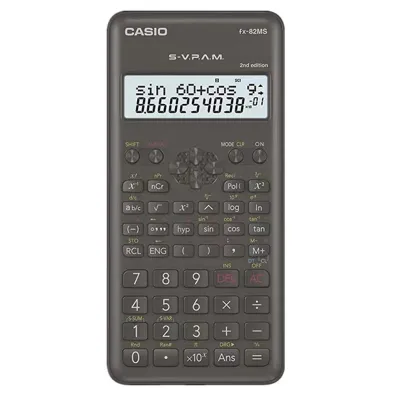
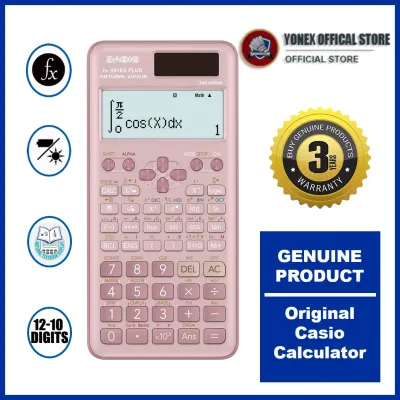
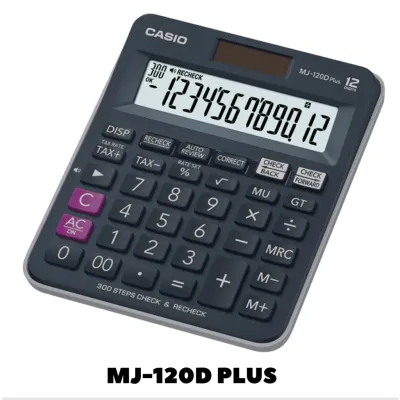
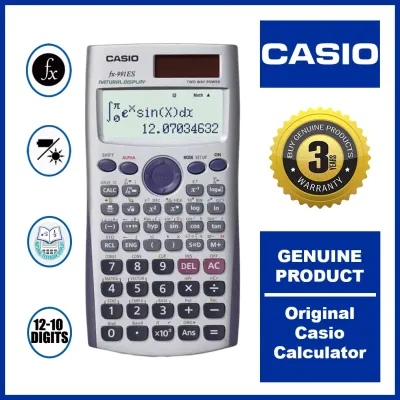
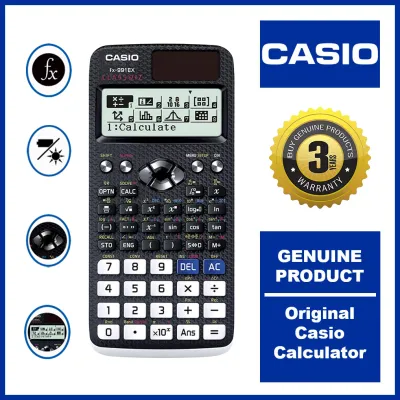
Prices are valid at publication and may change. Please refer to the product page for the latest price.
Feature Breakdown: Where the fx-991 and fx-570 Differ
To understand which model will serve you best during long study sessions and timed exams, you need to look closely at what happens under the plastic casing. While they may look nearly identical at a glance, their internal computational engines and user interfaces diverge in ways that directly impact your academic workflow. Let’s break down these differences across advanced mathematical functions and daily usability.

Advanced Calculations: Calculus, Matrices, and Equation Solving
The technical gap between these two models becomes obvious when you move beyond basic algebra. The Casio fx-991 series—especially the modern ClassWiz CW and EX generations—is built with an advanced computational engine designed to handle complex numerical integration, differentiation, matrix calculations up to 4×4, and vector operations. These tools allow you to solve systems of linear equations with up to four variables or find the roots of polynomial equations up to the fourth degree in seconds, which is a massive advantage during time-pressured exams.
In contrast, the fx-570 series has historically focused on standard algebraic, trigonometric, and statistical functions. While older or specific iterations of the fx-570 can perform basic matrix and vector calculations, they often lack the processing speed, memory capacity, or intuitive menu layouts required for high-level engineering and advanced calculus problems. When faced with complex numbers or iterative equations, the fx-570 might take longer to compute or require more manual steps, increasing the risk of input errors.
It is vital to pay close attention to the exact suffix of the model you are purchasing. For example, the newer ClassWiz CW series (such as the fx-991CW and fx-570CW) features a completely redesigned, app-style menu navigation that is highly intuitive but differs significantly from the older ES PLUS or EX series. Older generations like the fx-991ES PLUS or fx-570ES PLUS utilize a more traditional menu system that some students prefer for its familiarity, though they lack the high-resolution displays of the ClassWiz line.
Before buying, perform a quick syllabus check. Look at your upcoming course outlines for terms like “Differential Equations,” “Linear Algebra,” “Numerical Methods,” or “Complex Variables.” If these topics appear, cross-reference them with the official Casio packaging or user manual specifications to ensure the calculator you choose can natively handle those exact operations.
Everyday Usability: Display and Navigation
Beyond the internal programming, how you interact with your calculator on a daily basis determines how quickly you can work through complex problem sets. Both the fx-991 and fx-570 utilize Casio’s Natural Textbook Display (or Natural-V.P.A.M. on older versions), which is a game-changer for student comprehension. This technology renders mathematical expressions—such as fractions, exponents, square roots, and integrals—exactly as they are printed in your textbooks, reducing the cognitive load of translating formulas into a single line of text.
However, the ease of navigating these displays depends heavily on the generation of the calculator. The newer ClassWiz CW series introduces a streamlined, scroll-and-select menu system that replaces the older multi-key shortcut sequences. While this makes the calculator much easier for beginners to learn, it can feel slightly slower for experienced users who are accustomed to the rapid button-pressing sequences of the older ES PLUS models. If you are transitioning from an older model to a newer one, expect a brief adjustment period as you learn the new keystroke pathways.
Fortunately, physical build quality remains excellent across both model lines within the same generation. The plastic keys are engineered for high tactile responsiveness, ensuring that fast-typing students do not miss a keystroke during intense exams. Additionally, both models come equipped with a durable, slide-on hard plastic case that protects the high-contrast LCD screen and the delicate keys from the inevitable bumps, drops, and humid conditions of a typical Philippine school bag.
The Dealbreaker: Exam Regulations and School Policies
You could purchase the most advanced scientific calculator available, but it is completely useless if your teacher or exam proctor confiscates it at the door. Educational institutions and professional licensing boards enforce strict rules regarding calculator usage to ensure academic integrity. The primary concern is preventing students from using programmable calculators, devices with storage capabilities for text files, or models featuring Computer Algebra Systems (CAS) that can solve algebraic variables symbolically rather than numerically.
In the Philippines, the regulatory landscape is particularly strict. The Professional Regulation Commission (PRC) maintains an official list of allowed calculators for various board examinations, such as those for Civil Engineering, Mechanical Engineering, and Certified Public Accountants. Historically, certain advanced models of the fx-991 have faced temporary bans or specific restrictions in board exams due to their powerful equation-solving capabilities, while the fx-570 or more basic scientific models are sometimes favored by proctors for their compliance with non-programmable standards.
To avoid a costly mistake, you must take active steps to verify your calculator’s compliance before the academic year or exam season begins:
- Consult the official syllabus or student handbook: Most university departments, especially in engineering and sciences, explicitly list permitted calculator models.
- Speak directly with your instructor: Ask your professor or department coordinator during the first week of classes if the specific model suffix (such as CW or ES PLUS) is allowed in their exams.
- Inspect the packaging carefully: Look for "Non-Programmable" labels on the retail box, but remember that these marketing labels do not override the specific directives of your school or the PRC.
Never assume that because a classmate or senior is using a specific model, it will be permitted in your particular classroom or testing center. Rules can change from semester to semester, and individual professors often have the final say on what is allowed during their quizzes. Investing a few minutes in verifying your school’s policy beforehand ensures your calculator remains a helpful tool rather than a source of exam-day stress.
Price and Value: Is a Premium Casio Calculator Worth Your Budget?
When shopping for a new casio calculator in the Philippines, you will quickly notice a price difference between the two series. The Casio fx-991 typically commands a higher price premium compared to the fx-570. This cost difference is primarily attributed to the fx-991’s dual-power system—which combines solar panels with a backup battery—and its more advanced computational features. To determine if this extra expense is justified, you must weigh it against your long-term academic and career goals.
For students entering rigorous STEM tracks in senior high school or pursuing college degrees in engineering, physics, chemistry, or mathematics, the fx-991 is a highly justifiable investment. The time saved by using its advanced matrix solvers, numerical integration, and constant conversions over a four-to-five-year degree program easily offsets the initial price gap. Think of it as a long-term tool that will support you from your first college algebra class all the way to your graduation day and board exams.
On the other hand, if you are a junior high school student, enrolled in a non-STEM senior high school strand (such as ABM or HUMSS), or taking general education math courses, the fx-570 offers exceptional value. It provides almost all the fundamental scientific functions you will ever need—such as trigonometry, statistics, and basic algebraic fraction calculations—without forcing you to pay for advanced features that will sit unused in your desk drawer.
Regardless of which model you choose, you must be extremely cautious about where you buy your calculator. The popularity of Casio calculators has made them a prime target for counterfeiters in the Philippine market, with fake units widely distributed on unverified online marketplaces and street stalls. These counterfeit calculators often feature poor screen contrast, unresponsive keys, and, worst of all, inaccurate calculation algorithms that can cause you to fail an exam. Always purchase your device from authorized stationery stores, official brand counters in major department stores, or verified online mall flagship stores to ensure you receive an authentic, reliable product with a valid warranty.
Decision Framework: Choose the Right Casio Calculator
To help you make a final decision, we have summarized the key choice factors into a clear, actionable framework. Use these guidelines to match your academic scenario with the correct model.
Choose the Casio fx-991 if:
- You are a STEM student or engineering major: Your coursework involves frequent calculus, linear algebra, physics, and advanced chemistry where matrix calculations and numerical integration are daily requirements.
- You want maximum reliability: The dual-power system ensures that the calculator will not die in the middle of a major exam, as long as there is ambient light in the classroom.
- Your school policies permit its use: You have checked with your instructors or the PRC guidelines and confirmed that the fx-991 (and your specific suffix) is fully approved.
Choose the Casio fx-570 if:
- You are in junior high or a non-STEM strand: Your math classes focus on basic algebra, geometry, trigonometry, and general statistics, making the advanced features of the fx-991 unnecessary.
- You are on a tight budget: You want a highly capable, durable scientific calculator from a trusted brand without paying a premium for solar power or advanced calculus engines.
- Your exam board has strict limits: You are preparing for a standardized test that specifically bans dual-power or highly advanced calculators but allows standard scientific models.
Verify first if:
- You are unsure of the rules: Always check your department's calculator policy before unboxing or using your new device, as opened stationery items are often non-returnable.
- You are comparing generations: Make sure you know whether you are buying an older ES PLUS model or a newer ClassWiz CW model, as the interface and menu layouts are completely different.
Frequently Asked Questions (FAQ)
Can I use the Casio fx-991 for board exams or standardized tests?
Acceptance of the Casio fx-991 varies significantly depending on the specific professional regulation commission, university department, or testing body administering your exam. While it is widely accepted in many college-level courses, certain board examinations in the Philippines have strict lists of allowed non-programmable calculators to prevent any unfair advantage. You must consult the latest official examinee guidelines published by the PRC or your school’s testing center before the exam date. If the fx-991 is restricted, you will need to secure an approved, more basic model well in advance.
Is the Casio fx-570 good enough for senior high school STEM students?
The Casio fx-570 is highly capable and can handle the vast majority of senior high school STEM topics, including pre-calculus, basic calculus, and general physics. However, it may fall short in convenience when you encounter complex matrix operations or definite integrals that require rapid solving. If your budget allows, upgrading to the fx-991 is highly recommended for STEM students to save time during exams. Always consult your subject syllabus and your teacher’s recommendations before making your final decision.
Do these calculators require charging or battery replacements?
Neither the Casio fx-991 nor the fx-570 requires USB charging, but they do rely on traditional batteries. The fx-570 operates solely on battery power (typically a single AAA or button cell battery, depending on the generation), while the fx-991 features a dual-power system that uses solar energy as the primary source and a button cell battery as a backup. If you notice the display contrast fading, or if calculations take noticeably longer to resolve, it is time to replace the battery. For maximum reliability, check your calculator’s battery health before entering any major exam period.
Community discussion
Share your experience or ask a question. Comments are reviewed before publication.