
When choosing a casio scientific calculator, the ideal model depends on your academic track, your budget, and the specific examination rules of your institution. Selecting the wrong model can leave you without critical functions during a college exam, or worse, with an expensive device that is banned by your licensing board.
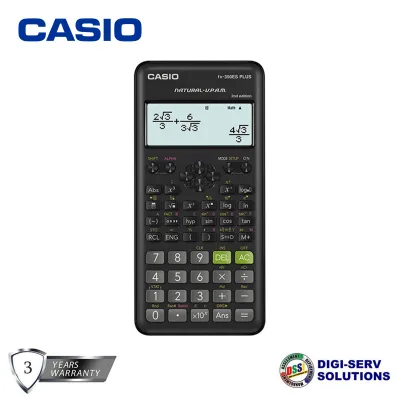
Choose the fx-82 series if you are in junior high school, studying basic algebra, or enrolled in non-STEM senior high school tracks. It is a highly affordable, durable, and straightforward tool that covers all fundamental mathematical operations without unnecessary complexity.
Choose the fx-570 series if you are a senior high school STEM student or a college student who requires advanced mathematical capabilities—such as calculus, matrices, vectors, and complex numbers—but you want to maximize your budget. It features the exact same advanced mathematical engine as the premium models but operates solely on battery power, making it more cost-effective.
Products mentioned in this guide

Prices are valid at publication and may change. Please refer to the product page for the latest price.
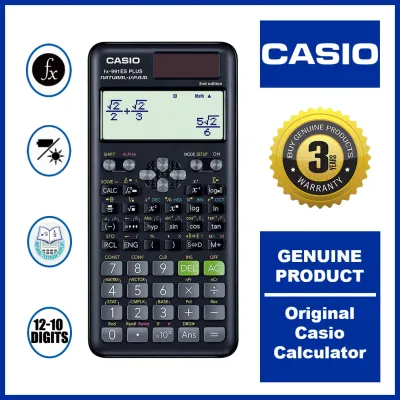
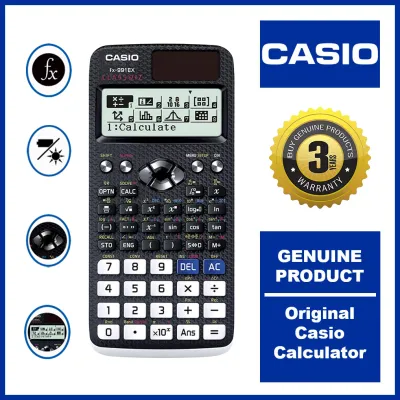
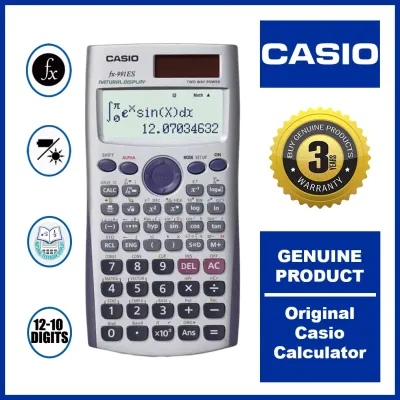
Choose the fx-991 series if you are an engineering, science, or mathematics major who demands the highest level of reliability. The fx-991 shares the same advanced feature set as the fx-570 but includes a dual-power system (solar panel and battery backup), ensuring your calculator will not shut down unexpectedly during high-stakes exams.
Verify first if your school, university department, or professional licensing board permits advanced scientific calculators. In the Philippines, the Professional Regulation Commission (PRC) and various university entrance exams enforce strict rules regarding which calculator models can enter the testing room. Always cross-reference your target exam’s official allowed list before making a purchase.
Feature and Hardware Comparison at a Glance
To help you quickly identify the physical and functional differences among these three popular series, the table below outlines their core specifications. Note that while features are consistent within each series, the user interface and screen resolution will vary depending on whether you purchase the older ES PLUS, the intermediate EX, or the latest CW generation.
| Feature / Dimension | Casio fx-82 Series | Casio fx-570 Series | Casio fx-991 Series |
|---|---|---|---|
| Primary Power Source | Battery Only (AAA or Button Cell) | Battery Only (AAA) | Dual Power (Solar + Battery) |
| Core Math Capabilities | Basic Statistics, Trigonometry, Fractions | Calculus, Matrices, Vectors, Equation Solvers | Calculus, Matrices, Vectors, Equation Solvers |
| Matrix & Vector Limits | Not Supported | Up to 4×4 Matrices (CW/EX generations) | Up to 4×4 Matrices (CW/EX generations) |
| Equation Solver | No | Yes (Simultaneous, Polynomial, General) | Yes (Simultaneous, Polynomial, General) |
| Display Type | High-Res Dot-Matrix (CW/EX) or standard LCD | High-Res Dot-Matrix (CW/EX) or standard LCD | High-Res Dot-Matrix (CW/EX) or standard LCD |
| Relative Price Band | Budget-Friendly | Mid-Range | Premium |
| Target Academic Level | Junior High, Non-STEM Senior High | Senior High STEM, College STEM | College STEM, Professional Board Exams |
Casio releases these calculators across different hardware generations, which are indicated by the letter suffix on the box. The older ES PLUS series features a standard liquid crystal display (LCD) with a traditional button layout. The EX ClassWiz series introduced high-resolution dot-matrix screens capable of displaying spreadsheets and QR codes. The latest CW (ClassWiz) series features a completely redesigned, menu-driven interface with flatter keys and a circular directional pad, which optimizes navigation but requires a slight adjustment if you are used to older layouts.
When writing down long, multi-step calculation results from a high-resolution screen onto standard school notebook paper, matching your writing tools is key. Using a high-precision gel pen on thin paper can lead to ink bleed-through, especially when copying dense matrices or statistical tables. To prevent this, pair your high-resolution calculator display with a clean, quick-drying ballpoint pen and paper of at least 80 GSM.
Hardware durability is highly dependent on how you protect the device. All three models come with a slide-on hard plastic cover. Always slide this cover over the keys when throwing the calculator into a crowded backpack, as direct pressure can damage the delicate liquid crystal display or cause key legends to rub off over semesters of heavy use.
Casio fx-82: The Essential Choice for Basic Math
The Casio fx-82 series is designed as an entry-level scientific calculator, providing a solid foundation for students entering secondary education. It excels at handling everyday mathematical tasks, including basic arithmetic, fractions, percentages, trigonometric functions, permutations, combinations, and single-variable statistics. If your academic curriculum does not involve higher-level mathematics, the fx-82 offers a clean, uncluttered interface that makes basic calculations fast and intuitive.

However, the fx-82 has clear functional boundaries. It does not support calculus operations such as definite integration or differentiation, nor can it handle complex numbers, matrix algebra, vector calculations, or multi-variable equation solving. Attempting to use this model for college-level engineering, physics, or advanced chemistry will leave you unable to complete standard coursework efficiently.
Despite these limitations, the fx-82 remains a highly popular choice due to its exceptional value proposition. It is lightweight, fits comfortably in a standard uniform pocket, and is priced significantly lower than its advanced counterparts. For junior high school students or senior high students in tracks like Humanities and Social Sciences (HUMSS) or General Academic Strand (GAS) in the Philippines, this calculator provides all the necessary tools without the added cost of unused features.
Because the fx-82 relies solely on battery power—typically a single AAA battery or a button cell, depending on the specific sub-version—it is crucial to monitor its performance. If you notice the screen contrast fading, especially when calculating complex statistical regressions, the battery is running low. Always keep a fresh, high-quality leak-resistant battery in your pencil case during exam weeks. In hot, humid tropical climates, cheap batteries are prone to leaking acid, which can permanently corrode the internal metallic terminals and ruin your calculator.
To clean your fx-82 and keep the key legends visible, use a dry, lint-free microfibre cloth. Never apply harsh chemical solvents, alcohol, or wet sanitizing wipes directly to the plastic casing or the screen, as these liquids can dissolve the printed symbols on the keys and cloud the clear plastic display cover.
Casio fx-570 vs fx-991: Advanced Tools for STEM Students
For students pursuing Science, Technology, Engineering, and Mathematics (STEM) pathways, the choice inevitably narrows down to the fx-570 and fx-991 series. Both of these models are computational powerhouses. They support advanced mathematical operations, including definite integrals (calculated numerically using Simpson’s rule), derivatives, complex number calculations, base-n conversions, matrix arithmetic up to 4×4 dimensions, vector calculations, and comprehensive equation solvers that handle simultaneous linear equations and polynomials.
The primary physical differentiator between these two advanced models is their power source. The fx-991 series features a prominent solar panel on the upper right corner of the faceplate, working in tandem with a small backup battery. This dual-power system ensures that the calculator runs primarily on ambient light, preserving the internal battery for years. The fx-570, on the other hand, is powered solely by a standard AAA battery, resulting in a slightly thicker profile and a heavier hand feel.
This power difference introduces a major reliability factor during long, high-pressure examinations. In a poorly lit exam hall, or during a rainy afternoon, a battery-only calculator like the fx-570 relies entirely on the charge left in its single cell. If that cell dies mid-exam, the calculator shuts down instantly. With the fx-991, the solar panel can keep the device running under standard classroom lighting even if the internal battery is completely drained, providing an invaluable safety net for college students.
Regional and institutional rules also play a role in which model you should buy. In certain standardized testing environments, proctors are highly suspicious of solar panels, occasionally confusing them with wireless communication sensors or programmable interfaces. Conversely, some licensing bodies specifically ban the fx-991 due to its popularity, while permitting older versions of the fx-570. In the Philippines, the Professional Regulation Commission (PRC) regularly updates its list of allowed calculators for civil, mechanical, and electrical engineering board exams, making it essential to check their latest memorandum before choosing between these two models.
If your budget is tight and your school rules permit both, the fx-570 offers the exact same mathematical processing power as the fx-991 for a lower price point. It is an excellent, cost-effective engine for solving complex systems of equations. However, if you want long-term peace of mind, superior battery longevity, and a slightly slimmer device profile, the dual-powered fx-991 is widely considered the safer, more reliable investment for a multi-year college degree.
How to Verify Exam Compatibility and Regional Versions
Before finalizing your purchase, you must verify that your chosen scientific calculator is permitted in your specific testing environment. Standardized exams, including university entrance tests (such as the UPCAT, USTET, or DLSUCET) and professional licensing examinations administered by the PRC, enforce strict policies to prevent academic dishonesty. Bringing a banned calculator can result in immediate disqualification from the exam.
While the fx-82, fx-570, and fx-991 are non-programmable scientific calculators, some strict testing centers ban models that feature equation solvers or matrix calculations to ensure students solve these problems manually. For instance, while the fx-82 is almost universally accepted due to its basic feature set, the advanced fx-991 and fx-570 models are frequently subject to specific version restrictions. Always download the most recent guidelines from your exam provider’s official website rather than relying on outdated advice from online forums.
Understanding Casio’s generation suffixes is critical when matching your calculator to your curriculum. The three most common generations found in retail stores are:
- ES PLUS (e.g., fx-991ES PLUS 2nd Edition): Features the classic Natural Textbook Display. It is highly reliable, has a traditional button layout, and is widely understood by older professors, but it features slower processing speeds when solving large matrices.
- EX ClassWiz (e.g., fx-991EX): Features a high-resolution screen, a spreadsheet function, and faster processing. While highly sought after, this generation has been largely phased out in favor of the newer CW series.
- CW ClassWiz (e.g., fx-991CW, fx-570CW): The current standard. It features a completely redesigned, flat-button interface, a simplified menu system, and a faster processor. It lacks the traditional ALPHA key shortcuts, relying instead on a dedicated VARIABLE key.
We strongly recommend buying the exact generation recommended by your course instructors or senior students. Because the button layouts and menu structures differ significantly between the older ES PLUS, the EX, and the newer CW generations, following along with a professor’s step-by-step blackboard instructions can be incredibly confusing if your calculator’s keys do not match theirs. Choosing a model that aligns with your classroom environment ensures you can execute calculations quickly and confidently during timed quizzes.
Frequently Asked Questions (FAQ)
Can I use the Casio fx-991 for board exams in the Philippines?
Whether you can use the Casio fx-991 for professional board exams in the Philippines depends entirely on the specific exam and the latest directives from the Professional Regulation Commission (PRC). While the fx-991 series has historically been a favorite among engineering and science students, the PRC has occasionally banned or restricted specific sub-models (such as the fx-991ES PLUS or fx-991EX) to maintain exam integrity. Always check the official, updated list of allowed calculators on the PRC website before your exam date, as these rules are subject to change without prior notice.
What is the difference between the EX and CW versions?
The primary difference lies in the user interface, physical design, and processing speed. The older EX ClassWiz series uses a traditional scientific calculator layout with secondary functions printed above the keys, accessed via the SHIFT and ALPHA buttons. The newer CW ClassWiz series features a streamlined, menu-driven interface with circular directional keys, flat buttons, and a dedicated VARIABLE key for storing values. The CW version also features a faster internal processor and an updated display font, though it requires a brief learning curve if you are transitioning from the classic EX or ES PLUS layouts.
How do I reset my Casio scientific calculator to factory settings?
To reset your calculator, the key sequence depends on the hardware generation of your device. For older ES PLUS and EX ClassWiz models, press SHIFT, then press the 9 key (which has CLR or RESET printed above it), select 3 (or All) to clear all memory and settings, and then press the = key followed by the AC key to confirm. For the newer CW ClassWiz models, press the SETTINGS key (represented by a gear icon), navigate down to System Settings, select Reset, choose Initialize All, and confirm your choice. Resetting will permanently erase all stored variables, statistical data, and custom contrast settings.
Community discussion
Share your experience or ask a question. Comments are reviewed before publication.