
Choosing the right scientific calculator is one of the most critical decisions an engineering or science student in the Philippines will make. The CASIO fx-991EX is often the necessary upgrade for students who require advanced calculus functions, complex matrix operations, and a high-resolution display that mirrors textbook formatting. On the other hand, the CASIO fx-570ES Plus serves as a highly reliable, budget-friendly baseline that easily handles general science coursework and standard mathematical equations. Ultimately, your final choice must depend on your specific college syllabus requirements, your budget, and the strict exam regulations set by your university or local professional licensing boards.
Core Differences in Display and Processing
The visual interface of a scientific calculator directly impacts how quickly and accurately you can input complex multi-line formulas during high-pressure exams. The CASIO fx-991EX features a high-resolution liquid crystal display (LCD) that utilizes Natural V.P.A.M. (Natural Textbook Display) technology. This allows fractions, exponents, logarithms, and calculus symbols to appear exactly as they are written in engineering textbooks. The high pixel density ensures that subscripts and superscripts remain legible, reducing the likelihood of transcription errors when copying values onto your exam sheet.
In contrast, the CASIO fx-570ES Plus relies on a standard dot-matrix display. While it also supports natural textbook formatting, the lower resolution means that complex formulas can sometimes look slightly pixelated or cramped. When dealing with nested fractions or long algebraic expressions, the characters on the fx-570ES Plus may appear smaller and more difficult to read at a glance, requiring closer inspection under classroom lighting.
Products mentioned in this guide
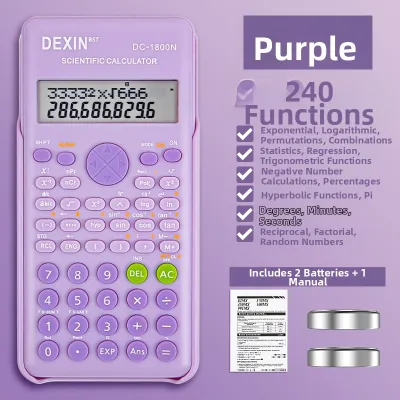
Prices are valid at publication and may change. Please refer to the product page for the latest price.
Menu navigation and user interface logic also differ significantly between these two models. The fx-991EX introduces an intuitive, icon-based menu system that resembles a basic smartphone or computer interface. Instead of memorizing numeric shortcuts or scrolling through text-heavy lists, you can navigate using the directional pad to select the desired mode, such as matrix, vector, or statistics. The fx-570ES Plus uses a more traditional, text-based menu system where you press a corresponding number key to enter a specific mode. While highly functional once memorized, this older layout requires a slightly steeper learning curve for students accustomed to modern digital displays.
Processing speed and visual feedback during complex calculations are also distinct. When inputting long, multi-line formulas, the fx-991EX handles scrolling and cursor movement smoothly, providing real-time feedback without noticeable lag. The fx-570ES Plus, while highly capable, may exhibit minor delays when rendering very long expressions or scrolling back to edit a previous step. For daily homework and quick calculations, both models perform admirably, but the fluid interface of the high-resolution model offers a more seamless user experience.
Advanced Math Features: What Your Coursework Actually Requires
As you progress through an engineering or science curriculum, the mathematical demands of your coursework will dictate which calculator features are indispensable. Both models offer robust support for core calculus operations, including numerical integration and differentiation. However, the workflow and speed of these calculations vary. The fx-991EX processes numerical integration using advanced algorithms that yield results faster, which can save precious seconds during timed quizzes.

Equation and inequality solving represent another major point of divergence. The fx-991EX can solve higher-degree polynomial equations and systems of linear equations with greater efficiency. It also includes a dedicated inequality solver, a feature that is highly beneficial for civil and mechanical engineering students analyzing structural limits or fluid dynamics. The fx-570ES Plus handles standard quadratic and cubic equations reliably but lacks some of the advanced inequality and high-order polynomial capabilities found in its counterpart.
Matrix and vector calculations are fundamental to electrical, structural, and chemical engineering. The fx-991EX supports larger matrix dimensions, allowing you to perform operations on matrices up to 4×4. This is particularly useful for solving complex circuit networks or structural analysis problems. The fx-570ES Plus is generally limited to 3×3 matrices, which is sufficient for introductory courses but may fall short when you encounter advanced multi-variable systems in your upper-level major subjects.
Furthermore, the fx-991EX includes advanced features such as a basic spreadsheet function and advanced statistical data processing. The spreadsheet tool allows you to input rows and columns of data directly on the calculator, making it easier to perform iterative calculations or manage laboratory data without needing a laptop. Before making a purchase, it is highly recommended to cross-reference your specific course syllabus. If your curriculum does not require matrix operations beyond 3×3 or advanced spreadsheet modeling, the standard features of the fx-570ES Plus will be more than adequate, saving you from paying for features you may never use.
Exam Compliance and Classroom Rules
Before investing in any scientific calculator, you must verify whether the device is permitted in your classrooms and, more importantly, during professional licensure examinations. In the Philippines, regulatory bodies such as the Professional Regulation Commission (PRC) maintain strict guidelines regarding the specific models of calculators allowed in board exams for civil, mechanical, electrical, and chemical engineering.
The advanced features of the fx-991EX, such as its equation solvers, matrix capabilities, and spreadsheet functions, make it a powerful tool, but they also make it subject to closer scrutiny. Some universities and specific professors ban calculators with advanced solvers or programmable-like features to ensure that students demonstrate a fundamental understanding of mathematical steps. While the fx-991EX is non-programmable, its high-resolution display and advanced capabilities occasionally place it on restricted lists for certain departmental exams.
Conversely, the fx-570ES Plus is widely regarded as a universally accepted “safe baseline” for standardized testing environments. Because it has been a staple in classrooms for years, most instructors and exam proctors are highly familiar with its capabilities and limitations. It is rarely excluded from approved calculator lists, making it a highly secure choice if you want to avoid any last-minute surprises on exam day.
To protect your academic progress, always consult the latest official calculator whitelist provided by your university department or the relevant local regulatory board. Do not rely solely on advice from peers or outdated online forums. Checking the official guidelines before purchasing ensures that your calculator remains a helpful tool rather than a liability during your most critical exams.
Price and Value Assessment in the Philippines
When evaluating the cost of these calculators, it is important to view the purchase as a long-term investment in your education. In the Philippines, scientific calculators are subjected to varying retail markups, and prices can fluctuate depending on where you shop. To get an accurate sense of the price difference in ₱, you should compare rates at authorized office supply chains, university bookstores, and official online brand stores rather than unverified third-party marketplace listings.
While the fx-991EX commands a higher price in ₱ compared to the fx-570ES Plus, you must weigh this premium against the duration of your degree. Over a four-year or five-year engineering program, the cost difference distributed annually is minimal. If the advanced matrix solvers, faster processing, and high-resolution screen save you time and reduce errors during your major exams, the initial investment in the premium model is easily justified.
However, the popularity of these models has unfortunately led to a market flooded with counterfeit units. Counterfeit calculators often look identical to genuine models but suffer from poor build quality, inaccurate calculation results, and sudden battery failures. When shopping in local retail hubs or online platforms, always perform physical verification checks. Genuine CASIO calculators feature high-quality holographic stickers on the packaging, crisp and aligned key printing, and a solid, durable plastic casing.
Additionally, authentic units will have a smooth keypress feel, whereas counterfeits often have stiff or unresponsive buttons. In the humid tropical climate of the Philippines, cheap internal components in counterfeit calculators are highly susceptible to corrosion and moisture damage, leading to premature failure. Purchasing only from authorized distributors ensures you receive a genuine product backed by a manufacturer warranty, protecting your investment throughout your college years.
Final Decision Framework
To help you make the right choice, use this simple decision matrix based on your academic needs, budget, and institutional rules:
- Choose the CASIO fx-991EX if: Your engineering or science major involves advanced calculus, complex matrix operations up to 4×4, or statistical modeling. The high-resolution display and faster processing speed are highly beneficial if you frequently work with long, multi-line formulas and your budget comfortably accommodates the premium price in ₱.
- Choose the CASIO fx-570ES Plus if: You are on a strict budget, your coursework focuses primarily on general science and standard mathematics, or your university and local exam boards strictly prohibit calculators with advanced solvers. It provides a highly reliable, universally accepted baseline that will easily get you through standard exams.
- Verify first if: Your course syllabus is ambiguous about calculator requirements, or you are preparing for a specific professional licensure exam in the Philippines. Always check the official, up-to-date whitelist of approved calculator models before finalizing your purchase.
Frequently Asked Questions (FAQ)
How do I reset these calculators to factory settings?
Resetting your calculator is a crucial step before entering an exam to clear any stored variables or custom settings. For the CASIO fx-991EX, press SHIFT, then press the 9 key (which corresponds to the Reset function). From the on-screen menu, select the option to initialize all settings and memory (usually option 3), then press the = key to confirm, and finally press the AC key. For the CASIO fx-570ES Plus, the sequence is highly similar: press SHIFT, then press the 9 key (labeled CLR). Select option 3 to clear all memory and settings, press the = key to confirm, and press AC to complete the process. Please note that this action will permanently erase all stored formulas, variables, and custom display configurations.
What type of batteries do they use, and how do I know when to replace them?
The power requirements depend on the specific model and its design. The CASIO fx-991EX features a dual-power system, utilizing a single LR44 button cell battery alongside an integrated solar panel. This solar backup helps extend the overall battery life, especially when working in well-lit classrooms. The CASIO fx-570ES Plus typically relies on a single AAA battery, though some sub-versions may use a button cell; always check the label on the battery compartment cover on the back of your device. You will know it is time to replace the battery when the screen contrast fades, the display becomes difficult to read under normal lighting, or the calculator takes noticeably longer to turn on or process calculations. In the humid climate of the Philippines, it is highly recommended to use high-quality, leak-proof batteries and replace them promptly to prevent internal corrosion and permanent damage to the calculator’s circuitry.
Community discussion
Share your experience or ask a question. Comments are reviewed before publication.