
Choosing the right scientific calculator is a high-stakes decision for students and board exam candidates in the Philippines. The tool you bring into the classroom directly influences how quickly you can solve complex systems of equations, verify matrix operations, and navigate timed exams. Two of the most ubiquitous models found in local bookstores and online marketplaces are the Casio fx-991EX ClassWiz and the Casio fx-570ES Plus. While both carry the trusted reputation of Casio’s mathematical engineering, they cater to different academic stages, budgets, and computational needs.
If you need an immediate verdict, the Casio fx-991EX ClassWiz is the superior investment for college students, engineering majors, and those pursuing advanced science or mathematics degrees. Its high-resolution screen, faster processor, and advanced spreadsheet capabilities make it a formidable tool for handling multi-step calculations. On the other hand, the Casio fx-570ES Plus remains a highly reliable, budget-friendly option for junior and senior high school students who primarily focus on general mathematics, trigonometry, and basic algebra. Crucially, neither model is programmable, which keeps them within the general boundaries of exam-compliant tools, though local guidelines can still vary.
Side-by-Side Comparison: fx-991EX ClassWiz vs fx-570ES Plus
Before exploring the detailed differences in processing power, display technology, and software capabilities, a direct comparison of their technical specifications provides a clear overview of how these two scientific calculators stack up against each other.
Products mentioned in this guide
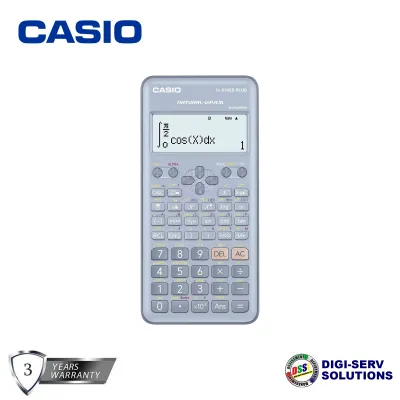
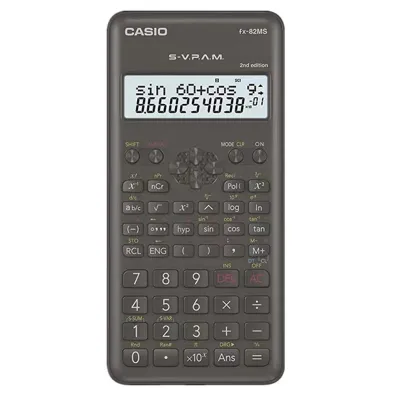
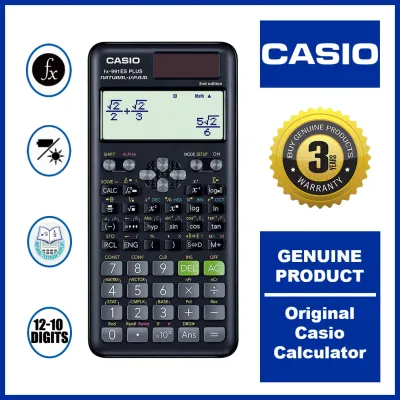

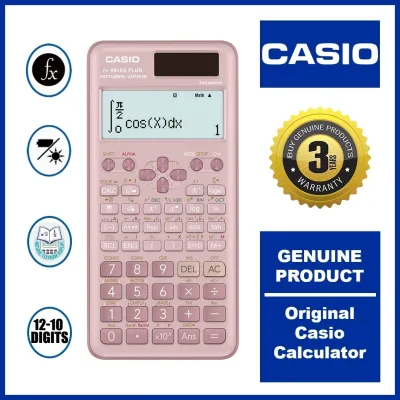
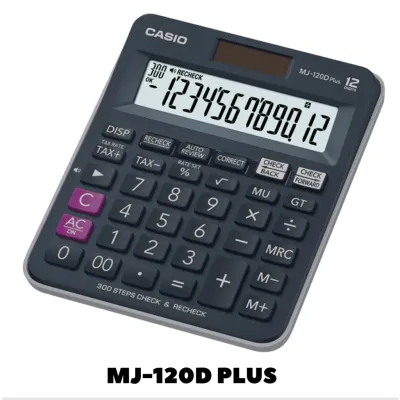
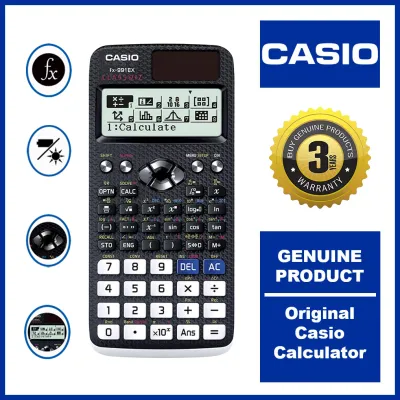
Prices are valid at publication and may change. Please refer to the product page for the latest price.
| Feature/Specification | Casio fx-991EX ClassWiz | Casio fx-570ES Plus |
|---|---|---|
| Display Type | High-Resolution LCD (192 x 63 pixels) | Classic Dot Matrix (31 x 96 pixels) |
| Natural Textbook Display | Yes (Natural-V.P.A.M.) | Yes (Natural-V.P.A.M.) |
| Total Functions | Over 552 functions | Over 417 functions |
| Matrix Calculations | Up to 4×4 matrices | Up to 3×3 matrices |
| Vector Calculations | Up to 4-dimensional vectors | Up to 3-dimensional vectors |
| Spreadsheet Function | Yes (Up to 5 columns x 45 rows) | No |
| QR Code Generation | Yes (For visualizing graphs on mobile) | No |
| Equation Solvers | Polynomial (up to 4th degree), Simultaneous | Polynomial (up to 3rd degree), Simultaneous |
| Power Source | Two-Way Power (Solar + LR44 Battery) | Single AAA Battery |
Use this table as a quick reference point as we delve deeper into how these technical specifications translate to real-world performance, usability, and academic advantages.
Screen and Navigation: High-Resolution LCD vs Classic Dot Matrix
The most immediate difference you will notice when placing these two calculators side by side is the quality of their displays. The Casio fx-991EX ClassWiz features a high-resolution LCD screen boasting 192 x 63 pixels, which is approximately four times the pixel density of the older ES Plus series. This increased resolution allows the ClassWiz to render highly detailed mathematical symbols, smooth fractions, and clear summation brackets exactly as they appear in college textbooks. Complex equations remain legible even when you stack multiple fractions or write extensive integration limits, minimizing the risk of misreading a tiny exponent during a high-pressure exam.

In contrast, the Casio fx-570ES Plus utilizes a classic dot-matrix display with a resolution of 31 x 96 pixels. While this screen is fully functional and features Casio’s Natural Textbook Display (Natural-V.P.A.M.) to show fractions and square roots in their proper mathematical formats, the lower pixel density results in a blocky, pixelated appearance. When dealing with long, multi-variable formulas, the characters can become cramped, forcing you to scroll horizontally to review your inputs. This classic display is perfectly adequate for standard algebraic expressions, but it lacks the modern clarity of its high-resolution counterpart.
This display difference also reshapes how you navigate the calculator’s internal menus. The fx-991EX ClassWiz introduces an intuitive, icon-based menu system that mirrors the user interface of modern digital devices. Instead of memorizing obscure key combinations or reading abbreviated text lists, you can navigate through options using a clear grid of visual icons representing different modes like Matrix, Vector, Statistics, and Spreadsheet. This visual approach drastically reduces the learning curve, allowing you to switch between computational modes in seconds.
Conversely, the fx-570ES Plus relies on a traditional, text-based menu structure. To access different mathematical modes, you must press the “Mode” key and select from a numbered list of text abbreviations. While experienced users can navigate this system quickly through muscle memory, it is inherently less intuitive for beginners. The multi-layered menus mean you often have to dig through several sub-menus to adjust settings, which can slow you down when time is of the essence during a mid-term exam.
Ultimately, the quality of the screen and the ease of navigation have a direct impact on your cognitive load and physical comfort. In the humid, often brightly lit classrooms and study halls of the Philippines, glare and poor screen contrast can quickly lead to eye strain during long study sessions. The crisp, high-contrast LCD of the fx-991EX ClassWiz remains highly readable under various lighting conditions, helping you maintain focus and speed when working through lengthy problem sets.
Feature Breakdown: Advanced Math vs Essential Scientific Functions
The functional gap between these two models determines whether you are buying a tool that will comfortably carry you through a five-year engineering curriculum or one that is best suited for general education requirements.
Calculus, Matrices, and Equation Solvers
When it comes to advanced mathematical computations, the fx-991EX ClassWiz offers a substantial performance upgrade. In matrix mode, the ClassWiz can handle calculations for matrices up to a 4×4 dimension, which is a standard requirement in university-level linear algebra, structural analysis, and electrical network courses. It also solves simultaneous linear equations with up to four unknowns and polynomial equations up to the fourth degree. The internal processor of the ClassWiz is significantly faster, allowing it to compute numerical integration and differentiation problems in a fraction of the time it takes older models.
The fx-570ES Plus, while capable, is more constrained in its advanced modules. It is limited to solving matrices up to a 3×3 dimension and vectors up to three dimensions. While this is sufficient for basic physics and introductory algebra, it falls short when you encounter the larger systems of equations common in advanced engineering and physics coursework. Its equation solver is capped at simultaneous equations with three variables and third-degree polynomials. Furthermore, because its internal processor is older, executing complex numerical integration or solving for variables using the “Solve” function can result in noticeable calculation delays, sometimes taking several seconds to display a result.
Spreadsheet and QR Code Capabilities
One of the most distinct innovations of the fx-991EX ClassWiz is its built-in spreadsheet function. This feature allows you to input, edit, and analyze data across a grid of up to 5 columns and 45 rows, bringing basic Excel-like functionality directly to your calculator. It is incredibly useful for statistics classes, physics labs, and chemistry courses where you need to calculate mean, variance, or apply repetitive formulas to a small dataset. This capability is entirely absent on the fx-570ES Plus, which relies on traditional, single-variable statistical input screens.
Additionally, the ClassWiz features a unique QR code generation system. By pressing a specific key combination, the calculator displays a QR code on its high-resolution screen containing the data or equation you are currently working on. When you scan this QR code using a smartphone or tablet, it redirects you to a dedicated Casio web service that visualizes your equations as interactive graphs, charts, or detailed tables. This provides an excellent visual aid for understanding functions and statistical distributions during self-study, though you must remember that smartphones are strictly prohibited in formal examination rooms.
Shared Core Scientific Functions
Despite these advanced differences, it is important to recognize that both calculators share a massive library of over 417 standard scientific functions. Both models excel at handling basic to intermediate mathematical tasks, including trigonometric functions, hyperbolic functions, common and natural logarithms, fractions, and percentage calculations. You can perform complex number calculations, coordinate conversions, and basic statistical regressions on either device.
If your daily academic work consists primarily of solving standard trigonometric identities, calculating logarithms, or working with basic statistical datasets, both calculators will deliver the exact same mathematical accuracy. The difference lies not in the correctness of the final answer, but in the speed, convenience, and maximum complexity of the problems you can input. For general science and basic mathematics, the fx-570ES Plus does not compromise on core computational reliability.
Exam Rules in the Philippines: Are Both Calculators Allowed?
In the Philippines, purchasing a calculator is not just about choosing the most powerful features; it is also about ensuring your investment is permitted inside the examination room. Both the Casio fx-991EX and the fx-570ES Plus are classified as non-programmable scientific calculators. This classification makes them widely accepted across major Philippine universities, high schools, and standard classroom tests, as they do not allow students to store custom text, formulas, or programs in the device’s memory.
However, the rules become significantly more stringent when preparing for professional licensure exams administered by the Professional Regulation Commission (PRC). The PRC maintains a strict, periodically updated list of allowed calculator models for various board examinations, such as Civil Engineering, Mechanical Engineering, Electrical Engineering, and Chemical Engineering. Historically, the PRC has banned specific models or entire series due to concerns over advanced features or potential exploits. For instance, models with extensive matrix solvers or dual-power options have occasionally faced intense scrutiny or temporary restrictions.
While the fx-570ES Plus has long been a staple of board exam preparation due to its classic, non-threatening feature set, the advanced capabilities of the fx-991EX ClassWiz—specifically its spreadsheet and QR code functions—can sometimes draw extra attention from strict room proctors. Even if a model is technically on the approved PRC list at the start of the year, individual proctors or sudden updates to board-specific guidelines can affect whether you are allowed to use it on the day of the exam. Therefore, it is absolutely vital to consult the latest official PRC memorandum for your specific field of study before committing to a purchase.
Furthermore, if you are a high school student preparing for college entrance exams like the UPCAT, ACET, DLSUCET, or USTET, you must check the specific test permits. Many of these college entrance examinations prohibit scientific calculators entirely, requiring students to rely on manual calculations or basic four-function calculators. Always verify the exact calculator policy of your school department, testing center, or licensing board to avoid the stress of having your primary tool confiscated right before a crucial test begins.
Price and Value: Justifying the Cost of the ClassWiz Series
When evaluating the cost-benefit ratio of these two models, you must weigh their price difference against your long-term academic trajectory. The Casio fx-991EX ClassWiz commands a higher price point in the Philippine market compared to the fx-570ES Plus. This premium is directly justified by its superior hardware, including the high-resolution LCD, a faster processor, a more durable key layout, and the inclusion of a dual-power system. The fx-991EX utilizes Two-Way Power (solar panels combined with a backup LR44 button battery), ensuring that the device remains operational even under the dim lighting of an exam hall, without the sudden risk of battery failure.
The fx-570ES Plus is a more budget-friendly alternative that runs solely on a single AAA battery. While this means you do not benefit from solar charging, AAA batteries are incredibly easy to find and replace anywhere in the Philippines, from local convenience stores to neighborhood sari-sari stores. If you are a junior or senior high school student, or a college student majoring in the humanities, social sciences, or business courses with minimal advanced math requirements, the extra cost of the ClassWiz may represent an unnecessary expense. The fx-570ES Plus provides exceptional value, handling all standard curriculum requirements without stretching your budget.
However, if you are embarking on a four-to-five-year degree in engineering, architecture, physics, or mathematics, the price premium of the fx-991EX ClassWiz is highly justified. The amount of time saved during exams by its rapid processing speed, coupled with the ability to solve 4×4 matrices and fourth-degree polynomials, can easily make the difference between passing and failing a timed engineering exam. Viewed as an investment spread over several years of intense study, the cost per semester is negligible compared to the massive boost in efficiency and ease of use.
Regardless of which model you choose, you must exercise extreme caution when purchasing online. The Philippine market is flooded with counterfeit Casio calculators that look nearly identical to genuine units but suffer from poor build quality, inaccurate calculations, sticky keys, and fragile screens. To protect yourself, avoid listings on e-commerce platforms that feature unusually low prices. Always purchase from authorized Casio distributors, official flagship brand stores, or established physical stationery and bookstore chains like National Book Store, central bookstores, or SM Stationery. Genuine units come with a verification QR code on the box packaging and an official warranty card.
Final Recommendation: Match the Calculator to Your Degree
To make your final decision as straightforward as possible, match your academic profile and career goals against the specific strengths of each calculator.
Choose the Casio fx-991EX ClassWiz if:
- You are a college student majoring in civil, mechanical, electrical, chemical, or computer engineering, or pursuing degrees in physics, statistics, and advanced mathematics.
- You frequently work with large matrices (up to 4×4), complex vector spaces, and multi-variable simultaneous equations.
- You want a crisp, high-resolution screen that reduces eye strain and an intuitive, icon-based menu that speeds up navigation during timed exams.
- You value the reliability of a solar-powered backup system so you never have to worry about a dead battery during an exam.
Choose the Casio fx-570ES Plus if:
- You are a junior or senior high school student navigating general mathematics, pre-calculus, basic statistics, and general science courses.
- You are a college student in a non-STEM major who only needs a reliable scientific calculator for general education requirements or basic business math.
- You are on a budget and want a highly durable, time-tested calculator that handles core scientific functions perfectly without premium additions.
- You prefer the simplicity of using a standard, easily replaceable AAA battery.
Verify first if:
- You are preparing for a specific professional board exam administered by the PRC. Always check the most recent list of approved calculators for your engineering or scientific discipline, as local regulations are subject to change.
Investing in the right calculator is ultimately about setting yourself up for academic confidence. By choosing the model that aligns with your current coursework and future exam requirements, you ensure that your focus remains entirely on mastering the mathematical concepts rather than fighting with your tools.
Frequently Asked Questions (FAQ)
Is the Casio fx-991EX allowed in PRC board exams in the Philippines?
The eligibility of the Casio fx-991EX ClassWiz for Professional Regulation Commission (PRC) board exams can vary depending on your specific field of study and the latest regulatory updates. While it is a non-programmable scientific calculator, some board examiners closely scrutinize its advanced capabilities, such as the spreadsheet and QR code functions. Historically, the PRC has issued specific memorandums listing allowed and banned calculator models for engineering and other professional licensure exams. Always cross-reference the official, most recent PRC calculator guidelines for your specific board before starting your review program.
Can the fx-570ES Plus handle college-level engineering math?
The Casio fx-570ES Plus can handle basic college-level engineering math, including basic calculus, complex numbers, and standard trigonometric functions. However, it is limited to 3×3 matrices and lacks the advanced 4×4 matrix capabilities, inequality solvers, and rapid processing speed of the fx-991EX. As you progress into advanced engineering subjects like structural analysis, fluid mechanics, or advanced electromagnetics, the limitations in matrix size and slower equation-solving speeds can become a significant bottleneck. For long-term engineering studies, upgrading to the ClassWiz series is highly recommended.
How can I verify if a Casio calculator is authentic when buying online?
To verify if a Casio calculator is authentic, start by checking the packaging for a holographic security sticker and a scratch-off verification code that you can check on Casio’s official website. Authentic units feature crisp, high-contrast printing on the keys, buttons that register inputs smoothly without sticking, and a clear, high-contrast LCD screen. When turned on, genuine models perform calculations instantly and display mathematical symbols cleanly. To guarantee authenticity, always purchase your calculator from official brand stores, authorized distributors, or reputable physical bookstores and stationery chains in the Philippines.
Community discussion
Share your experience or ask a question. Comments are reviewed before publication.