
Quick Answer: Which CASIO Model Fits Your Needs?
Selecting the right scientific calculator is a critical decision for students and professionals across the Philippines. The ideal choice depends heavily on your specific academic curriculum, course requirements, and budget. Rather than searching for a single absolute winner, it is far more practical to match the calculator’s capabilities to your daily mathematical tasks.
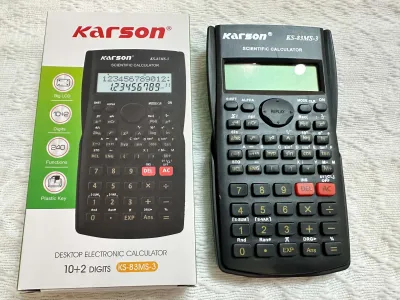
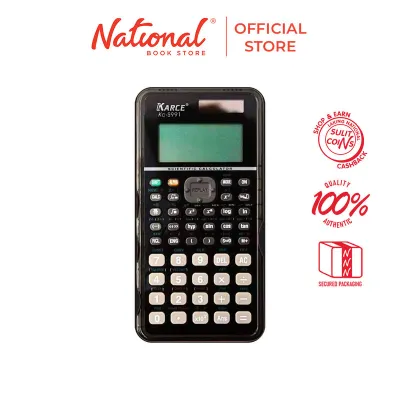
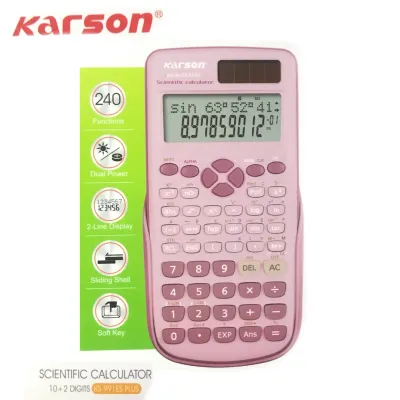
For basic office tasks or simple retail calculations, a standard desktop tool like a Karce calculator in the Philippines is often sufficient. However, when entering high school or university, academic programs demand advanced scientific functions that only dedicated devices can provide.
The CASIO fx-991 is the premium flagship option, designed for university students, engineering majors, and technical professionals who require advanced calculus, matrix calculations, and dual-power reliability.
Products mentioned in this guide

Prices are valid at publication and may change. Please refer to the product page for the latest price.
The CASIO fx-570 serves as a practical, mid-range alternative. It contains the exact same advanced mathematical engine and library of functions as the fx-991, but operates solely on battery power, making it a more affordable choice for budget-conscious students.
The CASIO fx-350 is the essential, entry-level scientific calculator. It is tailored specifically for junior and senior high school students who need reliable trigonometric and logarithmic functions without the complexity or cost of advanced solvers.
Core Specifications at a Glance
To help you evaluate these three popular models, the table below outlines their primary differences in target audience, computational capabilities, power configurations, and relative market positioning. Note that specific features can vary slightly depending on the generation of the model you purchase, such as the older ES PLUS series versus the modern ClassWiz (EX or CW) editions.

| Model | Target Audience | Key Advanced Functions | Power Source | Relative Price Tier |
|---|---|---|---|---|
| CASIO fx-350 | Junior & Senior High School | Basic Statistics, Trigonometry, Fractions | Single Battery (AAA or AAA-equivalent) | Entry-Level |
| CASIO fx-570 | College Students, STEM Majors | Calculus, Matrices, Vectors, Equation Solvers | Single Battery (AAA or button cell) | Mid-Range |
| CASIO fx-991 | Engineering, Science, University | Calculus, Matrices, Spreadsheets, Vector Math | Two-Way Power (Solar + Battery) | Premium |
This comparison highlights how CASIO structures its lineup. The fx-350 serves as a solid foundation, while the fx-570 and fx-991 scale up to handle advanced engineering and scientific computations. When shopping, always verify the exact sub-model suffix (such as “ES PLUS 2nd Edition” or “CW”) on the packaging, as these letters designate the physical interface and menu layout.
Feature and Functionality Breakdown
Understanding the specific mathematical capabilities of each model is essential to avoid either overpaying for features you will never use or buying a device that lacks the tools required for your exams.
fx-991: The Advanced Powerhouse
The CASIO fx-991 series (particularly the ClassWiz fx-991EX or the newer fx-991CW) represents the pinnacle of non-programmable scientific calculators. It boasts a library of over 500 functions, allowing users to perform complex numerical integrations, differential calculus, matrix calculations up to 4×4 dimensions, and vector mathematics.
For university students pursuing degrees in civil, mechanical, electrical, or chemical engineering, these features are indispensable. The calculator includes a dedicated spreadsheet mode, which allows for basic data logging and analysis directly on the high-resolution screen. Its equation solver can handle simultaneous linear equations with up to four unknowns, as well as quadratic and cubic polynomial equations.
The display technology is another major advantage. Featuring a high-resolution LCD screen, the fx-991 utilizes CASIO’s Natural Textbook Display (Natural V.P.A.M.) system. This technology ensures that fractions, exponents, square roots, and calculus symbols are displayed exactly as they appear in standard academic textbooks. This visual clarity reduces input errors and helps students verify their formulas during high-pressure exams.
fx-570: The Practical Alternative
The CASIO fx-570 is functionally identical to the fx-991. It shares the same internal processor, the same mathematical algorithms, and the same extensive function library. If you open the menu of an fx-570, you will find the exact same options for calculus, matrix calculations, vector analysis, and complex number operations.
The primary trade-off is hardware-based: the fx-570 lacks the solar panel found on the face of the fx-991. Because it relies entirely on a physical battery, the manufacturing cost is lower, which translates to a more affordable retail price in the market.
This makes the fx-570 an exceptional option for college students who require the full computational power of a flagship calculator but want to minimize their upfront expenses. It handles the most rigorous university-level coursework without compromise, provided you keep a spare battery on hand for emergencies.
fx-350: The Essential Foundation
The CASIO fx-350 is designed as a streamlined, highly reliable tool for foundational mathematics. It offers around 250 to 300 functions, focusing on trigonometry, logarithms, exponential calculations, coordinate conversions, and basic single-variable statistics.
Crucially, the fx-350 does not include advanced features such as numerical integration, differentiation, matrix operations, or complex number modes. While this might seem like a limitation, it is actually an advantage for younger students. Many junior high school curricula and standardized exams strictly prohibit calculators with equation-solving or calculus capabilities to ensure students learn the underlying mathematical concepts manually.
The simplified menu system of the fx-350 has a much gentler learning curve. Students can quickly navigate to basic fraction or trigonometric modes without getting lost in multi-layered technical menus. It is a durable, straightforward companion for general science and algebra classes.
Power Source and Hardware Differences
Beyond mathematical functions, the physical build and power systems of these calculators play a significant role in their long-term usability and maintenance requirements, particularly in the tropical climate of the Philippines.
The fx-991 features CASIO’s “Two-Way Power” system, combining a solar cell with a backup battery. Under normal classroom or office lighting, the solar panel provides the primary electrical current, preserving the internal battery. If the ambient light dims, the calculator seamlessly switches to battery power. This dual-source design ensures that the device remains functional even during power outages or in dimly lit exam rooms, and it dramatically extends the overall lifespan of the internal battery.
In contrast, the fx-570 and fx-350 rely entirely on single-battery power. Depending on the specific sub-model generation, these calculators typically use either a single AAA alkaline battery or a button-cell battery (such as an LR44). Because they lack solar support, these models drain their batteries faster, especially if used intensively for complex calculations.
The physical environment in the Philippines introduces specific hardware challenges. High humidity can accelerate battery corrosion and degrade internal contacts over time. To protect your investment, always use high-quality, leak-resistant alkaline batteries from reputable brands, and avoid leaving a dead battery inside the calculator for extended periods. If you plan to store the calculator during school breaks, it is wise to remove the battery entirely.
All three models feature robust plastic keys designed to withstand years of repetitive tapping. They also come equipped with a slide-on hard cover that protects the LCD screen and keyboard from scratches, dust, and minor impacts inside a school backpack. To prolong the screen’s life, avoid exposing the calculator to direct sunlight for prolonged periods, as extreme heat can cause the liquid crystal display to fade or bleed.
Evaluating Price and Value: CASIO vs Karce Calculator Philippines
When assessing the cost-to-value ratio of these calculators, it is important to understand how they fit into the local retail landscape. The fx-991 commands the highest price among the three, reflecting its dual-power hardware and comprehensive feature set. The fx-570 offers a moderate discount, providing flagship functionality at a mid-range price point. The fx-350 is highly accessible, making it an affordable purchase for families preparing for the school year.
When looking for a basic office tool, a budget-friendly Karce calculator in the Philippines might suffice for simple addition and subtraction. However, for scientific and engineering applications, investing in a genuine CASIO is highly recommended. To ensure you receive an authentic product, always purchase from authorized CASIO distributors, established national stationery chains, or official online flagship stores.
The Philippine market unfortunately contains a significant number of counterfeit calculators. These fake devices are often sold at suspiciously low prices on unverified online marketplaces. While they may look identical to genuine models on the outside, counterfeit calculators frequently suffer from critical defects:
- Inaccurate Calculations: Fakes often use cheap, low-grade processors that can produce rounding errors or completely incorrect answers during complex statistical or algebraic operations.
- Poor Screen Contrast: The LCD screens on counterfeit models often have terrible viewing angles and fade quickly under typical classroom lighting.
- Fragile Build Quality: The buttons on fake calculators are prone to sticking, registers may fail to register keystrokes, and the plastic casings crack easily under minimal pressure.
To get the best value, weigh the upfront cost against the expected lifespan of the device. A genuine CASIO fx-991 can easily last through four to five years of high school and university, saving you the expense of buying multiple replacement calculators over your academic career.
Final Decision Framework: Choose Based on Your Curriculum
To make your final decision as straightforward as possible, evaluate your current academic level and future educational path against these specific recommendations:
Choose the CASIO fx-991 if:
- You are enrolled in a university engineering, architecture, mathematics, physics, or statistics program.
- You require advanced features like calculus integration, matrix manipulation, and vector analysis.
- You want the peace of mind offered by solar power during long, high-stakes exams.
Choose the CASIO fx-570 if:
- You need the exact same advanced mathematical capabilities as the fx-991 for your college coursework.
- You are working within a tighter budget and prefer to save money upfront.
- You do not mind occasionally purchasing and replacing physical batteries.
Choose the CASIO fx-350 if:
- You are a junior or senior high school student focusing on general algebra, geometry, and basic science.
- Your school's curriculum explicitly bans calculators with equation-solving or calculus functions.
- You prefer a simple, highly durable device with an easy learning curve.
Before making your final purchase, always check the specific calculator guidelines provided by your school, university department, or professional licensing board. In the Philippines, the Professional Regulation Commission (PRC) maintains strict lists of allowed calculator models for various board examinations. Ensuring your chosen model is fully compliant with these regulations will prevent any stressful surprises on exam day.
Frequently Asked Questions (FAQ)
How can I verify if my CASIO calculator is authentic?
To confirm your CASIO calculator is genuine, look for the official hologram sticker on the packaging. On newer models like the ClassWiz series, you can press the menu button and display a QR code on the screen. Scanning this QR code with a smartphone will redirect you to the official CASIO website, which will instantly verify the authenticity of your specific device. Additionally, genuine models feature crisp, responsive buttons and high-contrast screens that do not fade when viewed from an angle.
Are these CASIO models allowed in Philippine board exams?
The eligibility of specific calculators varies depending on the board exam administered by the Professional Regulation Commission (PRC). While the entry-level fx-350 is widely permitted across almost all exams due to its lack of advanced solvers, models like the fx-991 and fx-570 are subject to periodic regulatory updates. For certain engineering and science boards, specific generations of the fx-991 are highly recommended, while other boards may restrict them. Always consult the latest official PRC guidelines or your review center’s advisory before your exam.
Community discussion
Share your experience or ask a question. Comments are reviewed before publication.