
Quick Answer: Which Scientific Calculator Brand Fits Your Business Needs?
Choosing the right scientific calculator for business depends entirely on your specific daily analytical tasks rather than a single universal winner. For most business professionals, data analysts, and logistics managers, CASIO is the premier choice. CASIO models excel by providing highly accessible statistical analysis, intuitive menu navigation, and natural textbook displays that simplify complex workflows.
Alternatively, Texas Instruments (TI) serves as the primary option for professionals whose business roles overlap heavily with advanced engineering, programming, or complex graphing needs. TI models offer robust matrix operations and programmable features that suit technical consultants but may feel overly complex for standard business operations.
For traditional finance professionals, HP remains a dedicated niche choice. HP calculators are highly favored by analysts who prefer Reverse Polish Notation (RPN), an entry system that enables rapid, parenthesis-free financial modeling and multi-step calculations once the user masters the initial learning curve. Sharp offers a dependable, budget-friendly alternative with straightforward algebraic entry, making it ideal for general office tasks that require reliable, everyday calculations without specialized programming.
Products mentioned in this guide
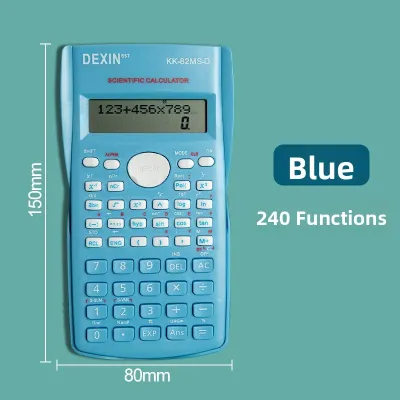
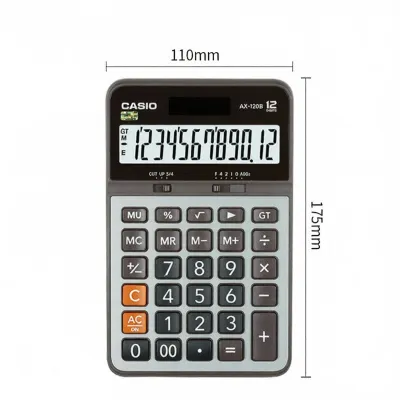
Prices are valid at publication and may change. Please refer to the product page for the latest price.
To make an informed decision, evaluate your daily mathematical requirements against this clear framework:
- Choose CASIO if you need fast statistical modeling, intuitive spreadsheet-like interfaces, and an easy transition from standard office calculators.
- Choose Texas Instruments (TI) if your business operations require advanced programming, visual graphing, or deep integration with engineering formulas.
- Choose HP if you are a seasoned finance professional who relies on RPN for rapid, high-volume financial calculations.
- Choose Sharp if you require a durable, cost-effective secondary device for standard algebraic calculations and basic statistical checks.
Why Use a Scientific Calculator for Business Tasks?
While standard desktop or printing calculators are staples of daily retail transactions, they fall short when business tasks transition from basic arithmetic to analytical and predictive math. Standard calculators are designed for transactional math, such as calculating simple margins, taxes, and basic sums. In contrast, a scientific calculator for business is built to handle complex, multi-variable formulas, statistical distributions, and predictive modeling.

In logistics and supply chain management, professionals must regularly calculate statistical variance and standard deviation to optimize safety stock levels and forecast inventory needs. Relying on a basic calculator for these tasks is inefficient and increases the risk of manual calculation errors. Scientific calculators streamline these operations by allowing users to input entire data sets to generate statistical summaries instantly.
Financial forecasting also demands more than basic arithmetic. Calculating compound interest, amortization schedules, and exponential growth models requires exponential functions, logarithms, and multi-line displays that show the relationship between variables. When a spreadsheet is unavailable—such as during field audits, client consultations, or off-site inspections—a scientific calculator serves as a portable, reliable analytical tool.
Transitioning from academic use to a professional environment highlights the need for speed, error reduction, and physical durability. Business professionals cannot afford the downtime caused by dead batteries or fragile designs. A high-quality scientific calculator provides tactile feedback that supports rapid, blind data entry, ensuring that calculations are performed quickly and accurately in fast-paced office or field environments.
CASIO vs. Competitors: Key Features Compared
The scientific calculator market is led by a few key brands: CASIO, Texas Instruments, HP, and Sharp. While these manufacturers all produce devices capable of performing advanced mathematics, their design philosophies differ significantly. For business users, the choice should not be based solely on the total number of functions advertised on the packaging. Instead, prioritize interface efficiency, statistical capabilities, and physical reliability, as these factors directly impact your daily business workflows.
Statistical and Analytical Functions
CASIO has established a strong reputation for accessible statistics, particularly through its advanced ClassWiz series. These models feature spreadsheet-like tables that allow business analysts to input, view, and edit data sets directly on the screen. This layout is highly beneficial for calculating standard deviation, variance, and linear regression analysis, as it mimics the structure of modern spreadsheet software. Users can quickly perform regression modeling to predict sales trends or analyze cost behaviors without navigating deep, confusing submenus.
In contrast, Texas Instruments takes an approach that leans heavily toward programmable features and advanced engineering matrices. While TI calculators are incredibly powerful, their statistical interfaces often require more keystrokes to achieve the same results as a CASIO. The inclusion of complex calculus and engineering functions in TI models can create unnecessary clutter for a business professional who primarily needs rapid statistical summaries and basic algebraic modeling.
When comparing brands, look beyond generic marketing terms like “500+ functions.” Many of these functions are highly specialized scientific constants or advanced calculus tools that have little application in business. Instead, consult the manufacturer’s official user manual or specification sheet to verify that the device supports the specific business-critical functions you need, such as normal probability distributions, linear regression, and matrix operations up to a specific dimension (e.g., 4×4 matrices for input-output economic models).
Display Interface and Input Efficiency
Input efficiency and display clarity are critical for reducing costly errors in financial and logistical modeling. CASIO’s Natural V.P.A.M. (Visually Perfect Algebraic Method) displays formulas, fractions, and exponents exactly as they appear in textbooks and business reports. This natural display allows analysts to easily audit their inputs on the screen before executing a calculation, ensuring that a misplaced decimal or parenthesis does not compromise the entire analysis.
Texas Instruments utilizes its MathPrint display technology, which similarly presents mathematical notation in a readable format. However, the cursor navigation and menu layouts differ. CASIO’s menu-driven logic is generally faster for professionals transitioning from standard calculators or spreadsheet software, as it uses icon-based menus that are easy to navigate. TI models often rely on multi-tiered physical menus that can require a steeper learning curve for non-technical users.
HP offers a completely different input logic with Reverse Polish Notation (RPN). RPN eliminates the need for parentheses by using an enterprise-grade stack-based entry system. For example, instead of entering (3 + 4) 5, an RPN user enters 3 [ENTER] 4 + 5 . While this system requires dedicated practice to master, it significantly reduces the number of keystrokes required for complex, multi-step business calculations, making it a highly efficient tool for experienced financial analysts.
Build Quality and Power Reliability
For business professionals who travel, conduct field audits, or work in varying office environments, physical durability and power management are critical considerations. The tactile feedback of a calculator’s keys is essential for rapid, blind data entry. CASIO and Sharp models generally feature hard plastic keys with a distinct tactile click, which helps prevent double-presses or missed inputs during intense analytical sessions. Some lower-end models from various brands use soft rubber keys, which can feel mushy and lead to input errors over time.
Power reliability is another key factor, especially in tropical climates like the Philippines, where high humidity can accelerate battery degradation. Dual-power systems that combine solar panels with a backup button-cell battery are highly recommended. CASIO and Sharp models frequently feature efficient dual-power designs, ensuring the calculator remains operational under office lighting or outdoors, even if the internal battery is completely drained. This dual-power setup prevents sudden data loss during critical meetings or field assessments.
To ensure long-term durability, check the manufacturer’s specifications for physical protection features. Look for models that include a rugged, slide-on hard case to protect the LCD screen and keyboard from scratches and impacts when stored in a briefcase or laptop bag. Additionally, verify the manufacturer’s rated battery life and drop-resistance standards to ensure the device can withstand the rigors of daily professional use.
Feature and Specification Comparison Matrix
The following matrix outlines the key differences between the major scientific calculator brands, focusing on features that impact business workflows. Use this table to identify which brand aligns with your professional requirements.
| Brand & Series | Display Type | Primary Business Strength | Power Source | Ideal User Profile |
|---|---|---|---|---|
| CASIO<br>(e.g., ClassWiz / fx-991 series) | Natural V.P.A.M. (Icon-based menus) | Intuitive statistical tables, regression analysis, spreadsheet-like data entry | Dual Power<br>(Solar + Battery) | Data analysts, logistics managers, general business professionals |
| Texas Instruments<br>(e.g., TI-36X series) | MathPrint (Multi-line text) | Advanced matrix operations, multi-variable equation solving | Dual Power or Battery Only<br>(Model dependent) | Technical consultants, field engineers, business programmers |
| HP<br>(e.g., HP 35s / Financial series) | Multi-line alphanumeric | Reverse Polish Notation (RPN) for fast, parenthesis-free modeling | Battery Only<br>(Typically CR2032) | Traditional finance professionals, investment analysts |
| Sharp<br>(e.g., WriteView series) | WriteView (Natural display) | Cost-effective, straightforward algebraic entry, quick fraction conversions | Dual Power<br>(Solar + Battery) | General office workers, budget-conscious professionals |
Note: Specific features, display resolutions, and power configurations can vary by model. Always verify the exact specifications in the manufacturer’s official product documentation before purchasing.
Navigating Price, Value, and Authenticity in the Philippines
When purchasing a calculator for business in the Philippines, evaluating value goes beyond comparing upfront prices in Philippine Pesos (₱). A high-quality scientific calculator is a long-term investment; a durable device can easily last five to ten years of daily professional use. When calculating the total cost of ownership, consider factors such as battery replacement intervals, the availability of local warranty support, and the productivity gained from an efficient, error-reducing interface.
A significant challenge in the local market is the prevalence of counterfeit scientific calculators, particularly on online marketplaces and e-commerce platforms. Counterfeit calculators often look nearly identical to genuine models but are built with inferior internal components, leading to mushy key responses, inaccurate calculation results, poor screen contrast under bright office lights, and premature battery failure. Using a counterfeit device in a professional setting poses a serious risk of calculation errors that could compromise business reports or financial forecasts.
To ensure you are purchasing an authentic device, look for specific security features implemented by reputable brands:
- Holographic Security Stickers: Authentic CASIO calculators sold in the Philippines typically feature a holographic sticker on the packaging. Many modern CASIO models also include a QR code function on the calculator itself. Pressing a specific key sequence generates a QR code on the screen that, when scanned with a smartphone, directs you to an official CASIO verification page confirming the device's authenticity.
- Tactile and Build Quality: Genuine calculators have keys with consistent travel and a clear, tactile click. The slide-on protective case should fit snugly without rattling, and the plastic casing should feel solid and free of rough edges or misaligned seams.
- Packaging and Warranty Cards: Authentic products are packaged in high-quality boxes with clear, professional printing. They must include a valid local warranty card from the authorized Philippine distributor, along with a comprehensive user manual in English.
To guarantee authenticity and secure reliable after-sales support, strongly recommend purchasing your scientific calculator from authorized stationery retailers, official brand stores, or reputable office supply chains in the Philippines. Buying from these verified channels ensures that your device is covered by a genuine manufacturer warranty, protecting your investment and ensuring accurate performance for years to come.
Final Verdict: How to Choose Based on Your Professional Role
To make your final decision, align the strengths of each calculator brand with your specific professional role and daily analytical requirements:
- Data Analysts, Logistics Managers, and Business Statisticians: Choose CASIO. The intuitive, spreadsheet-like interface of the ClassWiz series and the Natural V.P.A.M. display make entering data sets, calculating standard deviations, and performing regression analysis highly efficient. The menu-driven logic ensures a minimal learning curve, allowing you to focus on analyzing data rather than navigating the device.
- Field Engineers, Technical Consultants, and Programmers: Lean toward Texas Instruments (TI). If your business tasks frequently overlap with technical engineering calculations, physical modeling, or custom programming, TI’s robust matrix operations and programmable capabilities provide the advanced computational power required for these specialized tasks.
- Traditional Finance Professionals and Investment Analysts: Seek out HP models that support Reverse Polish Notation (RPN). For professionals who handle high-volume, multi-step financial formulas daily, the keystroke savings and logical flow of RPN offer unmatched calculation speed once mastered.
- General Office Professionals and Budget-Conscious Users: Opt for Sharp or entry-level CASIO models. These devices provide reliable dual-power operation, clear natural displays, and straightforward algebraic entry, delivering excellent value for everyday business math without unnecessary complexity.
Before finalizing your purchase, download the official user manual of your shortlisted model from the manufacturer’s website. Reviewing the manual allows you to verify that the key layouts, menu structures, and statistical formulas align perfectly with your daily business workflows, ensuring a seamless integration into your professional toolkit.
Frequently Asked Questions (FAQ)
Can I use a scientific calculator for financial accounting?
Yes, a scientific calculator can handle the complex exponential and logarithmic formulas required for financial accounting, such as compound interest and amortization. However, dedicated financial calculators (like the HP 12C or CASIO FC series) feature specialized physical keys for cash flow analysis, Net Present Value (NPV), and Internal Rate of Return (IRR). If your primary task is pure accounting or investment banking, a dedicated financial calculator will be significantly faster and more efficient than a scientific model.
How do I spot a fake CASIO calculator when buying online?
To spot a fake CASIO calculator on e-commerce platforms, perform three quick checks. First, verify if the packaging has the official holographic security sticker and a QR code on the box. Second, check if the calculator can generate an on-screen QR code for online authenticity verification. Finally, ensure the seller is an authorized office supply retailer or official brand store that provides a valid local distributor warranty card, and avoid listings with unusually low prices or poor-quality product photos.
Is a graphing calculator better for business than a scientific one?
For most business tasks, including statistical analysis, financial modeling, and logistics, a high-end scientific calculator is sufficient, more portable, and significantly more cost-effective. Graphing calculators offer large screens and visual data plotting, but these features are rarely necessary in a business environment where detailed data visualization is typically performed on computers or tablets. A scientific calculator provides all the analytical power needed for business without the added bulk, high cost, and short battery life of a graphing calculator.
Community discussion
Share your experience or ask a question. Comments are reviewed before publication.