
Choosing between a chisel tip and a bullet tip chalk marker pen comes down to your lettering style and the physical movements you prefer. There is no single option that excels at every task; instead, the physical shape of the marker nib dictates how ink flows onto the surface and how much control you have over your line widths. By understanding these mechanical differences, you can select the tool that matches your creative goals, whether you are designing a menu board for a local cafe, labeling storage jars, or creating temporary window art.
Chisel tips are defined by their angled, flat edges, allowing you to produce both broad strokes and razor-thin lines simply by changing the angle of your hand. This versatility makes them the traditional choice for classic calligraphy, bold block lettering, and filling in large areas quickly. On the other hand, bullet tips feature a rounded, symmetrical point that delivers a consistent line width regardless of how you hold or rotate the pen. This predictability makes bullet tips highly approachable for beginners, everyday handwriting, and intricate illustrations where uniform lines are essential.
Understanding the Core Differences in Tip Design
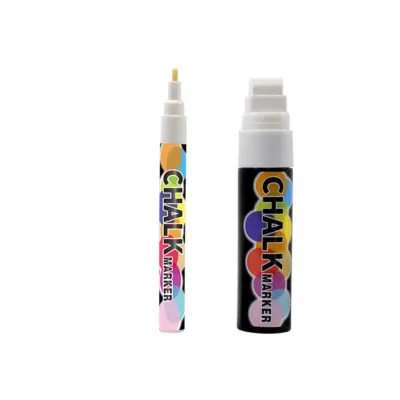
To understand how these tools behave, it helps to look closely at the geometry of their nibs. A chisel tip is cut at an angle, creating a flat, rectangular face bounded by sharp corners. When you drag the flat edge of the chisel tip across a non-porous surface like glass or a glossy blackboard, it deposits a wide band of liquid chalk. If you rotate the marker to write with the narrow edge or the sharp point, the contact area shrinks, resulting in a fine, delicate line.
Products mentioned in this guide
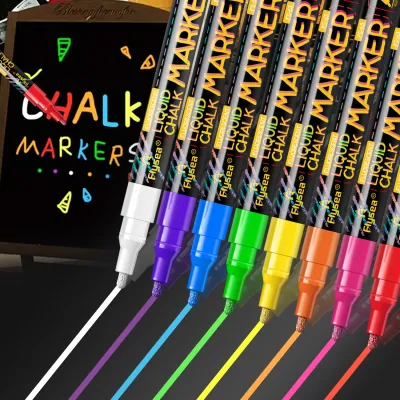
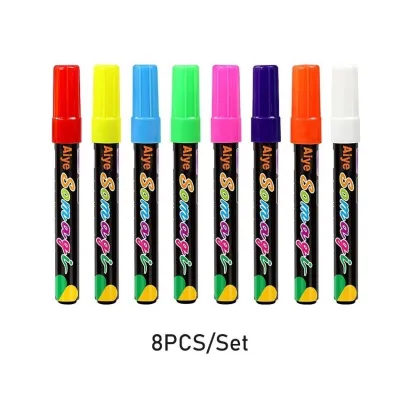
![[COD] SAjeNH SPORT Liquid Chalk Marker Pens Erasable Multi Colored LED Writing Board Glass Window Art Marker Children Painting Blackboard Painting](https://img.lazcdn.com/g/p/968517ccb556f30478586832eb972bbe.jpg_400x400q80.jpg_.webp)
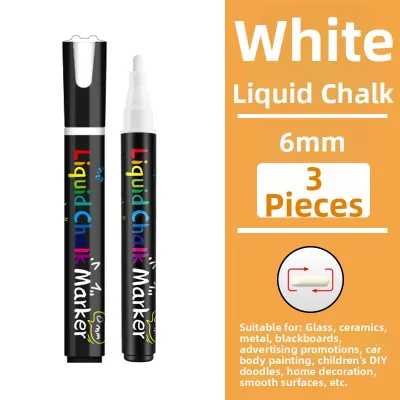
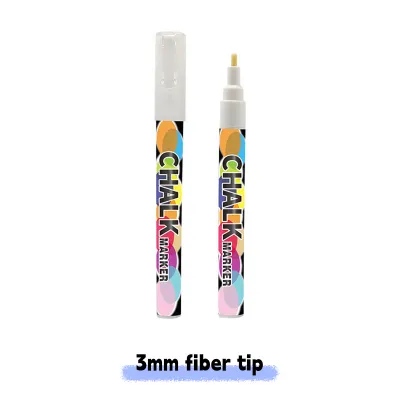
Prices are valid at publication and may change. Please refer to the product page for the latest price.
In contrast, a bullet tip is shaped like a dome or a rounded cone. Because the contact point remains virtually identical no matter how you tilt or turn the marker, the line width stays uniform. This symmetry eliminates the need to monitor your hand rotation mid-stroke, allowing you to focus entirely on the path of your lettering. The ink flow from a bullet tip tends to be highly concentrated at a single point, which helps maintain consistent opacity throughout long, continuous curves.
The physical surface area of the tip also influences how the liquid chalk ink behaves during application. Chisel tips, with their larger flat surfaces, pull more ink out of the reservoir when pressed flat, which is excellent for covering wide areas but requires a steady hand to prevent pooling. Bullet tips distribute ink through a smaller, rounded surface, which naturally regulates the flow and reduces the risk of accidental drips on vertical surfaces.
When to Choose a Chisel Tip Chalk Marker Pen
The chisel tip is the classic choice for projects that demand visual drama and scale. If your lettering style leans toward traditional calligraphy, Gothic script, or bold sans-serif block letters, the chisel tip is an indispensable tool. By holding the marker at a consistent angle—typically around 45 degrees relative to the baseline—you can create beautiful, automatic line variation where vertical downstrokes are thick and horizontal crossbars are thin.

Beyond formal lettering styles, chisel tips are highly efficient for large-scale displays. When you need to draw large headers, fill in the centers of hollow block letters, or create thick decorative borders, the broad edge of a chisel tip covers the ground in a fraction of the time. For businesses in the Philippines, such as neighborhood milk tea shops, boutiques, or family-run eateries, using a chisel tip to write daily specials on a sidewalk chalkboard ensures that the text is bold enough to be readable from a distance.
However, mastering the chisel tip requires practice and physical coordination. Because the line width depends entirely on the angle of the nib relative to the direction of your stroke, you must train your wrist to remain stable. If you unconsciously rotate the marker while rounding a curve, your line may thin out or thicken unexpectedly.
When to Choose a Bullet Tip Chalk Marker Pen
If your project involves detailed illustrations, small-scale writing, or casual everyday print, the bullet tip chalk marker pen is usually the more practical option. The rounded nib behaves exactly like a standard felt-tip marker or a heavy-duty pen, making it instantly familiar and comfortable to use. You do not need to worry about the angle of your wrist or the orientation of the pen; you can simply write, sketch, and draw with complete freedom of movement.
This ease of use makes the bullet tip highly forgiving for beginners and casual hobbyists. If you are creating labels for kitchen canisters, writing names on glass cups for a family gathering, or organizing a daily planner on a small desktop whiteboard, the bullet tip provides the clean, uniform lines needed for legibility. It is also the superior choice for intricate decorative work, such as drawing fine floral borders, cross-hatching, dot patterns, or adding delicate highlights to larger illustrations.
The primary limitation of the bullet tip is its inability to produce natural line variation in a single stroke. If you want to create a calligraphy effect with a bullet tip, you must use a technique known as faux calligraphy, where you manually draw the outlines of the downstrokes and fill them in afterward. While this method is highly effective and easy to learn, it takes significantly more time than using a chisel tip.
Key Specifications to Verify Before Purchasing
Before purchasing a chalk marker pen, look beyond the basic tip shape and verify the technical specifications on the packaging. First, check the exact line width in millimeters. Manufacturers use terms like “fine” or “broad” differently; a “medium” chisel tip from one brand might draw a 4mm line, while another brand’s “medium” is 6mm. If you are working on small menu boards or detailed labels, look for fine bullet tips in the 1mm to 2mm range. For large storefront windows, a broad chisel tip of 8mm to 15mm is much more appropriate.
Another critical factor to verify is the reversibility of the nib. Many high-quality chalk marker pens feature a clever design where the polyester nib can be pulled out, flipped around, and reinserted. One end of the nib is shaped as a chisel, while the other end is a bullet tip. Purchasing markers with reversible nibs gives you the ultimate flexibility, allowing you to switch styles mid-project without needing to buy two separate sets of markers.
You must also verify the compatibility of the ink with your intended surface. Liquid chalk markers are formulated with pigment suspended in a water-based solution, designed specifically for non-porous surfaces like glass, mirrors, glazed ceramics, metal, and specialized non-porous blackboards. If you use them on porous surfaces like unsealed wood, paper, or walls painted with standard matte paint, the ink will soak into the fibers, making it impossible to erase completely. Look for explicit “erasable” or “wet-wipe” labels on the packaging, and always perform a small test before committing to a large design.
Finally, consider how environmental conditions can affect the ink’s performance. In warm, humid tropical climates like the Philippines, the drying time of liquid chalk can vary. High humidity may keep the ink wet for slightly longer, increasing the risk of accidental smudging if you brush your hand across your work. Conversely, direct sunlight on an outdoor display can bake the pigment onto the surface, making it more difficult to erase later.
Decision Framework: Matching the Tip to Your Project
To make your final decision, evaluate your project requirements against the specific strengths of each tip shape. If your primary goal is to create high-impact, professional-looking signage with varied line weights, bold headers, and filled-in block letters, choose the chisel tip. The physical mechanics of the angled edge will allow you to execute classic lettering styles with speed and efficiency, making it the ideal choice for commercial displays and large-scale art.
If your project requires writing small, highly legible text, drawing detailed illustrations, or if you simply prefer a familiar, low-maintenance writing experience, choose the bullet tip. The rounded point ensures that your lines remain uniform and clean, allowing you to focus on your handwriting without worrying about pen rotation. It is the perfect entry point for beginners and the most efficient tool for detailed, close-up work.
If you are still undecided, look for a marker set that features reversible nibs. This option removes the need to choose between the two shapes entirely, allowing you to experiment with both styles on your target surface.
Frequently Asked Questions (FAQ)
Can I combine chisel and bullet tips in a single lettering project?
Yes, combining both tip shapes is an excellent way to create a balanced and visually appealing design. A common professional layout strategy is to use a broad chisel tip for the main headers, titles, and decorative borders to draw immediate attention. You can then switch to a fine or medium bullet tip to write the detailed body text, prices, or smaller descriptions, ensuring that the information remains clean and easy to read.
How should I test a new chalk marker pen before using it on a final surface?
To test a new marker safely, first shake it thoroughly with the cap securely on to mix the pigment. Gently press the tip down repeatedly on a piece of scrap paper or cardboard until you see the ink begin to saturate the nib. Once the tip is fully primed, find an inconspicuous corner or a hidden edge of your final display surface to write a small test stroke. Let the ink dry completely, then wipe it away with a damp microfiber cloth to verify that it erases cleanly without leaving any ghosting or permanent stains.
Community discussion
Share your experience or ask a question. Comments are reviewed before publication.