
Curved highlighter pens have redefined how students and journal enthusiasts organize their thoughts, offering a creative alternative to traditional chisel-tip markers. Unlike standard highlighters that produce a single, uniform block of color, these innovative writing instruments often feature specialized curved tips or rolling patterned wheels that allow you to create decorative borders, wavy underlines, and precise highlights with a single stroke. However, finding the perfect curved highlighter pen in the Philippines requires more than just picking an appealing color palette. The high humidity of a tropical climate directly impacts how ink behaves on paper, making it essential to match the pen’s nib design and ink properties to your specific study or journaling workflow. Rather than relying on generic marketing claims of flawless performance, building a reliable stationery kit involves understanding paper compatibility, performing observable checks, and verifying manufacturer specifications.
Understanding Curved Nib Designs and Ink Formulations
To select the right tool, you must first understand how curved nib designs interact with different ink formulations. Curved highlighters generally fall into two categories: those with physically curved felt or chisel tips, and those equipped with tiny, rolling patterned wheels that stamp wavy lines, dots, or dashes onto the page. The angle at which you hold these pens is critical. A rolling curved tip requires a consistent, perpendicular angle to ensure the entire pattern makes contact with the paper, whereas a curved chisel tip relies on the natural sweep of your wrist to vary the line width. If the angle is too steep or too shallow, the ink delivery will be uneven, resulting in broken lines or patchy patterns.
The ink inside these pens also plays a pivotal role in your overall experience. Most curved highlighters utilize water-based, gel, or mild fluorescent inks, each behaving differently under tropical conditions. Water-based inks are highly fluid and offer vibrant colors, but they are highly sensitive to the ambient humidity in the Philippines. In high-humidity environments, water-based inks take longer to dry, which increases the risk of feathering—where the ink spreads outward along the paper fibers—and bleed-through. Gel-based formulations, on the other hand, sit on top of the paper rather than soaking in, making them highly resistant to bleeding, though they can leave a slightly raised, waxy texture that takes time to cure. Mild fluorescent inks provide a softer, pastel-like alternative to traditional blinding neon colors, reducing eye strain during long reading sessions while still highlighting key information effectively.
Products mentioned in this guide
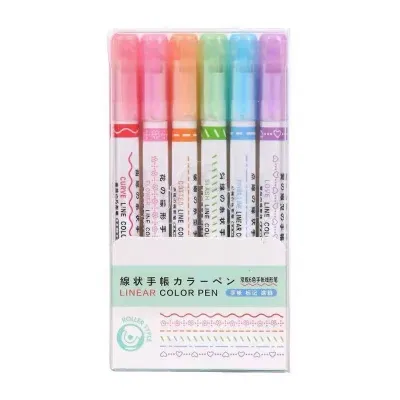
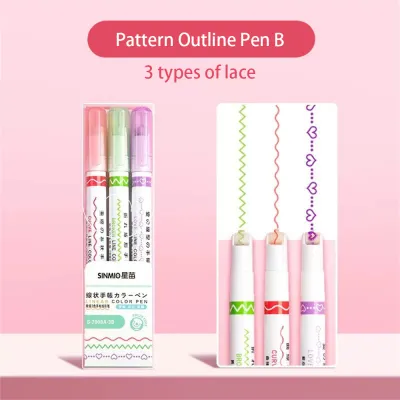
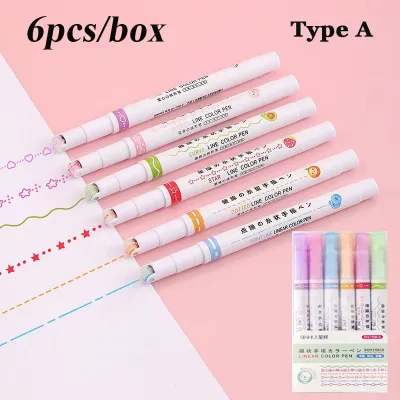
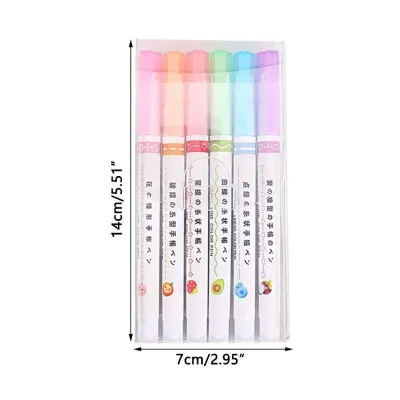
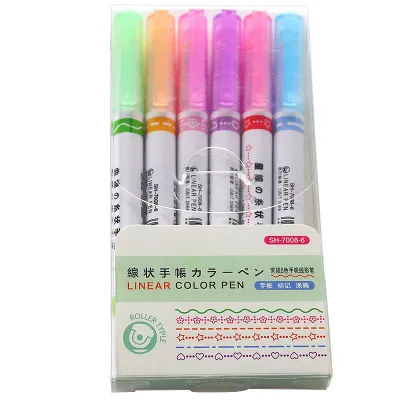
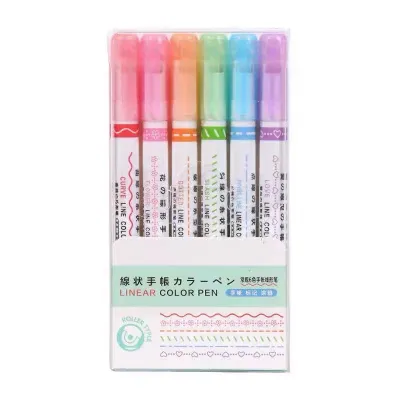
Prices are valid at publication and may change. Please refer to the product page for the latest price.
Before committing to a specific pen set, you can perform simple, observable checks to evaluate ink opacity and drying behavior on standard paper. Draw a single, continuous line on a sheet of standard 70 GSM or 80 GSM copy paper, which is commonly used in local schools and offices. Observe how quickly the ink pools at the end of the stroke; a heavy pool of ink indicates a slow-drying formula that is highly likely to bleed through thin pages. Touch the highlighted area after three seconds, five seconds, and ten seconds to determine the exact drying threshold. If the ink smears after five seconds, it may not be suitable for rapid note-taking or fast-paced study sessions where pages must be turned quickly.
Selection Criteria for Academic Note-Taking and Textbooks
For students preparing for university exams or professional board reviews in the Philippines, efficiency and legibility are paramount. Academic note-taking often involves marking dense, double-sided textbook pages, which are notoriously thin and prone to ink saturation. When evaluating curved highlighters for academic use, your primary focus should be on dry-time requirements. In a warm, non-airconditioned classroom or a humid study space, standard ink drying times can double. A slow-drying curved highlighter can easily smudge when you close your textbook or turn the page, ruining your notes and leaving unsightly stains on opposing sheets. Look for quick-drying formulas that set within two to three seconds to keep up with rapid, dense text marking.

Another critical factor is ink transparency. The primary purpose of highlighting is to emphasize key concepts, not to obscure them. Some curved highlighters, particularly those with highly saturated or darker pigment formulations, can make the underlying printed text difficult to read under standard fluorescent classroom lighting. This lack of transparency forces your eyes to work harder, leading to premature visual fatigue during extended study sessions. When testing a pen, ensure that the black ink of the textbook remains sharp and highly legible through the highlighted stroke.
Furthermore, you must verify manufacturer specifications regarding paper compatibility, especially when dealing with exceptionally thin paper. Many textbooks, law books, and Bibles are printed on lightweight paper ranging from 30 GSM to 50 GSM. Most standard water-based highlighters will bleed through these delicate pages instantly, rendering the reverse side unreadable. Check the product packaging or manufacturer guidelines for explicit mentions of thin-paper compatibility. If the manufacturer does not explicitly state that the pen is safe for thin paper, it is safest to assume it will bleed. In such cases, look for specialized dry gel highlighters or plan to use the pens exclusively on heavier notebook paper of at least 80 GSM to 100 GSM.
Essential Features for Aesthetic Journaling and Planning
Aesthetic journaling and bullet planning require a different set of priorities, focusing heavily on visual harmony, design flexibility, and media integration. Unlike academic highlighting, which demands high-contrast visibility, journaling often relies on muted, mild, or pastel color palettes. These softer tones allow you to create beautifully coordinated layouts, weekly spreads, and trackers without overwhelming the page. When selecting a curved highlighter set for journaling, evaluate how the colors complement one another. A well-curated set of earth tones, dusty pinks, and sage greens can elevate your planner’s design, whereas harsh neon inks can disrupt the aesthetic balance of a hand-drawn layout.
Nib durability and edge crispness are also essential for decorative work. If you are using a curved highlighter with a rolling pattern wheel to create borders, frames, or dividers, the mechanism must be durable enough to withstand repeated pressure. Cheaply constructed plastic wheels can wobble or wear down quickly, leading to distorted patterns, skipped lines, and fuzzy edges. Inspect the construction of the tip; a high-quality curved pen should have a secure, stable housing that keeps the wheel or felt tip perfectly aligned. This stability ensures that your decorative borders remain crisp and professional-looking from the first page of your journal to the last.
Because journaling often involves mixed media, you must plan overlay tests to check how the highlighter ink interacts with other materials. Journalers frequently layer highlighters over gel pens, fineliners, washi tape, and stickers. Some water-based highlighter inks can reactivate the dried ink of your favorite black gel pen, causing it to smear across the page. To prevent this, conduct a systematic overlay test on a scrap piece of your journal paper. Write a line with your primary writing pen, let it dry completely, and then roll the curved highlighter over it. If the underlying ink bleeds or smears, you will need to adjust your workflow—either by highlighting first and writing on top, or by switching to a smudge-resistant fineliner.
Building Your Shortlist: Pre-Purchase Verification Steps
With numerous stationery options available online and in local bookstores, building a reliable shortlist requires a systematic pre-purchase verification process. Start by cross-referencing product labels and manufacturer guidelines. Look for detailed specifications regarding paper weight compatibility, ink capacity, and whether the pens are refillable. While many budget-friendly curved highlighters are disposable, investing in a system that supports refillable ink or replacement tips is far more cost-effective and environmentally friendly in the long run. If you plan to spend between ₱150 and ₱400 on a quality set, verifying these details beforehand ensures you get the best value for your money.
Next, leverage the power of online marketplaces by carefully filtering customer reviews. When shopping on e-commerce platforms in the Philippines, do not rely solely on overall star ratings, which can sometimes be inflated by shipping speed or packaging quality. Instead, filter the reviews using specific search terms such as “bleed,” “smudge,” “dry,” “textbook,” or “fray.” Pay close attention to reviews written by students or journalers who upload photos or videos of the pens in action. These real-world demonstrations provide invaluable insights into how the ink behaves on standard local notebook brands and paper weights under typical tropical conditions.
Finally, establish clear stop conditions that will prompt you to remove a product from your shortlist. A major stop condition is the presence of conflicting paper compatibility claims. For instance, if a product listing claims “zero bleed-through on all paper types,” but multiple customer reviews show severe bleeding on standard 80 GSM paper, you should eliminate that option. Another stop condition is the complete lack of clear ink formulation details or manufacturer branding. Purchasing unbranded, generic pens often results in inconsistent ink flow, dried-out tips upon arrival, and poor chemical stability, which can ruin your expensive journals and textbooks.
Frequently Asked Questions (FAQ)
Can curved highlighters be used on both sides of thin paper without bleeding?
Whether you can use a curved highlighter on both sides of thin paper depends entirely on the ink volume, the paper’s density (measured in GSM), and the drying speed, rather than the shape of the nib itself. Because curved roller-tip highlighters often deposit a slightly thicker layer of ink to ensure the pattern is fully visible, they are more prone to bleeding through thin paper than standard chisel tips. To determine if your specific pen and paper combination is compatible, always perform a hidden corner test on an inconspicuous page of your book or notebook. Apply a single stroke, let it dry completely, and check the reverse side. If you observe any bleed-through or heavy ghosting, stop using the pen on that specific paper and consider upgrading to a higher GSM notebook or switching to a dry gel highlighter.
How do I maintain the curved nib to prevent fraying and uneven lines?
Maintaining the delicate tip of a curved highlighter requires proper handling and storage habits. Always cap the pen tightly immediately after use; the warm, humid climate of the Philippines can cause exposed ink to dry out rapidly, leading to clogged roller wheels or hardened felt tips. When highlighting, pay close attention to your writing angle. Avoid holding the pen at an extreme, sharp angle that forces the plastic housing of the tip to scrape against the paper, as this friction will quickly fray the felt or damage the rolling mechanism. If you notice that the lines are becoming uneven or the pattern is skipping, inspect the tip for paper fibers or dried ink buildup, which can often be gently cleared with a lint-free cloth. If the nib is permanently frayed or cracked, check if the manufacturer offers replacement tips; otherwise, the pen must be replaced to maintain clean, crisp lines.
Community discussion
Share your experience or ask a question. Comments are reviewed before publication.