
Selecting the right paper weight and binding style for your personalized prescription pad is a balance between clinical utility, writing comfort, and professional presentation. In busy medical practices, a prescription pad must withstand constant handling, resist the high humidity of tropical climates, and prevent ink from bleeding through to the next page. For most practitioners, an 80 GSM to 100 GSM paper weight paired with a top-glued binding offers the most efficient, clean tear-away experience, while a spiral binding provides superior flat-lay durability for writing on the move.
The physical feel of a prescription pad speaks volumes about your practice. A flimsy, easily torn pad that lets ink bleed through to the next sheet can look unprofessional and lead to legibility issues for pharmacists. By understanding how paper density interacts with your preferred writing instruments and how different binding methods support your daily workflow, you can design a customized pad that is both highly functional and durable.
Understanding Paper Weight to Prevent Ink Bleed-Through
Paper weight is measured in grams per square meter (GSM), which indicates the density and thickness of the paper. Standard office copy paper typically ranges from 70 GSM to 80 GSM. While this weight is sufficient for basic photocopying, it often lacks the opacity and structural integrity required for a professional prescription pad. When paper is too thin, ink from your pen can easily seep through the fibers, causing “ghosting” (where the writing is visible on the reverse side) or “bleeding” (where the ink physically penetrates to the sheet underneath).
Products mentioned in this guide
Prices are valid at publication and may change. Please refer to the product page for the latest price.
The type of pen you use daily should dictate your choice of paper weight. Ballpoint pens use thick, oil-based inks that sit on top of the paper fibers, making them highly compatible with standard 80 GSM paper. However, many physicians prefer gel pens or rollerball pens for their smooth, effortless glide during long consultations. These pens use water-based inks that flow more generously, requiring a denser paper like 90 GSM or 100 GSM to absorb the liquid without feathering—a phenomenon where ink spreads sideways along the paper fibers, making your handwriting look fuzzy.
If you prefer premium writing instruments, such as fountain pens or heavy felt-tip markers, you should opt for 100 GSM to 120 GSM paper. This premium thickness provides excellent opacity and a smooth, substantial feel that prevents any trace of ink from transferring to the next prescription sheet. However, keep in mind that thicker paper makes the overall pad bulkier, which might limit the number of sheets you can comfortably include in a single pad.
To avoid ordering a large print run of pads that do not perform well with your favorite pen, always perform an observable trial. Request a few sample sheets of different GSM ratings from your local printer. Write several test prescriptions using your daily pen, applying your normal writing pressure. Inspect the reverse side of the sheet for ghosting and check the sheet directly beneath it for any ink spots. Additionally, observe how quickly the ink dries on the paper surface; highly coated or overly dense papers can sometimes slow down drying times, leading to accidental smudges when you hand the prescription to a patient.
In tropical environments with high ambient humidity, paper naturally absorbs moisture from the air, which softens the cellulose fibers. This moisture absorption makes the paper more porous and susceptible to ink bleeding and feathering than it would be in a dry, air-conditioned space. Choosing a slightly heavier paper weight, such as 90 GSM, provides a safety margin against humidity-induced ink spread, ensuring your written instructions remain sharp and legible under all clinical conditions.
Comparing Binding Styles for Daily Clinical Durability
The binding style of your personalized prescription pad determines how easily you can write on it, how well it holds together in your medical bag, and how cleanly the pages detach. Each style offers distinct advantages depending on your physical workspace and daily routine.

Spiral binding, which uses a plastic or metal coil threaded through punched holes along the top or side edge, is highly valued for its exceptional flexibility. A spiral-bound pad can fold completely back on itself (a full 360 degrees), allowing you to write comfortably even when space on your desk is limited by a computer keyboard or medical equipment. This flat-lay capability is also ideal for doctors who conduct ward rounds and must write prescriptions while standing. However, because spiral pages do not detach naturally, you must ensure the printer includes micro-perforations just below the spiral wire to allow for clean, professional tearing without leaving messy paper scraps.
Stitched binding, often referred to as book-bound or thread-sewn, offers a highly formal and traditional aesthetic. In this configuration, sheets are folded into booklets and sewn together, creating a permanent spine. While stitched binding is incredibly durable and prevents pages from accidentally falling out, it is generally impractical for standard patient prescriptions that must be torn out and handed away. Instead, stitched binding is best reserved for duplicate or triplicate record books, where a carbonless copy of each prescription remains permanently bound in the book for your clinic’s legal and administrative archives.
Glued binding, commonly known as padded binding, is the industry standard for prescription pads. This method uses a flexible, rubberized padding compound applied to the top edge of the paper stack, holding the sheets securely together while allowing them to be peeled away effortlessly with a single downward pull. Glued pads are highly cost-effective and provide a clean, straight edge upon removal. However, because a glued pad lacks a rigid cover, its durability depends entirely on the quality of the backing board.
To ensure a glued pad remains functional throughout its lifespan, it must be mounted on a thick, rigid chipboard backing. Without a sturdy backing board, a glued pad will bend, warp, and eventually fall apart, especially when exposed to the daily wear and tear of being slipped into a desk drawer or a doctor’s bag. A rigid backing also acts as a portable writing surface, allowing you to write legibly even when a desk is unavailable.
Decision Framework: Matching Paper and Binding to Your Workflow
To select the perfect combination of paper weight and binding for your personalized prescription pad, evaluate your specific clinical environment, writing habits, and administrative needs. Matching these physical specifications to your daily workflow prevents frustration and ensures a seamless patient experience.
If you run a high-volume outpatient clinic where speed and efficiency are paramount, the optimal configuration is an 80 GSM paper weight with a top-glued binding. This setup is highly economical for printing in bulk, and the 80 GSM paper is thick enough to prevent bleed-through when using standard ballpoint pens. The glued top allows you to tear off and hand over prescriptions in a split second, keeping your patient flow moving smoothly. Ensure the pad is backed by a standard 1.5mm chipboard to maintain its shape.
For practitioners who prioritize a premium patient experience or prefer writing with liquid ink gel pens, a 90 GSM or 100 GSM paper paired with a top-glued binding is highly recommended. The heavier paper weight provides a luxurious, professional feel and completely eliminates the risk of ink ghosting, ensuring that your clinic’s branding and your contact details on the prescription look pristine. This combination is particularly suited for private specialty clinics where patient volume is moderate, and a high-end presentation is desired.
If your medical practice involves frequent travel, home visits, or hospital rounds where you rarely write at a dedicated desk, choose a spiral-bound pad with 90 GSM micro-perforated paper. The spiral binding allows you to fold the pad in half, creating a compact, rigid surface that fits easily in one hand. The micro-perforations ensure that when you do tear a prescription out, it detaches cleanly without ripping the vital medical information printed near the top margin.
Finally, if your clinical workflow requires strict record-keeping and physical tracking of all issued medications, opt for a duplicate carbonless (NCR) pad with a spiral or stitched binding. In this system, the top sheet (usually 80 GSM) is written on and torn out for the patient, while the pressure-sensitive duplicate sheet underneath permanently retains the impression of your writing within the bound book. This ensures you always have an unalterable physical record of every prescription issued, organized chronologically.
Essential Customization Checks Before Ordering
Before submitting your design to a local print shop or an online printing service, there are several critical physical and layout specifications you must verify to ensure your personalized prescription pads are practical and compliant.
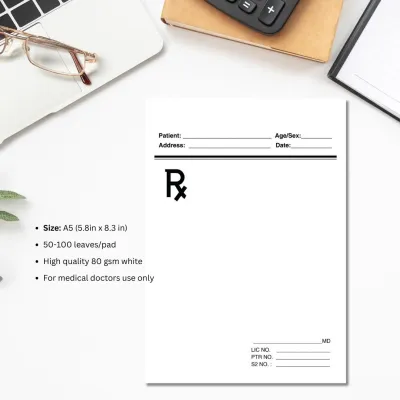
First, confirm the physical dimensions of the pad. The most common standard sizes for prescription pads are A6 (approximately 4.1 x 5.8 inches) and A5 (approximately 5.8 x 8.3 inches). A6 is highly portable and fits easily into a lab coat pocket, making it a favorite for mobile doctors, while A5 offers a larger writing area suitable for complex dosing instructions or multi-medication prescriptions. Ensure your layout leaves a safe margin of at least 12mm to 15mm at the top edge to accommodate the glue line or spiral punches, preventing your clinic logo, name, or PRC license registration details from being obscured.
Second, pay close attention to the paper grain direction. Paper fibers naturally align in one direction during manufacturing, making the paper easier to fold and tear along that specific axis. When ordering glued pads, instruct your printer to align the paper grain parallel to the tear direction (usually vertical). If the grain runs horizontally across a top-glued pad, tearing a page off will often result in jagged, diagonal rips that can ruin the prescription or tear off important security features and contact numbers.
Third, verify the specifications of the backing board. Many budget-friendly printing services use thin, flimsy cardstock as a backing to save on shipping weight and material costs. To ensure your pads do not warp or sag under tropical humidity, explicitly request a heavy-duty grey chipboard backing of at least 1.5mm thickness. This small upgrade adds minimal cost but dramatically improves the structural integrity of the pad, allowing you to write comfortably down to the very last sheet.
Frequently Asked Questions (FAQ)
Can I use both sides of the prescription pad paper?
Single-sided printing is the standard for medical prescription pads to ensure absolute legal and clinical clarity. Printing or writing on both sides of a prescription sheet increases the risk of a pharmacist overlooking critical dosage instructions or refills written on the back, which can lead to serious medication errors. If you must print general clinic information, a map, or terms of service on the reverse side, you must use a paper weight of at least 100 GSM to prevent the ink from the front side from ghosting through and making the reverse text unreadable.
How do I prevent the pages from curling after tearing?
Paper curling is typically caused by a mismatch between the paper grain direction and the binding edge, exacerbated by high ambient humidity. To prevent curling, ensure your printer cuts the paper so that the grain runs parallel to the tear direction. Additionally, high-quality printers use flexible, non-brittle padding compounds that do not pull or warp the paper fibers at the glue joint. To protect your pads from absorbing excess moisture in tropical climates, store them flat in a dry drawer, a sealed plastic sleeve, or an air-conditioned room until they are ready for clinical use.

Community discussion
Share your experience or ask a question. Comments are reviewed before publication.