
Selecting your first Zig brush pen for lettering requires matching the pen’s physical construction to your hand’s natural pressure. For beginners, the primary challenge is not learning how to draw beautiful letterforms, but rather training the hand to transition smoothly between heavy downstrokes and light upstrokes. If you choose a pen that is too soft or highly flexible, the tip will collapse under minimal pressure, resulting in thick, shaky lines and immediate frustration. Conversely, a pen that is too stiff will require excessive force, leading to hand fatigue and uneven ink distribution.
To build a solid foundation, you must understand how different nib materials, ink formulations, and paper surfaces interact. Zig offers a wide array of brush pens, ranging from delicate nylon bristles to firm synthetic felt tips. By focusing on how these tools behave under pressure, you can select a forgiving pen that matches your current skill level and practice environment.
Core Criteria for Choosing a Beginner-Friendly Brush Pen
Nib elasticity, often referred to as “snap-back,” is the speed and force with which a brush tip returns to its original pointed shape after being bent. For a beginner, high elasticity is incredibly helpful. When you release pressure at the end of a downstroke, a responsive nib immediately snaps back into a fine point, allowing you to transition into a thin upstroke without pausing. If a nib lacks this springiness, it remains bent or sluggish, forcing you to manually adjust your hand angle to keep your lines from becoming thick and muddy.
Products mentioned in this guide
Prices are valid at publication and may change. Please refer to the product page for the latest price.
Ink flow consistency is another critical factor governed by the pen’s internal feed system. Some brush pens use a free-ink system with a regulator, while others rely on a fiber reservoir. For those just starting out, a fiber reservoir system is generally more forgiving because it delivers a controlled, steady flow of ink. Free-ink systems can sometimes flood the tip if you apply heavy pressure or hold the pen at a steep angle, leading to pooling on your practice sheets. A consistent, moderate flow allows you to focus entirely on your stroke mechanics without worrying about sudden blots.
The chemical composition of the ink—specifically whether it is dye-based or pigment-based—directly impacts how your lettering looks and how it interacts with paper. Dye-based inks are highly soluble in water, offering vibrant colors and excellent blending capabilities. However, they are prone to bleeding through thin paper and can easily smudge if they encounter moisture. Pigment-based inks contain microscopic solid particles that bind to the surface of the paper once dry. This makes them highly water-resistant and smudge-proof, which is ideal for creating crisp, clean lines that won’t smear under your hand.
Finally, you must consider the physical size of the brush tip relative to your hand size and the scale of your practice. Large brush tips require broad, sweeping arm movements and are best suited for large-format lettering on spacious paper. If you try to write small letters with a large brush tip, the loops and counters of your letters will quickly fill with ink, turning your writing into illegible blocks. Small brush tips allow you to practice on standard-sized grid paper using comfortable, controlled finger and wrist movements, making them far more practical for daily drills.
Comparing Common Zig Brush Pen Nib and Ink Styles
The Zig lineup generally falls into two distinct categories based on tip construction: true nylon bristles and synthetic fude (felt or elastomer) tips. True nylon bristles consist of individual synthetic hairs bound together in a ferrule, mimicking a traditional watercolor brush. Synthetic fude tips, on the other hand, are molded from a single piece of flexible polyurethane, rubber, or dense felt. Understanding how these two designs respond to your hand is the key to choosing the right starter pen.

These two tip styles handle pressure and angle variations in completely different ways. Nylon bristles are highly sensitive to the angle at which you hold the pen; if you write too vertically, the bristles will splay outward in all directions, making control nearly impossible. They require a consistent 45-degree angle to the page. Synthetic fude tips are much more forgiving of varying pen angles. Because the molded tip bends as a single, cohesive unit, it provides a predictable pivot point that absorbs excess pressure without losing its shape.
Durability and maintenance also vary significantly between these materials. Nylon bristles are incredibly resilient against rough paper textures because the individual hairs can slide past one another, though they can eventually split if subjected to harsh, dry scrubbing. Synthetic fude tips are more vulnerable to physical abrasion. Writing on rough, uncoated paper can quickly wear down the delicate pointed tip of a felt fude pen, causing it to “pill” or become blunt. Choosing the right tip style requires a realistic assessment of the paper you plan to use for your daily practice.
Nylon Bristle Tips with Water-Based Dye Ink
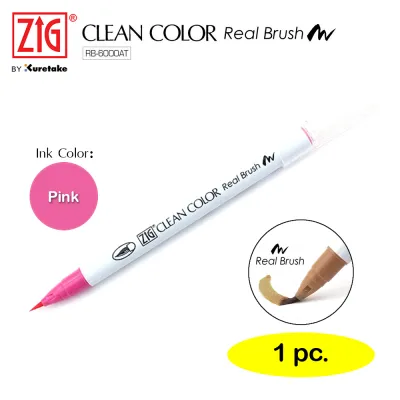
Pens featuring true nylon bristles, such as the Zig Clean Color Real Brush, offer unparalleled flexibility but come with a steep learning curve for beginners. Because the tip is made of individual hairs, it behaves exactly like a fine artist’s paintbrush. When you apply pressure, the bristles spread wide to create lush, thick strokes. However, controlling the transition back to a hairline upstroke requires an incredibly light touch and precise muscle control, as the soft snap-back offers very little physical resistance to guide your hand.
The water-based dye ink used in these bristle pens is highly fluid and designed for artistic expression. This ink remains water-soluble even after it dries on the page. For lettering artists, this property opens up creative possibilities like color blending, ombre effects, and watercolor washes. You can touch two pen tips together to transfer ink, or use a water brush to soften the edges of your letters. The trade-off is that this ink is highly sensitive to humidity and moisture; a single drop of water or a sweaty palm can instantly ruin hours of work.
To keep a nylon bristle pen in good working order, you must perform regular visual checks. Hold the pen up to a bright light source and inspect the tip. If you see individual bristles pointing outward away from the main bundle, or if the tip no longer forms a sharp, needle-like point when wet, the nib has begun to splay. This is usually caused by applying too much downward pressure at a 90-degree angle. To correct this, gently dip the bristles in warm water and reshape them with your fingers, then store the pen horizontally to let the fibers settle.
Synthetic Fude Tips with Pigment or Standard Ink
For most beginners, synthetic fude tips—such as those found on the Zig Fudegokochi or Zig Brushables—are the most practical starting point. These molded tips offer a firm, rubbery resistance that acts as a physical buffer for your hand. When you press down to create a thick stroke, the tip bends predictably, and when you release the pressure, it immediately springs back to its original shape. This firm response forgives the heavy-handedness common among beginners who are transitioning from standard ballpoint pens.
Many of these fude-tip pens utilize pigment-based inks, which offer distinct advantages for daily practice and finished pieces. Pigment ink dries to a rich, matte finish that is highly resistant to water, light, and smudging. Once the ink is fully dry, you can safely write over it with other markers or apply watercolor washes without fear of the black lines bleeding or blurring. This makes pigment-ink fude pens excellent for mixed-media projects, journaling, and archival practice sheets that you want to keep for tracking your progress.
However, synthetic fude tips do have physical limitations that you should keep in mind. Because the tip is molded from a solid material, it cannot achieve the ultra-fine, single-hair lines that a real bristle brush can produce. The maximum stroke width is also limited by the physical size of the molded tip; trying to force a small fude pen to make a very thick line by pressing harder will only damage the internal structure of the tip. Additionally, because the ink is often formulated for quick drying and crisp edges, these pens are not suitable for smooth watercolor-style blending.
Matching Your Pen to Paper and Practice Goals
Choosing the right paper is just as important as choosing the right pen, as the interaction between the two determines your success. To prevent premature nib damage and frustrating ink bleeds, you must learn to evaluate paper quality before you begin writing. Look at the manufacturer’s label for the paper weight, which is typically measured in grams per square meter (gsm). For brush lettering, you should look for smooth, coated paper with a weight of at least 100 gsm, which provides enough density to prevent ink from soaking through to the next page.
Beyond weight, the surface texture of the paper is critical. You can perform a simple tactile test by running your fingertips across the sheet. If the paper feels slightly rough, chalky, or toothy—like standard copy paper or cheap sketchbooks—it will act like fine sandpaper on your brush tips. Over time, this friction will fray synthetic fude tips and split nylon bristles. Instead, look for paper that feels silky, glossy, or exceptionally smooth to the touch, such as specialized marker paper, tracing paper, or high-grade notebook paper.
In the tropical climate of the Philippines, high relative humidity plays a significant role in how your stationery behaves. High humidity softens paper fibers, making them more absorbent and prone to swelling. This means that water-based inks will dry much slower than they would in a dry environment, greatly increasing the risk of smudging your work as your hand moves across the page. Furthermore, humid paper fibers tend to pull ink out of the pen tip faster, which can cause severe feathering—where the ink spreads outward along the fibers, creating fuzzy, blurred edges instead of crisp lines.
To determine if a specific pen and paper combination is viable, perform a quick test on a scrap sheet. Write a series of thick downstrokes and thin upstrokes, then observe the ink behavior. Check if the edges of the lines remain sharp or if they begin to feather. Look at the back of the paper to see if the ink is bleeding through or ghosting heavily. Finally, check how long the ink takes to dry by gently tapping a stroke with a clean finger after ten seconds. If you observe severe feathering, bleeding, or excessively slow drying times, stop using that paper immediately to protect your pen tips and keep your practice clean.
Building a Practical Starter Kit for Brush Lettering
When building your first brush lettering kit, resist the temptation to buy large, multi-color sets. A massive array of colors can actually hinder your progress by distracting you with color theory before you have mastered basic stroke mechanics. Instead, start with a highly focused, two-pen setup consisting of one deep black pen and one medium gray pen. The black pen is your primary tool for practicing letterforms, while the gray pen is invaluable for drawing guidelines, sketching layouts, or adding simple drop shadows to your finished letters.
Budgeting for your hobby requires evaluating the cost per pen in Philippine Pesos (₱) alongside the pen’s lifespan. A single high-quality Zig brush pen typically ranges from ₱80 to ₱180 in local stationery shops. While disposable pens are highly convenient, you should check if the model you choose has refill cartridges or replacement tips available. Investing slightly more upfront in a refillable pen body can save you money over months of daily practice, as buying ink refills is far more economical than purchasing entirely new pens.
Purchasing your pens from online marketplaces or e-commerce platforms requires careful verification to avoid counterfeit products. Authentic Zig pens feature crisp, clear branding on the barrel, a secure cap that clicks tightly to prevent drying, and consistent ink flow. Before buying, check the seller’s overall rating and read customer reviews, paying close attention to user-uploaded photos of the packaging and pen tips. If a listing offers a large set of pens at a price that seems too good to be true, it is highly likely to be a counterfeit that will fray quickly and dry out.
To complete your starter kit, gather a few low-cost auxiliary tools that will protect your pens and streamline your practice. A simple sheet of smooth tracing paper placed over a printed grid guide allows you to practice your letter heights and angles repeatedly without drawing directly on expensive paper. You can also use a small piece of laminated cardstock or a plastic pocket sleeve as a DIY blending palette. This setup lets you scribble ink onto the plastic and pick it up with another pen, allowing you to experiment with color transitions safely and cheaply.
Frequently Asked Questions (FAQ)
Do I need to buy a full color set to start learning?
No, starting with a full color set is unnecessary and often counterproductive for beginners. When you are first learning brush lettering, your primary goal is to develop muscle memory for pressure control and stroke consistency. Practicing with a single dark, high-contrast color—such as deep black or dark blue—makes it much easier to see variations in your line weight and identify where your transitions are shaky. Once you can consistently produce clean, sharp strokes with one pen, you can gradually introduce other colors to your collection.
How do I know if a nib is damaged and needs replacing?
You can identify a damaged nib through both visual inspection and physical performance. Visually, look for frayed fibers at the tip, a split in the brush point, or a bent core that no longer returns to its straight shape. Physically, a damaged nib will feel scratchy or rough when writing on smooth paper, and your upstrokes will appear thick, fuzzy, or inconsistent. If the pen is simply dry, scribbling gently on a damp paper towel can sometimes restore ink flow, but structural damage to the physical fibers of the tip cannot be repaired and requires a replacement.
Can I use these pens on standard printer paper?
You should avoid using standard, uncoated printer paper for brush lettering practice. Standard copy paper (typically 70 gsm to 80 gsm) has a rough, fibrous texture that acts like fine sandpaper, quickly fraying the delicate tips of both synthetic fude pens and nylon bristle brushes. Additionally, this paper is highly absorbent, which causes the ink to bleed through the page and feather along the edges of your strokes. For budget-friendly daily practice, opt for smooth tracing paper, layout paper, or specialized smooth practice pads instead.

Community discussion
Share your experience or ask a question. Comments are reviewed before publication.