
The Deli Think ballpen is a popular choice for daily writing tasks, offering a balance of affordability and functional design. Whether it is worth adding to your pencil case depends on how its specific ink flow, tip size, and grip comfort align with your writing habits. For students taking rapid lecture notes or professionals signing documents in the Philippines, verifying these features under real-world conditions is the key to finding the right writing instrument. By understanding its core specifications and testing its performance on standard paper, you can determine if this pen meets your daily demands.
Decoding the Core Specifications of the Deli Think Ballpen
Before testing any writing instrument, identifying the official specifications printed on the packaging or the pen barrel provides a baseline of what to expect. The Deli Think ballpen comes in various configurations, and reading these details helps you avoid purchasing the wrong model for your specific tasks.
First, locate the tip size, which is typically indicated in millimeters on the box or the barrel itself. Common sizes include 0.5 mm for fine, precise lines and 0.7 mm for medium, bolder strokes. If your daily writing involves filling out compact planners, solving mathematical equations, or writing in tight grid notebooks, a 0.5 mm tip is generally more suitable. For rapid note-taking or signing official documents where visibility is key, a 0.7 mm tip offers a more pronounced line.
Products mentioned in this guide
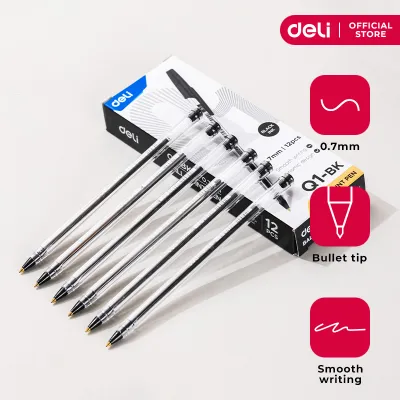
![Deli Q1-BK Think 0.7mm Bullet Tip Ball Point Pen [79Q1-BK]](https://img.lazcdn.com/g/p/f71c6bc8c9a42030ac841a8a8e279f7e.jpg_400x400q80.jpg_.webp)
![Deli Q1-BK Think 0.7mm Bullet Tip Ball Point Pen [79Q1-BK] 1pc](https://img.lazcdn.com/g/p/af152c161567edfa6aa030ee08c6aaa2.jpg_400x400q80.jpg_.webp)
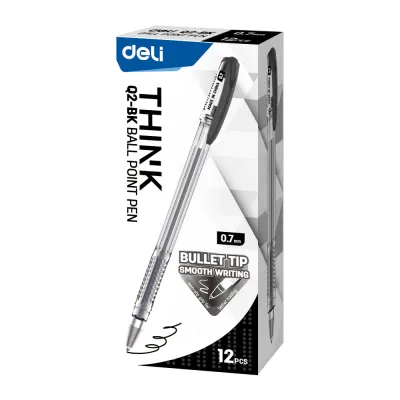
![Deli Q1-BK Think 0.7mm Bullet Tip Ball Point Pen 12pcs/box [79Q1-BKP12]](https://img.lazcdn.com/g/p/cc94f97438d5c4c4432ced23f5b322ba.jpg_400x400q80.jpg_.webp)
Prices are valid at publication and may change. Please refer to the product page for the latest price.
Next, verify the ink type used in the pen. Deli Think pens are often categorized as gel pens or low-viscosity hybrid ballpoints. Gel ink uses water-based pigments that deliver highly opaque, vibrant lines, though they can require a moment longer to dry. Hybrid inks combine the smooth glide of gel with the fast-drying, oil-based properties of traditional ballpoint ink. In the humid climate of the Philippines, paper often absorbs ambient moisture, which can cause standard water-based inks to spread or feather more easily, making hybrid options highly practical.
Finally, check the refill compatibility indicators. Many sustainable stationery users prefer to reuse the pen casing rather than discarding it. Look for a specific cartridge model number printed on the refill inside the barrel. Verifying whether the pen accepts standard international refills or requires proprietary Deli replacement cartridges will save you time when shopping at local stationery stores or online marketplaces.
Translating Specifications into Real-World Writing Performance
While specifications on paper provide a helpful guide, the true test of a writing instrument lies in how it performs on the page. Conducting a few simple, observable tests with your Deli Think ballpen on your preferred paper stock will reveal its actual capabilities.

Begin with a smoothness and skip test. On a standard sheet of notebook or copy paper, draw a series of rapid, continuous loops and long straight lines. Observe whether the ink flows consistently from the very first stroke or if it leaves blank gaps, known as skipping. A reliable pen should maintain a steady ink flow without requiring excessive downward pressure, which helps prevent hand strain during long writing sessions.
Drying time is another critical factor to observe, especially if you write quickly or use your left hand. Write a few words on your typical writing paper and immediately run a finger across the text at one-second intervals. In humid tropical environments, ink can remain wet on the page longer than expected. If the ink smudges after two or three seconds, you may need to pair the pen with more absorbent paper or adjust your writing speed to keep your pages clean.
Lastly, check for bleed-through and feathering. Examine the reverse side of the paper to see if the ink has seeped through the fibers, making the back of the page unusable. This is particularly common with thin, low-cost school notebooks. If you notice the ink spreading outward from your written lines like tiny spiderwebs, the ink formula may be too wet for that specific paper grade, indicating a need for a drier hybrid ink or thicker paper.
Ergonomics and Build Quality for Extended Use
A pen might write beautifully, but if it is uncomfortable to hold, it will quickly find its way to the bottom of your drawer. Assessing the physical design and build quality of the Deli Think ballpen ensures it can handle hours of continuous use without causing discomfort.
Examine the grip section of the pen. Many models feature a soft, rubberized sleeve, while others rely on textured plastic ridges. In warm weather, fingers can easily become sweaty, causing your grip to slip. A rubberized or deeply textured grip provides the necessary friction to keep your fingers in place, reducing the amount of squeezing force required to write steadily.
Consider the weight distribution and overall balance of the pen. A lightweight plastic barrel is excellent for reducing overall hand fatigue, but it must be balanced correctly. Hold the pen in your natural writing position to see if it feels top-heavy, especially when the cap is posted on the back. A well-balanced pen sits comfortably in the web of your hand, allowing the tip to glide naturally across the paper under its own weight.
Additionally, evaluate the durability of the external components. Test the pocket clip by securing it to a notebook cover or a shirt pocket; it should feel springy yet secure enough not to snap. If you prefer a retractable model, click the mechanism several times to ensure the internal spring operates smoothly without catching or sticking, which is a common failure point in budget-friendly pens.
Final Verdict: Matching the Pen to Your Daily Routine
Deciding whether the Deli Think ballpen is worth your investment comes down to matching its verified performance against your daily writing routine and budget.
For students and office workers who require a dependable tool for high-volume writing, this pen offers a highly practical solution. If your tests reveal fast drying times and a comfortable grip, it is well-suited for lecture notes, journaling, and daily administrative tasks. However, if you frequently work with low-grade, highly absorbent paper, you will want to stick to the finer 0.5 mm tip sizes to minimize feathering.
From a financial perspective, these pens are highly accessible, typically retailing between ₱15 and ₱40 in local stationery shops and online marketplaces. This budget-friendly price point makes them an excellent option for stocking up before the school year or keeping spares around the office. When paired with easily sourceable refills, the long-term cost of ownership remains incredibly low, offering excellent value compared to premium imported brands.
Ultimately, the main dealbreakers to watch out for are ink drying speeds in high humidity and your personal preference for pen weight. If you prefer a heavy, metallic pen or require specialized waterproof ink for archival documents, you might want to explore alternative specialty pens. Otherwise, for straightforward, comfortable, and economical daily writing, the Deli Think ballpen is a worthy addition to your desk.
Frequently Asked Questions (FAQ)
Can the Deli Think ballpen be refilled?
Yes, many Deli Think ballpen models are designed to be refilled, which is both cost-effective and environmentally friendly. To verify if your specific model is refillable, unscrew the barrel near the grip section to expose the internal cartridge. Check the cartridge for any printed model numbers or measure its length and tip style to match it with standard gel or hybrid refills available at local stationery stores.
Is this ballpen suitable for left-handed writers?
The suitability for left-handed writers depends largely on the specific ink type and drying speed of the model you choose. Left-handed writers push the pen across the page, meaning their hand is more likely to drag over freshly written text. To avoid smudging, left-handed users should opt for Deli Think models utilizing fast-drying hybrid ink rather than slow-drying gel ink, and perform a quick smudge test on their preferred paper before committing to long writing sessions.
Community discussion
Share your experience or ask a question. Comments are reviewed before publication.