
Erasable highlighters have transformed how students and professionals interact with printed texts, study guides, and planners. In the Philippines, where academic workloads are demanding and professional organization is key to managing busy schedules, the ability to correct highlighting mistakes is incredibly valuable. Choosing the right erasable highlighter requires looking beyond simple color preferences. It involves understanding how these specialized inks interact with local paper qualities, withstand the tropical climate, and fit into your daily workflow. By evaluating ink chemistry, tip designs, and paper compatibility, you can select a tool that keeps your notes clean, organized, and completely adaptable to changes.
Understanding Erasable Ink: How It Works and Its Limits
To make an informed choice, it is essential to understand the science behind erasable highlighters. Unlike traditional highlighters that use permanent dyes or water-based pigments to stain paper fibers, erasable highlighters rely on thermo-sensitive ink technology. This ink typically contains a mixture of leuco dyes, color developers, and temperature-sensitive chemical regulators. When you apply friction using the highlighter’s built-in rubber tip, the resulting heat triggers a chemical reaction. This reaction causes the color developer to release the leuco dye, rendering the ink completely translucent.
This heat-activated mechanism introduces specific environmental limitations, particularly in a tropical climate like the Philippines. Because the ink becomes invisible at elevated temperatures—typically around 60°C (140°F)—leaving your highlighted notebooks, textbooks, or planners in hot environments can cause your markings to disappear. Common risk areas include parked cars exposed to direct sunlight, study desks near unshaded windows, or bags left in non-airconditioned rooms during the dry season. Conversely, exposure to extreme cold can sometimes cause the faded ink to reappear, which highlights the unstable nature of the pigment.
Products mentioned in this guide
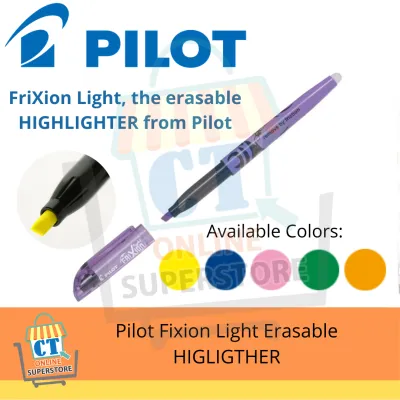
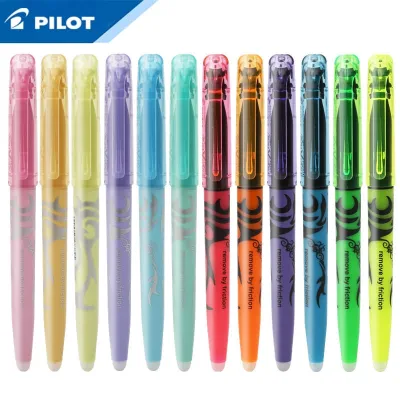
![Pilot Frixion Erasable Highlighter Pen Pink Green Blue Yellow Violet Orange Chisel Tip FriXion SW-FL Frixion Light Highlighter [Future Industries]](https://img.lazcdn.com/g/p/93ff61b8f39fc41c2f89d9bbca0cf45d.jpg_400x400q80.jpg_.webp)
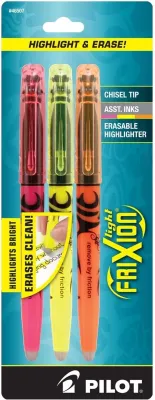
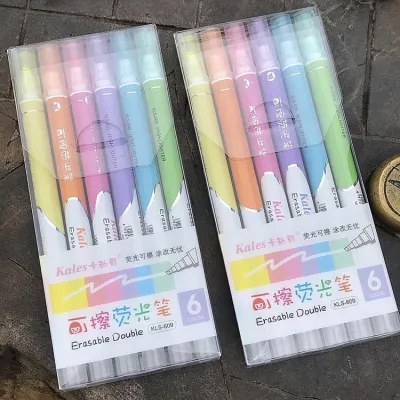
Prices are valid at publication and may change. Please refer to the product page for the latest price.
Furthermore, erasable highlighters lack the archival stability of standard permanent highlighters. Over time, the chemical bonds in thermo-sensitive ink can degrade, leading to gradual fading even under normal storage conditions. If you are preparing documents, research papers, or journals that need to be preserved for several years, erasable ink is generally not recommended. For daily study sessions, temporary lecture notes, and dynamic weekly planners, however, the flexibility of being able to erase and redraw lines outweighs these long-term preservation concerns.
Key Features to Evaluate Before Buying
When browsing the selection of erasable highlighters on local stationery shelves or online marketplaces, the physical design of the pen tip is your first major consideration. Chisel tips are the most common and versatile, allowing you to draw broad lines to cover standard text sizes or use the sharp point for fine underlining. Bullet tips offer a consistent, rounded line that is ideal for circling keywords or writing brief margin notes. Brush tips, though less common in standard highlighters, provide a flexible stroke that adapts well to creative journaling, hand lettering, and varied highlighting widths in planners.

Ink opacity and color vibrancy also differ significantly from traditional highlighters. Because of the chemical components required for thermo-sensitivity, erasable inks are naturally less saturated and may appear lighter or more pastel on the page. If you prefer high-contrast, neon-bright highlights that immediately pop, you might find erasable options slightly muted. However, many students and professionals prefer this softer palette, as it reduces eye strain during long reading sessions and prevents the highlighted text from becoming visually overwhelming.
Paper compatibility is another critical factor to test, especially when dealing with thin notebook paper, newsprint textbooks, or lightweight planner inserts. Erasable highlighters are water-based, meaning they can cause thin or low-gsm (grams per square meter) paper to warp, feather, or bleed through to the other side. Additionally, the physical act of erasing requires applying friction to the paper surface. If the paper is too delicate or has loose fibers, the friction from the rubber tip can easily pill, tear, or wear down the sheet, leaving a damaged texture that is difficult to write over.
Finally, examine the erasing mechanism itself. Most erasable highlighters feature a built-in, hard silicone or rubber tip integrated into the cap or the end of the pen body. This design is highly convenient because it ensures you always have the eraser on hand and do not have to worry about losing a separate accessory. Some specialized sets may offer separate friction-based erasers, which can be useful for erasing larger blocks of color quickly. Ensure the eraser material is firm, clean, and free of oily residues that could smudge the ink or leave dark streaks on your clean pages.
Matching Highlighter Types to Your Daily Tasks
Your daily routine and environment should dictate the specific type of erasable highlighter you choose. For students in the Philippines navigating dense textbooks, reviewer sheets, and lecture slides, color variety is often the highest priority. A wide range of colors allows for the creation of detailed color-coding systems—such as yellow for main definitions, green for formulas, and pink for exam dates. Students should look for multi-packs that offer a broad spectrum of pastel and mild tones, along with fine chisel tips that can easily fit within the narrow margins of printed handouts and pocket-sized study guides.
Professionals, on the other hand, typically require a more subdued and streamlined approach. In a corporate or office setting, bright neon colors can sometimes look unprofessional on meeting agendas, printed reports, or shared planners. Opting for subtle, neutral, or gray-toned erasable highlighters allows you to organize your tasks and highlight key action items without drawing excessive attention. Clean erasing is paramount for professionals who update physical planners or client-facing documents daily, as messy smudges or torn paper can compromise the polished appearance of your work.
Budget considerations are also essential when building your stationery kit. While premium erasable highlighters offer excellent ink flow and durable eraser tips, they generally carry a higher price per unit in ₱ compared to standard permanent highlighters. If you are a high-volume user who goes through multiple pens a term, purchasing multi-packs or looking for options that offer individual color replacements can be highly cost-effective. Evaluate your monthly usage frequency and calculate the replacement costs in ₱ to determine whether to invest in a premium, long-lasting set or a more budget-friendly bulk pack.
How to Test and Verify Performance on Your Paper
Because paper quality varies widely across different notebooks, textbooks, and office printouts, you should always perform a structured test before using a new erasable highlighter on important documents. Start by creating a small swatch test on an inconspicuous page or a spare sheet of the exact paper you plan to use. Apply a single stroke of the highlighter and observe the drying time. In the humid tropical climate of the Philippines, water-based inks can take slightly longer to dry; verifying the drying speed prevents you from accidentally smudging the ink with your hand as you continue reading.
Once the ink is completely dry, test the erasing clean-up. Apply firm, even friction with the built-in rubber eraser over a portion of the highlighted swatch. Observe the paper closely for any signs of physical damage, such as fiber pilling, thinning, or tearing. Check for ghosting—where a faint shadow of the color remains visible—or smudging, which occurs if the ink has not fully cured or if the eraser tip is dirty. A high-quality combination of paper and ink should allow the color to disappear completely, leaving a clean, smooth surface that is ready to be highlighted or written on again.
You can also test the temperature resilience of the ink to understand how it behaves in your typical daily environment. If you frequently study in non-airconditioned spaces or travel during hot afternoons, place a test sheet with highlighted text in a warm area for a few hours. Observe if any premature fading occurs. If the ink fades too easily under normal ambient heat, you may need to adjust your storage habits, such as keeping your notebooks inside an insulated bag or ensuring they are never left near windows or hot electronic devices like laptop exhaust vents.
Lastly, establish clear criteria for when to stop using a specific erasable highlighter. Over time, the felt tip of the highlighter can become frayed, split, or clogged with paper fibers, leading to inconsistent ink flow and scratchy lines. Similarly, the rubber eraser tip can accumulate dirt, graphite, or ink residue from previous corrections. If you notice that the eraser is starting to leave dark smudges instead of clearing the page, or if the ink flow becomes faint and streaky despite proper storage, it is time to replace the pen or clean the eraser tip to maintain clean notes.
Buying Online: What to Check Before and After Delivery
Purchasing stationery through online marketplaces and e-commerce platforms offers incredible convenience and access to a wider variety of erasable highlighters than what might be available in local physical stores. However, online shopping requires extra diligence to ensure you receive genuine, high-quality products. Always prioritize buying from authorized sellers, official brand stores, or highly rated stationery specialty shops. This significantly reduces the risk of purchasing counterfeit goods or old stock that has been sitting in a hot warehouse, which can dry out the thermo-sensitive ink before it even reaches your doorstep.
Before adding an item to your cart, carefully read the product listings and customer reviews. Look for any mentions of manufacturing dates or shelf-life indicators, as erasable ink formulations can degrade and lose their effectiveness over time if stored improperly. Pay close attention to recent reviews from local buyers in the Philippines, as they can provide valuable insights into how well the seller packages the items to protect them from heat and physical damage during transit through local sorting hubs.
Immediately upon receiving your delivery, conduct a thorough inspection of the highlighters. Uncap each pen and test the ink flow on a scrap piece of paper to ensure the tips are fully saturated and have not dried out. Check the physical condition of the felt tips for any splitting or deformation, and inspect the rubber eraser tips to ensure they are firmly attached and free of defects. If you detect any issues, such as dry pens or damaged tips, contact the seller immediately and utilize the platform’s return and refund policies to secure a replacement or refund.
Frequently Asked Questions (FAQ)
Can erased highlighter ink reappear if a notebook gets hot?
Actually, heat is what makes the ink disappear, while extreme cold is what can make it reappear. If you have erased some highlighted text using friction, the ink has become translucent due to the heat generated by the rubber tip. If the notebook is subsequently exposed to very cold temperatures—such as being placed in a freezer or left in an extremely cold airconditioned room—the chemical regulator in the ink can reverse, causing the faded color to become visible again. To prevent accidental ink return or unwanted fading, store your notebooks in a stable, room-temperature environment away from extreme temperature fluctuations.
Do erasable highlighters dry out faster than regular highlighters?
Erasable highlighters can be more sensitive to drying out than standard highlighters if they are not cared for properly. The specialized water-based formulation of thermo-sensitive ink evaporates relatively quickly when exposed to air. To maximize the lifespan of your pens, always snap the caps on tightly immediately after use, and store them horizontally to ensure even ink distribution to the tip. If a pen is left uncapped or exposed to direct heat sources, the ink inside the reservoir can dry out permanently, rendering the highlighter unusable.
Are erasable highlighters safe to use on official documents or legal contracts?
No, erasable highlighters should never be used on official documents, legal contracts, government forms, or school exams. Because the ink can be easily removed with friction or faded by heat, using it on legal or financial paperwork poses a significant security risk, as important markings or notes could be altered or accidentally erased. Additionally, many institutions and government offices have strict policies against the use of erasable inks on official records. For permanent documents, always use standard, archival-quality permanent highlighters and pigment-based inks that resist fading and environmental changes.
Community discussion
Share your experience or ask a question. Comments are reviewed before publication.