
Selecting the perfect writing or drawing instrument is a deeply personal decision that directly impacts the quality of your work. If you are looking for a reliable faber castell graphite pencil, the ideal grade depends entirely on your specific task, your writing pressure, and the texture of your paper. Faber-Castell utilizes the traditional European grading scale, which ranges from hard, light-marking leads to soft, deep-black leads. By understanding how these grades behave under different conditions, you can easily find the perfect match for everything from clean engineering blueprints to rich, expressive portraits.
Quick Guide: The Faber-Castell Graphite Grading Scale
The pencil grading scale is an essential map for navigating the wide range of graphite options. Faber-Castell pencils follow the European system, which uses letters and numbers to indicate the hardness and darkness of the core. The letter “H” represents “Hard,” indicating a lead that resists wear and leaves a light, precise mark. Conversely, the letter “B” stands for “Black,” denoting a soft lead that deposits a generous amount of dark graphite onto the page.
Between these two extremes lie the intermediate grades, which balance hardness and darkness for everyday utility. Numbers are added to these letters to show the intensity of the characteristic; for instance, a 9H pencil is exceptionally hard and light, while a 9B pencil is incredibly soft and dark. This standardized scale remains consistent across various product lines, such as the iconic green Castell 9000 or the student-friendly Goldfaber series, allowing you to switch between different pencil models with predictable results.
Products mentioned in this guide
![Faber-Castell CASTELL 9000 2B Graphite Pencil 12PCS/BOX [12117102ABX]](https://img.lazcdn.com/g/p/272be7d72636e081d8bb96291ec73010.jpg_400x400q80.jpg_.webp)
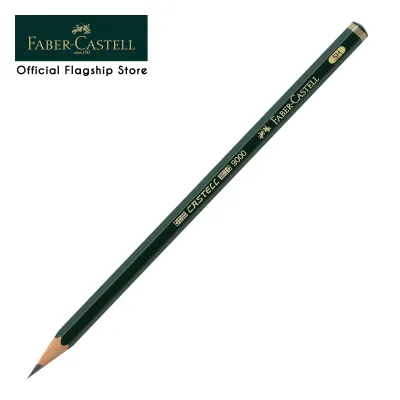
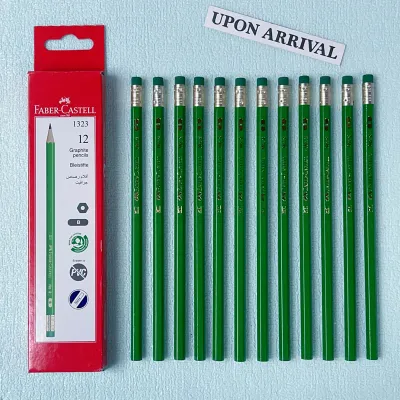
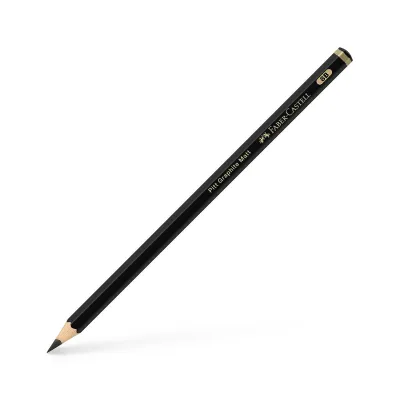
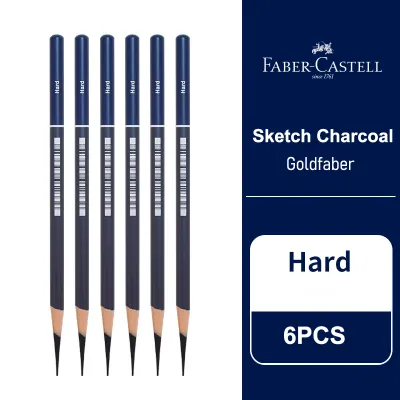
Prices are valid at publication and may change. Please refer to the product page for the latest price.
Decoding the Specs: What the Faber-Castell Graphite Pencil Grades Mean
Every pencil core is made from a carefully calibrated mixture of natural graphite and clay. The ratio of these two primary ingredients determines how the pencil behaves when it contacts paper. By adjusting this mixture, manufacturers alter the physical properties of the lead, affecting its smoothness, point retention, and erasability.

The "H" (Hard) Grades
Hard pencils, ranging from 2H up to 9H, feature a higher clay-to-graphite ratio. The clay acts as a binding agent that hardens the core, making it highly resistant to physical wear. As a result, these pencils produce clean, exceptionally fine lines and hold a sharp point for an extended period without needing frequent sharpening.
However, this hardness comes with a practical trade-off. Because the lead is so firm, you must apply more pressure to get a visible mark, which can easily indent or tear delicate paper fibers. In the humid climate of the Philippines, paper can absorb ambient moisture and become softer and more fragile. Using a high H-grade pencil on damp paper requires extra care to avoid gouging the surface, making these grades less forgiving for heavy-handed writers.
The "B" (Black/Soft) Grades
Soft pencils, spanning from 2B to 9B, contain a much higher proportion of graphite and less clay binder. This composition allows the core to crumble slightly under minimal pressure, releasing a dense layer of dark graphite particles onto the paper. These grades are prized for their buttery smoothness, effortless blending capabilities, and ability to create deep, rich shadows.
Despite their artistic advantages, soft leads require careful handling. They dull quickly, demanding frequent trips to the sharpener to maintain a fine point. Additionally, the loose graphite particles do not adhere tightly to the paper fibers, making B-grade marks highly susceptible to smudging. This smudging risk is further amplified in high-humidity environments, where moisture on your hands can easily smear the soft graphite across your notebook or sketchbook.
The Middle Ground: HB and F
For those who need a versatile tool that handles various tasks, the middle of the scale offers a practical compromise. The HB grade, which stands for “Hard Black,” represents the ultimate balance between point retention and darkness. It is dark enough to be easily readable yet hard enough to resist excessive smudging, making it the global standard for general use.
The F grade, which stands for “Fine,” is a slightly harder alternative to HB. It is formulated to sharpen to a very fine point and retain that sharpness longer than an HB, while still delivering a dark, clear line. This makes the F grade an exceptional choice for continuous, long-form writing, as it minimizes the interruption of frequent sharpening while keeping your handwriting legible and crisp.
Which Grade to Choose for Your Specific Tasks
Matching the right pencil grade to your specific activity ensures a smoother workflow and professional results. Whether you are preparing for school exams, drafting architectural layouts, or sketching in a local café, selecting the appropriate lead hardness will make your work much easier.
Everyday Writing and Note-Taking
For daily office tasks, schoolwork, and journaling, the HB and F grades are the undisputed champions. These pencils offer the best balance of legibility and clean performance. They write smoothly on standard notebook paper without leaving messy smudges on your hands or the opposite page.
While it might be tempting to use a soft 2B pencil for writing because of its dark line, doing so often results in messy notebooks. The soft graphite will easily transfer to other pages when the notebook is closed, especially under the pressure of a school backpack. Stick to HB or F for continuous writing, and ensure your pencils are certified non-toxic (such as those carrying the CE or AP marks) if they are being used by young children.
Technical Drafting and Sketching
Precision work requires a pencil that can draw ultra-fine, consistent lines without breaking or smearing. For technical drafting, architectural layouts, and the initial guidelines of an artwork, grades from 2H to 4H are highly recommended.
These hard leads allow you to map out perspective lines and structural grids that remain light enough to be easily erased once the final design is complete. Because they do not smudge, you can slide rulers and triangles across your drawing board without ruining your clean layout. These lines also serve as excellent, subtle guides that will not bleed or show through when you apply ink or watercolor washes over them.
Shading and Artistic Drawing
When it is time to add depth, dimension, and drama to a drawing, you must transition to the soft B grades. Artists typically rely on a range from 2B to 6B for expressive sketching, portraiture, and tonal shading.
Creating smooth gradients and realistic textures requires the easy blending properties of soft leads. You can use a 2B pencil for mid-tones and light shading, while reserving a 4B or 6B for deep shadows and high-contrast areas. Because these soft marks are easily smudged, it is highly recommended to work from the top-left to the bottom-right of your page (if you are right-handed) and to apply a high-quality art fixative spray over your finished piece to preserve your work.
How to Test and Verify the Right Grade for Your Paper
Because paper characteristics vary wildly, the best way to find your perfect pencil is to conduct a simple, hands-on test. The interaction between the graphite core and the paper surface—often referred to as the paper’s “tooth” or texture—plays a massive role in how the pencil performs. A soft 2B pencil might feel wonderfully smooth on a textured sketchpad but feel overly slippery and smudge-prone on a coated, ultra-smooth journal page.
To perform a swatch test, take the paper you plan to use and draw a series of small, solid blocks using different pencil grades. Apply light, medium, and heavy pressure within each block. Observe how much the paper indents under heavy pressure; if a hard pencil leaves deep grooves (ghosting) that remain after erasing, you should switch to a softer grade.
Next, run a clean finger or a blending stump across the swatches to evaluate their smudge resistance. This is particularly important in tropical climates where humidity can affect paper absorption. Finally, use a high-quality vinyl eraser to test how cleanly each grade lifts from the page. By verifying these factors beforehand, you can ensure your chosen Faber-Castell pencil will perform flawlessly for your specific writing or drawing style.
Frequently Asked Questions (FAQ)
Is a Faber-Castell HB the same as a standard No. 2 pencil?
Yes, a Faber-Castell HB pencil is the direct European equivalent to the standard No. 2 pencil commonly used in the United States and the Philippines. This means you can confidently use a Faber-Castell HB pencil for standardized exams, optical character recognition (OCR) forms, and general school tests that require a No. 2 pencil.
Do harder pencils last longer than softer ones?
Yes, harder pencils (H grades) physically last much longer than softer pencils (B grades). Because H-grade cores contain more clay, they wear down slowly and require far less frequent sharpening. While the physical length of the pencil core is identical, a soft B-grade pencil deposits significantly more graphite onto the paper with every stroke, causing the lead to wear down rapidly during use.

Community discussion
Share your experience or ask a question. Comments are reviewed before publication.