
Selecting the correct graphite grade is one of the most critical decisions in pencil drawing, as it directly determines the tonal depth, line quality, and texture of your artwork. The choice between HB, 2B, 4B, and 6B pencils is not merely a matter of personal preference; it is a technical decision that influences how graphite interacts with paper fibers under varying levels of hand pressure. Understanding when to deploy each grade allows you to execute precise details, smooth gradients, and deep, dramatic shadows without damaging your drawing surface.
To help you make an immediate decision for your current project, consider this practical, condition-based framework:
- Choose HB if you need precise outlines, light initial guidelines, or are executing tight architectural drafting and technical layouts.
- Choose 2B if you want a versatile, all-rounder pencil for everyday sketching, rapid gesture drawing, and general structural layouts.
- Choose 4B if your primary focus is on expressive shading, building rich mid-tone depth, and creating smooth, realistic gradients in portraiture.
- Choose 6B if you need to push deep, dramatic shadows, blend softly, and establish high-contrast, charcoal-like values.
While each grade has a distinct specialty, professional pencil drawing rarely relies on a single pencil. Instead, artists typically combine these grades in a structured sequence, moving from hard to soft to build a complete, three-dimensional tonal range. By selecting the right grade for each stage of your drawing, you preserve the integrity of your paper and achieve a professional, polished finish.
Products mentioned in this guide
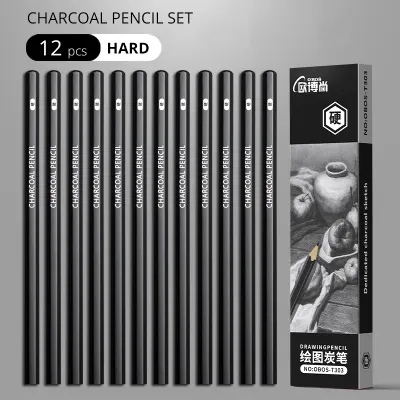
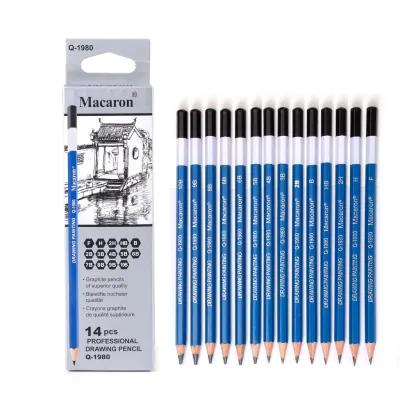
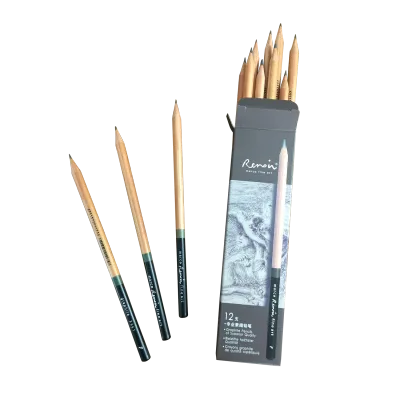
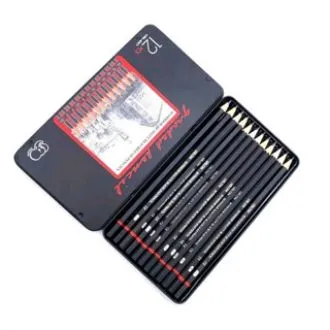
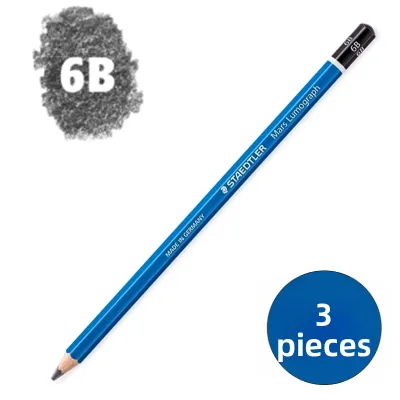
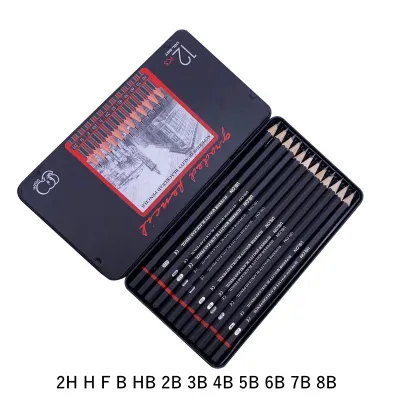
Prices are valid at publication and may change. Please refer to the product page for the latest price.
How the Graphite Grading Scale Works
The graphite grading scale is an international standard that measures the hardness and blackness of a pencil core. This system uses the letters H (Hard) and B (Black) to designate the physical properties of the lead. The scale runs from extreme H grades (which are exceptionally hard and light) to extreme B grades (which are incredibly soft and dark), with F (Firm) and HB sitting directly in the center as the neutral balancing points.
The physical behavior of each pencil grade is determined during manufacturing by the ratio of clay binder to graphite. Natural graphite is a soft, greasy, and highly reflective carbon material that easily transfers to surfaces. Clay, on the other hand, is dry, rigid, and holds its shape under pressure. By blending these two raw materials in precise proportions, manufacturers control how easily the pencil deposits material onto the paper:
- High Clay Content (H Grades): A higher proportion of clay creates a structurally rigid core. When you draw, the hard clay matrix limits the amount of graphite that can rub off onto the paper. This results in thin, light grey lines that resist smudging.
- High Graphite Content (B Grades): A higher proportion of graphite creates a soft, crumbly core. The weak clay matrix allows a massive volume of loose graphite particles to transfer to the paper with minimal friction, resulting in rich, dark black marks.
Within this vast scale, the HB, 2B, 4B, and 6B range represents the essential sweet spot for most artistic applications. Extreme H grades (such as 6H to 9H) are far too light and abrasive for expressive art, often scratching the paper fibers rather than coating them. Conversely, extreme B grades (such as 8B to 10B) are highly unstable, crumbling under moderate pressure and creating excessive dust that smudges at the slightest touch. The core range of HB to 6B provides artists with the perfect balance of control, tonal variety, and structural stability.
Comparing Line Quality, Tone, and Handling in Pencil Drawing
To understand how these four pencil grades perform in real-world conditions, it is helpful to compare their physical output and handling characteristics side-by-side. The table below outlines how each grade behaves across key performance metrics.

| Pencil Grade | Hardness/Feel | Line Darkness | Smudge/Blend Ability | Point Retention |
|---|---|---|---|---|
| HB | Firm, slightly scratchy | Light grey | Low; clean lines | Excellent; holds a sharp tip |
| 2B | Moderately soft, smooth | Medium-dark grey | Moderate; easy to control | Good; standard wear |
| 4B | Soft, buttery | Dark charcoal grey | High; blends smoothly | Low; wears down quickly |
| 6B | Very soft, crumbly | Deep near-black | Very high; highly blendable | Very low; requires constant sharpening |
These physical differences directly dictate how you must handle each pencil during a drawing session. Harder pencils like the HB require very little maintenance. They hold a fine, needle-like point for extended periods, making them ideal for intricate details. However, they carry a distinct physical risk: because the core is hard, applying excessive downward pressure in an attempt to make a darker line will score or indent the paper. These physical grooves are permanent; they cannot be erased, and if you attempt to shade over them later with a softer pencil, the graphite will skip over the groove, leaving an unsightly white line in your artwork.
Softer pencils like the 4B and 6B require a completely different handling technique. Because they deposit a high volume of loose graphite particles, they wear down to a flat, dull edge within just a few strokes. This means you must sharpen them frequently to maintain line control. The loose graphite particles also sit loosely on top of the paper fibers rather than embedding deeply into them, making them highly susceptible to accidental smudging from your hand.
In tropical, high-humidity environments like the Philippines, managing this loose graphite is particularly challenging. High ambient humidity softens paper fibers, making them more absorbent and prone to swelling. When paper absorbs moisture, soft graphite from a 4B or 6B pencil can become muddy and smear across the page much more easily than it would in a dry climate. To combat this, artists working in humid conditions should always use a clean sheet of scrap paper or a specialized drawing glove under their hand to prevent skin oils and moisture from mixing with the loose graphite.
Matching Pencil Grades to Specific Drawing Techniques
Every drawing style requires a specific interaction between the pencil tip and the paper surface. By matching the mechanical properties of HB, 2B, 4B, and 6B pencils to specific stages of your drawing, you can work more efficiently and achieve cleaner results.
HB: Precision, Outlines, and Light Sketching
The HB pencil is the ultimate tool for structural accuracy and planning. Because it leaves a light, crisp mark that sits lightly on the surface, it is the ideal grade for laying down your initial guidelines, perspective grids, and proportional envelopes. If you make a mistake during this early, exploratory phase, the HB graphite can be erased completely without leaving ghost images or smudges behind.
This grade is also highly valued in technical drawing, architectural sketching, and tight realism. When drawing fine details like individual hairs, wood grain, or sharp metallic edges, the HB holds its sharp point long enough to execute consistent, uniform lines. To get the best results, hold the pencil further back from the tip and use a feather-light touch. Let the natural weight of the pencil do the work; never press hard into the paper to force a darker tone from an HB.
2B: The Versatile All-Rounder for Everyday Sketching
If you could only carry a single pencil in your sketchbook, the 2B is the undisputed choice. It represents the perfect equilibrium of the graphite scale, offering enough darkness to create impactful sketches while retaining enough hardness to keep a usable point. This balance makes it the standard tool for rapid gesture drawing, life drawing classes, and capturing quick observational studies on the go.
In everyday sketching, the 2B allows you to transition seamlessly from line work to basic shading. By tilting the pencil to utilize the side of the exposed lead, you can quickly lay down soft mid-tones, then rotate it back to the tip to define sharp contours. It provides a smooth, drag-free drawing experience without the scratchiness of harder grades, making it highly comfortable for long, continuous sketching sessions.
4B: Expressive Shading and Mid-Tone Depth
As you move into the shading phase of a drawing, the 4B becomes your primary workhorse for building form, volume, and three-dimensional depth. This grade is soft enough to bridge the gap between light guidelines and deep, dark shadows, making it essential for rendering smooth gradients on organic surfaces like human skin, fabric drapery, and rounded botanical subjects.
With a 4B pencil, you can achieve rich, dark values with very light hand pressure, which protects the texture of your drawing paper. It is particularly effective for cross-hatching and tonal blending. Because the graphite is soft, the lines blend together naturally under the pressure of successive layers, allowing you to create the illusion of soft light wrapping around a curved object. When using the 4B, focus on building your values gradually in thin, overlapping layers rather than trying to achieve maximum darkness in a single pass.
6B: Deep Shadows, Blending, and Dramatic Contrast
The 6B pencil is reserved for the final, high-impact stages of a drawing. Its primary purpose is to establish maximum contrast by pushing the darkest areas of your piece—such as the deep shadows under a figure, the pupils of an eye, or the dramatic dark backgrounds of a chiaroscuro composition. Without the deep blacks provided by a 6B, drawings can often look flat, washed out, and lacking in visual impact.
The ultra-soft, buttery core of the 6B makes it incredibly easy to blend using tools like blending stumps (tortillons), chamois leather, or even a dry paint brush. However, this extreme softness comes with a high risk of smudging. A finished 6B drawing is highly fragile; simply closing your sketchbook can transfer graphite to the opposite page. To preserve your work, always apply a light coat of workable spray fixative once the drawing is complete, and store your finished pages away from high humidity to prevent the graphite from transferring or dulling over time.
How to Build a Minimal Pencil Drawing Kit
Many beginners make the mistake of purchasing large, expensive 12-piece or 24-piece pencil sets. In reality, most of those pencils will go completely unused, as the extreme hard grades are too abrasive for artistic work and the extreme soft grades are too messy for general use. A far more practical, cost-effective, and highly portable approach is to curate a minimal, high-quality kit focused on a core selection of grades.
To build a highly versatile kit, you only need three essential pencils: an HB for light outlines, a 2B for mid-tones and structural sketching, and either a 4B or 6B for deep, dramatic shadows. In the Philippines, high-quality professional drawing pencils typically range from ₱40 to ₱100 per pencil in specialized art supply stores, while basic student-grade options can be found for ₱15 to ₱30. Investing in a few premium individual pencils is always preferable to buying a cheap, low-quality set with cores that break internally during sharpening.
When building your kit, keep in mind that pencil performance is heavily dependent on the paper you choose. Graphite requires a physical texture, known as “tooth,” to scrape the material off the pencil core.
- Smooth Paper (e.g., Bristol Board): Excellent for HB and 2B precision work, but struggles to hold the heavy graphite layers of a 4B or 6B, which can quickly saturate the surface and look shiny or slick.
- Textured Paper (e.g., Cartridge Paper or Medium-Tooth Sketchpads): Highly recommended for general drawing. The textured surface easily grabs the soft graphite of 4B and 6B pencils, allowing you to build rich, deep values without slipping.
To complete your minimal kit, skip the standard hard pink erasers, which tear paper fibers and smear graphite. Instead, include a kneaded eraser. This pliable, clay-like tool can be molded into precise points to lift graphite vertically off the page, allowing you to clean up highlights and correct mistakes without damaging your paper or smudging your clean line work.
Frequently Asked Questions (FAQ)
Can I use a 6B pencil for writing or everyday notes?
While you can physically write with a 6B pencil, it is highly impractical for daily note-taking. Because the core is exceptionally soft, the tip will wear down to a flat, dull edge within writing just a few sentences, requiring constant sharpening. Additionally, the high volume of loose graphite will smudge easily as your hand moves across the page, leaving messy grey streaks on your paper and dark stains on your skin.
Why does my HB pencil tear the paper when I try to shade?
An HB pencil contains a high proportion of clay binder, making the core physically hard and abrasive. If you try to force a dark shadow out of an HB by pressing down hard, the sharp, rigid tip will slice through the paper fibers and create permanent physical indentations. If you need a darker tone, do not apply more pressure; instead, switch to a softer B-grade pencil like a 2B or 4B, which will deposit dark graphite with minimal effort.
Do I need an 8B or 9B if I already have a 6B?
For the vast majority of standard drawing styles, a 6B pencil provides more than enough darkness to establish a full tonal range. Extreme grades like 8B or 9B are highly specialized tools that behave almost like charcoal; they are incredibly crumbly, generate a lot of dust, and smudge at the slightest touch. They are typically only necessary for large-scale, expressive drawings, hyper-realistic portraits requiring absolute pitch-black values, or artists who prefer a highly textured, charcoal-like finish.

Community discussion
Share your experience or ask a question. Comments are reviewed before publication.