
When your daily office tasks involve binding thick reports, legal briefs, or academic manuscripts, a standard desk stapler often leaves you with bent wire, torn pages, and jammed mechanisms. Choosing the right heavy-duty stapler requires matching your maximum document stack height (measured in sheets and paper weight) and your daily binding frequency to the correct staple leg length, physical form factor, and mechanical leverage of the machine. By evaluating your specific volume needs, you can transition to a heavy-duty model that uses thicker wire gauges and longer staple legs, ensuring clean, professional binding without physical strain or wasted consumables.
Standard office staplers are typically engineered to handle up to 20 or 25 sheets of standard 80 GSM copy paper. Attempting to force these smaller tools through thicker stacks damages both the document and the internal spring alignment of the stapler. A heavy-duty stapler, by contrast, utilizes robust leverage systems and thicker steel components designed to pierce through 50, 100, or even over 200 sheets of paper with minimal effort. Investing in the correct tool not only streamlines your administrative workflow but also ensures that your bound documents remain secure, neat, and presentable for clients, colleagues, or archival storage.
Do You Actually Need a Heavy Duty Stapler for Your Current Workflow?
You need a heavy-duty stapler if your documents regularly exceed 20 to 30 sheets of paper or if your current standard stapler frequently jams, bends staples, or fails to penetrate the entire stack. Upgrading is justified when the physical limits of standard office fasteners cause consistent document damage and lost productivity.
Products mentioned in this guide
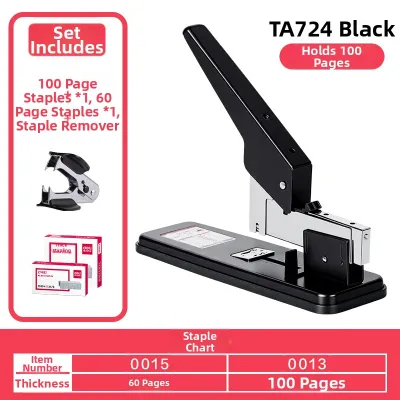
189 Lazada user ratings
It works great and can staple very thick stacks of paper. The color is quite nice. It staples very securely, and the base is quite stable.
The quality is excellent, and it's a trusted big brand! It's really easy to use!
It's pretty much like this, a stapler that's nice and hefty, all in black.
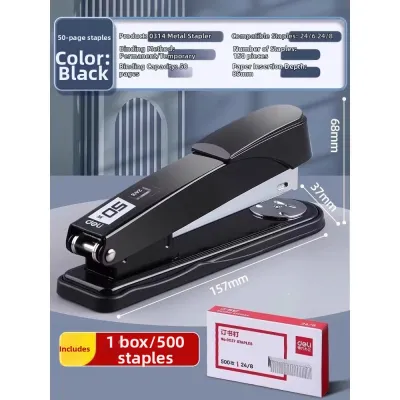
51 Lazada user ratings
Nabuksan pa lang hindi pa nagagamit, mukhang ok naman sia at maganda naman itdura
Durability:smooth
long lasting
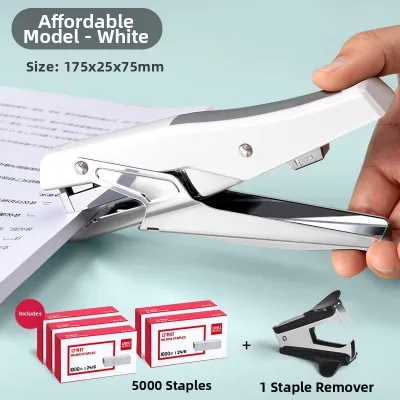
31 Lazada user ratings
Good seller service, Perfect for office, Versatile usage, Ideal for thick documents, Durable material, Powerful mechanism, Easy to use, Fast…Read full reviewShow less
Good seller service, Perfect for office, Versatile usage, Ideal for thick documents, Durable material, Powerful mechanism, Easy to use, Fast and efficient, Ease of Use:good Design:go Durability:good
Versatile usage, Ergonomic grip, Ideal for thick documents, Durable material, Good seller service,
Powerful mechanism, Good seller service, Ideal for thick documents,
Very nice product I like it very much
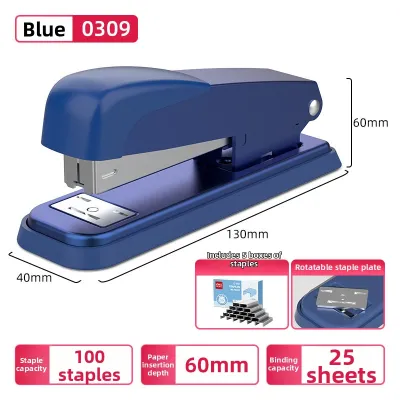
7 Lazada user ratings
Deli products are always great and this one is really good. It is very convenient for binding my child's thick test papers. I would definite…Read full reviewShow less
Deli products are always great and this one is really good. It is very convenient for binding my child's thick test papers. I would definitely buy this again.
Deli products are reliable and work really well. It is very convenient for stapling my child's thick school papers. I would definitely buy t…Read full reviewShow less
Deli products are reliable and work really well. It is very convenient for stapling my child's thick school papers. I would definitely buy this again.
The stapler is very easy to use and quite nice; I really like it, and my child loves the blue color too.
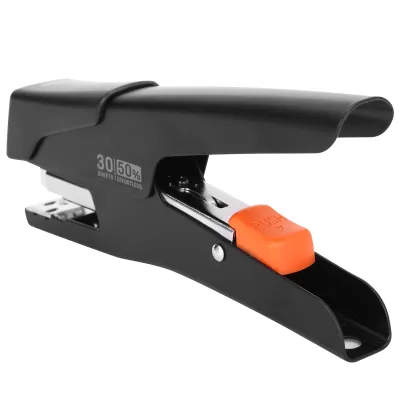
3,373 Lazada user ratings
Durable and reliable., Compatible with 24/6 and 26/6 staples., Efficient and precise stapling., Sleek and stylish design., High-quality offi…Read full reviewShow less
Durable and reliable., Compatible with 24/6 and 26/6 staples., Efficient and precise stapling., Sleek and stylish design., High-quality office essential., Effortless stapling experience!, Perfect for heavy-duty tasks.,
Design:sleek and stylish design saves time and effort Ease of Use:efficient and preice staplingCompatible with 24/6 and 26/6 staples., Durab…Read full reviewShow less
Design:sleek and stylish design saves time and effort Ease of Use:efficient and preice staplingCompatible with 24/6 and 26/6 staples., Durability:Staples up to 30 sheets with ease.,
Durability: High-quality office essential., Durable and durable and reliable Efficient and precise stapling., I love the design and this is …Read full reviewShow less
Durability: High-quality office essential., Durable and durable and reliable Efficient and precise stapling., I love the design and this is ideal for office use.
Product received within a week. No damage and quality is just right for the amount. Otherwise i give it a five star.
ang swabe. it is easy to use. bought this for organizing our office documents like contracts and proposals. thanks.
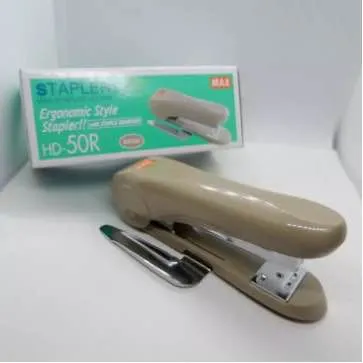
94 Lazada user ratings
Design:Great aesthetics, Ease of Use:Simple and intuitive, User-friendly design, Durability:Well I hope it would hold it's own against a fal…Read full reviewShow less
Design:Great aesthetics, Ease of Use:Simple and intuitive, User-friendly design, Durability:Well I hope it would hold it's own against a fall to the floor.
fast delivery. trusted brand as I have similar stapler and same size. durable and long lasting usage.
Design:great Ease of Use:good Durability:excellent
Design:Attractive colors, Great aesthetics,
good quality. well pack and rider is good .
Prices are valid at publication and may change. Please refer to the product page for the latest price.
When a standard stapler is pushed past its limit, the staple legs buckle before penetrating the bottom sheets, creating a safety hazard of exposed sharp metal. This failure is a clear indicator that your current workflow has outgrown standard office supplies. The cost of replacing cheap standard staplers repeatedly—often ranging from ₱300 to ₱600 per unit—quickly surpasses the single upfront investment of a robust heavy-duty stapler, which can range from ₱1,200 to over ₱3,000 depending on capacity. Additionally, consider the volume of wasted staples and the time spent clearing jams.
When employees must manually pry open bent staples with a letter opener or scissors, it wastes valuable minutes and risks tearing the paper, which then requires a complete reprint of the document. If your documents regularly exceed 150 or 200 sheets, however, even heavy-duty staplers may struggle; at this extreme thickness, alternative binding methods like plastic comb binding, wire-o binding, or heavy-duty clamp clips offer a more secure and professional finish without risking mechanical damage to your stapling equipment. Evaluating your exact document thickness prevents you from over-investing in an excessively large stapler when a mid-range heavy-duty model or an alternative binding system would serve your office more efficiently.
How Many Sheets Do You Need to Bind in a Single Stack?
To determine the correct stapler capacity, you must calculate your maximum stack height based on the actual paper weight (GSM) you use rather than relying solely on the sheet-count printed on the packaging. Matching this thickness to the correct staple leg length ensures the staple can fully penetrate the stack and fold flat.

Most manufacturer sheet capacities are rated using standard 70 GSM or 80 GSM copy paper. If your workflow involves thicker materials, such as 100 GSM presentation paper, 120 GSM letterheads, or heavy cardstock covers, a stapler rated for “100 sheets” might only handle 70 or 80 sheets safely. To find the right fit, measure the physical thickness of your typical maximum stack. The staple leg must be long enough to pass through the entire stack and leave at least 3 to 4 millimeters of wire to fold over flat on the back.
Standard copy paper is relatively thin, but cardstock can be 200 to 300 GSM. If you are binding a report with a cardstock cover, that single cover sheet is equivalent to three or four standard sheets of paper. If the leg is too short, the staple will not close; if it is too long, the excess wire will overlap awkwardly, creating a bulky corner that can tear adjacent documents. Maintaining a 20% capacity buffer is highly recommended. For example, if you regularly staple 80-sheet documents, choose a stapler rated for at least 100 sheets to minimize wear on the internal driving blade and spring mechanism. This buffer prevents the stapler from operating at its absolute mechanical limit, extending the lifespan of the tool and ensuring consistent, clean penetration with every use.
Should You Use a Desktop or Handheld Heavy Duty Stapler?
Choose a desktop heavy-duty stapler if you primarily bind thick documents at a fixed workstation, as these models provide a stable base and increased leverage. Opt for a handheld heavy-duty stapler if your tasks require mobility, binding at unusual angles, or working away from a desk.
Desktop heavy-duty staplers are designed to sit flat on a work surface, utilizing a long lever arm that allows you to use your body weight rather than raw hand strength to press the staple through the paper. This design is essential for stacks exceeding 50 sheets, where the physical force required is substantial. These models often feature non-slip rubber bases to prevent sliding during operation, ensuring that the driving force is directed straight down through the paper stack. Desktop models require dedicated desk space, often measuring 30 centimeters or more in length, so they are best suited for permanent administrative stations.
Handheld heavy-duty staplers, sometimes called plier staplers, rely entirely on your grip strength. While they offer excellent portability and are ideal for packaging, tagging, or quick binding in retail and warehouse environments, they typically cap out at a lower sheet capacity (often around 40 to 50 sheets) to prevent hand fatigue. Handheld models can be tucked away in a drawer or carried in a tool belt, making them highly versatile. Ergonomically, look for contoured handles with rubberized grips on handheld models, and extended, padded levers on desktop models to distribute pressure evenly across your palm. Choosing the wrong form factor can lead to physical strain, especially during repetitive binding sessions.
How Does Your Daily Stapling Frequency Dictate the Mechanism Type?
Your daily stapling frequency determines whether you should invest in a manual lever-action stapler or an electric/assisted-spring model. High-volume, repetitive tasks require assisted or electric mechanisms to prevent repetitive strain injuries and maintain workflow speed.
For offices that only bind thick reports a few times a week, a manual lever-action stapler is highly efficient and cost-effective. These manual units rely on robust internal spring tension and solid steel driving channels to deliver force. However, if your workflow requires stapling dozens of thick documents every hour, manual operation will quickly lead to operator fatigue and inconsistent binding. Electric heavy-duty staplers automate the driving force entirely, activating via a sensor when the paper stack is inserted.
Electric models ensure a uniform punch every time, regardless of user strength. Some electric models require a constant AC wall outlet connection, which limits where you can place them, while others use batteries but may have lower driving power as the batteries drain. When evaluating durability, inspect the construction materials: high-frequency environments require all-metal internal components and heavy-gauge steel housings. Plastic housings may suffice for light or occasional use, but they are prone to cracking under the high impact forces generated during heavy-duty stapling. Ensuring that the internal mechanism is made of hardened steel guarantees that the stapler can withstand thousands of cycles without losing alignment.
Which Staple Sizes and Wire Gauges Are Compatible With Your Choice?
You must select staple sizes and wire gauges that match both your document thickness and the specific mechanical requirements of your stapler model. Using incompatible staples is the primary cause of jamming, weak binds, and mechanical damage.
Heavy-duty staples are categorized by their wire thickness (gauge) and leg length, often represented by dual numbers like 23/10 or 23/13. The first number (e.g., 23) refers to the wire gauge—where a lower number indicates a thicker, stronger wire—and the second number (e.g., 10 or 13) indicates the leg length in millimeters. Standard office staples (typically 26/6) are too thin and short to penetrate dense stacks. Thicker documents require heavy-gauge wire (such as 23-gauge or 24-gauge) to resist buckling as they are driven through the paper.
Heavy-duty staples are often made of high-carbon steel to prevent buckling, whereas standard staples use softer, zinc-plated wire. Always consult your stapler’s instruction manual or the compatibility label on the magazine before purchasing refills. There is no universal standard across brands; some heavy-duty staplers are engineered specifically for proprietary staple SKUs, and using generic alternatives can void warranties or cause persistent feeding issues. Verifying the exact dimensions and wire specifications before purchasing ensures smooth operation and prevents the frustration of clearing avoidable jams.
What Built-In Features Prevent Jamming During Heavy Use?
Built-in anti-jam mechanisms, adjustable paper guides, and clear-out buttons are essential features that minimize downtime and simplify maintenance during high-volume stapling. These design elements ensure consistent alignment and allow you to quickly clear misfed staples without tools.
Even high-quality heavy-duty staplers can experience jams if a staple hits an exceptionally dense spot or if the paper is misaligned. Look for models equipped with a dedicated jam-release button, which instantly clears the driving channel by releasing tension on the staple magazine. Front-loading magazines, which slide out from the front at the press of a button, are generally easier to reload and clear than traditional back-loading spring assemblies.
An adjustable paper depth guide (or throat depth regulator) is another crucial feature; it allows you to set a consistent margin for where the staple penetrates the page, preventing crooked or shallow binds. Finally, a clear window or low-staple indicator helps you monitor your consumable levels, preventing “dry firing” which can dull the driving blade over time. A simple test is to staple a scrap stack of the target thickness and observe if the staple legs fold symmetrically on the reverse side. These small but practical features collectively ensure a smoother, more reliable binding process for all your heavy-duty document needs.
Community discussion
Share your experience or ask a question. Comments are reviewed before publication.