
Finding a reliable index cards set 100 pcs in the Philippines requires looking beyond the simple count on the packaging. Whether you are a student preparing for board exams, a reviewer mastering active recall, or an office professional organizing physical records, the paper quality, ruling, and durability of your cards directly impact your daily productivity. Because local stationery shops and online marketplaces offer a wide variety of options with varying paper weights and finishes, making an informed purchase means understanding how to evaluate these products. This guide provides a comprehensive framework to help you select, match, and verify the ideal 100-piece index card set for your specific writing tools and organizational workflows.
Key Specifications to Check When Buying Index Cards
The weight of the paper, typically measured in grams per square meter (GSM), is the most critical factor determining card quality. Standard writing paper is usually around 70 to 80 GSM, whereas high-quality index cards should ideally range from 150 GSM to 230 GSM. A higher GSM indicates a thicker, more rigid cardstock that resists bending and prevents ink from showing through on the reverse side. If you plan to write on both sides of the card—which is standard practice for flashcards—look for a minimum of 180 GSM to ensure complete opacity. Thinner cards under 120 GSM behave more like heavy writing paper, which may warp or tear under heavy ink flow or frequent handling.
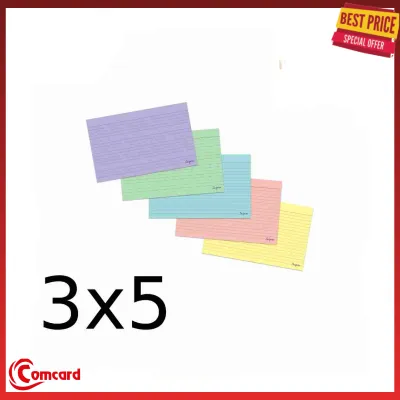
Index cards are traditionally available in three standard sizes, each suited to different levels of detail. The classic 3×5 inch (approximately 76×127 mm) card is highly portable and perfect for short definitions, vocabulary words, or quick formulas. The medium 4×6 inch (approximately 102×152 mm) card offers more space for detailed study notes, presentation outlines, or recipe records. The large 5×8 inch (approximately 127×203 mm) card functions almost like a small notebook page, making it ideal for comprehensive summaries, project planning, or meeting minutes.
Products mentioned in this guide
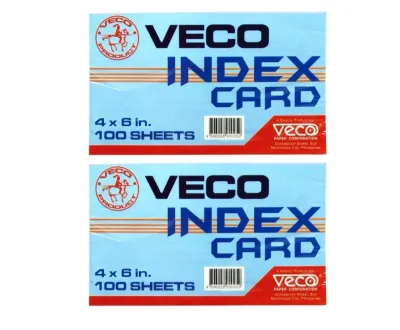
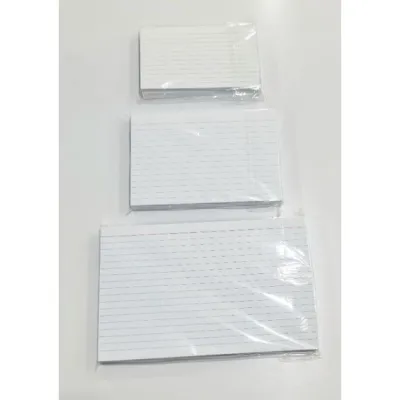
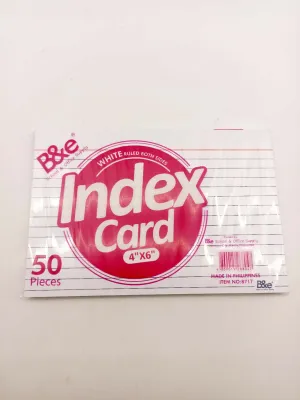
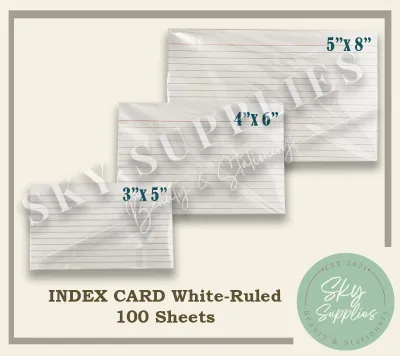
Prices are valid at publication and may change. Please refer to the product page for the latest price.
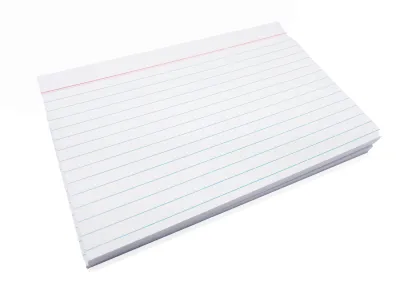
Beyond size, the ruling format dictates how you organize information. Lined or ruled cards feature horizontal lines, often with a red margin line at the top, which helps keep text neat and readable. Blank cards offer complete creative freedom, making them the preferred choice for mind maps, sketches, diagrams, or clean visual aids. Grid or graph-ruled cards feature a light grid pattern, which is incredibly useful for mathematical equations, scientific diagrams, or structured data tables.
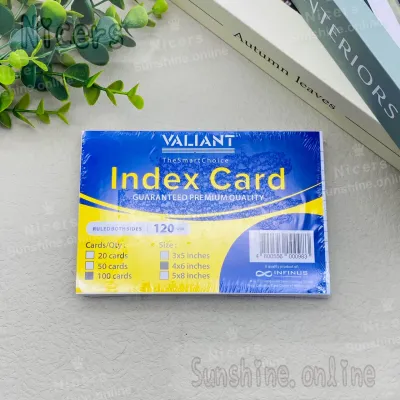
The way a 100-piece set is packaged plays a vital role in preserving the condition of the cards before they reach your desk. Shrink-wrapped sets are tightly sealed in plastic, which provides excellent initial protection against moisture and dust during transit, though they offer little structural support once opened. Boxed sets come in a dedicated cardboard or plastic box, providing a built-in storage solution that keeps the cards upright and prevents the corners from fraying. Banded sets are held together by a simple paper or plastic band; while eco-friendly, they require immediate transfer to a card holder or drawer to prevent the stack from scattering or bending in a crowded bag.
Matching Index Card Features to Your Daily Tasks
For students and language learners in the Philippines, index cards are indispensable tools for active recall and spaced repetition. When creating flashcards, portability is key, as you will likely carry them in your bag to study during commutes or between classes. A 3×5 inch, blank or grid-ruled card is highly recommended for this purpose. The blank side allows you to write a prompt or question without any visual distractions, while the reverse side can hold the answer or explanation. Opting for a thicker cardstock ensures that you cannot see the answer through the card, which is crucial for maintaining the integrity of your self-testing sessions.

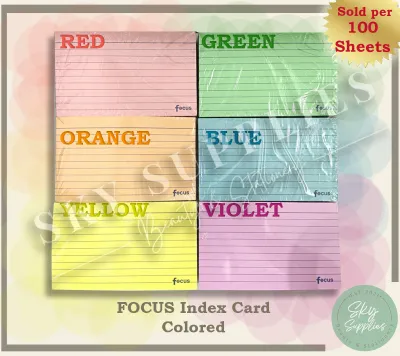
In professional or home office environments, index cards serve as excellent tools for inventory tracking, recipe logging, and physical filing systems. For these tasks, color-coded index card sets are highly beneficial. Using different colors—such as blue for client contacts, yellow for urgent tasks, and pink for administrative notes—allows for instant visual categorization. Ruled 4×6 inch cards are particularly suited for these applications, as the pre-printed lines ensure that contact details, step-by-step instructions, or tracking logs remain perfectly aligned and easy to read at a glance.
The surface finish of the cardstock determines how well it interacts with different writing instruments and how it holds up to frequent handling. Matte, uncoated cardstock is the most common and versatile finish. It absorbs ink quickly, making it highly compatible with gel pens, ballpoints, and pencils. However, uncoated paper is more susceptible to absorbing atmospheric moisture, which can soften the cards over time in humid tropical climates. Coated or semi-glossy cards offer a smoother writing experience and slightly better resistance to light wear, but they require slow-drying inks to be avoided, as gel and rollerball pens will easily smudge on their non-porous surfaces.
Practical Quality Checks Before and After Purchase
Once you receive your 100-piece index card set, it is wise to perform a quick ink compatibility test on a single card before writing on the entire batch. Take your most frequently used pens—such as a gel pen, a ballpoint, a fine liner, or a highlighter—and draw a few test lines on one corner of a card. Observe how the ink behaves on the paper surface. If the ink spreads outward along the paper fibers, this is known as feathering, which indicates a highly absorbent, lower-quality cardstock. Flip the card over to check for bleed-through; if the ink has penetrated to the back, you may need to switch to a drier ballpoint pen or a pencil to utilize both sides of the cards. Additionally, note the drying time to prevent accidental smudging during fast-paced note-taking.
High-quality manufacturing is reflected in the precision of the card cuts. Inspect the edges of the stack to ensure they are clean, straight, and free from paper burrs or fraying. If the set features rounded corners, check that the radius is consistent across all cards. Rounded corners are highly desirable because they are less likely to catch on clothing or bend when slid into pockets or card holders. If the cards were originally bound together as a pad, check the top edge for any sticky glue residue; excess adhesive should be gently rubbed off to prevent the cards from sticking together in your storage box.
It is always good practice to verify that your package contains the full 100 pieces as advertised. While counting, stack the cards tightly together on a flat surface to check for dimensional consistency. Every card in the set should be identical in height and width; uneven cuts can make shuffling difficult and look untidy in a filing box. Finally, inspect the stack for any signs of warping or bending. In the Philippines, high humidity can cause paper products to absorb moisture unevenly, leading to curled edges. A perfectly flat stack indicates that the paper was properly cured and packaged in a moisture-controlled environment.
Frequently Asked Questions (FAQ)
Can I use wet-ink pens on standard index cards without bleeding?
Whether you can use wet-ink pens, such as fountain pens, rollerballs, or heavy gel pens, depends entirely on the paper weight and the sizing treatment of the cardstock. Standard, budget-friendly index cards often use highly absorbent, low-GSM paper that causes wet inks to bleed through to the back and feather across the surface. To determine if your cards can handle wet ink, conduct a simple corner test: write a few words using your wettest pen and wait thirty seconds. If the lines remain sharp and do not show through the reverse side, the cardstock is suitable for wet-ink writing. If bleeding occurs, switching to a standard ballpoint pen or a dedicated extra-fine gel pen will yield much cleaner results.
How should I store paper cards to prevent warping in humid weather?
In the tropical climate of the Philippines, high relative humidity can cause paper index cards to absorb moisture from the air, leading to limp, warped, or curled edges. To preserve the stiffness and quality of your cards, store them in a tightly sealed plastic container, a dedicated card box, or a zippered pouch when they are not in active use. Avoid leaving loose cards exposed on open desks or near windows where damp air and direct sunlight can accelerate degradation. For long-term storage, placing a small silica gel packet or desiccant inside your storage box will actively absorb excess moisture, keeping your 100-piece set crisp, dry, and ready for writing.
Community discussion
Share your experience or ask a question. Comments are reviewed before publication.