
Maintaining a consistent bullet journaling routine requires a tool that can keep up with your rapid logging, habit tracking, and creative layouts without cluttering your desk. Carrying a separate pen for every color in your coding system often leads to a bulky pencil case and interrupted focus as you constantly cap and uncap different barrels. A reliable multi-color pen solves this dilemma by consolidating your essential color palette into a single, convenient writing instrument. Finding the right multi-color pen for journaling in the Philippines involves balancing technical ink performance against paper compatibility, choosing an ergonomic switching mechanism, and ensuring you can easily source authentic refills locally.
What tip sizes and ink properties work best for bullet journaling?
The ideal tip size and ink formulation for bullet journaling depend on your layout style and how quickly you need the ink to dry on the page. Generally, fine tips between 0.38mm and 0.5mm prevent ink from spreading on standard grid paper, while gel or emulsion inks offer a practical balance of smoothness and drying speed.
When selecting a tip size, consider the grid or dot spacing of your journal. Most bullet journals feature a 5mm dot grid, which leaves very little vertical space for handwriting. A 0.38mm or 0.4mm ultra-fine tip is highly suitable for these tight layouts, as it allows you to write legible characters within a single grid row and draw precise lines for habit trackers. A 0.5mm fine tip offers a slightly bolder line that remains clean and readable for daily task lists. If you prefer writing large, expressive headers or coloring in small icons, a 0.7mm medium tip provides excellent coverage, though it lays down a heavier volume of ink that requires careful handling to avoid smudging.
Products mentioned in this guide
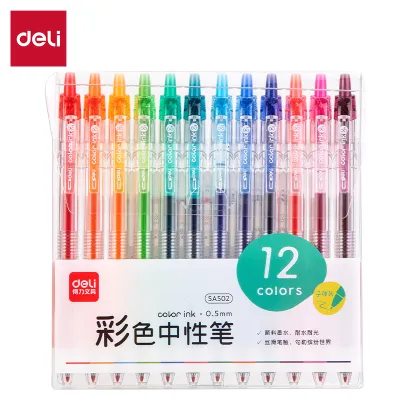
24 Lazada user ratings
The colors are vibrant, and the gel ink looks really nice.
The only way I could manage that was if you had to do it.
Totally trustworthy seller. Great quality item.
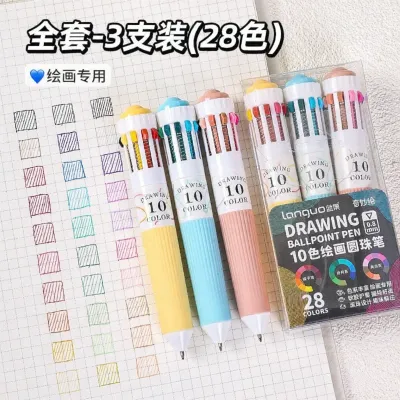
17 Lazada user ratings
I bought the complete set of gel pens, and they're really great to use! They're perfect for drawing and adding details. I'm very satisfied w…Read full reviewShow less
I bought the complete set of gel pens, and they're really great to use! They're perfect for drawing and adding details. I'm very satisfied with them for my journaling.
I bought the full set of ballpoint pens and they're really great for drawing and adding fine details. I'm very satisfied with them for my jo…Read full reviewShow less
I bought the full set of ballpoint pens and they're really great for drawing and adding fine details. I'm very satisfied with them for my journaling.
as expected goods for drawing and blending colors tnx kuya rider and lazada
completed the colors and the paper was so cute and small
received my parcel in good condition
Prices are valid at publication and may change. Please refer to the product page for the latest price.
Ink chemistry is equally critical to your journaling experience, especially in the humid climate of the Philippines, which can prolong drying times. Gel ink is frequently chosen by stationery enthusiasts for its vibrant, saturated colors and smooth glide across the page. However, because gel ink is water-based and goes on wet, it is prone to smudging if you close your journal too quickly or run a hand over fresh writing. Left-handed writers, in particular, should look for fast-drying gel formulations to avoid smearing their work.
For those who prioritize speed and reliability, low-viscosity hybrid or emulsion inks offer a practical alternative. These inks combine the fast-drying, water-resistant properties of traditional oil-based ballpoint ink with the smooth, skip-free flow of gel ink. Hybrid inks dry almost instantly upon contact with the paper, making them ideal for rapid logging and quick color-coding.
Additionally, pay attention to whether the ink is pigment-based or dye-based. Pigment-based inks contain microscopic solid particles that sit on top of the paper fibers rather than soaking in. This makes them highly water-resistant and fade-resistant over time, ensuring your journal entries remain legible for years. Dye-based inks, while offering bright colors, can bleed more easily through thin paper and may run if they come into contact with water or water-based highlighters.
Which multi-pen mechanism suits your daily journaling workflow?
Choosing a multi-pen mechanism comes down to how frequently you switch colors and how much barrel thickness you find comfortable for long writing sessions. The physical design of the pen—whether it uses sliders, a twist collar, or customizable click selectors—directly impacts your writing speed and ergonomics.

Slider mechanisms are the most common design found in multi-color pens. These pens feature colored tabs near the top of the barrel; sliding a tab down deploys the corresponding ink cartridge, and pressing another tab automatically retracts the previous color. This design allows for fast, one-handed color switching, which is convenient for dynamic journaling sessions where you constantly alternate between task logging and color-coded highlighting. However, because the barrel must accommodate three to five parallel ink cartridges, slider pens tend to have a wider diameter. Some writers find this wider grip comfortable because it reduces finger cramping, while others with smaller hands may experience fatigue during extended writing sessions. Additionally, the protruding slider tabs can occasionally catch on notebook spirals or pencil case linings, leading to accidental pen deployment.
Twist-action mechanisms offer a sleeker, more streamlined aesthetic. To switch colors, you rotate the upper portion of the pen barrel or a dedicated collar until the desired color clicks into place. Because the internal components rotate around a central axis rather than sliding parallel to each other, twist multi-pens can be manufactured with much slimmer barrels that closely resemble standard single-color pens. This makes them highly portable and comfortable for traditional writing grips. The primary trade-off is speed: switching colors with a twist mechanism is a more deliberate, often two-handed process that can disrupt the flow of rapid logging if you need to change colors frequently.
Customizable click or selector systems provide a high level of flexibility for bullet journalers who want complete control over their color palette. Instead of buying a pre-filled pen, you purchase an empty multi-pen body and select individual ink cartridges to fill the slots. This allows you to mix and match different tip sizes (such as a 0.38mm black cartridge for daily text and a 0.5mm red cartridge for urgent tasks) or even include a mechanical pencil component in the same barrel. While highly versatile, these customizable bodies can be quite wide and lightweight, as they are often constructed from plastic to accommodate the user-replaceable parts. When choosing a customizable system, check the overall build quality and ensure the grip section features a comfortable rubber or textured surface to prevent slipping.
How can you test a multi-color pen for bleed-through and feathering?
To prevent a new multi-color pen from ruining your journal layouts, you should perform a structured swatch test on an inconspicuous page before writing your main entries. This test allows you to observe how the ink interacts with your specific paper’s weight, texture, and coating.
Begin your test on a back page or an extra index page of your journal. Draw a series of small squares with each color of your multi-pen, filling some in completely to simulate heavy ink application and writing a few lines of text to simulate normal use. Immediately after writing, gently run your finger across the ink at one-second intervals to determine the exact drying time. This is particularly important if you plan to use water-based highlighters or brush pens over your color-coded notes, as slow-drying inks will smudge under a highlighter tip.
Next, turn the page to inspect the reverse side. Look closely for two distinct issues: ghosting and bleed-through. Ghosting, or shadowing, occurs when you can see the outline of your writing through the paper, even though the ink has not physically penetrated the fibers. This is common in lightweight journals, such as those with 80 GSM (grams per square meter) paper. While ghosting does not ruin the reverse page, it can make your layouts look cluttered. Bleed-through occurs when the ink physically leaks through the paper, creating spots or lines on the opposite side and rendering that page unusable.
If your multi-pen causes significant bleed-through, you have several options to adjust your setup. You can switch to a journal with thicker paper, such as 120 GSM or 160 GSM, which can easily handle wet gel inks without shadowing. Alternatively, you can modify your writing technique by applying lighter pressure, which reduces the amount of ink deposited onto the page. Using a plastic backing sheet, often called a pencil board, underneath your active page can also prevent the pen tip from embossing deep ridges into the subsequent sheets, keeping your writing surface flat.
How do you find authentic multi-color pens and refills on local e-commerce platforms?
Sourcing genuine multi-color pens and compatible refills in the Philippines requires verifying seller credentials and double-checking product codes on online marketplaces. Because counterfeit stationery can lead to scratchy writing and leaking ink, buying from authorized distributors is essential for a reliable journaling experience.
When browsing local e-commerce platforms, start by identifying authorized flagship stores and highly rated local stationery boutiques. Genuine products are typically sold by merchants with high positive feedback ratings (ideally 95% or above) and active customer service channels. Be cautious of listings that feature generic titles, lack clear brand packaging photos, or offer prices that seem too low to be realistic. While a standard multi-pen might retail for ₱150 to ₱500 depending on the materials and brand, counterfeit versions are often sold in bulk at suspiciously low prices. These cheap imitations frequently suffer from poor mechanical alignment, causing the pen tips to stick or wobble during use.
Before finalizing your purchase, read through customer reviews and pay close attention to user-uploaded photos. Look for reviews that mention the freshness of the ink. Gel ink cartridges have a limited shelf life and can dry out if stored in hot, humid warehouses for extended periods. Authentic, high-quality pens usually arrive with small wax or plastic protective tips on each ink point, which prevents the ink from drying out before its first use. If reviewers complain of skipping ink or scratchy writing, it may indicate old stock or counterfeit goods.
Finally, plan for the long-term maintenance of your multi-pen by verifying refill compatibility. Multi-pens do not use universal refills; a refill designed for one brand’s three-color pen will rarely fit another brand’s four-color body. Locate the exact refill compatibility code, which is usually printed on the pen’s packaging or the original cartridge itself (such as standard Japanese codes like SXR-80 or UMR-109). Search for these specific codes on your preferred online marketplace to ensure that replacement cartridges are readily available and reasonably priced, typically ranging from ₱40 to ₱80 per refill. Keeping a small stock of your most-used colors ensures your bullet journaling workflow remains uninterrupted.
Community discussion
Share your experience or ask a question. Comments are reviewed before publication.