
Selecting the right whiteboard marker for a busy office or classroom involves more than grabbing the first pack on the shelf. In tropical environments like the Philippines, where high humidity and temperature fluctuations can affect ink performance and drying times, choosing a reliable writing instrument is essential for clear communication. Pilot offers a diverse range of whiteboard markers designed to meet different writing styles, room sizes, and budget considerations. By understanding how different tip shapes, ink delivery systems, and refill options interact with your specific board surface, you can ensure your presentations remain highly visible and your clean-up remains hassle-free.
Assessing Your Whiteboard Surface and Room Environment
Before selecting a specific marker model, you must evaluate the physical characteristics of your workspace, starting with the whiteboard material itself. Standard whiteboards are typically made of melamine, painted steel, porcelain, or glass, and each surface interacts differently with marker ink. Melamine boards are budget-friendly but porous, meaning they tend to absorb ink over time and require markers with highly stable, easy-to-erase formulations. Porcelain and glass boards are non-porous and highly durable, but their slick surfaces can cause some inks to bead up or appear faint if the marker is not designed for high-contrast application. Always check your whiteboard manufacturer’s documentation to identify any specific restrictions on marker types.
The physical dimensions of your room and the distance to the furthest seat dictate the tip size and line width you need. In a large university lecture hall or a spacious corporate boardroom, students or colleagues sitting at the back will struggle to read fine lines. For these environments, broad chisel tips that produce thick, high-visibility strokes are necessary to maintain legibility across long viewing distances. Conversely, in a small office huddle room or a personal cubicle, a broad stroke can quickly crowd the board, making a fine bullet tip much more practical for detailed diagrams and dense notes.
Products mentioned in this guide
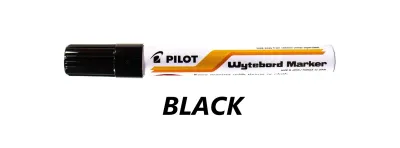
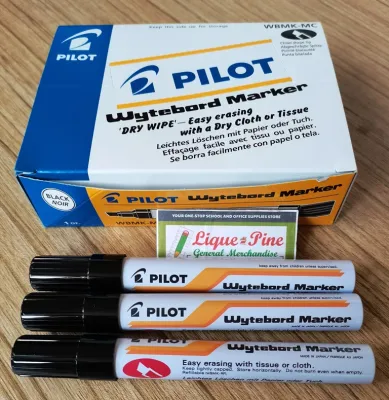
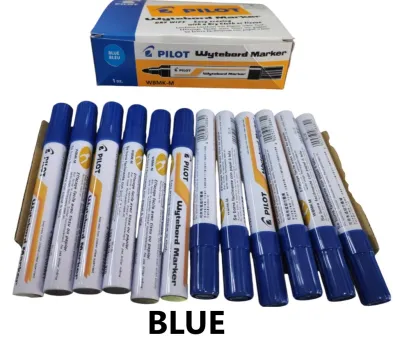
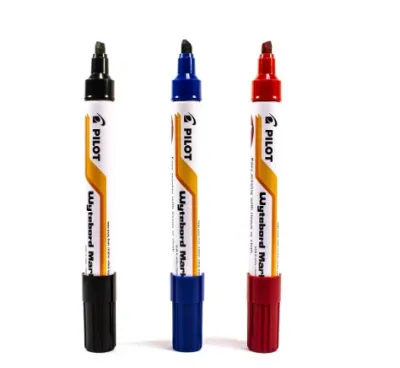
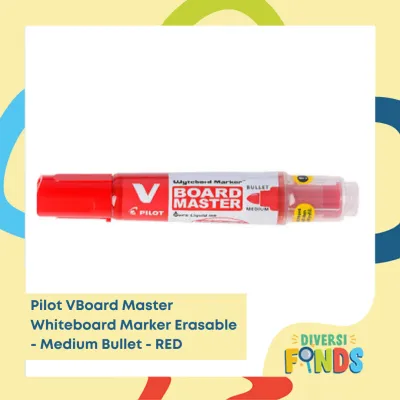
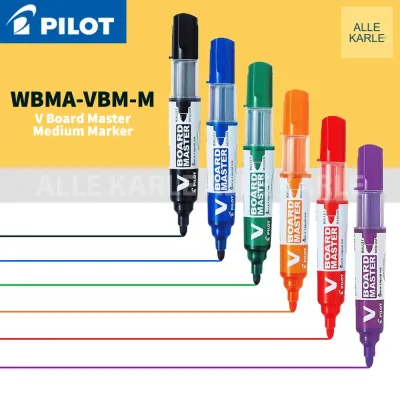
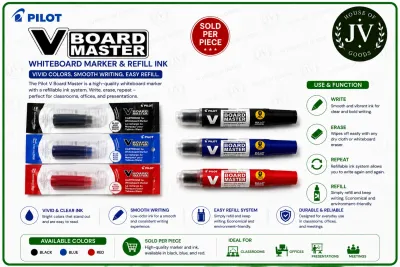
Prices are valid at publication and may change. Please refer to the product page for the latest price.
Lighting conditions and glare also play a significant role in how your writing is perceived. Bright overhead fluorescent lights or direct sunlight from windows can create harsh reflections on glossy whiteboard surfaces, washing out lighter ink colors. To combat this, look for markers that deliver dense, highly opaque ink that stands out even under intense glare. Testing different ink colors under your room’s specific lighting setup can help you determine which shades offer the best contrast for your audience.
Comparing Pilot Whiteboard Marker Categories
Pilot’s whiteboard marker lineup is categorized by distinct ink-delivery systems and tip structures, each tailored to specific writing habits and operational budgets. Understanding these categories allows you to balance the initial purchase cost against long-term usability and performance. The primary distinction lies between liquid ink systems, traditional fiber or felt tips, and specialized fine-point markers.

When comparing these categories, look closely at the product packaging for indicators of refillability, ink-level visibility, and tip durability. Some models feature transparent barrels or ink windows that eliminate the guesswork of when a marker will run dry, which is particularly useful during critical presentations or exams. Additionally, consider how the tip material holds up under heavy pressure; some users write with a heavy hand, which can prematurely flatten soft felt tips on abrasive board surfaces. Balancing these design trade-offs ensures you select a marker category that matches your daily writing demands.
Refillable Liquid Ink Models
For high-volume environments like schools, training centers, and busy corporate offices, refillable liquid ink markers offer a highly sustainable and cost-effective solution. Unlike traditional markers that rely on an internal fiber reservoir to hold the ink, liquid ink models store free-flowing ink directly in the barrel. This design utilizes a specialized control mechanism to deliver a steady, consistent flow of ink to the tip from the first stroke to the last, preventing the gradual fading common in standard markers.
One of the most practical features of these liquid ink models is the transparent barrel or integrated ink window. This allows teachers and presenters to monitor the exact ink level at a glance, preventing the frustration of a marker running out mid-sentence. When the ink is depleted, you simply replace the empty cartridge with a fresh one rather than discarding the entire marker casing. This cartridge-replacement system significantly reduces plastic waste and lowers the long-term cost per milliliter of ink, making it an excellent choice for daily classroom instruction.
When planning to adopt refillable models, it is important to verify the availability of compatible replacement cartridges. Check with local office supply stores or reliable online marketplaces to ensure that the specific cartridge model is consistently in stock. Keeping a small inventory of refills on hand ensures that your writing instruments are always ready for use, maximizing the utility of the durable marker bodies.
Standard Felt and Chisel Tip Models
Traditional felt-tip markers remain a staple in many office environments due to their simplicity, reliability, and immediate readiness. These models typically feature a fiber reservoir that holds the ink, feeding it to either a rounded bullet tip or an angled chisel tip. Bullet tips are excellent for general-purpose writing, as they maintain a consistent line width regardless of the angle at which you hold the marker, making them highly intuitive for quick brainstorming sessions.
Chisel tips, on the other hand, offer greater versatility by allowing you to vary your stroke width. By adjusting the angle of the marker, you can write with a broad, thick line for headings and key terms, or a thin, precise line for subtext and detailed annotations. When selecting these traditional models, check the product packaging for details regarding tip durability and resistance to fraying. A high-quality fiber tip should resist splitting or flattening, even when used on older, slightly textured whiteboards.
These standard models are highly suitable for moderate-use environments where markers are shared among multiple team members. Because they do not require cartridge changes or complex mechanisms, they are easy to distribute across various meeting rooms. They are ideal for quick notes, spontaneous diagrams, and collaborative sessions where immediate usability is the primary requirement.
Fine Tip and Specialty Models
When your work involves detailed diagrams, complex mathematical formulas, or dense organizational charts, standard whiteboard markers can be too thick and clumsy. Fine-tip and specialty Pilot markers are specifically designed for these high-precision tasks, offering a much narrower line width that allows you to write legibly in confined spaces. These models are particularly useful for personal desktop whiteboards, tracking calendars, and small-group tutoring sessions.
However, using fine-tip markers requires careful consideration of visibility limits. Because the lines produced are significantly thinner, they are much harder to read from a distance. To compensate for this reduced line width, it is crucial to select high-contrast ink colors, such as deep black or dark blue, and avoid lighter shades that can easily disappear under room lighting. Always verify the exact tip width, usually specified in millimeters on the product label, to ensure it matches your detail requirements.
Specialty models may also include unique features tailored to specific tasks, such as dual-sided tips or integrated erasers on the cap. These design elements add convenience for individual users who need to make quick corrections without searching for a separate eraser. By matching the specialty tip to your specific workflow, you can maintain clean, organized, and highly detailed boards.
Checking Ink Properties and Erasing Requirements
The performance of a whiteboard marker is heavily defined by its ink formulation and how cleanly it erases from the board. When purchasing markers for enclosed spaces with limited ventilation, such as small meeting rooms or air-conditioned classrooms, look for low-odor or non-toxic certifications on the packaging. These indicators help ensure a comfortable writing environment, preventing the strong chemical smells that can cause headaches or discomfort during long sessions.
While many markers claim to be easy to erase, actual performance depends significantly on the condition and material of your whiteboard. Over time, whiteboards can develop microscopic scratches or lose their original protective coating, which allows ink pigments to penetrate the surface. To prevent permanent staining or “ghosting”—where a faint shadow of previous writing remains visible—it is wise to perform a simple test. Apply a small stroke of the marker in an inconspicuous corner of your board, let it dry completely, and then erase it to verify that it leaves no residue.
Proper erasing habits also play a critical role in maintaining your whiteboard’s lifespan. Always allow the ink to dry completely before attempting to erase it; wiping wet ink can smear the pigment across the board and push it deeper into the surface pores. Additionally, use a clean, high-quality microfiber cloth or a dedicated whiteboard eraser, and avoid using abrasive materials or unauthorized cleaning solvents that can strip away the board’s smooth finish.
Creating Your Purchasing and Maintenance Plan
To get the most value out of your stationery budget, establish a clear purchasing and maintenance plan tailored to your organization’s needs. Begin by creating a shortlist of required markers based on your room assessments. For instance, a school might prioritize refillable liquid ink models with broad chisel tips for main classrooms, while keeping a stock of fine-tip bullet markers for administrative offices and individual teacher planners.
When purchasing your selected models, especially through online marketplaces, verify the seller’s credentials to ensure you are receiving authentic products. Look for official brand stores or authorized distributors to avoid counterfeit items that may suffer from poor ink quality or dry out prematurely. Buying in multi-packs or bundle sets that include both markers and compatible refill cartridges is often the most economical approach, reducing the overall cost per unit and ensuring you have a steady supply of ink.
Proper storage is the final step in maximizing the lifespan of your whiteboard markers. Always recap the markers tightly immediately after use; leaving a marker uncapped, even for a short meeting, can dry out the tip and disrupt the ink flow. Store your markers horizontally when not in use. This practice keeps the ink evenly distributed throughout the reservoir or delivery system, ensuring that the tip remains moist and ready to write the next time you start a presentation.
Frequently Asked Questions (FAQ)
Can I use Pilot whiteboard markers on glass boards?
Yes, standard Pilot whiteboard markers can be used on glass boards, but visibility and performance can vary. Because glass is completely non-porous and highly reflective, standard inks may appear less opaque or bead up slightly compared to how they look on traditional whiteboards. For the best results, look for high-opacity formulations or colors with strong contrast, and always perform a small test in a corner of the glass board to ensure the ink erases cleanly without leaving a hazy residue.
How do I revive a dried-out Pilot whiteboard marker?
If a Pilot whiteboard marker has dried out due to being left uncapped, the safest first step is to recap it tightly and store it horizontally for several hours to allow the ink to redistribute naturally. For refillable liquid ink models, check if the cartridge is empty and replace it if necessary. Avoid dipping the tip in water, alcohol, or other unauthorized solvents, as these chemicals can break down the specialized ink formulation, ruin the tip fibers, and potentially damage your whiteboard surface. If the tip is physically frayed or the internal reservoir is completely depleted, it is time to replace the marker or the tip assembly.
Community discussion
Share your experience or ask a question. Comments are reviewed before publication.