
To choose a big wall calendar that fits your space without overwhelming the room, you must balance the physical dimensions of your wall with your primary viewing distance and the scale of surrounding furniture. A calendar that is too large can make a room feel cramped, while one that is too small forces you to squint. By measuring your available wall area, leaving a visual margin of at least 15 to 20 centimeters on all sides, and matching the calendar’s width to the furniture below it, you can find a functional layout tool that enhances your productivity and complements your interior design.
Assessing Your Wall Space and Viewing Distance
To find the optimal calendar size, measure the exact wall area where you plan to hang it. Use a metal measuring tape to find the clear width and height of the designated spot, subtracting any space occupied by nearby furniture, open doors, window frames, and existing wall decor. This gives you the true “active” wall area, preventing you from purchasing a calendar that overlaps with other household items.
Next, consider your primary viewing distance—the space between where you usually sit or stand and the wall. If you plan to read your schedule from a desk across the room, you will need larger grids and bolder typography. If you only look at the calendar while standing directly in front of it, a more compact format is highly effective. As a general rule, greater viewing distances require larger overall dimensions and date boxes to remain legible.
Products mentioned in this guide
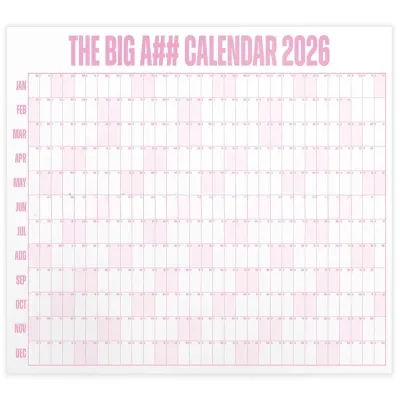
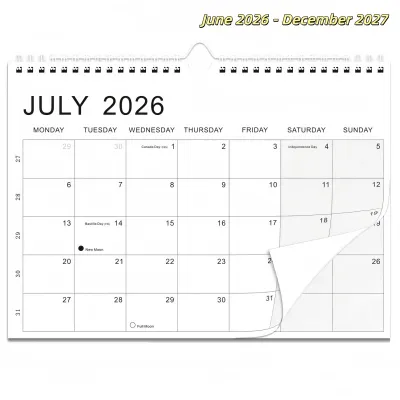
Prices are valid at publication and may change. Please refer to the product page for the latest price.
Finally, plan for visual breathing room. A large calendar should never touch the ceiling, baseboards, or adjacent wall corners. Leaving a clear margin of empty wall space around the perimeter of the calendar creates a visual frame. This frame prevents the calendar from looking squeezed into a tight spot, ensuring the room maintains an open, uncluttered feel.
Understanding Common Large Calendar Dimensions
When shopping on an online marketplace, you will encounter various size labels. Standard large-format calendars often follow international paper sizes like A2 and A1, or use custom oversized dimensions. An A2 calendar measures approximately 420 by 594 millimeters, making it a versatile choice for medium-sized walls. An A1 calendar is twice that size, measuring about 594 by 841 millimeters, which demands a much larger, dedicated wall space to avoid dominating the room.

The binding style also plays a significant role in how much physical space the calendar occupies. A top-bound spiral calendar flips upward, meaning you must account for the clearance of the flipped pages at the top. A side-bound calendar opens like a book, requiring more horizontal space. Poster-style or single-sheet yearly planners display all twelve months on a single flat sheet, requiring no page-flipping clearance but demanding a large, continuous block of wall space.
Because terms like “large” or “jumbo” are subjective and vary widely between manufacturers, always verify the exact dimensions listed on the product detail page. Do not rely solely on promotional photos, which often use digital mockups that distort the calendar’s actual scale. Check the product specifications for the precise width and height, and use those numbers to map out the calendar’s footprint on your wall before purchasing.
Matching Calendar Size to Room Proportions
The size of your calendar should harmonize with the overall proportions of the room and the furniture within it. In narrow hallways, compact home offices, or cozy bedrooms, an excessively wide calendar can make the walls feel like they are closing in. For these smaller spaces, consider elongated vertical formats or moderately sized A2 planners that provide ample writing space without overwhelming the limited visual field.
In contrast, spacious living areas, open-plan offices, or large family rooms easily accommodate oversized formats. In these environments, a large A1 calendar or a custom dry-erase board serves as a functional focal point. Instead of looking cluttered, a large calendar in a spacious room helps anchor the design, filling empty wall space and acting as a central hub where everyone can view the schedule at a glance.
When hanging a calendar above furniture, such as a desk or console table, coordinate the widths to maintain visual balance. A good design guideline is to ensure the calendar’s width does not exceed two-thirds of the width of the furniture below it. If the calendar is wider than the desk, the arrangement will look top-heavy and unstable. Keeping the calendar slightly narrower than the furniture creates a pleasing, grounded composition.
Installation and Layout Considerations
Proper installation ensures your large wall calendar is both comfortable to use and visually appealing. Aim to mount the calendar so that its center point is at eye level, which is typically around 1.5 meters from the floor. If you plan to write on the calendar while seated at your desk, lower it slightly so you can reach the daily grids without straining your arms or standing up to add an appointment.
You must also account for the physical clearance required to interact with the calendar. If you choose a page-flipping design, ensure there is enough vertical space above the calendar to flip the pages easily without hitting the ceiling. Similarly, make sure the bottom edge of the calendar does not collide with your desk or computer monitor. If you use a tear-off calendar, leave enough room to cleanly pull sheets away without pulling the mounting hardware out of the wall.
Finally, consider the weight of the calendar and your wall material to select the right mounting hardware. Large, multi-page calendars with thick paper and metal spiral bindings can be surprisingly heavy. In humid tropical climates, paper can absorb moisture from the air, increasing its weight over time and causing standard adhesive strips to fail. For drywall or plaster, use sturdy nails or screw-in anchors. If you are renting, look for heavy-duty adhesive hooks rated for the calendar’s weight, and apply them to a clean, dry surface.
Common Sizing Mistakes to Avoid
One of the most common mistakes is relying on visual estimation rather than physical measurements. It is easy to look at an empty wall and assume a large calendar will fit, only to find that it overlaps with a light switch, a door frame, or a bookshelf once it arrives. Always use a tape measure to verify the dimensions before ordering, and consider taping a piece of newspaper cut to the calendar’s exact size onto the wall to preview the layout.
Another frequent oversight is forgetting to factor in the extra space required by the calendar’s hardware. The listed dimensions often refer only to the paper pages, ignoring the hanging wire, the top binding rings, or the decorative wooden hanger. These elements can add several centimeters to the overall height or width. If you have a tight space, these extra centimeters can mean the difference between an ideal fit and a calendar that hangs awkwardly over a trim.
Lastly, avoid placing your calendar in a poorly lit corner or too far from your primary workspace. A large calendar is only useful if you can easily read and write on it. Position it in a well-lit area, preferably near natural light or a dedicated task lamp, and ensure it is close enough to your desk or seating area so that you can read the main headings without straining your eyes.
Frequently Asked Questions (FAQ)
Can I use a big wall calendar in a small room? (FAQ)
Yes, you can successfully use a large wall calendar in a small room by utilizing vertical space and choosing a narrow, tall format. A vertical layout maximizes your writing area while minimizing the horizontal wall space it occupies, preventing the room from feeling crowded. To maintain a sense of openness, hang the calendar on a clear, uncluttered wall with minimal surrounding decor, allowing it to serve as the single, clean focal point.
How do I know if the calendar text will be readable from my desk? (FAQ)
To determine if the calendar text will be readable from your desk, check the physical dimensions of the daily writing blocks and the font size of the dates. You can test readability before buying by printing a single page of a similar layout on a standard printer, placing it on the wall, and viewing it from your desk. If you cannot easily read the dates or your own handwriting from your chair, choose a larger calendar size or mount it closer to your workspace.
Community discussion
Share your experience or ask a question. Comments are reviewed before publication.