
Panel lining is one of the most effective techniques in scale modeling, transforming flat plastic surfaces into highly detailed, three-dimensional replicas. By flowing a thin, dark paint into the recessed grooves of a model kit, you simulate the natural shadows and depth found on real-world machinery. To achieve this effect efficiently, the tamiya panel line accent color range has become the industry standard for modelers of all skill levels. However, choosing the wrong shade can ruin an otherwise flawless paint job, resulting in stark, unnatural lines or messy, muddy surfaces.
To select the ideal Tamiya Panel Line Accent Color, you must match the wash’s tone to your model’s base coat value. As a general rule, use black for high-contrast definition on light bases, gray for realistic shadows on medium or dark bases, brown for organic weathering on earth tones and metallics, and white for inverted highlights on very dark surfaces. Making the right choice requires understanding how these enamel-based washes interact with your underlying paint layers and how the tropical climate can affect their application and curing times.
Quick Selection Guide: Matching Accent Colors to Base Coats
For a quick reference before starting your next project, use this systematic mapping of base coats to their ideal Tamiya Panel Line Accent Colors. This guide ensures that your panel lines remain in-scale and visually convincing.
Products mentioned in this guide
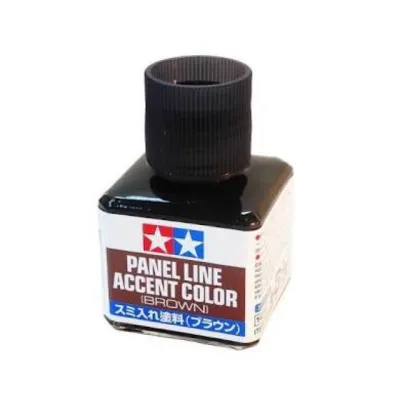
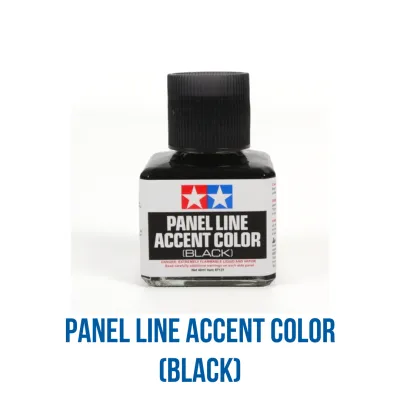
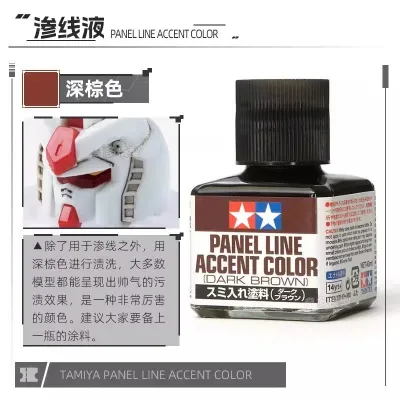
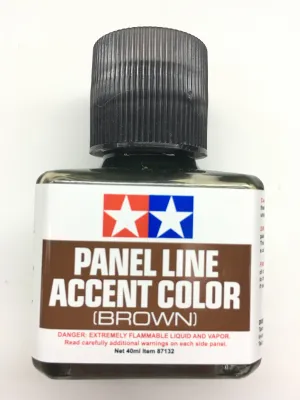
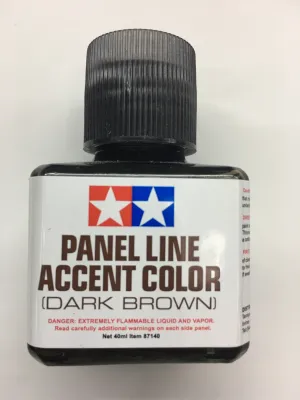
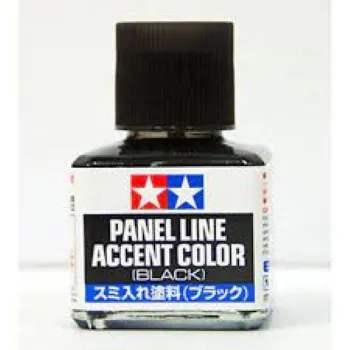
Prices are valid at publication and may change. Please refer to the product page for the latest price.
| Base Coat Color | Recommended Accent Color | Visual Effect | Ideal Subject Matter |
|---|---|---|---|
| White, Light Gray, Yellow, Bright Red | Black | High contrast, sharp panel definition | Sci-fi mechs (Gunpla), civilian sports cars, anime-style figures |
| Medium Gray, Dark Blue, Olive Drab, Green | Gray | Subtle, realistic ambient shadows | Modern military aircraft, naval warships, tactical armored vehicles |
| Tan, Sand, Brown, Gold, Copper, Silver | Brown | Earthy grime, rust, oily patina | WWII tanks, weathered off-road vehicles, mechanical engine bays |
| Black, Dark Gray, Deep Navy Blue | White | Inverted highlights, edge definition | Sci-fi spacecraft interiors, stealth fighters, dark mecha armor |
Selecting the correct pairing prevents your model from looking flat or overly stylized, maintaining the illusion of scale realism.
Understanding the Enamel Formula and Capillary Flow
Tamiya Panel Line Accent Colors are formulated as highly diluted enamel washes. Unlike standard acrylic paints, which rely on water as a carrier, these washes use a low-viscosity organic solvent. This chemical makeup gives the fluid an incredibly low surface tension, allowing it to exploit capillary action. When a small drop of the wash touches a recessed groove, the fluid naturally pulls itself along the panel line, filling joints, rivets, and crevices without requiring manual brush strokes across the flat surfaces.

This behavior contrasts sharply with standard acrylic washes or heavily pigmented paints. Acrylic paints dry rapidly and have high surface tension, which often causes them to bead up or leave unsightly tide marks on flat plastic surfaces. Tamiya’s enamel formula remains workable for a longer period, allowing the pigments to settle evenly at the bottom of the recessed lines while the carrier solvent evaporates, leaving behind a crisp, uniform shadow.
However, this enamel formulation introduces a critical prerequisite: you must apply the wash over a fully cured gloss or semi-gloss clear coat. Gloss clear coats—typically acrylic or lacquer-based—create a microscopically smooth surface. This smoothness minimizes friction, allowing the enamel wash to glide effortlessly through the panel lines. Conversely, a matte or flat clear coat has a rough, microscopic texture designed to scatter light. If you apply an enamel wash directly to a matte surface, the rough texture acts like a sponge, trapping the pigment and causing permanent staining that is nearly impossible to clean up.
Environmental factors also play a major role in how these materials behave. In tropical climates with high relative humidity, such as the Philippines, the curing process of your base paints and clear coats slows down significantly. Moisture trapped in the air can prevent acrylic clear coats from hardening completely, even if they feel dry to the touch. If you apply an enamel wash over an incompletely cured clear coat, the aggressive enamel thinner can easily penetrate the soft barrier, dissolving your base paint and attacking the underlying plastic. Modelers working in humid conditions should allow their clear coats to cure for at least 24 to 48 hours, or utilize a dedicated drying booth, before proceeding with panel lining.
Which Shade to Choose: A Color-by-Color Breakdown
To select the perfect accent color, you must evaluate the specific visual outcome you want to achieve. Each of Tamiya’s four primary panel line shades serves a distinct artistic and practical purpose on the workbench.
Black: High Contrast and Deep Shadows
Black is the most popular and striking variant in the lineup, designed to deliver maximum contrast. When applied to light-colored bases such as white, light gray, yellow, or bright red, it creates bold, graphic outlines that immediately define individual parts. This high-contrast look is highly sought after in sci-fi modeling, particularly for Bandai’s Gundam kits (Gunpla), where clean, comic-book-style line art is preferred. It is also excellent for civilian vehicles, such as white or red sports cars, where you need to clearly separate doors, hoods, and trunk seams from the main body panels.
Despite its popularity, black has significant limitations in scale realism. On military models, such as 1/72 scale aircraft or 1/35 scale tanks, pure black panel lines can look overly harsh and cartoonish. In the real world, shadows in panel gaps are rarely pure black; instead, they are darker shades of the surrounding color. Furthermore, black wash will completely disappear or look like a muddy smudge when applied over dark gray, olive drab, or navy blue base coats, failing to provide any useful definition.
Gray: Subtle Definition and Realistic Weathering
Gray is the unsung hero of realistic scale modeling. It is specifically formulated to provide a softer, more natural shadow effect on medium-to-dark base coats, including medium gray, tactical blue, and forest green. It simulates ambient occlusion—the soft, diffused shadows that occur where surfaces meet. This makes it the ideal choice for modern military aircraft, naval vessels, and realistic sci-fi models where you want to highlight surface detail without making the model look like a toy.
Using gray also respects the concept of scale effect. As a model’s scale decreases, the contrast of its details should also decrease to maintain a realistic appearance from a distance. A pure black line on a 1/144 scale fighter jet represents a gap that would be several inches wide in real life, which looks highly unrealistic. A gray line, however, provides the optical illusion of depth while maintaining perfect scale harmony. It is also highly effective for breaking up monochromatic paint schemes on dark green or blue military vehicles without introducing distracting outlines.
Brown: Earthy Tones and Grime Accumulation
Brown is the primary choice for adding environmental wear, dirt, and organic grime to a model. It pairs perfectly with earth-toned base coats such as tan, sand, brown, and olive drab. When applied to these colors, the brown wash does not just define the panel lines; it simulates years of accumulated dust, dried mud, and rain streaks in the recesses. This makes it indispensable for World War II armor, off-road civilian trucks, construction equipment, and diorama bases.
Beyond earth tones, brown is incredibly effective when applied over metallic base coats. If you are painting engine exhausts, hydraulic pistons, brass pipes, or silver fuselage panels, a brown enamel wash adds an instant oily, heat-stained patina. It tempers the bright, artificial sheen of metallic paints, giving them a heavy, functional, and weathered appearance that suggests active mechanical operation.
White: Highlighting and Inverted Panel Lines
White is a specialized variant designed to solve a common modeling dilemma: how to define panel lines on very dark or black surfaces. On a model painted in deep navy, dark gray, or pure black, any dark wash will be completely invisible. White panel line accent color reverses the traditional shadow technique by adding a subtle highlight to the recessed lines, creating an “inverted” panel line effect.
This technique is highly effective for sci-fi interiors, high-tech dark mecha, and stealth aircraft like the F-117 Nighthawk or F-22 Raptor. The white wash simulates light catching the edges of the panel gaps, revealing the complex surface geometry of an otherwise monochromatic dark shape. Because white pigment is heavier and settles quickly, you must shake the bottle frequently during application to ensure an even distribution of the pigment particles.
Application and Cleanup: Protecting Your Paint Job
Applying an enamel wash requires a systematic approach to prevent damaging your model’s plastic or ruining your base paint job. Enamel solvents are chemically aggressive, meaning proper preparation and technique are mandatory.
Preparation and the Gloss Barrier
Before opening your bottle of Tamiya Panel Line Accent Color, verify that your model has been sealed with a high-quality, fully cured gloss or semi-gloss clear coat. This clear coat serves two vital functions: it protects the underlying base paint from the enamel solvents, and its smooth surface allows the wash to flow smoothly via capillary action. If you are working in a highly humid environment, ensure the clear coat has cured completely—typically 24 to 48 hours—to prevent the enamel thinner from penetrating a softened acrylic barrier.
Application Technique
Do not brush the panel line wash onto the model like standard paint. Instead, follow these steps for a controlled application:
- Agitate the Bottle: Shake the bottle thoroughly until the settled pigment at the bottom is completely suspended. You should hear the mixing ball rattling freely inside.
- Load the Brush: Unscrew the cap and use the built-in fine-tip brush. Wipe excess fluid off the brush stem against the inner rim of the bottle neck to prevent dripping.
- Touch and Flow: Gently touch the very tip of the brush to a panel line junction, corner, or rivet. Let capillary action draw the fluid along the groove. Do not drag the brush along the line; let physics do the work.
- Work in Sections: If a panel line is long or interrupted, touch the brush to the next open section to continue the flow.
Cleanup Process
Once applied, the wash will dry quickly as the carrier solvent evaporates, leaving behind excess pigment around the application points.
- Wait for Drying: Allow the wash to dry for 10 to 15 minutes. The wet sheen will turn into a dull, matte finish when it is ready for cleanup.
- Prepare the Swab: Moisten a cotton swab with Tamiya Enamel Thinner (X-20) or a mild mineral spirit. The swab must be damp, not dripping wet. Press the swab against a clean paper towel to remove excess thinner.
- Wipe Perpendicularly: Gently wipe the damp cotton swab across the panel line at a 90-degree angle. Never wipe parallel to the line, as this will pull the pigment out of the recessed groove.
- Replace Swabs Frequently: Change to a clean cotton swab as soon as the tip becomes loaded with pigment to avoid smearing dissolved wash across your clean paint job.
Material Limits and Safety
Enamel thinners can degrade polystyrene plastic—the material most model kits are made of—making it brittle and prone to stress cracking. This vulnerability is especially high at snap-fit joints, peg connections, and areas under physical tension. To protect your model, never apply enamel washes directly to bare, unpainted plastic. Avoid letting the wash or thinner pool in deep recesses, joints, or interior peg holes. If pooling occurs, immediately wick away the excess fluid with a dry cotton swab or a clean, dry paintbrush. Always work in a well-ventilated space to avoid inhaling solvent fumes.
Frequently Asked Questions (FAQ)
Can I mix different Tamiya Panel Line Accent Colors?
Yes, because all variants in the Tamiya Panel Line Accent Color range share the same enamel formulation, they can be mixed freely on a palette before application. This allows you to create custom intermediate shades to perfectly match your specific project. For example, you can mix 70% Gray with 30% Black to create a dark charcoal wash that is less harsh than pure black, or blend Brown and Black to simulate dirty engine grease.
Do I need to thin the accent colors before use?
No, these washes are pre-thinned by the manufacturer to the exact viscosity required for optimal capillary flow. Adding more thinner is unnecessary and can weaken the binding agents in the paint, leading to chalky lines that lift easily during the cleanup process. Simply shake the bottle thoroughly before each application to ensure the settled pigments are fully redistributed.
Will the enamel wash damage my model's bare plastic?
Yes, enamel thinner can cause stress cracking on bare polystyrene plastic if it is allowed to sit for prolonged periods. The solvent penetrates the micro-fissures in the plastic, weakening its structural integrity, which often causes snap-fit joints to crumble. To prevent this, always seal your model with a protective acrylic or lacquer clear coat before applying the wash, and avoid letting the fluid pool in joints or crevices.
Community discussion
Share your experience or ask a question. Comments are reviewed before publication.