
Finding the ideal dot grid notebook in the Philippines involves balancing your writing instruments, binding preferences, and budget. The Kokuyo Dotliner notebook series—highly regarded for its specialized dot-ruled and dot-grid layouts—is celebrated for its ultra-smooth paper, precise Japanese engineering, and exceptional performance with gel pens and fine-liners.
However, the best choice is highly conditional. If you are a dedicated fountain pen user who loves heavy ink pooling, or if you require thick paper for watercolor washes, a competitor with a higher paper weight might serve you better. This comparison breaks down paper quality, dot spacing, binding durability, and local pricing dynamics to help you select the perfect notebook for your daily writing needs.
Paper Quality and Ink Compatibility
Paper quality is the foundation of any writing experience. It is primarily determined by paper weight, measured in grams per square meter (GSM), and the surface treatment or coating applied during manufacturing. While high GSM generally indicates thicker paper that prevents ink from bleeding through, fiber density and surface sizing play a massive role in how ink behaves when it hits the page.
Products mentioned in this guide
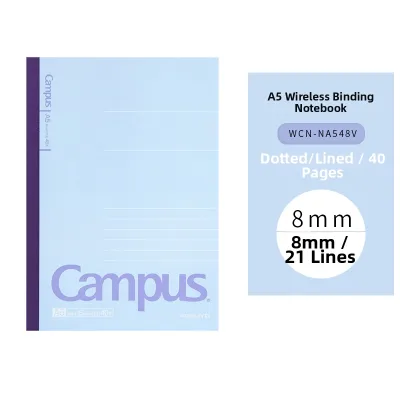
Prices are valid at publication and may change. Please refer to the product page for the latest price.
In the tropical climate of the Philippines, paper is constantly exposed to high relative humidity. Humid air can cause low-quality paper fibers to swell and act like a sponge, drawing ink out of pens and causing severe feathering, where the ink spreads outward in tiny spider-web patterns, and ghosting, where the writing is visible on the reverse side.
The Kokuyo Dotliner notebook series typically utilizes proprietary Japanese paper, such as Kokuyo’s Campus Sarasara or Mio paper, which generally ranges from 70 to 80 GSM. Despite this relatively modest weight, the paper is highly engineered with a smooth, dense surface coating. This coating allows gel pens, ballpoints, and fine-liners to glide effortlessly across the page with minimal friction. The ink dries reasonably fast, and the lines remain crisp without feathering, even in humid weather.
In contrast, competitors in the premium dot grid space offer different paper profiles. Brands like Leuchtturm1917 use 80 to 120 GSM paper with a slightly toothier texture, which provides more tactile feedback when writing. Meanwhile, bullet-journal-focused brands or local premium options utilize ultra-thick 160 GSM paper. This heavy, cardstock-like paper is designed to handle wet media, heavy marker layering, and watercolor washes without any risk of bleed-through, though it makes the notebook significantly heavier and bulkier.
When shopping, always check the product packaging or official online storefront listings for the paper’s GSM rating and surface description. If you are unsure how your favorite pen will interact with a new notebook, perform a simple, low-risk ink test. Turn to the very last page or a small corner of a back sheet, write a few sample strokes with your most saturated pens, and wait a few minutes. Check the reverse side for ghosting or bleed-through before committing to a full-page layout.
Dot Spacing and Grid Visibility
The layout of a dot grid is defined by two primary characteristics: the physical distance between the dots and the intensity of the print. These elements dictate how much structure the page provides without cluttering your visual field or distracting from your work.

Standard dot spacing is 5mm, which is the benchmark used by the Kokuyo Dotliner and many other Japanese stationery brands. This 5mm grid is highly versatile, matching the natural handwriting size of most users and aligning perfectly with standard mathematical and technical layouts. It provides enough density for compact print while remaining spacious enough for cursive writing.
Some competitors offer alternative spacing options to cater to specific niches. For example, some specialized notebooks feature a tighter 4mm grid, which is excellent for individuals with micro-handwriting or those who want to maximize page real estate for complex, dense charts. On the other end of the spectrum, wider 7mm or 8mm spacings exist, which resemble traditional ruled paper and are more comfortable for large, expressive handwriting or quick, unstructured brainstorming sessions.
Dot visibility is equally crucial. The Kokuyo Dotliner uses a very subtle, light gray dot print. This design choice ensures that the dots serve as a gentle guide while you write, but practically disappear when you step back to look at the completed page. This low-contrast grid is highly beneficial if you plan to scan or photocopy your pages. When captured by mobile scanning apps, the light dots easily drop out, leaving behind clean, high-contrast digital notes that are easy to share with classmates or colleagues.
Some western competitors, however, print their grids with darker, higher-contrast dots. While this makes the grid easier to see under dim lighting conditions, it can distract from your actual writing and may show up prominently in digital scans. Before purchasing, verify the exact dot spacing and color in the product specifications, as manufacturers sometimes release different editions or regional variants of the same notebook line.
Binding Styles and Lay-Flat Performance
The binding of a notebook determines how it opens, how durable it is under daily carry, and how comfortable it is to write on both the left and right pages. If a notebook resists staying open, writing near the inner margin—the gutter—becomes a frustrating chore.
Perfect binding is common in budget notebooks, where the pages are glued directly to the spine. While inexpensive, perfect-bound notebooks rarely lay completely flat and can crack over time, causing pages to fall out if forced open.
The Kokuyo Dotliner notebooks utilize advanced binding techniques designed specifically for lay-flat performance. Many of their notebooks feature thread-sewn or specialized glue bindings that allow the notebook to open a full 180 degrees without any resistance. This flat profile ensures that your hand can glide smoothly across the entire page, including the gutter, without the paper curling upward.
In contrast, spiral or twin-wire binding is a popular alternative offered by many competitors. Wire-bound notebooks lay perfectly flat and allow you to fold the cover entirely back on itself, which is highly convenient when writing on your lap or on a cramped desk in a local coffee shop. However, the metal or plastic coils can snag on loose threads inside your backpack, and they can feel uncomfortable under your wrist when writing near the center of the page.
Another alternative is disc-bound or loose-leaf systems, which allow you to easily add, remove, or rearrange pages. While incredibly flexible, these systems require specialized punches and are generally bulkier than bound notebooks.
To assess binding durability for a notebook that will face a daily commute in the Philippines, look for reinforced spines, heavy-duty covers, or exposed thread-sewn structures. A well-constructed thread-sewn spine can withstand being stuffed into a crowded bag day after day during the monsoon season without losing its structural integrity.
Assessing Value and Cost in the Philippines
When evaluating dot grid notebooks in the Philippine market, looking solely at the upfront retail price can be misleading. A cheaper notebook might seem like a bargain, but if the paper is thin and only usable on one side, you are effectively cutting your usable page count in half.
To find the true value, calculate the cost per usable page. Divide the retail price (₱) by the number of sheets, and factor in whether the paper quality allows you to write on both sides without bleed-through. For example, a premium notebook priced at ₱600 with 160 pages of high-quality paper may offer better long-term value than a ₱300 notebook with 100 pages of thin paper that bleeds with every gel pen.
Long-term value is also influenced by the availability of refills and system modularity. If you choose a loose-leaf or disc-bound system, check if compatible refills are readily available locally.
To ensure you are getting an authentic product, purchase from official brand stores, authorized stationery retailers, or reputable online mall flagship stores. The Philippine market has seen an influx of counterfeit or low-quality imitation stationery products on generic online marketplaces. Authentic Kokuyo products feature precise grid printing, high-grade paper, and durable binding that cheap knockoffs cannot replicate.
Additionally, remember to factor in shipping costs or local travel expenses when comparing prices. An online deal might look attractive, but high shipping fees to provinces outside Metro Manila can quickly erase any savings. Purchasing in physical retail stores also allows you to physically feel the paper texture and test the binding before spending your money.
Final Decision Framework
To make your final decision, evaluate your writing habits, preferred tools, and daily environment against these key criteria.
Choose the Kokuyo Dotliner if…
- You primarily write with gel pens, ballpoints, or fine-liners and value an ultra-smooth, low-friction writing surface.
- You prefer a standard 5mm dot grid with subtle, light gray dots that do not distract from your notes or interfere with digital scanning.
- You need a lightweight, portable notebook that lays perfectly flat for comfortable writing across the entire page.
Choose a premium competitor if…
- You exclusively use wet fountain pens with broad nibs, heavy ink markers, or light watercolors, and require thick, high-GSM paper to prevent ghosting.
- You prefer a highly textured paper that provides tactile feedback while writing.
- You want luxury cover materials, such as genuine leather or heavy hardcovers, for archival bullet journaling.
Choose a budget or alternative binding if…
- You need a notebook that can fold completely back on itself, such as a spiral-bound notebook, for writing in tight spaces.
- You are buying notebooks in bulk for school or office use and need to minimize the upfront cost per page.
- You prefer a modular system where you can easily rearrange pages, such as a disc-bound notebook.
By matching your specific pen choices and daily writing scenarios to these characteristics, you will find a notebook that enhances your productivity and creative expression.
Frequently Asked Questions (FAQ)
Is the Kokuyo Dotliner suitable for fountain pens?
While Kokuyo’s paper is exceptionally smooth and high-quality, standard-weight paper (70-80 GSM) may show some ghosting or slight bleed-through when used with very wet fountain pen inks, broad nibs, or heavy flex nibs. However, fine or extra-fine fountain pen nibs with well-behaved, dry inks typically perform beautifully on this paper. To avoid ruining important notes, check the specific paper weight on the notebook packaging and perform a quick test on the back cover or a single page before committing to double-sided writing.
Can I use both sides of the page in a dot grid notebook?
Whether you can comfortably write on both sides of a page depends heavily on the paper’s thickness, the ink formulation of your pens, and your writing pressure. Thicker papers (100 GSM and above) generally prevent ghosting, allowing you to use both sides easily regardless of the pen. If you are using thinner paper, you can still write on both sides by opting for quick-dry gel pens, fine-point ballpoints, or pencils. Additionally, letting the ink dry completely and placing a clean blotter sheet under the active page will help prevent ink transfer and minimize ghosting.
Community discussion
Share your experience or ask a question. Comments are reviewed before publication.