
The practical difference between lined, dotted, grid, and blank A6 refill paper lies in how they balance structural guidance with creative freedom. The compact A6 size (typically 105 mm x 148 mm) is highly valued for its portability, fitting easily into small bags for daily commutes, office meetings, or university lectures. However, because the writing surface is limited, the ruling format you choose directly dictates how efficiently you can use the available space.
Choosing the right format depends on whether your daily routine prioritizes rapid linear writing, flexible planning, precise diagramming, or unconstrained sketching. By understanding how each layout interacts with your writing instruments and binder setup, you can optimize your compact planner for maximum productivity.
Core Differences Between Lined, Dotted, Grid, and Blank Formats
Lined refill paper features horizontal lines running across the page, which is the most traditional format for handwriting. This layout is designed specifically for linear text, helping you maintain straight, consistent lines of writing without conscious effort. In the compact A6 format, the distance between these lines—known as the line spacing or ruling—is a critical factor. Standard rulings typically range from 6mm to 8mm. A narrower 6mm ruling is highly efficient for small, precise handwriting, allowing you to maximize the number of lines on a single page. Conversely, a wider 8mm ruling offers more breathing room for larger handwriting but significantly reduces the total amount of text you can fit on the small A6 canvas.
Products mentioned in this guide
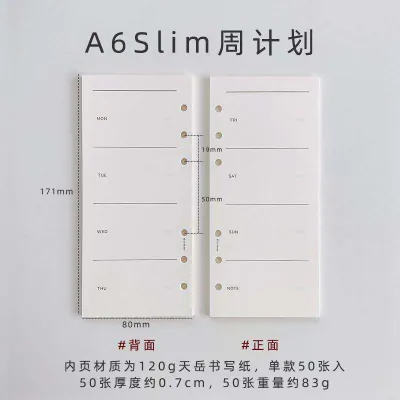
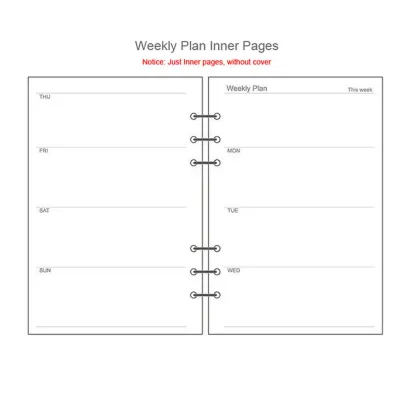
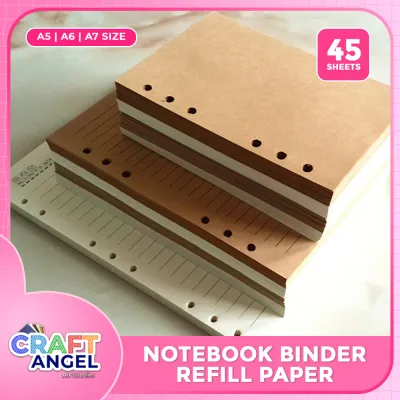
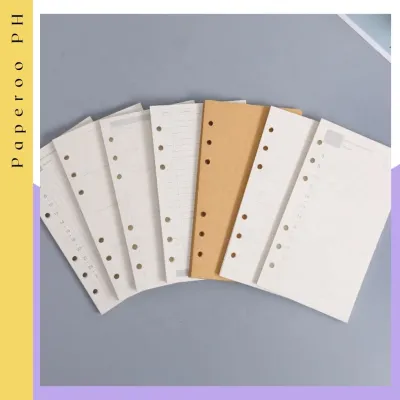
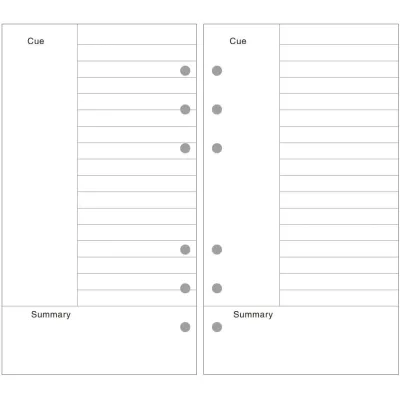
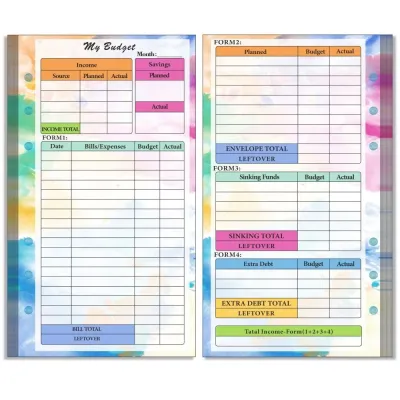
Prices are valid at publication and may change. Please refer to the product page for the latest price.
Dotted refill paper consists of a subtle grid of light dots, usually spaced 5mm apart. This format has gained immense popularity because it offers the best of both worlds: the structure of a grid and the clean look of blank paper. The dots provide just enough visual guidance to keep your handwriting straight and your layouts aligned, yet they are faint enough to fade into the background once the page is filled. This makes dotted paper exceptionally versatile, accommodating everything from structured daily logs to freeform sketches and diagrams without the visual clutter of solid lines.
Grid refill paper, also known as graph paper, features a continuous pattern of intersecting horizontal and vertical lines that form uniform squares, typically in 5mm or 3mm sizes. This format is the ultimate tool for precision and structure. The dual-axis grid allows you to align elements perfectly both vertically and horizontally, making it ideal for drawing tables, charts, mathematical equations, and technical diagrams. In an A6 binder, a grid format helps you utilize every millimeter of space with mathematical precision, though a very dense grid can sometimes feel visually overwhelming if the page is crowded with text.
Blank refill paper is completely unruled, offering an entirely open, white canvas. Without any pre-printed lines or dots, this format provides absolute creative freedom. It is the preferred choice for freehand sketching, mind mapping, and mixed-media journaling where structured lines would only serve as a distraction. However, writing in straight lines on blank paper requires a steady hand and deliberate control, as handwriting naturally tends to drift upward or downward on an unguided page, especially within the narrow confines of an A6 sheet.
How to Choose the Right Format for Your Tasks
Selecting the ideal A6 refill paper format depends heavily on your daily writing habits, planning style, and the specific tools you use. To find the perfect match for your binder, consider how your primary tasks align with the strengths of each format.

Choose lined paper if your primary activity is long-form writing, rapid note-taking, or traditional daily journaling. If you need to quickly jot down thoughts during a meeting, record lecture notes, or write diary entries without worrying about page layout, lined paper is the most efficient and low-effort option. It keeps your writing neat and legible, allowing you to focus entirely on the content of your thoughts rather than the structure of the page.
Choose dotted paper if you practice bullet journaling or enjoy creating custom planner layouts. The 5mm dot spacing is the industry standard for a reason; it allows you to easily draw weekly spreads, habit trackers, and custom headers without needing a ruler for every single line. It is also highly suited for those who like to mix text with quick doodles or diagrams, as the dots guide your pen when you need them but disappear visually when you do not.
Choose grid paper if you are highly analytical, love tracking data, or need to draw precise diagrams. If your daily planning involves intricate habit trackers, budget tables, or pixel-art layouts, the solid grid lines provide the exact boundaries you need. Grid paper is also excellent for students and professionals in technical fields who need to sketch quick schematics, scale drawings, or mathematical formulas on the go.
Choose blank paper if you use your A6 binder primarily as a portable sketchbook, brainstorming pad, or scrapbook. If you frequently paste photos, tickets, or stickers into your journal, or if you prefer to map out ideas using organic, non-linear diagrams like mind maps, blank paper ensures that no pre-printed lines interfere with your visual elements.
The compact A6 size interacts uniquely with each of these formats. Because an A6 page is relatively small, a lack of margins on blank paper can make your pages look cluttered very quickly if your writing is disorganized. On the other hand, a highly dense grid or narrow lined format can make the page look cramped if you use a thick pen tip. For A6 paper, pairing your format with the right pen tip size is essential; fine tips (such as 0.38mm or 0.5mm gel pens) work beautifully with grid and dotted formats, while medium tips (0.7mm or above) are better suited for wider lined or blank pages.
One of the greatest advantages of a ring-bound A6 binder is the ability to mix and match these formats. You do not have to commit to just one style. A highly practical setup involves dividing your binder into functional sections using tab dividers. For example, you can dedicate the front section of your binder to a monthly calendar and habit trackers using grid paper, the middle section to daily journaling using lined paper, and the back section to spontaneous sketching and brainstorming using blank paper. This hybrid approach ensures you always have the perfect canvas for whatever task arises.
Binder Compatibility and Paper Quality Checks
Before purchasing a bulk pack of A6 refill paper, it is crucial to verify that the paper is physically compatible with your binder and that the paper quality matches your writing instruments.
First, examine the binder ring mechanism. The standard A6 refill paper designed for ring binders typically features a 6-hole punch configuration. However, you must verify the exact spacing of the holes. Standard A6 6-hole paper has a spacing of 19mm between the holes within each group of three, with a wider 38mm gap in the middle. Measure your binder’s rings center-to-center to ensure a perfect fit. Additionally, check the margin clearance on the inner edge of the refill paper. The punched holes should leave enough blank space so that the binder rings do not overlap with your writing or cause the paper to tear easily when you turn the pages.
Second, evaluate the paper weight and coating, which are critical indicators of how the paper will handle different inks. Paper weight is measured in grams per square meter (GSM). Standard, budget-friendly refill paper is typically around 70 GSM to 80 GSM. While this weight is perfectly adequate for standard ballpoint pens, it is highly susceptible to ghosting (where the writing is visible on the reverse side) and bleed-through (where ink physically leaks through the page) when used with gel pens, rollerballs, or fountain pens. For a premium writing experience, look for refills with a weight of 100 GSM to 120 GSM.
In tropical climates, high relative humidity can significantly affect paper performance. Paper is naturally hygroscopic, meaning it absorbs moisture from the surrounding air. When paper becomes damp from humidity, its fibers expand, which can cause inks to feather (spread outward along the fibers, creating fuzzy edges) and bleed more easily. Humid conditions also slow down ink drying times, increasing the risk of smudging as you write. To prevent these issues, look for high-quality refills that specify a smooth, ink-resistant coating or a higher GSM. Storing your spare refill packs in a sealed container or a dry drawer with a silica gel packet can also help maintain the paper’s original crispness and ink performance.
Finally, always perform a simple ink test before committing to writing on a new batch of paper. Take a single sheet of the refill paper and write a few test lines using your preferred pens, markers, or highlighters. Observe how quickly the ink dries, whether the lines remain sharp or begin to feather, and if there is any visible ghosting or bleeding on the back of the page. This quick check will save you from the frustration of ruining a beautifully planned page with incompatible ink.
Frequently Asked Questions (FAQ)
Can I mix different paper formats in the same A6 binder?
Yes, you can easily mix different paper formats within a single A6 binder. Because the ring mechanism allows you to insert and remove pages at will, combining lined, dotted, grid, and blank sheets is highly recommended for creating a customized planning system. The only requirement is ensuring that all the refills you purchase share the exact same physical dimensions (typically 105 mm x 148 mm) and the identical 6-hole punch pattern to match your binder’s rings. To keep your mixed formats organized and easy to navigate, use durable divider tabs or color-coded index sheets to separate your writing, planning, and sketching sections.
Does the printed format affect how my pens perform?
No, the printed lines, dots, or grids themselves do not alter the physical absorbency, texture, or ink resistance of the paper. These guide markings are printed onto the surface of the paper during the manufacturing process and do not change the underlying paper fibers. Your pen’s performance—including drying speed, feathering, and bleed-resistance—is determined entirely by the paper’s base material, its weight (GSM), and whether it has a specialized surface coating. When choosing refills, always look at the paper’s material specifications rather than the printed layout to determine how well it will handle your favorite fountain pens or gel rollers.

Community discussion
Share your experience or ask a question. Comments are reviewed before publication.