
Selecting the right intermediate pad paper layout is a simple decision that directly impacts your academic performance and study comfort. The ideal format depends entirely on the specific demands of your subjects. While ruled paper provides the linear structure required for essays and language notes, plain paper offers unrestricted freedom for mind maps and sketches, and graph paper delivers the precise grid alignment necessary for mathematics and technical drawings. Matching your pad layout to your coursework helps keep your notes organized, legible, and easy to review when exam season arrives.
Understanding Ruled, Plain, and Graph Layouts
To make an informed choice, it helps to understand the physical design and primary purpose of each layout. Intermediate pad paper is a staple in classrooms across the Philippines, characterized by its top-bound, tear-off sheet format. Unlike standard notebooks, these pads allow you to easily submit individual assignments or file sheets into separate binders.
The visual structure of each layout dictates how you interact with the page. Ruled paper features horizontal lines, usually accompanied by a vertical margin line on the left, which guides the flow of text from left to right. Plain paper is entirely blank, offering a clean canvas free of any pre-printed lines or grids. Graph paper, also known as grid paper, consists of intersecting horizontal and vertical lines that form small, uniform squares across the entire sheet.
Products mentioned in this guide
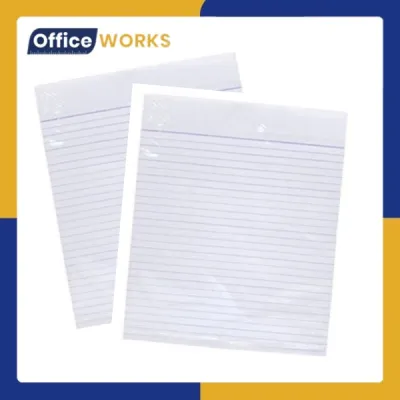
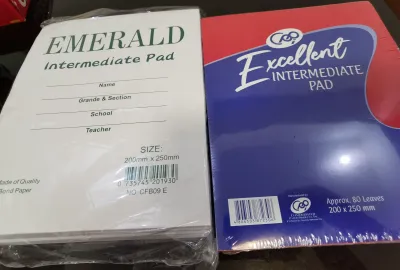
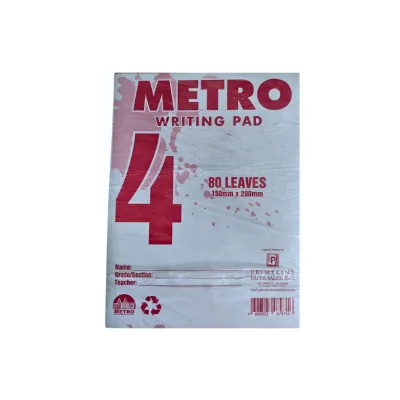
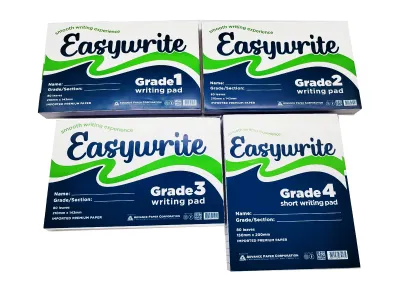
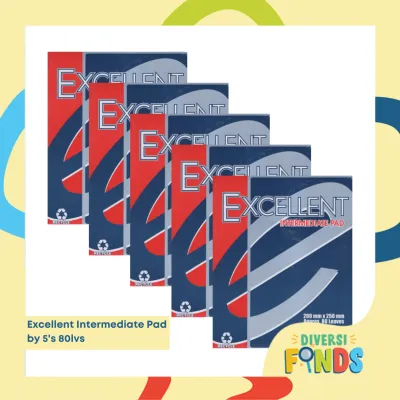
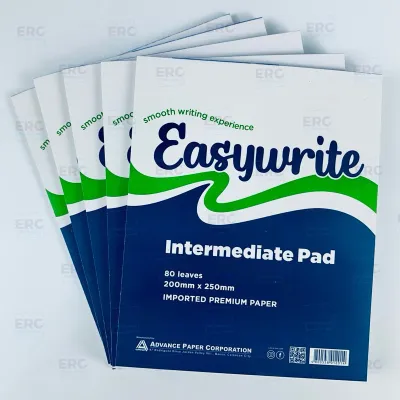
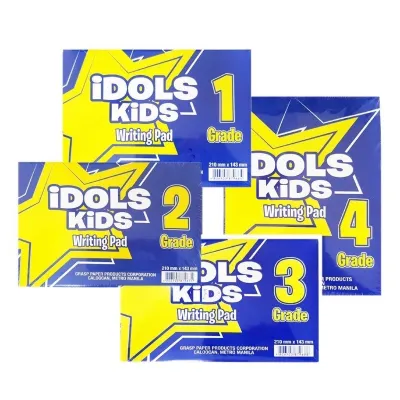
Prices are valid at publication and may change. Please refer to the product page for the latest price.
These structural differences directly influence your handwriting scale and spatial organization. Lined layouts naturally restrict your writing to a specific height, while grid layouts encourage precise, block-like character placement. Blank sheets leave the scale entirely up to your hand coordination, which can be liberating but requires more conscious control to prevent your sentences from drifting diagonally.
Ruled Paper: Best for Essays, Notes, and Language Subjects
Ruled intermediate pad paper is the traditional workhorse for humanities, social sciences, and language arts. If your daily coursework involves writing long-form essays, vocabulary lists, or lecture summaries, a lined layout is almost always the most practical choice. It mirrors the natural structure of written language, helping you maintain a clean, readable presentation.

The primary benefit of ruled lines is the effortless consistency they bring to your handwriting. The horizontal guides keep your sentences perfectly aligned, preventing text from crowding or overlapping. Additionally, the vertical red or blue margin line on the left side of the pad provides a designated space for teacher corrections, paragraph indentations, or quick bullet points, which is essential for structured academic submissions.
However, this linear structure becomes highly restrictive when you step outside of text-heavy subjects. Attempting to draw complex biological diagrams, chemical structures, or multi-step mathematical equations on ruled paper often leads to visual clutter. The horizontal lines can interfere with subscripts, exponents, and fraction bars, making your calculations difficult to read and increasing the risk of simple calculation errors.
Plain Paper: Ideal for Sketching, Mind Maps, and Freeform Drafts
Plain intermediate pad paper is designed for tasks that require unstructured thinking, visual planning, and creative freedom. When you are brainstorming ideas for a creative writing assignment, mapping out a complex history timeline, or sketching a design for an art class, pre-printed lines can feel like unnecessary obstacles.
The absence of visual clutter is the greatest advantage of a blank sheet. Without lines or grids competing for your attention, your eyes can focus entirely on your own drawings, diagrams, or hand-lettered concepts. This makes plain paper highly effective for spatial learning techniques, such as mind mapping, where ideas branch out in multiple directions rather than following a strict top-to-bottom sequence.
The main challenge of using plain paper is the self-discipline required to keep your work organized. Without physical guides, handwriting tends to slant upward or downward, and maintaining consistent spacing between lines becomes difficult. If you need to submit formal written assignments on plain paper, you may find it helpful to place a lined guide sheet underneath the page to keep your writing straight, though this adds an extra step to your study routine.
Graph Paper: Essential for Math, Science, and Technical Drawing
Graph intermediate pad paper is an indispensable tool for STEM subjects, including algebra, geometry, physics, and chemistry. The grid layout provides a built-in coordinate system that makes it easy to plot points, draw geometric shapes, and sketch accurate scientific diagrams.
The intersecting lines of a grid assist in scaling drawings and maintaining precise proportions. For example, when graphing functions in algebra, you can assign specific values to each grid square to ensure your curves and lines are mathematically accurate. In chemistry, the grid helps you draw balanced molecular structures, while in physics, it allows for the neat alignment of vectors and force diagrams.
Beyond drawing, graph paper is highly beneficial for basic arithmetic and long calculations. By placing one number or symbol in each grid square, you can keep columns perfectly aligned during long division, matrix multiplication, or multi-step algebraic equations. This simple habit significantly reduces the likelihood of misreading your own handwriting and making avoidable calculation mistakes.
How to Choose the Right Layout for Your Subjects
Selecting the right pad paper does not have to be complicated. By evaluating the primary tasks of each class, you can match the subject to the layout that will make your work easiest to write and review.
Use this simple decision framework to guide your choice:
- Choose Ruled if your primary task is writing paragraphs, taking lecture notes, or completing language assignments where neat, linear text is the main priority.
- Choose Plain if you are brainstorming, sketching, creating visual diagrams, or practicing freeform layouts that require zero background lines.
- Choose Graph if you are plotting coordinates, solving complex math equations, drawing geometric shapes, or aligning columns of numbers.
The following table summarizes how each layout fits different academic needs:
| Layout Type | Ideal Subjects | Primary Benefit | Main Limitation |
|---|---|---|---|
| Ruled | English, Filipino, History, Literature | Keeps handwriting straight and neat | Restricts freeform drawing and complex math |
| Plain | Art, Creative Writing, Biology (diagrams) | Zero visual clutter for creative freedom | Hard to keep text straight without guides |
| Graph | Math, Physics, Chemistry, Drafting | Perfect alignment for numbers and graphs | Can feel visually busy for standard essays |
For mixed-use scenarios, such as a science class that requires both lecture notes and detailed diagrams, consider keeping separate pads on hand. Alternatively, you can use a multi-subject binder system where you can insert individual sheets of ruled, plain, or graph paper as needed, allowing you to adapt to the changing demands of your school day.
Key Pad Paper Specifications to Verify Before Buying
While the ruling layout is crucial, several physical attributes of intermediate pad paper affect its daily usability and durability in tropical climates. Checking these specifications before purchasing ensures your paper performs well under various writing conditions.
First, verify the paper size and dimensions. Standard intermediate pad paper in the Philippines typically measures around 200 mm by 250 mm, but slight variations exist between brands. Ensure the pad fits comfortably inside your school folders, envelopes, or binders without the edges bending or tearing.
Second, pay attention to paper weight and thickness, usually measured in grams per square meter (gsm). In humid tropical environments, thinner paper can absorb moisture from the air, making it more prone to ink feathering and bleed-through. If you prefer writing with gel pens, rollerballs, or fountain pens, look for pads with a higher gsm rating to ensure your ink dries cleanly without soaking through to the next page. To verify the paper’s compatibility with your favorite pens, perform a quick spot test on the back page of the pad. Write a few characters using your daily gel pen or fountain pen, then observe the drying speed and check the reverse side of the sheet for any signs of ink bleeding or feathering.
Third, examine the binding and perforation quality. A high-quality pad should have a secure top binding that holds the sheets together during transport in your backpack, yet allows for clean, easy tearing when you need to submit an assignment. Poorly perforated pads often rip unevenly, leaving messy, jagged edges that look unprofessional.
Finally, check for pre-punched holes if you plan to store your completed work in a ring binder. Buying pre-punched intermediate pads saves you the time and effort of manually punching holes, helping you keep your notes organized throughout the semester.
Frequently Asked Questions (FAQ)
Can I use ruled paper for math homework?
Yes, you can use ruled paper for basic math homework, but it is not ideal for complex equations or graphing. While simple arithmetic can be written on lined paper, multi-line equations, fractions, and matrices can easily become cramped and difficult to read. If your math homework requires plotting coordinates or drawing geometric shapes, switching to graph paper will make your work significantly neater and easier for your teacher to grade.
What is the standard size of intermediate pad paper?
In the Philippines, standard intermediate pad paper typically measures approximately 200 mm by 250 mm (about 7.87 inches by 9.84 inches). This size is slightly smaller than standard letter or A4 paper, making it highly portable and easy to fit on small classroom armchairs. Always check the dimensions printed on the packaging to ensure the pad fits your specific school binders or plastic envelopes.
Does graph paper come in different grid sizes?
Yes, graph paper is available in various grid sizes, with the most common being 5×5 mm (five squares per inch or metric equivalent) and 4×4 mm. A smaller grid is excellent for detailed technical drawings and complex mathematical functions, while a larger grid is better suited for younger students learning to align numbers or for basic science diagrams. Check the product label to verify the grid spacing before purchasing.
Community discussion
Share your experience or ask a question. Comments are reviewed before publication.