
Choosing the right music notebook depends entirely on the instrument you play, your current skill level, and how you conceptualize music. A classical pianist, a fingerstyle guitarist, and a lyric-focused songwriter all require completely different visual layouts to capture their ideas before they fade. Selecting an incompatible format can slow down your creative workflow, leading to messy scribbles and frustrating practice sessions. By matching the page layout to your specific musical tasks and verifying physical stationery specifications like paper weight and binding, you can find a notebook that keeps your notation organized and legible.
Understanding the Core Differences Between Music Notebook Formats
Music notebooks are not one-size-fits-all tools; they are structured environments designed for specific notation languages. The three primary formats—staff paper, tablature, and chord notebooks—differ fundamentally in how they represent pitch, rhythm, and performance instructions on the page.
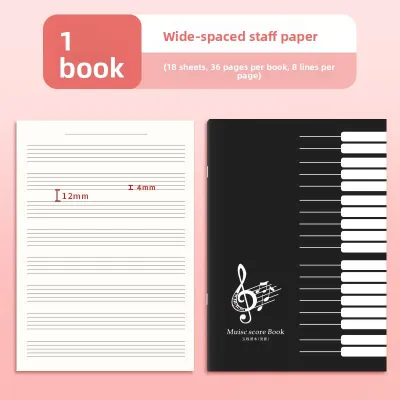
Standard staff paper, often called manuscript paper, consists of pages printed with clef-less staves, typically featuring five horizontal lines and four spaces per staff. This layout is the universal language of formal music theory and classical composition. It allows you to plot exact pitches across multiple octaves, define precise rhythmic durations using note heads and stems, and write detailed dynamics or expression markings. Because it does not favor any single instrument, staff paper is highly versatile but requires a solid understanding of traditional music reading. You can draw a treble clef for high-pitched instruments, a bass clef for lower registers, or combine them for keyboard instruments.
Products mentioned in this guide


Prices are valid at publication and may change. Please refer to the product page for the latest price.
Tablature notebooks, commonly referred to as tab paper, are designed specifically for fretted string instruments. Instead of representing abstract pitches, the horizontal lines in a tab notebook represent the physical strings of your instrument—typically six lines for guitar or four lines for bass and ukulele. Numbers are written directly on these lines to indicate which fret to press down. This visual map bypasses the need to translate a pitch into a physical finger position, making it incredibly intuitive for quick transcription, though it traditionally lacks detailed rhythmic notation unless paired with a standard staff. The top line of the tab represents the highest-pitched string, while the bottom line represents the lowest, creating a direct physical mirror of the fretboard.
Chord notebooks focus on song structure, harmony, and lyrics rather than individual notes. These pages usually feature blank chord diagram grids (small boxes representing a portion of the fretboard or keyboard) alongside wide-ruled lines for writing lyrics and rhythm slashes. This format is built for songwriters and rhythm players who need to map out progressions, track lyric placement, and visualize chord shapes at a glance without getting bogged down in note-by-note transcription. The grids allow you to mark exact finger placements with dots, making it easy to remember unique voicings or transitions.
Matching the Format to Your Instrument and Notation Needs
Selecting the ideal format requires analyzing your primary instrument and how you prefer to read and write music. While some musicians rely solely on one style, multi-instrumentalists and composers often keep a variety of formats on hand to suit different stages of their creative process.

When to Choose Staff Paper
Staff paper is the indispensable standard for classical musicians, keyboardists, woodwind and brass players, and vocalists. If your musical practice involves instruments like the piano, violin, flute, or trumpet, standard notation is the only format capable of capturing the full range and complexity of your repertoire. It is also the primary medium used in formal music theory classes, ear training exercises, and academic composition.
For keyboard players, staff paper often features the grand staff—two staves joined by a bracket—allowing you to write separate parts for the left and right hands simultaneously. Vocalists and choral composers rely on it to align lyrics precisely beneath specific pitches and rhythms. If you are practicing sight-reading or preparing for formal examinations, writing out exercises on physical staff paper reinforces your visual memory of pitch intervals and rhythmic groupings.
However, staff paper has a steep learning curve for beginners who have not yet mastered reading standard notation. For fretted string players, translating a note on a five-line staff to a specific fret on a guitar neck can be slow and inefficient during a fast-paced writing session. If your primary goal is to quickly jot down a guitar riff or a bassline without worrying about formal music theory, staff paper may introduce unnecessary friction to your workflow.
When to Choose Tablature Notebooks
Tablature notebooks are the most efficient choice for guitarists, bassists, lutenists, and ukulele players. If your practice revolves around learning complex fingerpicking patterns, intricate solos, or specific fretboard shapes, tab paper allows you to record these physical movements instantly. You do not need to know the exact pitch names of the notes you are playing; you simply write down the string and the fret number.
This format is particularly valuable for documenting alternate tunings, which are common in modern acoustic and metal guitar styles. When an instrument is not in standard tuning, reading traditional staff paper becomes highly confusing because the physical fingerings no longer match the expected pitches. Tablature solves this by focusing entirely on physical execution, ensuring you can recreate your ideas exactly as you played them.
The primary limitation of tablature is its lack of inherent rhythmic information. Traditional tabs show you where to place your fingers, but they do not easily communicate how long to hold each note or the precise syncopation of a passage. While advanced players sometimes add stems and flags to their tab numbers, this can quickly become cluttered. Additionally, tablature is entirely instrument-specific; a six-line guitar tab notebook is virtually useless to a pianist, violinist, or saxophonist.
When to Choose Chord Notebooks
Chord notebooks are designed specifically for songwriters, rhythm guitarists, ukulele players, and keyboardists who play from lead sheets. If your musical goals involve writing lyrics, arranging chord progressions, or comping behind a vocalist, this format provides the structural framework you need. It eliminates the clutter of individual notes, allowing you to focus on the macro-level structure of a song.
The inclusion of blank chord grids at the top of the page or interspersed between lines is incredibly helpful for documenting unique chord voicings or jazz extensions. You can quickly sketch out a chord shape, write the lyrics below, and use simple slash marks to indicate the strumming pattern or beat count. This makes chord notebooks highly portable and practical for jam sessions, band rehearsals, and casual songwriting on the go.
Despite their convenience, chord notebooks are not suitable for detailed melodic transcription. If you want to write down a complex classical piano piece, a fast violin run, or a detailed horn arrangement, a chord notebook will not provide the necessary precision. It is a tool for harmony and structure, not for intricate counterpoint or precise pitch tracking.
Physical Features to Check Before Buying a Music Notebook
Once you have determined the correct format for your musical needs, you must evaluate the physical construction of the notebook. A music notebook is a working tool that must withstand frequent erasing, heavy ink use, and constant transport.
Paper weight and opacity are critical factors, especially if you prefer writing with gel pens, fountain pens, or dark felt-tip markers. Look for notebooks featuring high-density paper, typically measured in grams per square meter (gsm). Paper that is 100 gsm or higher generally offers excellent resistance to ink feathering and bleed-through. In warm, humid tropical climates, paper naturally absorbs moisture from the air, which can cause standard inks to spread or bleed more easily than they would in dry conditions. Choosing a high-quality, bleed-resistant paper ensures your notes remain crisp and legible even during rainy seasons.
Erasability is another vital consideration for musicians, who frequently revise their compositions and exercises. Cheap, thin paper tends to pill, tear, or smudge when rubbed repeatedly with a standard vinyl eraser. Opt for notebooks with smooth, wood-free paper or high-quality cotton blends that can handle multiple rounds of graphite correction without wearing thin. If you prefer using pencils, verify that the paper has a slightly toothy texture that grabs graphite well and resists smudging during heavy erasing.
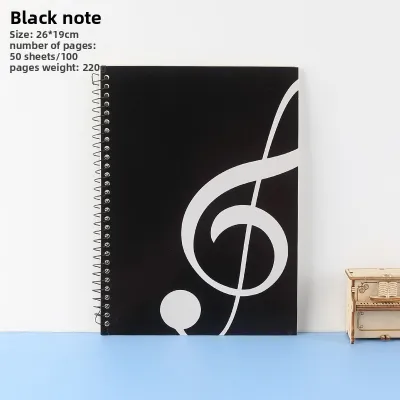
The binding type directly impacts how easily the notebook sits on a music stand or keyboard desk. Spiral-bound or wire-O notebooks are highly recommended for active practice because they can fold completely flat or double back on themselves without damaging the spine. Stitched or thread-bound notebooks also offer excellent lay-flat capabilities if they are designed with a flexible spine, allowing you to read your music hands-free. Avoid tight, perfect-bound (glued) notebooks that constantly spring shut, as they are incredibly frustrating to use while trying to play an instrument at the same time.
Page size and ruling dimensions are also vital for comfortable reading. Standard music notebooks usually come in A4 or letter sizes, which provide ample space for multiple staves or systems per page. Check the spacing between the staff lines; lines that are printed too close together make it difficult to write legible note heads, ledger lines, or fret numbers, especially if you have larger handwriting. Conversely, overly wide spacing reduces the number of systems you can fit on a single page, forcing frequent and disruptive page turns during performance. For songwriters on the go, a smaller A5 pocket-sized chord notebook might be more convenient, but for detailed classical scores, a large A4 manuscript book is essential.
Decision Framework: Which Music Notebook Should You Buy?
To make your final purchase decision, consider your primary musical activities and match them to these straightforward guidelines:
Choose staff paper if you play classical piano, orchestral strings, woodwinds, or brass, or if you are actively studying formal music theory and composition. This format is the universal standard for capturing precise pitch, rhythm, and dynamics across all octaves.
Choose a tablature notebook if your focus is entirely on fretted string instruments like the guitar, bass, or ukulele, and you need a fast, visual way to record finger placements, riffs, and solos without translating them into standard notation.
Choose a chord notebook if you are a songwriter, vocalist, or rhythm player who needs to organize lyrics, map out chord progressions, and sketch fretboard diagrams without the need for detailed, note-by-note transcription.
Before adding a notebook to your cart on your preferred online marketplace, check the paper weight to ensure it can handle your favorite writing instruments under local humidity conditions, and select a lay-flat binding like spiral or exposed stitching to keep your hands free while you play.
Frequently Asked Questions (FAQ)
Can I use a regular lined notebook for writing music?
While you can use a regular lined notebook to write down lyrics, chord names, or basic structural notes, it is highly inefficient for actual musical notation. Lined paper lacks the precise five-line groupings required for standard staff notation, meaning you would have to hand-draw every single staff line, which is tedious and rarely neat. It also lacks the specific vertical spacing needed for clear tablature or the pre-printed grids required for chord diagrams. For accurate transcription and readable practice guides, a dedicated music notebook is always the superior choice.
Are there music notebooks that combine staff paper and tablature?
Yes, hybrid music notebooks are widely available and are highly recommended for guitarists and bassists who want the best of both worlds. These notebooks typically feature pages with alternating systems: a standard five-line staff printed directly above a matching six-line tablature staff. This layout allows you to write the exact pitch and rhythmic duration on the top staff while documenting the precise fretboard position and fingering on the bottom staff. It is an exceptional tool for intermediate to advanced players, music teachers, and composers who want to ensure their music can be read by both classical musicians and tab-reliant players.
Community discussion
Share your experience or ask a question. Comments are reviewed before publication.