
When shopping for an acrylic marker dual tip set, you need to look beyond the vibrant colors on the box. The ideal set must balance tip configurations that match your art style, reliable valve mechanics that prevent messy leaks, and an ink formulation that offers high opacity. By focusing on these technical specifications, you can avoid dried-out nibs, streaky coverage, and ruined projects.
In tropical climates like the Philippines, high humidity can affect how acrylic ink cures and how markers behave during storage. Selecting the right dual-tip configuration ensures you have both a precision tool for fine details and a broader tip for sweeping coverage in a single marker. This guide decodes the key specifications of dual-tip acrylic markers so you can make an informed choice for your next creative project.
Decoding Dual-Tip Configurations
A dual-tip design is highly efficient because it packs two distinct line-making tools into a single barrel, saving space in your art kit. Typically, manufacturers pair a precision nib on one end with a broader, more flexible tip on the other, allowing you to switch between outlining and coloring without changing pens.
Products mentioned in this guide
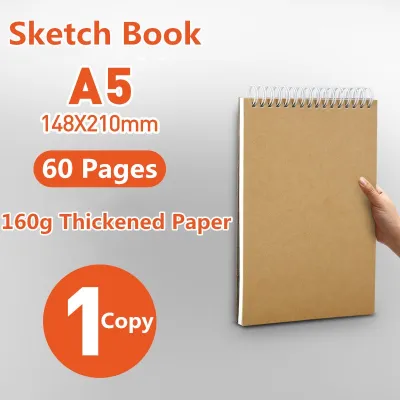
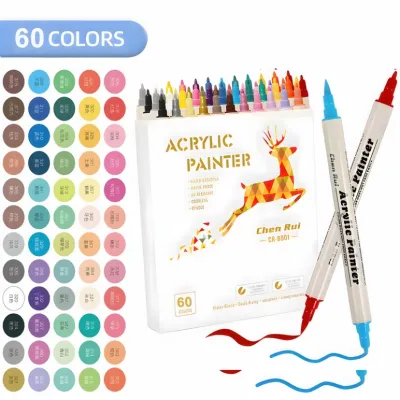
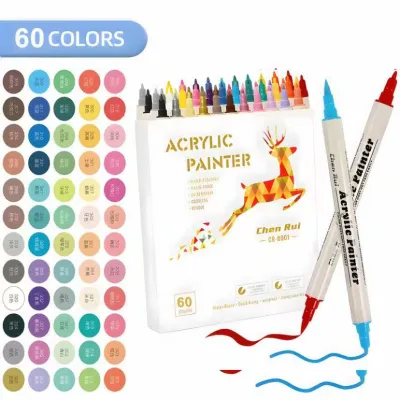
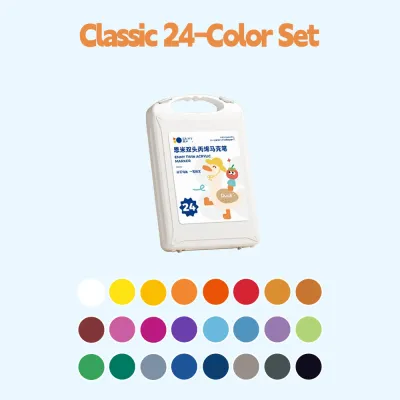
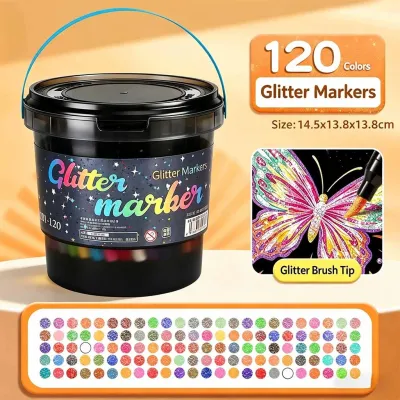
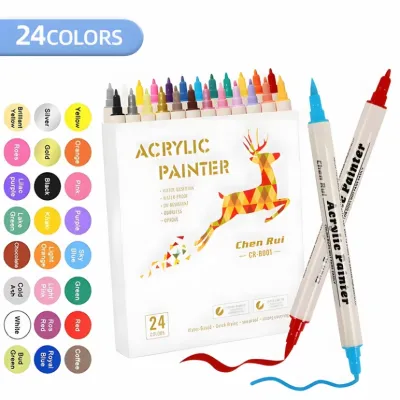
Prices are valid at publication and may change. Please refer to the product page for the latest price.
However, the tip sizes printed on the packaging, such as “0.7mm” or “1-5mm,” are nominal standards. Actual line performance varies based on pressure, hand angle, and surface texture. To ensure the marker meets your expectations, check actual stroke samples provided by the manufacturer or look for user demonstrations on similar materials.
Fine and Bullet Tips for Precision
Fine, needle-like, or bullet tips are engineered to provide consistent, narrow line widths that are essential for detailed work. These tips are the go-to choice for intricate outlines, precise calligraphy, and adding highlights to finished paintings.
- Surface Compatibility: Delicate, extra-fine plastic or felt tips can wear down or fray rapidly when used on rough, abrasive surfaces like raw canvas, unglazed terracotta, or textured wood.
- Best Practices: Reserve your finest bullet tips for smooth paper, primed boards, or treated surfaces to preserve their shape.
- Verification Check: Run a light trial stroke on a scrap piece of your target material to verify if the tip glides smoothly without catching.
Brush and Chisel Tips for Coverage
Broad tips are designed to fill large areas quickly and create dynamic, expressive strokes. The two most common broad options are flexible brush tips and rigid chisel tips, each serving a fundamentally different artistic purpose.
- Flexible Brush Tips: These tips behave like traditional paintbrushes, bending to allow for dramatic line variation, organic sweeps, and smooth wet-blending. They are ideal for brush lettering, botanical illustrations, and soft shading.
- Rigid Chisel Tips: These tips offer a structured, angled edge that provides uniform broad strokes, sharp geometric lines, and efficient color blocking.
- Selection Rule: Choose a brush tip if your art style relies on organic shapes and fluid lines, or opt for a chisel tip if you focus on architectural drawings, hard-edged patterns, and large-scale coverage.
Evaluating Acrylic Ink and Valve Mechanics
The performance of any acrylic marker dual tip depends heavily on ink chemistry and the engineering of the marker’s barrel. High-quality markers must deliver consistent, opaque color without flooding your work surface or drying out inside the pen.

Do not assume that all markers labeled “acrylic” will perform identically. Some budget options contain thin, watery pigments, while others feature professional-grade, heavy-body formulations. Always verify the manufacturer’s specific claims regarding lightfastness and water resistance, as these properties dictate how well your work will endure over time.
Opacity, Pigment Load, and Drying Time
A high pigment load is what gives premium acrylic markers their signature opaque coverage. This density allows light pastel colors to completely cover dark backgrounds, such as black cardstock or dark painted wood, without letting the underlying color bleed through.
- Layering and Drying: Acrylic ink dries rapidly through water evaporation. While this fast-drying nature is excellent for quick layering without muddying your colors, it narrows the time window for blending colors directly on your surface.
- Formulation Types: For projects requiring bold, solid colors on dark or non-porous surfaces, look for markers that specify "heavy-body" or "high-opacity" acrylic formulations.
- Bleed and Smoothness Test: Before starting your project, perform a test stroke on a hidden area of your medium. Observe how quickly the ink dries and if it leaves visible streak marks when dry.
Pump-Action Valves and Flow Control
Most dual-tip acrylic markers utilize a “shake-and-press” pump-action mechanism to deliver ink from the reservoir to the nib. This system uses an internal mixing ball to homogenize the pigment and binder before you press the tip down to prime the pen.
- Anti-Leak Valve Quality: Look for markers equipped with reliable, spring-loaded anti-leak valves. High-quality valves prevent the ink from flooding out when the marker is stored horizontally or subjected to temperature and air pressure changes, which are common in tropical environments.
- Ink Monitoring: A transparent or semi-transparent window on the marker barrel is an incredibly useful specification. It allows you to monitor the remaining ink levels visually, saving you from running out of a key color mid-project.
- Storage Requirements: Always store your dual-tip markers horizontally when not in use. This keeps the ink distributed evenly between both nibs, preventing one end from drying out.
Surface Compatibility and Adhesion Limits
Acrylic markers are celebrated for their multi-surface versatility, but they behave very differently depending on the porosity of the substrate. On porous surfaces—such as paper, raw canvas, unpainted wood, and fabric—the ink absorbs deep into the fibers, creating a strong, permanent physical bond. On non-porous surfaces—including glass, glazed ceramics, smooth plastics, and metals—the ink simply sits on top of the material as a dry film.
Because of this difference, proper surface preparation is essential for long-lasting results. Always clean non-porous items thoroughly with soap and water or rubbing alcohol to remove oils and dust before drawing. For exceptionally smooth plastics or metals, a light sanding with fine-grit sandpaper or the application of a dedicated primer coat will dramatically improve ink adhesion.
“Multi-surface” labels on packaging do not guarantee that your designs will be scratch-proof, dishwasher-safe, or weather-resistant out of the box. For any item that will undergo regular handling, washing, or outdoor exposure, you must apply a compatible clear protective sealant or varnish after the ink has cured completely. Always check the marker label and your specific object’s manufacturer instructions to ensure compatibility before applying any spray or brush-on sealant.
Navigating Color Sets and Blending Constraints
When purchasing your first acrylic marker dual tip set, it is easy to be enticed by massive color collections. However, larger sets often include highly redundant shades. For beginners, hobbyists, or those working on specific craft projects, starting with a core set of 12 to 24 highly versatile colors is generally more practical and cost-effective.
A higher color count does not automatically mean better quality. It is far better to own a smaller set of markers with consistent ink flow, durable nibs, and excellent opacity than a massive, cheap set where the tips fray easily and the ink is watery. Prioritize well-built markers that offer replaceable nibs or refillable ink reservoirs if you plan to use them frequently.
Furthermore, you must understand the blending constraints inherent to acrylic paint pens. Unlike alcohol-based markers, which blend seamlessly on paper by dissolving previous layers, acrylic ink dries to a plastic-like film that cannot be easily reactivated. To achieve smooth gradients, you must employ wet-on-wet techniques, lightly mist the paper with water, or use a damp brush to blend the wet ink before it sets.
Frequently Asked Questions (FAQ)
Can dual-tip acrylic markers be used on fabric or glass?
Yes, dual-tip acrylic markers can write on both fabric and glass, but the durability of the design depends entirely on post-application treatment. On fabric, the ink can bleed into the surrounding threads or wash out over time; you may need to mix the ink with a fabric medium or heat-set the dried design with an iron to make it washable. On glass, the ink remains highly vulnerable to scratching and moisture. To protect glass designs, apply a glass-safe clear varnish, allow it to cure fully according to the manufacturer’s instructions, and hand-wash the item gently without soaking.
How do you revive a clogged or dried-out acrylic marker tip?
If a marker tip becomes clogged or dry, you can often revive it because acrylic ink is water-soluble while still wet. Gently pull the removable nib out of the marker barrel and soak it in a small container of warm water for a few minutes to dissolve the hardened paint. Avoid using harsh solvents like acetone or rubbing alcohol, as these chemicals can degrade the synthetic fibers of the nib or damage the internal plastic valve seals. If the internal pump mechanism itself has completely hardened with dried paint, the marker may be permanently clogged, which highlights the critical importance of keeping caps tightly snapped shut and storing your pens horizontally.
Community discussion
Share your experience or ask a question. Comments are reviewed before publication.