
Selecting the ideal Deli highlighter is not just about choosing your favorite color; it is about matching the ink type and pen design to your specific reading environment, paper quality, and daily routine. Whether you are a student reviewing dense textbooks for hours, an office professional managing documents on the go, or a creative planner organizing a personal journal, the right tool can significantly improve your efficiency and comfort. Deli offers three distinct highlighter categories—fluorescent, pastel, and retractable—each engineered to address different organizational challenges and user preferences.
Fluorescent highlighters provide the classic, high-contrast visibility needed for rapid information retrieval, making them excellent for quick scanning and urgent reviews. Pastel highlighters offer a softer, low-saturation alternative that minimizes eye strain during extended reading sessions and blends beautifully into creative layouts. Retractable highlighters prioritize physical convenience and speed, utilizing a capless click mechanism that protects the ink from drying out while allowing for easy, one-handed operation. By understanding the unique characteristics of each type, you can build a stationery setup that perfectly supports your daily tasks.
Fluorescent, Pastel, and Retractable: What Sets Them Apart?
The primary distinction among these three Deli highlighter categories lies in their visual output and physical construction. Fluorescent highlighters utilize highly saturated, light-reflecting pigments that demand immediate attention. When applied to a page, these inks create a high-contrast mark that stands out even in low-light environments, which is highly beneficial when you need to locate key terms instantly. However, this intense brightness can sometimes cause visual fatigue if used excessively over large blocks of text.
Products mentioned in this guide
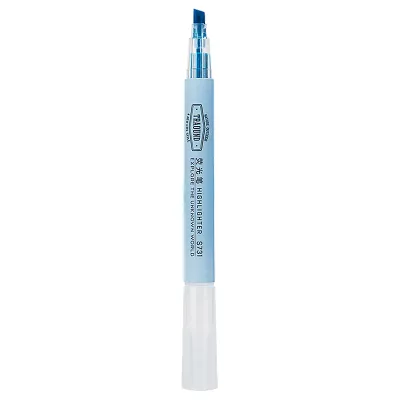
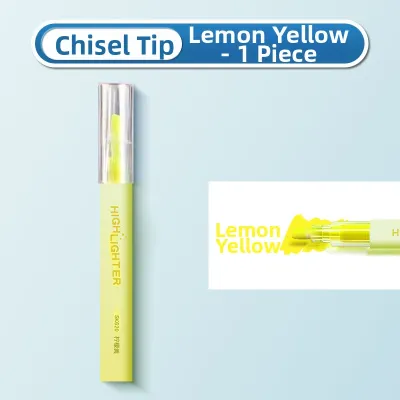
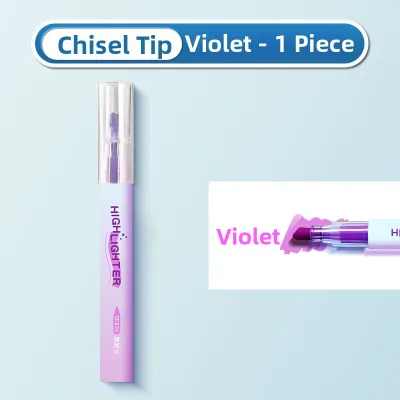
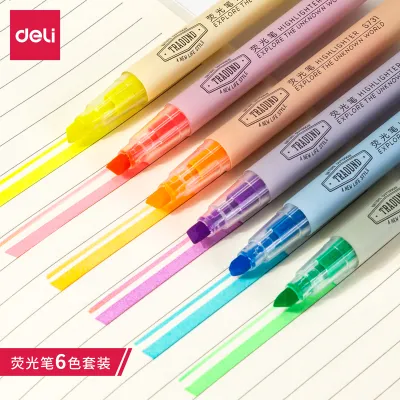
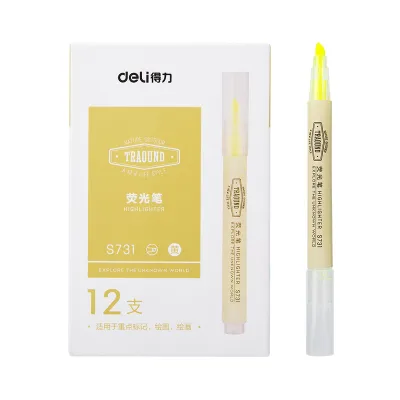
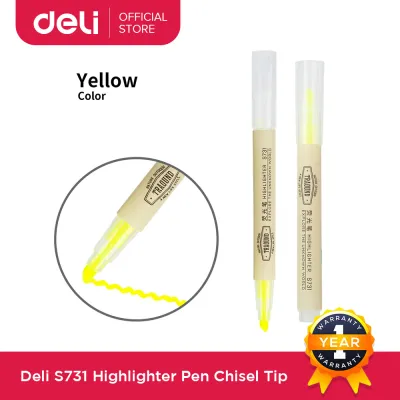
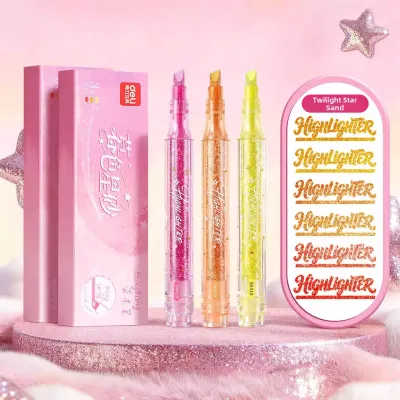
Prices are valid at publication and may change. Please refer to the product page for the latest price.
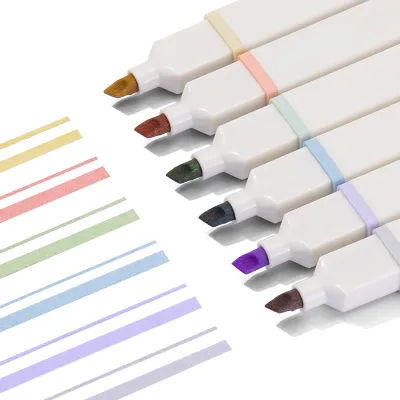
In contrast, pastel highlighters feature low-saturation, water-based inks designed to be gentle on the eyes. Instead of shouting for attention, pastel shades like soft mint, lavender, and dusty rose elegantly shade the text, allowing your eyes to glide over the page without the glare associated with traditional neon colors. This makes them highly popular for modern journaling and dense academic reading where visual comfort is a priority over long hours.
Retractable highlighters introduce a structural innovation by replacing the traditional removable cap with a click-to-write mechanism. Inside the tip of a retractable model, a tiny, spring-loaded shutter door seals the nib when it is retracted, preventing air exposure and keeping the ink fresh. This design eliminates the common hassle of losing pen caps during busy workdays or commutes. While the ink inside a retractable model can be either fluorescent or pastel, the primary value of this category is its physical utility and ease of deployment.
It is important to note that actual ink behavior, including drying speed and resistance to bleed-through, is not solely determined by the color category. These factors depend heavily on the specific product line’s formulation and the characteristics of the paper you are using. Highly absorbent paper may cause even a pastel ink to bleed, while coated paper might extend the drying time of a fluorescent ink. Therefore, always verify the specific product labels and paper compatibility guidelines before making a bulk purchase for your desk.
Matching the Highlighter to Your Daily Tasks
Studying and Textbook Annotation
For students preparing for long study sessions, such as reviewing for university exams or professional board examinations in the Philippines, managing visual fatigue is crucial. When you are reading hundreds of pages of dense academic text under study lamps, highlighting entire paragraphs with bright fluorescent yellow can quickly lead to eye strain. In these scenarios, pastel highlighters are highly effective because they allow you to mark supporting arguments and contextual details softly, keeping the page readable and visually calm.

Fluorescent highlighters should be reserved for high-priority elements that require immediate visual retrieval during quick review sessions. Use these high-contrast markers sparingly for critical formulas, primary definitions, exam dates, or key terms that you must memorize. By establishing a clear hierarchy—using pastel shades for general context and fluorescent colors for absolute essentials—you train your brain to recognize priority levels instantly.
Before applying any ink to your textbooks, always check the paper thickness and quality. Many modern textbooks use thin, lightweight paper that is highly susceptible to ink bleed-through, which can ruin the text on the reverse side of the page. To prevent this, perform a quick test by applying a small stroke of your chosen Deli highlighter on an inconspicuous corner or a blank index page to observe how the ink behaves as it dries.
Office Work and Document Review
In a fast-paced office environment, efficiency and mobility are paramount. Professionals often find themselves moving between meeting rooms, commuting on public transit, or working from shared hot desks where losing a pen cap is a constant risk. Retractable highlighters are exceptionally useful in these situations because they can be operated easily with one hand, allowing you to keep your other hand on your document, tablet, or laptop.
Color choice in the office also carries professional implications. Fluorescent highlighters are excellent for internal document reviews, allowing you to flag urgent action items, budget discrepancies, or critical deadlines that require immediate attention from your team. For client-facing documents, formal contracts, or presentation printouts, pastel highlighters offer a more polished, understated look that organizes information without looking overly casual or distracting.
Additionally, office workers frequently handle specialty papers, such as thermal paper receipts, glossy presentation sheets, or thin carbonless copy papers. Standard highlighter inks can sometimes smudge printed text or cause thermal paper to turn black due to chemical reactions. To avoid damaging important business documents, verify the ink compatibility by checking the manufacturer’s specifications on the packaging to ensure the highlighter is safe for use on your specific office media.
Journaling and Creative Planning
For planners, bullet journal enthusiasts, and creative hobbyists, highlighters serve as essential tools for layout design and aesthetic organization. Pastel highlighters are particularly favored in this community for their layering and color-blocking capabilities. Because the ink is soft and low in saturation, you can use pastel shades to create beautiful background headers, decorative borders, or functional color-coded keys without overpowering your handwritten gel pen notes.
The interaction between the highlighter’s nib shape and the ink type also plays a significant role in creative planning. A classic chisel tip allows you to draw broad, solid blocks of color for headers, or thin, precise lines for underlining and grid borders simply by changing the angle of your hand. Some Deli models feature fine or bullet tips that are ideal for writing directly or adding small, decorative dot patterns to your weekly layouts.
When journaling, the weight of your paper—typically measured in grams per square meter (GSM)—is the single most important factor in determining how your highlighter ink will look. Thin journal pages under 80 GSM are highly prone to ghosting, where the shadow of the ink is visible on the other side, or actual bleed-through. If you enjoy layering pastel inks to build depth or create gradient effects, ensure your journal features heavier paper, preferably 100 GSM or higher, to maintain clean, crisp pages.
Key Features to Verify Before You Buy
Nib Shape and Line Width
Before purchasing your Deli highlighters, closely inspect the packaging to identify the nib shape and the line widths it can produce. The chisel tip is the most versatile option, typically offering a broad line of around 4mm for covering standard text sizes and a fine line of 1mm for precise underlining. If your work involves small, tightly spaced text, such as financial spreadsheets or compact pocket planners, look for bullet or fine-tip highlighters that allow you to mark individual characters without spilling over into adjacent lines.
Ink Base and Drying Properties
The formulation of the ink base directly affects how quickly the highlighter dries and how well it resists smudging. Most Deli highlighters use water-based inks, which are generally low-odor and safe for regular use, but drying times can vary depending on the local humidity and the paper’s coating. If you are left-handed, quick-drying properties are essential to prevent your hand from smearing the ink as you write from left to right across the page. Look for explicit “quick-dry” labels on the product packaging to ensure a clean, smudge-free experience.
Retractable Mechanism Integrity
If you decide to purchase a retractable model, the durability and design of the click mechanism are critical to the pen’s lifespan. A high-quality retractable highlighter must feature a reliable internal seal that snaps shut completely when the nib is retracted, protecting the water-based ink from evaporating in warm, tropical climates. Before committing to a bulk pack, check the physical responsiveness of the clicker and verify that the shutter door closes fully without leaving any gaps that could expose the tip to air.
Decision Framework: Which Deli Highlighter Fits You?
To make your final selection, consider how your daily tasks align with the specific strengths of each Deli highlighter type. This structured framework can guide your purchasing decision based on your primary working conditions:
- Choose Fluorescent if your main priority is rapid information retrieval, high-contrast scanning, or marking critical alerts, formulas, and key terms that must stand out instantly during quick study sessions or document reviews.
- Choose Pastel if you spend long hours reading and annotating dense texts, prefer a clean and minimalist aesthetic, or want to layer colors in journals and planners without causing eye strain or obscuring handwritten notes.
- Choose Retractable if you are constantly on the move, work in shared office spaces, frequently lose pen caps, or require a convenient, one-handed writing tool that can be safely tucked into a bag or pocket without leaking.
Regardless of the type you choose, always verify the compatibility of the ink formulation if you plan to use the highlighters on specialty papers, such as thermal receipts, glossy planner pages, or ultra-thin textbook sheets. Testing a single pen on your preferred paper type before purchasing bulk sets ensures that your highlighting remains clean, legible, and highly effective.
Frequently Asked Questions (FAQ)
Can I use pastel highlighters on thin paper without bleeding through?
While pastel highlighters feature lighter, softer colors, their potential to bleed through paper is determined by the volume of liquid ink deposited and the paper’s weight, not the pigment’s shade. If you apply heavy pressure or hold the tip in one spot for too long, the paper fibers will saturate and cause the ink to bleed through to the other side. To minimize this risk on thin paper, use a light, swift stroke, and try to use paper with a weight of at least 80 GSM for standard notes, or 100 GSM and above for creative journaling.
How do I prevent my retractable highlighter from drying out?
To keep your retractable highlighter performing optimally, always ensure that the click mechanism is fully engaged and retracted when the pen is not in use. You should hear a distinct click, which indicates that the internal shutter door has completely sealed the nib away from the air. Additionally, storing your retractable highlighters horizontally or tip-down helps maintain a consistent ink flow to the nib, preventing the tip from drying out prematurely in air-conditioned offices or warm, humid environments.
Community discussion
Share your experience or ask a question. Comments are reviewed before publication.