
Selecting a watercolor set requires matching your current skill level and painting style to the paint’s grade and format. Beginners benefit from affordable, portable pan sets that simplify color theory, while advanced artists require high pigment loads, lightfastness, and the flexibility of tube paints for large washes. In tropical climates like the Philippines, humidity also plays a major role in how you store and preserve your watercolor supplies.
Choosing the wrong set can lead to unnecessary frustration. A beginner using professional-grade tube paints might feel overwhelmed by the fast-drying nature and high cost, while an advanced artist using student-grade pans might struggle to achieve deep, vibrant washes. By understanding the key differences in paint formulation and packaging, you can make an informed decision that supports your creative journey.
Decoding Giorgione Watercolor Grades and Formats
Watercolor paints are generally categorized into two main grades: student and artist (or professional). The primary difference lies in the ratio of pigment to binder and the presence of fillers. Student-grade watercolors contain lower concentrations of pure pigment, often substituting expensive organic pigments with synthetic alternatives labeled as “hues.” They also contain more fillers, such as chalk or dextrin, which can make the paint appear slightly opaque or chalky when dry.
Products mentioned in this guide
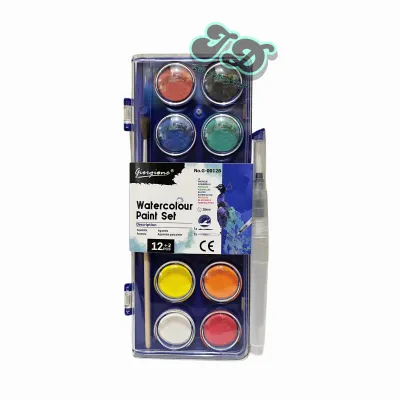
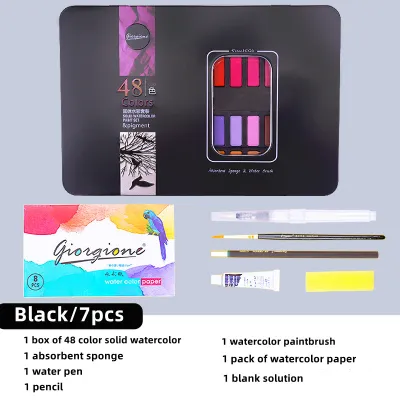
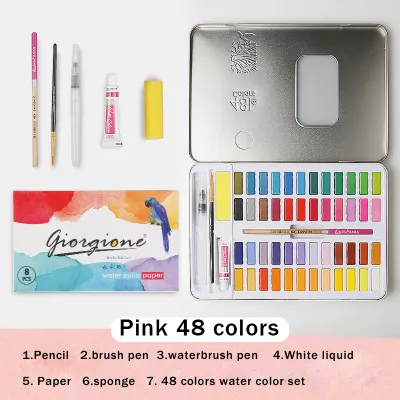
Prices are valid at publication and may change. Please refer to the product page for the latest price.
In contrast, artist-grade watercolors feature a high concentration of finely ground, pure pigments bound with high-quality gum arabic. This formulation allows for exceptional color vibrancy, superior transparency, and excellent lightfastness, ensuring your artwork does not fade over time. When browsing Giorgione products, look closely at the packaging labels. Student lines are often marked with terms like “Studio,” “Academy,” or “Fine,” while professional lines are designated as “Artist,” “Professional,” or “Extra Fine.”
Beyond paint grade, you must choose between pan and tube formats. Pans are small, dry cakes of watercolor housed in plastic cups (half-pans or full-pans) that reactivate when touched with a wet brush. They are highly portable, making them excellent for outdoor sketching, journaling, and small-scale illustrations. However, mixing large washes of color from a pan can be tedious and can wear down your brush bristles over time.
Tubes contain moist, paste-like watercolor that you squeeze onto a palette. This format is ideal for mixing large volumes of paint quickly, making it the preferred choice for large-scale paintings and bold, wet-on-wet techniques. Tubes also allow you to control the exact consistency of your paint, though they require a dedicated palette and are less convenient for travel.
Selecting Giorgione Watercolors for Beginners and Hobbyists
For those who are new to the medium or paint as a casual hobby, student-grade pan sets offer the most practical and encouraging entry point. When you are learning the basics of color mixing, water control, and brushwork, you need a forgiving medium that does not make you feel guilty about wasting expensive materials. A budget-friendly pan set allows you to practice freely without financial pressure.

When selecting a beginner set, look for a balanced color palette rather than the largest set available. A set with 12 to 24 colors is ideal, provided it includes warm and cool variations of the primary colors (red, yellow, and blue). This setup teaches you how to mix clean secondary and tertiary colors without creating muddy mixtures. Additionally, look for sets that feature integrated mixing wells in the lid and include a travel water brush, which simplifies your setup and eliminates the need for separate water cups.
However, it is important to manage your expectations when using entry-level watercolors. Because student-grade paints contain more fillers, you may notice a slight chalky residue on the paper once the paint dries. They also require more effort to build up deep, dark values, as the pigment concentration is lower. If you plan to display your work in brightly lit rooms, keep in mind that student-grade paints generally have lower lightfastness, meaning the colors may gradually fade when exposed to sunlight over several months or years.
Giorgione Watercolor Choices for Intermediate and Advanced Painters
As your skills progress, you will likely find yourself limited by the working properties of student-grade paints. Upgrading to artist-grade Giorgione sets—whether in pans or tubes—unlocks the ability to execute advanced techniques like precise glazing, where multiple transparent layers are built up to create depth. Artist-grade paints offer the transparency needed for these layers to interact beautifully without becoming muddy or opaque.
Advanced painters should pay close attention to the pigment information printed on the back of the packaging or color charts. Look for single-pigment codes (such as PB29 for Ultramarine Blue or PY43 for Yellow Ochre) rather than multi-pigment mixtures. Single-pigment paints mix much more predictably, allowing you to create clean, vibrant custom shades. You should also verify the lightfastness rating, which is typically indicated by a star system or ASTM classification (such as Class I or II), ensuring your finished pieces remain archival and gallery-ready.
Another benefit of professional-grade paints is granulation. Certain natural pigments settle into the texture of watercolor paper, creating beautiful, organic textures that are highly prized in landscape and portrait painting. Student-grade paints, with their heavy fillers, often mask this natural effect.
At this stage, instead of buying a massive pre-packaged set of 36 or 48 colors, consider investing in a smaller, high-quality set or purchasing individual tubes of essential colors. A curated palette of split primaries, a few earth tones (like Burnt Sienna and Raw Umber), and a couple of convenience greens or blues is often all an experienced artist needs. This approach allows you to customize your palette to your specific painting style, whether you focus on delicate botanical illustrations or dramatic, textured landscapes.
What to Verify Before Buying Your Giorgione Set
Before finalizing your purchase, performing a few quick quality checks can save you from receiving a defective or unsuitable product. First, inspect the physical packaging. If you are buying tubes, check that the seals are intact and there are no signs of leaking or hardening around the caps. For pan sets, ensure the cakes are not excessively cracked or crumbling, which can indicate that the paint has dried out too much during storage or that the binder ratio was off.
Next, consider the environment where you will be painting. If you share your workspace with children or pets, or if you are purchasing supplies for a classroom, verify that the watercolor set carries a certified non-toxic label, such as an AP seal or EN71 compliance mark. This ensures the pigments do not contain harmful heavy metals like cadmium or cobalt, which are sometimes found in traditional artist-grade paints.
To evaluate the true value of a set, calculate the cost per milliliter or gram in ₱ rather than focusing solely on the upfront price. A larger set might seem like a bargain, but if it contains small half-pans with low pigment concentration, you may end up spending more in the long run than you would on a smaller set of highly concentrated paints.
Finally, keep the local climate in mind. In the tropical, high-humidity environment of the Philippines, watercolor supplies require careful storage. High humidity can prevent pans from drying completely after use, making them susceptible to mold growth. Look for sets housed in sturdy, rust-resistant metal tins or airtight plastic cases that protect the paints from moisture and pests when not in use.
Frequently Asked Questions (FAQ)
Can I mix student-grade and artist-grade Giorgione watercolors?
Yes, student-grade and artist-grade watercolors are physically compatible because they both use a water-soluble binder, typically gum arabic or a synthetic equivalent. You can safely mix them on the same palette or layer them on your paper. However, keep in mind that the overall archival quality and lightfastness of the mixture will default to the lower-grade paint. If you mix a highly lightfast artist-grade blue with a fugitive student-grade yellow, the resulting green may fade unevenly over time. A practical approach is to use student-grade paints for large background washes or initial underpaintings, and save your high-quality artist-grade paints for the focal points and final detailed layers.
How do I safely reactivate dried Giorgione pan watercolors?
Reactivating dried pan watercolors is simple and safe if done correctly. The best method is to use a fine mist spray bottle filled with clean, distilled water. Lightly spray the surface of the pans a minute or two before you begin painting, allowing the water to gently soften the dry pigment cake. Avoid using harsh solvents, rubbing alcohol, or excessive heat, as these can break down the gum arabic binder and cause the paint to crack or lose its adhesive properties. If you notice any signs of mold, such as fuzzy spots or an unusual odor, avoid using the paint, as mold spores can ruin your watercolor paper and contaminate your brushes.
Community discussion
Share your experience or ask a question. Comments are reviewed before publication.