
When managing personal or business loans, keeping an accurate physical record is essential for maintaining trust and ensuring clear terms. The ideal loan agreement booklet for your workflow depends on your specific balance of transaction volume, the complexity of your terms, and your need for legal safety nets. While a pre-printed form booklet offers speed and a reliable checklist for repetitive transactions, a blank ledger register provides total freedom for complex, multi-stage repayments. Meanwhile, a template-based notebook acts as a middle ground, offering structural prompts without locking you into rigid fields. Choosing the right format ensures that your records remain organized, legally useful, and easy to maintain over time.
Assess Your Loan Documentation Workflow First
Before purchasing a loan agreement booklet, you must analyze how your lending operations function on a day-to-day basis. If you are running a small enterprise, a neighborhood micro-lending service, or managing informal credit for a family-owned business, your documentation needs will differ vastly from someone handling a one-off personal loan. Start by evaluating your lending frequency. Lenders who process multiple transactions a week require a rapid, repeatable system to keep up with administrative demands. On the other hand, occasional lenders can afford to spend more time drafting bespoke agreements for individual borrowers.
Next, consider the complexity of your loan terms. A basic loan may only require tracking the principal amount, a flat interest rate, and a single maturity date. However, more complex agreements often involve collateral descriptions, variable installment schedules, guarantor details, or specific late-payment penalties. If your transactions regularly feature these variable elements, a rigid document structure may restrict your ability to record crucial details.
Products mentioned in this guide
Prices are valid at publication and may change. Please refer to the product page for the latest price.
Error prevention is another critical factor to weigh. Forgetting to write down a due date, omitting a signature line, or failing to state the interest calculation method can lead to disputes or render an agreement difficult to enforce. If you or your staff are prone to skipping steps during busy hours, a booklet that provides built-in prompts and structured fields will minimize human error. Ultimately, the decision comes down to a trade-off between standardization—which guarantees speed and consistency—and flexibility, which allows you to tailor terms to unique financial agreements.
Pre-Printed Forms: Ideal for Standardized, High-Volume Lending
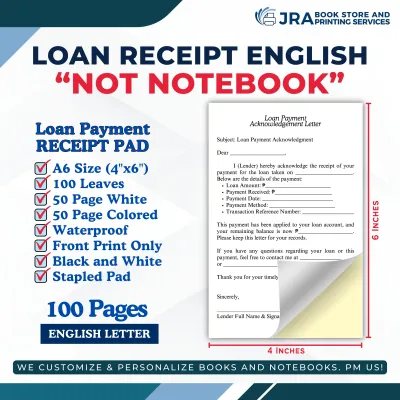
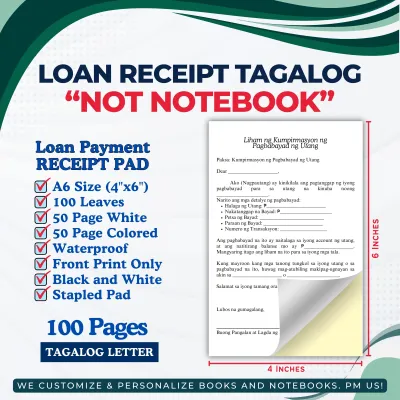
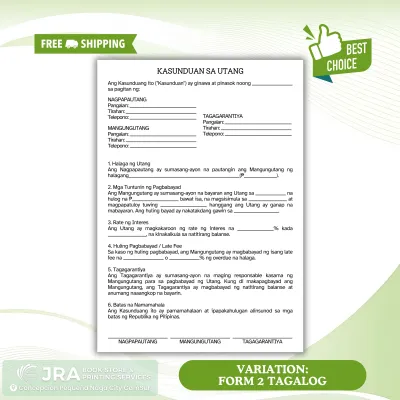
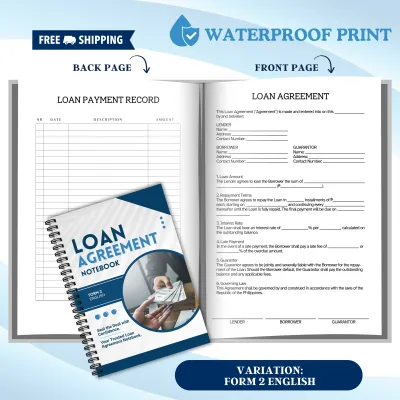
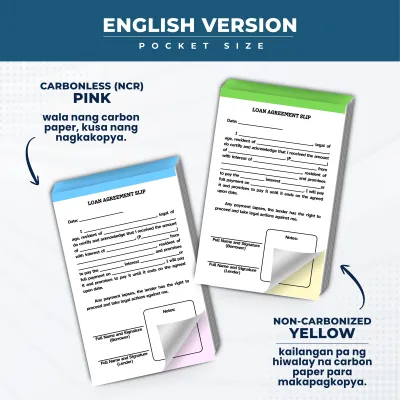
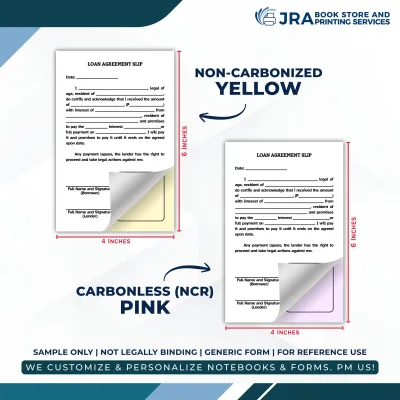
Pre-printed loan agreement booklets are designed for speed, consistency, and high-volume operations. These booklets feature a fixed layout where the essential legal and financial fields are already printed on the page. Each page contains dedicated blank lines for the borrower’s personal information, the principal loan amount, the agreed interest rate, the repayment schedule, and designated signature blocks for both parties and their witnesses. Many pre-printed booklets also include carbonless copy paper (NCR), allowing you to generate duplicates instantly so that both the lender and the borrower receive an identical, physical copy of the signed contract on the spot.

The primary benefit of this format is that it serves as an automatic checklist. Because the fields are clearly labeled, you are highly unlikely to forget crucial details such as the date of the transaction or the specific terms of default. This structured layout dramatically reduces the time spent drafting each contract, making it highly efficient for busy micro-finance operations, cooperative lenders, or retail businesses offering installment plans. Whether you are lending ₱5,000 or ₱50,000 under uniform terms, these forms ensure that every transaction is documented identically.
However, this rigidity is also the format’s main limitation. Pre-printed forms offer virtually no flexibility for non-standard terms. If a borrower offers a unique form of collateral—such as agricultural equipment or a vehicle—there may not be enough physical space to write a detailed description of the asset. Similarly, if you agree on an unconventional repayment schedule, fitting these terms into standard weekly or monthly boxes is incredibly difficult.
This booklet type is ideal for lenders who issue uniform, small-scale personal or business loans. If your terms are identical from one borrower to the next and you prioritize rapid processing over custom clauses, a pre-printed form booklet will streamline your administrative workflow and keep your records perfectly standardized.
Blank Ledger Registers: Best for Custom Terms and Complex Tracking
Blank ledger registers offer a completely open format, typically featuring blank pages, simple ruled lines, or grid patterns. Unlike pre-printed forms, these registers do not contain any pre-written text, labels, or prompt fields. They provide a clean slate, allowing you to design and write out the entire agreement, terms, and repayment history from scratch for every single transaction.
The outstanding advantage of a blank register is its absolute flexibility. You are not confined by pre-determined boxes or word limits. This format allows you to draft highly customized agreements that include extensive terms and conditions, detailed collateral descriptions, and specific clauses regarding late fees or early repayment incentives. Furthermore, a blank ledger provides ample space to track complex, multi-stage repayment histories directly on the pages following the initial agreement. You can manually draw columns to log the date of each payment, the amount paid, the remaining balance, and signatures acknowledging each installment, keeping the contract and the payment history bound together in one place.
Despite these benefits, blank registers carry a high risk of human error. Because there are no visual prompts, the responsibility falls entirely on you to ensure that every necessary legal and financial detail is included. Forgetting to write down the interest rate, omitting the date of execution, or failing to secure a signature in the correct spot can severely compromise the agreement’s utility. Drafting these agreements manually also requires a significant investment of time, making this format highly impractical for high-volume lending.
A blank ledger register is best suited for experienced lenders, business owners, or individuals managing high-value, unique, or non-standard loan structures. If you already have a legally vetted agreement template that you prefer to write out or paste into the book, and you need to track detailed, ongoing payments over several months or years, a blank register provides the blank canvas required for comprehensive record-keeping.
Template-Based Notebooks: The Middle Ground for Guided Flexibility
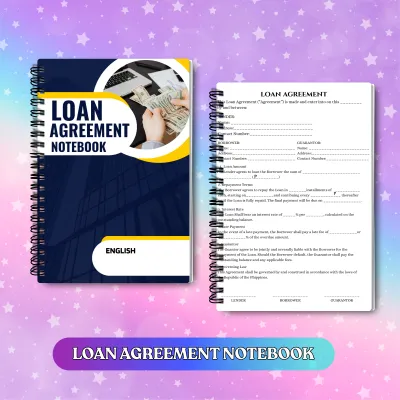
Template-based notebooks represent a deliberate compromise between the rigid structure of pre-printed forms and the open canvas of blank registers. These booklets typically provide a modular layout, featuring light prompt text, section dividers, or subtle grid lines that guide the writer without strictly limiting what can be written. For example, a page might have a small header area for basic details like “Borrower Name” and “Date,” followed by a large, lightly ruled section labeled “Terms & Collateral,” and ending with a designated “Signatures” block at the bottom.
The primary benefit of a template-based notebook is its ability to balance structure with adaptability. It acts as a helpful guide, reminding you to fill in critical administrative details at the top and obtain signatures at the bottom, while leaving the middle section completely open for custom text. This allows you to write out specific repayment conditions, describe unique collateral, or add custom clauses without feeling constrained by tiny, pre-printed boxes. It keeps your records looking consistent and organized from page to page while accommodating the natural variations that occur in everyday lending.
However, this middle-ground approach has its own limitations. For highly complex legal agreements that require multiple pages of dense, standardized fine print, a template notebook may still feel too loose and disorganized. Conversely, for high-volume lenders who want to complete a transaction in under two minutes, having to write out custom terms in the open sections can feel slow and repetitious compared to simply filling in the blanks on a pre-printed form.
This format is ideal for moderate-volume lenders, such as small business owners, landlords managing security deposits and tenant loans, or individuals who frequently assist associates with formal personal loans. It provides the perfect safety net to ensure you do not forget the basics, while granting you the creative freedom to adapt the agreement to the specific needs of each transaction.
Quick Comparison: Matching the Booklet to Your Lending Profile
To help you quickly determine which booklet format aligns with your specific record-keeping needs, the following table summarizes the key differences in flexibility, error prevention, ideal use cases, and limitations.
| Booklet Type | Flexibility | Error Prevention | Best For | Limitations |
|---|---|---|---|---|
| Pre-Printed Forms | Extremely Low | High (built-in prompts and fields) | Standardized, high-volume micro-loans and routine retail credit | Cannot accommodate custom clauses or complex collateral |
| Blank Ledger Registers | Extremely High | Low (requires manual drafting of all terms) | High-value, unique loans and detailed installment tracking | High risk of omitting critical legal fields; time-consuming |
| Template-Based Notebooks | Moderate | Moderate (provides basic structural prompts) | Moderate-volume lenders needing custom terms with basic guidance | May feel too loose for rapid entry or too small for long legal text |
If you find that your needs span multiple categories, you can easily adopt a hybrid approach. For instance, you can use a blank ledger register to maintain a clean, chronological log of all repayment transactions, while attaching a signed, pre-printed or digital loan agreement form as a physical addendum to the page. This allows you to benefit from the structured safety of a standard form while utilizing the spacious layout of a blank register for long-term payment tracking.
Stationery Specs to Verify Before Purchasing
Once you have decided on the structural format of your loan agreement booklet, you must evaluate its physical construction. Because these booklets serve as financial and legal records that must be preserved for years, selecting durable, high-quality stationery is essential.
Paper Quality and Ink Compatibility The weight and quality of the paper are critical for long-term readability. Look for paper with a weight of at least 80 to 100 GSM (grams per square meter). Thinner paper is highly susceptible to ink bleed-through and ghosting, especially if you or your borrowers sign agreements using gel pens, rollerballs, or fountain pens. In the humid tropical climate of the Philippines, paper naturally absorbs moisture from the air, which can soften the fibers and exacerbate ink feathering. To ensure legibility, always perform a quick ink test on an inconspicuous back page before writing your first official agreement.
Binding and Lay-Flat Ability A booklet’s binding directly impacts how easy it is to write in and sign. For loan agreements, look for thread-sewn (case-bound) or lay-flat glue bindings. These construction methods allow the booklet to open completely flat on a desk without requiring you to forcefully hold the pages down, which is particularly important when two parties need to sign across a spread. Avoid tight, perfect-bound paperback books that constantly spring shut, as they make writing awkward and can cause the spine to crack and pages to fall out over time.
Size and Archiving Consider where and how the booklet will be stored. Standard A4-sized booklets are highly recommended for formal business use, as they provide ample space for detailed writing and are easy to photocopy, scan, or file alongside standard legal documents. If portability is your main priority—such as collecting payments in person at various market stalls—an A5 booklet offers a compact, travel-friendly alternative that fits easily into a bag while still providing enough room for basic transaction entries.
Page Numbering and Indexing To prevent tampering and maintain the chronological integrity of your records, select a booklet with pre-numbered pages. If pages are numbered consecutively, it is impossible for anyone to tear out a page to erase a transaction without leaving obvious evidence of tampering. Additionally, a booklet that features a blank index at the front allows you to quickly log the borrower’s name and page number, making it simple to locate specific agreements months or years down the line.
Frequently Asked Questions (FAQ)
Can I use a regular notebook for legally binding loan agreements?
Yes, the legal validity of a loan agreement in the Philippines generally depends on the essential elements of a contract—such as mutual consent, a lawful object, and consideration (the loan amount)—rather than the specific type of paper used. However, using a standard, loose-leaf school notebook is highly discouraged for professional record-keeping. Bound registers or dedicated booklets are significantly better because they prevent pages from being easily removed, added, or altered, which helps protect the integrity of your chronological records if a dispute arises. For high-value transactions or complex terms, it is always advisable to consult a local legal professional to ensure your documentation complies with Philippine credit laws.
How should I handle corrections or mistakes in a loan register?
When managing a bound loan register, you should never use correction fluid, correction tape, or attempt to erase a mistake. Altering a financial record in this manner can look like unauthorized tampering or fraud if the document is ever reviewed in a legal setting. Instead, follow standard accounting and record-keeping practices: draw a single, clean line through the incorrect text or figure so that the original entry remains legible, write the correct information clearly nearby, and have both the lender and the borrower place their initials directly next to the correction. This transparent correction process proves that both parties mutually agreed to the change at the time it was made.
Community discussion
Share your experience or ask a question. Comments are reviewed before publication.