
Choosing the right mechanical pencil lead refill for daily writing in the Philippines often comes down to balancing precision with comfort. In a tropical climate where high humidity can make paper fibers slightly damp and soft, the interaction between your pencil lead and your notebook becomes highly noticeable. The choice between a 0.5mm HB lead and a 0.7mm 2B lead represents two entirely different writing experiences. While one prioritizes fine, clean lines that resist smudging even on humid days, the other offers a dark, buttery-smooth stroke that glides effortlessly during fast-paced lectures or long board exam review sessions.
Your handwriting size, the pressure you apply when writing, and the quality of your paper are the primary factors that determine which lead refill will serve you best. A 0.5mm HB lead is the traditional standard for students and professionals who need to fit a lot of information into tight spaces, such as ledger columns, pocket planners, or compact review notebooks. On the other hand, a 0.7mm 2B lead caters to those who find thin lines too faint or fragile, offering a bolder visual presence and a softer feel that reduces hand fatigue during extended writing tasks. Understanding how these physical and chemical differences interact with your specific habits will help you select the most comfortable and efficient option for your mechanical pencil.
Line Width and Darkness: Visual Output on Paper
The visual output of your mechanical pencil is determined by two physical characteristics: the diameter of the lead and the ratio of graphite to binder clay. A 0.5mm HB lead produces a thin, crisp line that is highly suited for precise work. Because HB sits in the middle of the hardness scale, it contains a balanced mixture of graphite and clay, resulting in a medium-gray mark. This fine line width is excellent for writing complex mathematical equations, drawing detailed diagrams, or filling out forms with small boxes. If your handwriting is naturally small and compact, the 0.5mm HB ensures that letters like “e” and “a” do not fill in or become illegible blobs.
Products mentioned in this guide
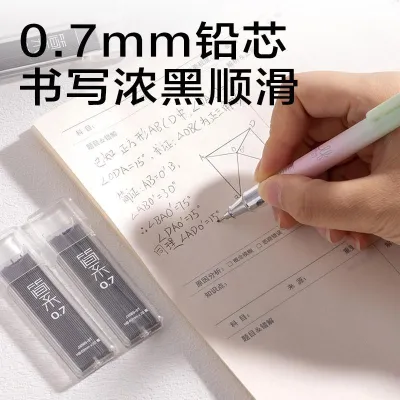
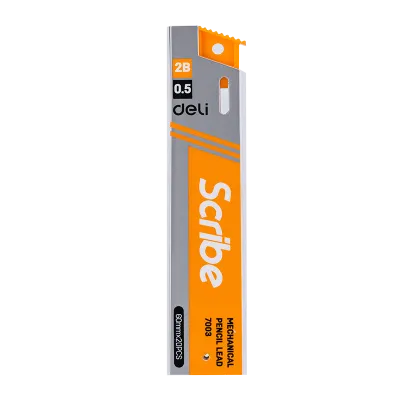
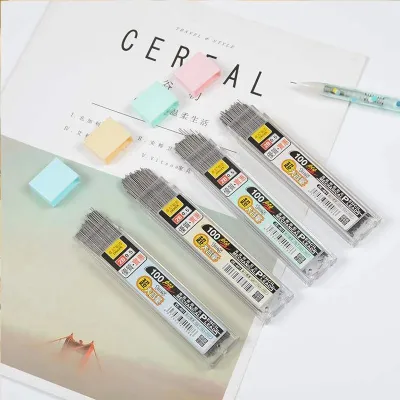
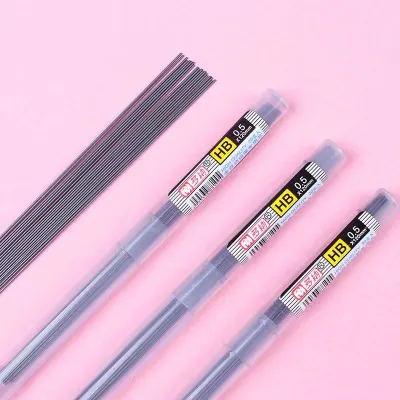
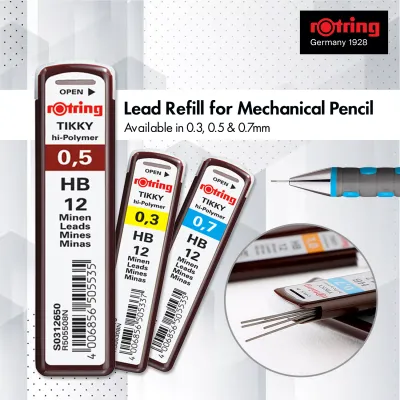
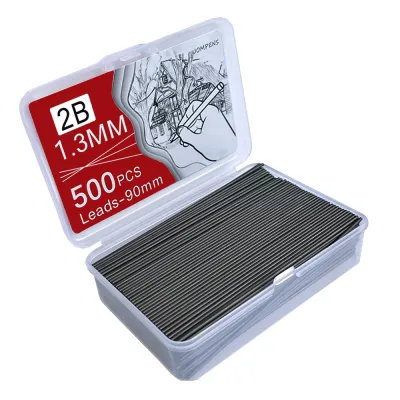
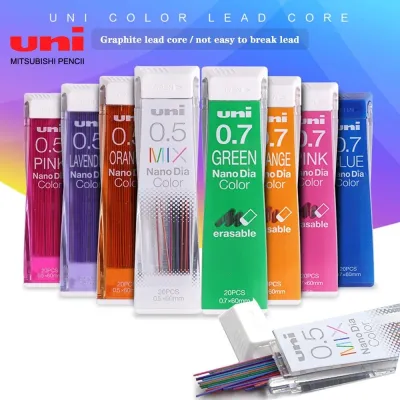
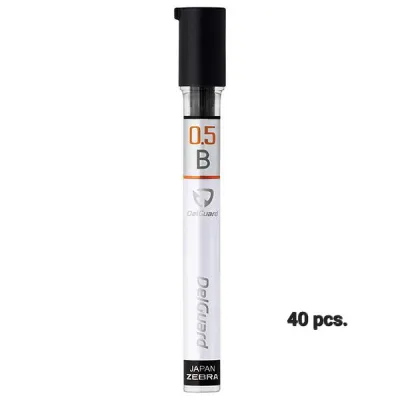
Prices are valid at publication and may change. Please refer to the product page for the latest price.
In contrast, a 0.7mm 2B lead delivers a significantly bolder and darker stroke. The 0.7mm diameter is physically wider, which naturally deposits more material onto the page with every stroke. Additionally, the “2B” designation indicates a softer grade containing a higher proportion of graphite relative to clay. This formulation allows the lead to shed its material more easily, producing a rich, dark black line that offers high contrast against the paper. This high visibility is particularly beneficial for quick reading under dim classroom lights or during late-night study sessions. However, if you have very small handwriting, the combination of a thicker 0.7mm line and a darker 2B formulation can cause your letters to run together, making your notes look cluttered.
When comparing the visual output on standard paper, the difference in contrast is immediately apparent. The 0.5mm HB line remains consistent and neat, but it can sometimes look faint if you write with a light hand. The 0.7mm 2B line stands out clearly, making it excellent for headings, mind maps, and rapid brainstorming. However, because the 2B lead is softer and deposits more loose graphite particles on the surface of the paper, the risk of visual degradation over time is higher. If you frequently flip through your notebook pages, the dark 2B marks can gradually transfer to the facing pages, a problem that is much less pronounced with the harder, lighter 0.5mm HB lead.
Writing Feel: Smoothness and Tactile Feedback
The tactile sensation of writing—often referred to as feedback—plays a crucial role in how quickly your hand tires during long writing sessions. A 0.7mm 2B lead is widely celebrated for its buttery-smooth feel. Because the lead is soft and contains more lubricating graphite, it glides across the paper with minimal resistance. This low friction means you do not need to press down hard to get a dark, legible line. For students taking rapid-fire notes during a lecture or professionals drafting quick memos, this smooth glide can significantly reduce finger strain and wrist fatigue, making it a highly comfortable option for continuous writing.

Conversely, a 0.5mm HB lead provides a much firmer and more controlled writing experience. The harder clay-heavy composition of HB lead resists wearing down, which means the tip retains its shape longer but also creates more friction against the paper fibers. This friction is felt as tactile feedback, giving you a clear physical sensation of the paper’s texture. Many writers prefer this feedback because it offers greater precision and control over letter formation, preventing the pencil from sliding uncontrollably on smooth paper surfaces. If you find that your handwriting becomes messy when using a lead that glides too quickly, the resistance of a 0.5mm HB can help stabilize your hand.
Your natural writing speed and grip pressure will dictate which feel is more comfortable. If you have a heavy hand and tend to grip your pencil tightly, the high feedback of a 0.5mm HB might feel scratchy, as the thin, hard point digs into the paper. For heavy-handed writers, switching to a 0.7mm 2B can make writing feel much softer and more cushioned. However, if you write with a very light touch and prefer a fast, effortless stroke, the 2B lead will feel like it is doing the work for you, whereas the HB lead might require you to apply more downward pressure than you find comfortable just to achieve a readable level of darkness.
Break Resistance: Managing Lead Snapping
Lead breakage is one of the most common frustrations when using mechanical pencils, and it is directly influenced by both the thickness and the hardness of the lead. A 0.7mm lead has a distinct structural advantage over a 0.5mm lead simply due to its physical dimensions. The cross-sectional area of a 0.7mm lead is nearly double that of a 0.5mm lead, making it inherently much stronger and more resistant to shear stress. If you tend to write with heavy hand pressure or if you write at a steep angle, a 0.7mm lead is far less likely to snap during a sudden movement, providing a more reliable and uninterrupted writing flow.
While 0.5mm leads are physically thinner and more fragile, the hardness of the HB grade provides some structural compensation. Because HB lead contains more clay binder, it is more rigid than softer grades of the same thickness, such as a 0.5mm 2B. This rigidity helps the thin lead resist bending forces up to a certain point. However, if you extend a 0.5mm HB lead too far out of the pencil tip, or if you apply sudden lateral pressure, it will snap cleanly. Writers using 0.5mm pencils must develop a disciplined clicking habit, usually extending no more than one or two clicks of lead to keep the exposed portion short and supported by the metal sleeve of the pencil.
To minimize breakage, it is helpful to observe the signs of lead fatigue. If you notice tiny graphite crumbs accumulating around your writing area, or if the lead feels like it is crumbling rather than gliding, you may be applying too much pressure for that specific thickness and hardness. If you find yourself constantly snapping 0.5mm HB lead despite keeping it short, it is a clear sign that your writing pressure is better suited for the thicker 0.7mm format. Conversely, if you use a 0.7mm 2B lead, you must also be careful; although it is thicker, the soft 2B formulation can crumble if subjected to extreme pressure, though it will rarely snap with the clean, sharp break characteristic of a 0.5mm lead.
Paper Compatibility and Smudge Potential
In the Philippines, where high relative humidity can soften paper fibers and make paper surfaces slightly damp, the interaction between lead and paper is a critical consideration. Softer leads like the 0.7mm 2B are highly prone to smudging under these conditions. Because 2B lead deposits a large volume of loose graphite on the surface of the paper rather than embedding it deeply into the fibers, any friction can easily smear the text. If you are left-handed, your hand dragging across the freshly written line will likely result in a silver-gray smudge on your palm and a blurred mess on your page. Furthermore, when you close a notebook, the pressure can cause the dark 2B graphite to transfer to the opposite page, leaving mirror-image shadows over your clean notes.
The 0.5mm HB lead performs exceptionally well on standard, slightly rough notebook paper. The harder lead structure allows the graphite to lock into the paper fibers more securely, resulting in excellent smudge resistance. Even in humid weather, HB notes remain crisp and legible, making this combination the preferred choice for official documents, exam answer sheets, and journals that will be handled frequently. However, because 0.5mm HB is thin and hard, it can sometimes catch on rough or low-quality paper. If the paper has a loose fiber structure, a sharp 0.5mm tip can tear or scratch the surface, especially if you apply too much pressure.
Before purchasing lead refills in bulk, it is wise to evaluate the paper you use most frequently. If your primary notebooks feature smooth, high-density, or coated paper, a 0.7mm 2B lead will glide beautifully, but you must allow it some space and avoid rubbing the pages. If you use standard school notebooks, newsprint exam sheets, or textured sketchpads, a 0.5mm HB lead will provide a much cleaner, smudge-free result. Checking how a single refill performs on your favorite paper brand under local weather conditions will save you from the frustration of illegible notes and messy hands.
Decision Framework: Choosing Your Daily Lead Refill
To choose the right lead refill for your daily routine, you can use a simple decision framework based on your writing habits, tools, and environment. Your choice should align with your natural handwriting style and the physical limitations of your mechanical pencil.
You should choose the 0.5mm HB lead refill if you meet the following criteria:
- Your handwriting is naturally small, compact, or highly detailed.
- You frequently write mathematical formulas, technical diagrams, or fill out small forms.
- You prefer a firm, controlled writing feel with noticeable tactile feedback.
- You write on standard, slightly textured, or lower-weight paper where smudge resistance is a priority.
- You have a light to medium writing pressure and can manage a thinner, more delicate lead.
You should choose the 0.7mm 2B lead refill if you meet the following criteria:
- Your handwriting is medium to large, and you prefer bold, highly visible lines.
- You write quickly, such as during rapid lecture dictations or brainstorming sessions.
- You suffer from hand fatigue and want a soft, buttery-smooth glide that requires minimal downward pressure.
- You use high-quality, smooth paper and do not mind taking extra care to prevent smudging.
- You have a heavy hand and frequently snap thinner leads.
Before making your purchase, always verify the exact lead size supported by your mechanical pencil. Mechanical pencil clutch mechanisms are engineered to extremely precise tolerances and are strictly size-specific. A pencil designed for 0.5mm lead cannot hold or advance 0.7mm lead, and attempting to force a mismatched size will jam or damage the internal clutch. Additionally, keep in mind that standard graphite leads are designed for general writing; if your work requires specialized properties such as complete waterproof permanence, archival certification, or colored drafting capabilities, you may need to look beyond standard HB and 2B graphite formulations to specialized polymer or wax-based colored leads.
Frequently Asked Questions (FAQ)
Can I use 0.5mm lead in a 0.7mm mechanical pencil?
No, you cannot use 0.5mm lead in a 0.7mm mechanical pencil. The internal clutch mechanism and the tip sleeve of a mechanical pencil are designed to match one specific lead diameter. If you place a 0.5mm lead into a 0.7mm pencil, the clutch will not be able to grip the thin lead securely. As a result, the lead will simply slide out and fall through the tip when you press the click button. Conversely, attempting to force a 0.7mm lead into a 0.5mm pencil will cause the lead to jam inside the chamber or break before it can even reach the tip. Always match your lead refill size exactly to the size printed on your mechanical pencil’s body.
Does 2B lead dull faster than HB lead?
Yes, 2B lead wears down and dulls significantly faster than HB lead. Because 2B lead is softer and contains a higher concentration of graphite relative to the clay binder, it sheds its material much more rapidly onto the paper to create those dark, smooth lines. As you write, the sharp point of a 2B lead quickly flattens out into a broad, blunt tip, which can cause your line width to thicken during a single paragraph. This rapid wear requires you to click the pencil more frequently to expose fresh lead, or to rotate the pencil constantly in your hand to find a sharp edge. In contrast, the harder HB lead retains its point shape for a much longer duration, offering greater line consistency and requiring fewer clicks over a long writing session.

Community discussion
Share your experience or ask a question. Comments are reviewed before publication.