
Choosing the right scientific calculator is one of the most critical decisions for students in the Philippines, especially those pursuing Science, Technology, Engineering, and Mathematics (STEM) tracks or preparing for professional licensure examinations. The debate often centers on the Canon F-789SGA II and various CASIO scientific calculators, which are the dominant tools found in local classrooms and lecture halls. Both brands offer robust mathematical tools, but their differences in menu layout, input logic, and official exam compliance can significantly impact your academic performance and daily study habits.
To make an informed purchase, you must look beyond basic arithmetic and evaluate how each device handles complex equations, matrix operations, and statistical distributions under timed conditions. Factors such as screen readability under classroom lighting, tactile button response, and long-term durability in high-humidity tropical environments also play a vital role. By comparing these aspects systematically, you can select a calculator that not only fits your current coursework but also serves as a reliable companion throughout your academic journey.
Core Specifications and Curriculum Compliance
Before purchasing any scientific calculator, your primary step must be verifying its alignment with your specific academic syllabus and the regulations of local educational governing bodies. In the Philippines, institutions like the Department of Education (DepEd) and the Commission on Higher Education (CHED) set general guidelines, but individual universities and specific professors often have their own strict requirements. Furthermore, if you are preparing for professional board exams, the Professional Regulation Commission (PRC) maintains a highly specific list of allowed calculator models, which is subject to periodic updates and revisions.
Products mentioned in this guide
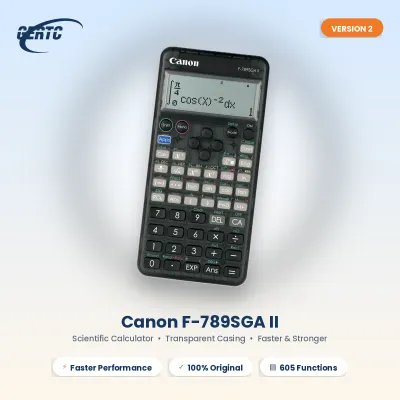
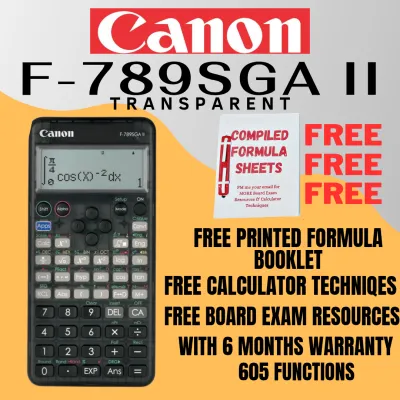
![Canon F-789SGA II VERSION 2 Scientific Calculator Transparent Casing[Fast Shipping]](https://img.lazcdn.com/g/p/c5f425276ea1bb43dd7518e53651f928.jpg_400x400q80.jpg_.webp)
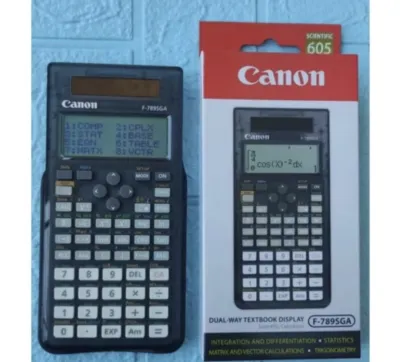
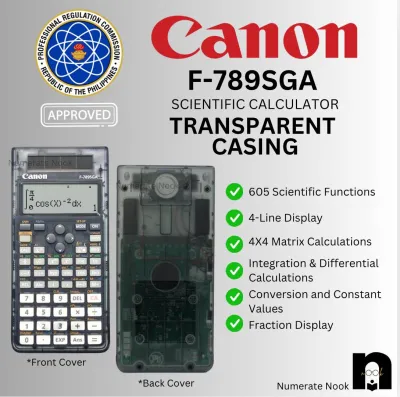
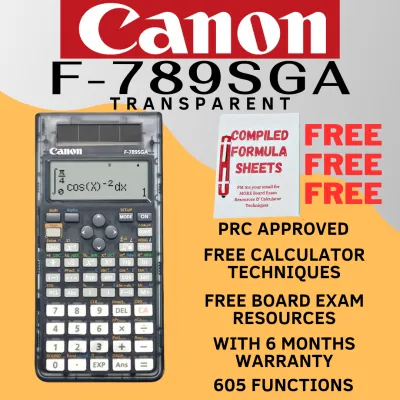
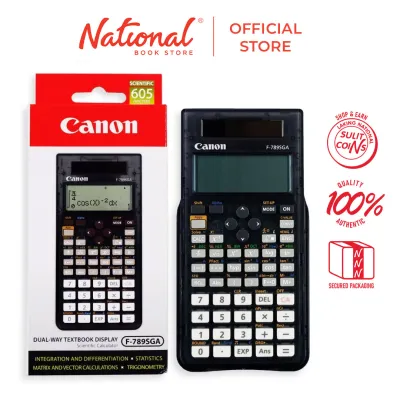
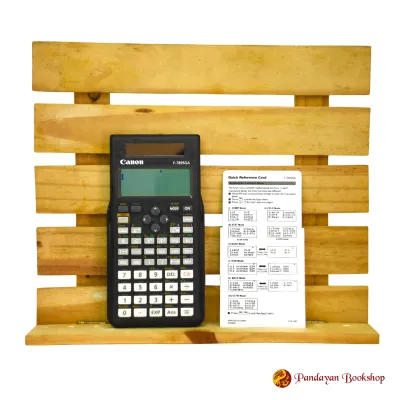
Prices are valid at publication and may change. Please refer to the product page for the latest price.
When comparing the Canon F-789SGA II with CASIO models, you should carefully examine the official specification sheets for the total number of built-in functions. While a higher number of functions generally indicates a more versatile tool, you must ensure that these functions include the exact mathematical capabilities required for your major. For instance, engineering and mathematics majors will need advanced capabilities such as vector calculations, matrix operations up to a certain dimension, integration, differentiation, and complex number calculations.
Statistical capabilities are another critical area of comparison, particularly for social science, business, and engineering students who must perform regression analysis and probability distributions. Check whether the calculator allows you to input and edit statistical data sets easily, and verify the maximum number of variables and data points the device can process simultaneously. Some advanced CASIO models and the Canon F-789SGA II handle these operations differently, so reviewing the user manual’s section on statistical limits is highly recommended before making a final decision.
Finally, always cross-reference the exact model number of your prospective calculator with the latest official PRC advisory. A model that is permitted for general university coursework may be strictly prohibited during board exams to prevent academic dishonesty or unfair advantages. It is wise to purchase a model that is pre-approved for both your university exams and your future licensure exams, saving you the trouble of relearning a completely new calculator interface right before graduation.
Display, Interface, and Daily Usability
The daily user experience of a scientific calculator depends heavily on its display technology and how intuitively it presents complex mathematical expressions. Most modern student calculators utilize either a standard dot-matrix display or a high-resolution screen capable of showing natural textbook formats. This natural display format allows fractions, exponents, square roots, and integrals to appear on the screen exactly as they are written in textbooks, which significantly reduces input errors and helps you visualize the problem more clearly.

When comparing the Canon F-789SGA II to CASIO’s popular lineups, pay close attention to the screen resolution and contrast settings. In typical Philippine classrooms, which may rely on fluorescent lighting or natural light from windows, screen glare can be a persistent issue. A display with adjustable contrast and clear, sharp characters will prevent eye strain during long study sessions and high-pressure exams. You should physically test the devices if possible, observing how the characters look from different viewing angles and under varying light conditions.
Button layout and tactile feedback are equally important for speed and accuracy during timed assessments. The keys should have a distinct, tactile click when pressed, ensuring that every input is registered without requiring excessive force. Compare the spacing between keys and the clarity of the secondary functions printed above each button; some students prefer the color-coded labeling system of CASIO, while others find the clean, streamlined layout of the Canon F-789SGA II more readable.
The learning curve associated with switching between standard decimal outputs and scientific fraction or radical formats can also impact your exam performance. Different brands use different key sequences—such as the conversion keys on CASIO or equivalent toggle keys on Canon—to convert answers instantly. Familiarizing yourself with these input modes and menu navigation systems early in the semester is crucial, as searching for a specific menu option during a timed exam can cost you valuable minutes.
Build Quality, Power Source, and Durability
A student’s calculator must be built to withstand the rigors of daily commutes, crowded backpacks, and accidental drops on hard classroom floors. The physical construction of both the Canon F-789SGA II and CASIO calculators typically features hard plastic bodies accompanied by protective slide-on cases. When evaluating build quality, inspect the rigidity of the plastic, the secure fit of the protective cover, and the overall feel of the casing. A cover that slides on smoothly and locks securely in place will protect the delicate LCD screen and keypads from scratches and impact damage.
Given the tropical climate and high humidity levels in the Philippines, electronic components are susceptible to moisture damage and battery terminal corrosion over time. Dual-power mechanisms, which combine solar panels with a backup battery, are highly advantageous for student use. The solar panel powers the device under sufficient ambient light, preserving the internal battery for low-light environments. You should check the manufacturer’s specifications to confirm if the model you choose features this dual-power system and verify how easy it is to access the battery compartment when a replacement eventually becomes necessary.
Warranty terms and the availability of local service centers are final but crucial aspects of the durability equation. Authorized distributors in the Philippines typically offer a standard warranty period, but the ease of claiming this warranty can vary. Choosing a brand with an established local presence and accessible customer service centers ensures that you can quickly resolve any manufacturing defects or hardware issues without disrupting your school schedule.
Price, Value, and Authenticity Checks
Evaluating the price-to-feature ratio is essential for students working within a budget, but this evaluation must always be paired with strict authenticity checks. While it may be tempting to purchase the cheapest option available on online marketplaces, the local market is unfortunately flooded with counterfeit scientific calculators. These fake devices often look remarkably similar to genuine Canon and CASIO models but suffer from poor build quality, inaccurate mathematical calculations, and sudden hardware failures during critical moments.
To ensure you are paying for a genuine product, always purchase from authorized office supply stores, major department stores, or verified official flagship stores on e-commerce platforms. Genuine calculators from both Canon and CASIO typically feature specific security measures, such as holographic stickers on the packaging, unique serial numbers, and QR codes that can be scanned to verify authenticity on the manufacturer’s official website. Be highly suspicious of listings that offer prices significantly lower than the standard retail rates found in established physical bookstores.
When you receive the calculator, perform a thorough physical inspection before discarding the packaging. Check the clarity of the printed brand logo, the alignment of the keys, and the quality of the user manual. Counterfeit models often exhibit blurry printing, misaligned buttons, or poorly translated instruction booklets. Additionally, genuine calculators usually have a built-in self-diagnostic test mode—accessible via a specific key combination detailed in the official manual—which allows you to verify the screen pixels, button functionality, and internal ROM version.
Final Decision Framework for Students
To finalize your purchase decision, you should use a structured framework that prioritizes your specific academic environment, budget, and long-term goals. Your first and most critical step is to consult your university’s department handbook or your licensing board’s official website to confirm which models are strictly permitted. If a specific model is banned, no amount of advanced features or cost savings can justify its purchase.
You should choose the Canon F-789SGA II if you prefer its specific display layout, appreciate its sleek aesthetic, and find it available at a highly competitive price point through authorized local retailers. It serves as an excellent, feature-rich alternative that handles advanced mathematics, statistics, and engineering calculations with high precision, making it a reliable tool for students who want great value without compromising on functionality.
On the other hand, you should opt for a CASIO scientific calculator if your school curriculum, professors, or peers strictly standardize on CASIO’s menu layouts and instructional guides. Because many local textbooks and classroom tutorials demonstrate step-by-step calculations using CASIO interfaces, matching your device to the classroom standard can significantly reduce confusion and speed up your learning process. Whichever brand you select, ensure that you purchase only from verified sources to guarantee accuracy, reliability, and peace of mind during your exams.
Frequently Asked Questions (FAQ)
Is the Canon F-789SGA II allowed in professional board exams in the Philippines?
To verify if the Canon F-789SGA II is permitted for your specific professional board exam, you must consult the latest official guidelines and advisories published by the Professional Regulation Commission (PRC). The list of allowed calculators can change from year to year, and certain engineering, accountancy, or science board exams have highly specific restrictions on programmable features or specific model series. Never assume a calculator is approved simply because it is classified as a non-programmable scientific model; always check the exact model number on the active PRC whitelist before your exam date.
How can I spot a fake scientific calculator when buying online?
When shopping on e-commerce platforms, protect yourself by buying exclusively from stores with official brand badges, authorized dealer certificates, or high ratings with verified buyer reviews that include real photos. Upon delivery, inspect the packaging for official holographic security stickers, clear and crisp printing, and a valid serial number. You can also perform the manufacturer’s official diagnostic test on the device itself and attempt to register the product warranty online to confirm that your calculator is a genuine, reliable tool.

Community discussion
Share your experience or ask a question. Comments are reviewed before publication.