
Choosing between the Canon F-789SGA and the CASIO fx-991 series is a pivotal decision for Filipino students navigating the demanding curriculum of Senior High School STEM tracks or college-level science, technology, engineering, and mathematics (STEM) programs. Both calculators are highly capable tools designed to simplify complex computations, yet they differ in display clarity, advanced function sets, physical durability, and overall value. By understanding how these devices compare across key performance areas and verifying their compatibility with local academic guidelines, you can select the ideal calculator to support your studies and exams.
Core Specifications and Display Differences
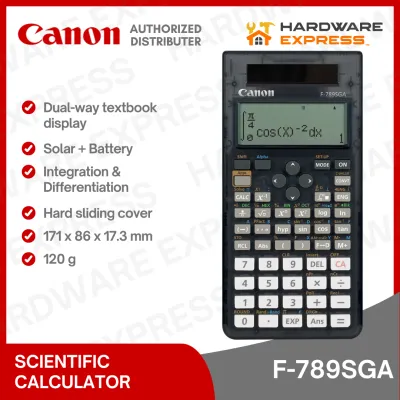
When studying complex equations, how you view mathematical expressions on screen directly impacts your learning efficiency and accuracy. Both the Canon F-789SGA and the CASIO fx-991 series feature natural textbook display technologies, which render fractions, exponents, and square roots exactly as they appear in your textbooks. This visual alignment reduces input errors and helps you verify your steps during timed exams.
However, screen resolution varies across different generations of these devices. While the Canon F-789SGA offers a clear, high-contrast dot-matrix display, certain newer sub-models in the CASIO fx-991 lineup, such as the ClassWiz (EX or CW) series, feature higher-resolution screens that can display more detailed variables and even basic spreadsheet grids. You should inspect the screen in person or check the manufacturer’s specifications to ensure the contrast and font size are comfortable for your eyes during long study sessions.
Products mentioned in this guide
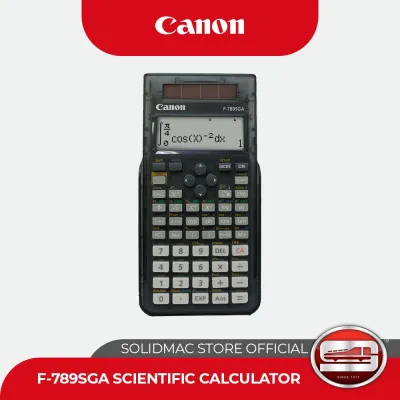
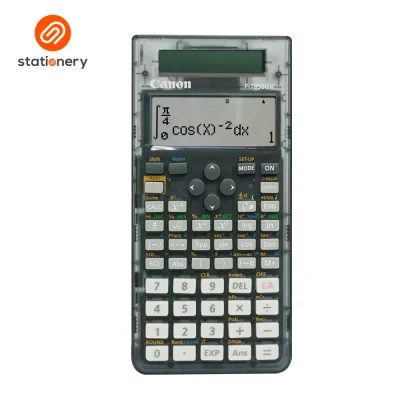
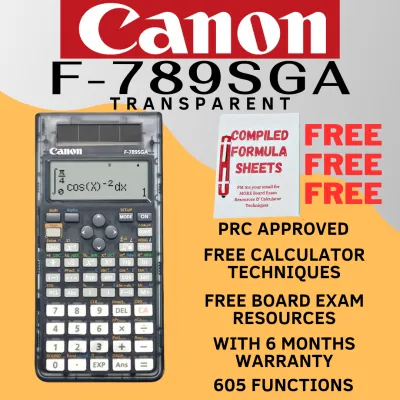
Prices are valid at publication and may change. Please refer to the product page for the latest price.
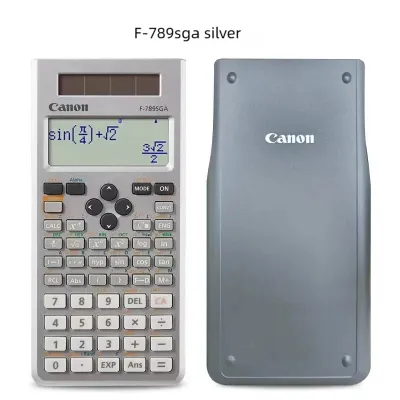
The physical interface is another critical factor for daily usability. The Canon F-789SGA features a sleek, flat key design with distinct spacing, which some students find easier to clean in dusty or humid tropical environments. In contrast, the CASIO fx-991 series typically utilizes slightly domed keys with a tactile click that provides immediate physical feedback. Testing both layouts at a local stationery store can help you determine which button spacing matches your typing speed and hand size.
When carrying a heavy backpack filled with textbooks and notebooks, the weight and size of your calculator matter. Both the Canon F-789SGA and the CASIO fx-991 series are designed to be lightweight and compact, fitting easily into standard pencil cases or school bag compartments. However, you should verify the exact dimensions if you have limited space. The Canon model often features a slightly slimmer profile, while the CASIO series may feel more robust in hand due to its textured back grip.
Mathematical Functions and Curriculum Compatibility
Before purchasing any scientific calculator, you must verify that its built-in mathematical operations align with your coursework. The total number of functions is always listed on the product packaging or in the user manual, ranging from standard trigonometric and logarithmic calculations to advanced matrix operations. While both models easily handle general high school algebra and trigonometry, college-level courses require a closer look at advanced capabilities.

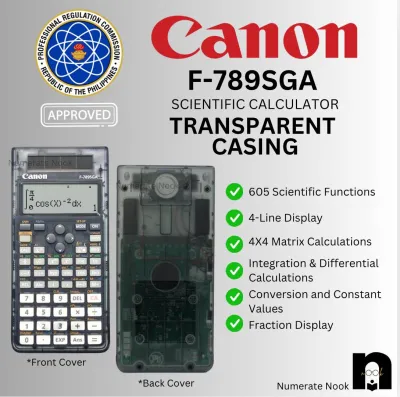
If you are enrolled in engineering, statistics, or advanced mathematics, you will need to verify the calculator’s capacity for calculus operations, such as numerical integration and differentiation. The CASIO fx-991 series, particularly the newer iterations, is highly regarded for its fast processing of complex equation solvers and matrix calculations up to 4×4 dimensions. The Canon F-789SGA also boasts a comprehensive suite of advanced functions, including vector calculations and matrix operations, often at a highly competitive price point.
When comparing the mathematical interfaces, pay attention to how each brand handles multi-step calculations. The CASIO fx-991 series often uses a structured menu system that allows you to navigate options using a directional pad, which is highly intuitive for students accustomed to smartphone interfaces. The Canon F-789SGA, on the other hand, relies on a more traditional key-combination system (using Shift or Alpha keys) to access secondary functions. You should try both systems to see which one feels more natural and faster for your workflow.
To avoid overpaying for features you will never use, or conversely, buying a device that lacks essential capabilities, cross-reference the calculator’s specification sheet with your university syllabus. Some departments require specific statistical distributions or complex number operations that may only be fully supported by premium sub-models. Consulting your professors or senior students in your department can prevent costly mid-semester upgrades.
Build Quality, Power Source, and Daily Usability
A student’s calculator must endure years of being tossed into backpacks, exposed to tropical humidity, and dropped on classroom floors. Both brands provide hard slide-on protective covers that shield the screen and keys from scratches and impact. When examining these covers, check that they slide on smoothly and snap securely into place without wobbling.
Power reliability is another essential consideration for exam days. Look for models that feature a dual-power system, which combines solar panels with a backup button battery. This setup ensures the calculator remains fully functional under dim classroom lighting or during evening study sessions. Single-battery models are lighter but require you to monitor battery health more closely to avoid sudden shutdown during a test.
In the Philippines, high relative humidity can cause battery contacts to corrode over time if the calculator is left unused for long periods, such as during summer breaks. When choosing a calculator, inspect the battery compartment to ensure it is tightly sealed with screws rather than a simple slide-off tab, which prevents moisture and dust from entering. Additionally, look for keys with a matte finish, as glossy keys tend to attract finger oils and become slippery in warm weather.
Key durability also affects long-term usability. High-quality scientific calculators feature wear-resistant key labels that do not fade after months of heavy typing. Inspect the buttons to see if the labels are deeply printed or molded into the plastic. In humid climates, sweat and friction can quickly wear down cheap surface-printed labels, making it difficult to identify secondary functions over time.
Pricing, Value, and Authenticity Checks
In the Philippines, retail prices for scientific calculators can vary significantly depending on the seller and the specific sub-model. You can find these devices at authorized physical stationery stores, official brand stores, and reputable online marketplaces. Generally, the Canon F-789SGA is positioned as a highly cost-effective alternative, offering advanced mathematical functions at a price point that is often lower than the premium models of the CASIO fx-991 series.
When evaluating the value proposition, consider your long-term academic path. If you are a general science or business student, the savings offered by a more budget-friendly model like the Canon F-789SGA may represent the best value. However, if you are pursuing a rigorous engineering or actuarial science degree, investing in a premium CASIO fx-991 sub-model with advanced spreadsheet or matrix capabilities is often justified by the time saved during complex exams.
Because counterfeit calculators are common in online marketplaces, verifying authenticity is critical. Counterfeit units often suffer from slow processing speeds, poor build quality, and critical calculation errors that can ruin your exam scores. Always check the packaging for official holographic security stickers, verify that a valid warranty card is included, and purchase only from authorized distributors to ensure you receive a genuine, reliable device.
A reliable way to verify authenticity is to run a quick diagnostic test on the device. Genuine calculators use high-quality processors that compute complex equations almost instantly. If you input a large matrix calculation or a definite integral and the calculator takes several seconds to display the result, or if the screen flickers significantly, you may be holding a counterfeit unit. Furthermore, check the alignment of the printed text on the casing; fake models often have slightly crooked labels or spelling errors in the secondary function names.
Decision Framework: Which Calculator Should You Buy?
To make your final decision, evaluate your academic needs against these practical guidelines:
- Choose the Canon F-789SGA if: You want a highly reliable, budget-friendly scientific calculator with a clean key layout and a natural textbook display that easily covers high school math and standard college algebra or statistics.
- Choose the CASIO fx-991 Series if: Your college curriculum involves advanced engineering, physics, or mathematics courses that benefit from high-resolution displays, fast matrix solvers, or specific spreadsheet functions found in newer sub-models.
- Verify first if: You are preparing for a professional licensure exam in the Philippines. Always consult the latest official list of permitted calculators issued by the Professional Regulation Commission (PRC) or your specific examining board, as permitted models can change.
- Neither may fit if: Your coursework explicitly requires programmable functions, advanced graphing capabilities, or a Computer Algebra System (CAS). In these cases, you will need to look beyond standard scientific calculators and invest in a dedicated graphing calculator approved by your institution.
Frequently Asked Questions (FAQ)
Are these calculators permitted in Philippine licensure exams?
The Professional Regulation Commission (PRC) maintains strict guidelines regarding the types of calculators allowed in board exams. Generally, standard, non-programmable scientific calculators are permitted, while devices with graphing capabilities, programmable memory, or wireless communication are strictly prohibited. Because the list of approved calculator models is updated periodically, you must check the official PRC website or consult your review center for the most current list of allowed models before purchasing a calculator specifically for a licensure exam.
How do I verify the authenticity of my scientific calculator?
To ensure your calculator is genuine, purchase it only from official brand stores or authorized physical stationery retailers. When inspecting the device, look for high-quality, crisp printing on the keys and casing, as well as an official holographic security sticker on the packaging. You can also perform a quick diagnostic test by inputting complex calculations with known results or checking if the calculator’s built-in self-test function (usually accessed by holding specific key combinations during startup, as detailed in the official manual) runs correctly.

Community discussion
Share your experience or ask a question. Comments are reviewed before publication.