
Choosing the right scientific calculator is one of the most critical decisions a student in the Philippines can make. Whether you are navigating high school algebra, solving complex calculus problems in college, or preparing for a rigorous professional licensure examination, your calculator is your primary tool for academic survival. The market is largely dominated by two major names: Canon and CASIO. While CASIO has long been a household name in classrooms across the archipelago, the Canon F-789SGA has emerged as a formidable challenger, offering a robust set of features that appeals directly to budget-conscious students and board exam reviewees.
Selecting between these two options requires looking beyond brand popularity. You must evaluate how each device handles complex mathematical inputs, how readable the screen remains under classroom fluorescent lights, and whether the physical keys can withstand years of rapid tapping. Furthermore, local academic guidelines and strict examination rules mean that a calculator’s feature set is not just a matter of convenience, but of compliance. Understanding these nuances ensures you invest in a tool that supports your educational journey without failing you when it matters most.
Identifying Your Academic and Exam Requirements
Your academic level and specific field of study dictate the level of calculator functionality you need. A junior high school student focusing on basic geometry and introductory statistics requires a far simpler tool than an engineering, architecture, or accountancy major dealing with multi-variable calculus, matrix transformations, and complex numbers. Before comparing specific models, review your course syllabus to identify the exact mathematical operations you will perform. Purchasing an overly advanced model can lead to a cluttered interface that slows you down, while an underpowered model will leave you unable to complete advanced coursework.
Products mentioned in this guide
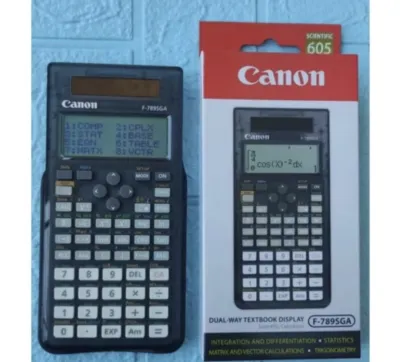
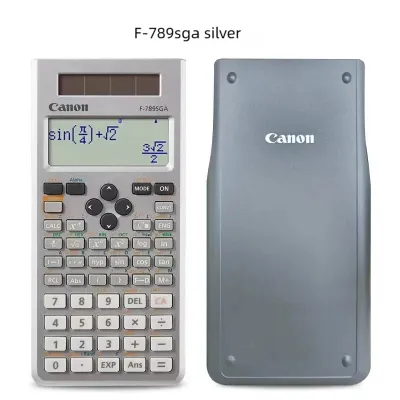
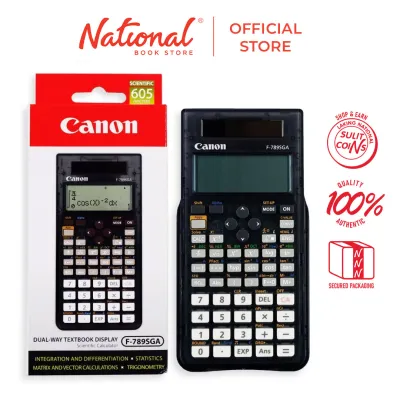
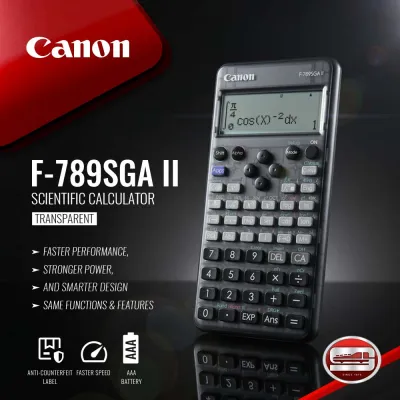
Prices are valid at publication and may change. Please refer to the product page for the latest price.
For college students and aspiring professionals in the Philippines, the ultimate test of a calculator’s utility is its compliance with the Professional Regulation Commission (PRC). The PRC enforces strict guidelines regarding the specific calculator models permitted inside testing centers for board examinations, such as those for civil, mechanical, electrical, and chemical engineering. These regulations are designed to prevent academic dishonesty by banning calculators with programmable memory, graphing capabilities, or text-storage functions.
Before committing to a purchase, you must consult the latest official PRC resolutions or memorandums. The list of allowed calculators can change, and using an unauthorized model can result in immediate disqualification on exam day. Many engineering students choose to purchase and master their board-compliant calculator early in their college years. This practice builds muscle memory and deep familiarity with the button layouts, ensuring they do not waste precious seconds searching for functions during high-pressure exams.
Core Feature Comparison: Canon F-789SGA vs CASIO Models
To understand how the Canon F-789SGA stacks up against the diverse lineup of CASIO scientific calculators, it is helpful to compare their fundamental specifications. CASIO offers a wide spectrum of models, ranging from the entry-level fx-82 series to the highly advanced fx-991 series. The Canon F-789SGA is positioned as a high-function, cost-effective alternative to CASIO’s upper-tier non-programmable models.

| Feature | Canon F-789SGA | Typical CASIO Advanced (e.g., fx-991 series) | Typical CASIO Basic (e.g., fx-82 series) |
|---|---|---|---|
| Display Type | Dot Matrix with Natural Display | High-Resolution ClassWiz / Natural Display | Standard Dot Matrix / Two-Line Display |
| Power Source | Dual (Solar and Battery) | Dual (Solar and Battery) | Single Battery (AAA or Button Cell) |
| Function Count | Over 600 built-in functions | Over 400 to 500+ built-in functions | Around 250 to 300 built-in functions |
| Body Material | Recycled plastic components | Standard durable plastics | Standard durable plastics |
| Key Layout | Structured rows with metallic finish keys | Textured keys with high-contrast labeling | Standard plastic keys |
As the table indicates, the Canon F-789SGA competes directly with CASIO’s advanced non-programmable offerings rather than their basic models. When deciding, you must compare the Canon model specifically against the CASIO model that matches your academic requirements, rather than making a generalized brand-to-brand comparison.
Display Technology and User Interface
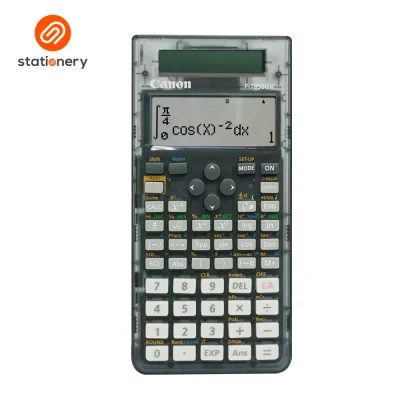
The clarity of a calculator’s screen directly impacts your speed and accuracy during long study sessions. Both Canon and CASIO utilize advanced display technologies designed to mimic textbook formatting. Canon’s natural display and CASIO’s Natural V.P.A.M. (or the higher-resolution ClassWiz screens) allow fractions, square roots, exponents, and calculus symbols to be written exactly as they appear in your textbooks. This visual consistency reduces input errors, as you do not have to translate complex formulas into single-line syntax.
Screen resolution is another critical factor, particularly when dealing with multi-line calculations or statistical tables. Advanced CASIO models often feature high-contrast, high-resolution dot-matrix displays that render sharp characters and clear mathematical symbols. The Canon F-789SGA also offers a highly legible dot-matrix screen, though the font style and contrast levels differ slightly. Under bright classroom lights or dim study lamps, check how easily you can read the screen from different viewing angles to avoid eye strain.
The physical interface and button layout govern your daily interaction with the device. CASIO calculators are renowned for their intuitive menu navigation, often utilizing structured icon menus that make finding specific modes straightforward. The Canon F-789SGA features a highly organized layout, but it may require different key combinations or multi-tap sequences to access certain advanced functions. When testing these calculators, pay close attention to the tactile feedback of the keys; they should feel responsive and register inputs reliably without requiring excessive force.
Mathematical Functions and Processing Speed
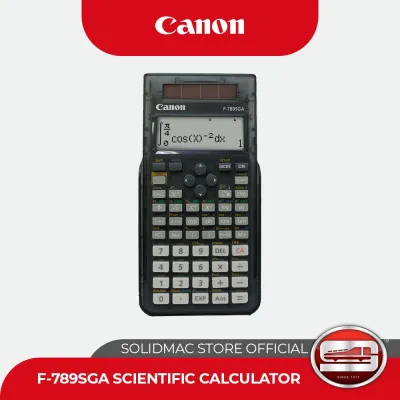
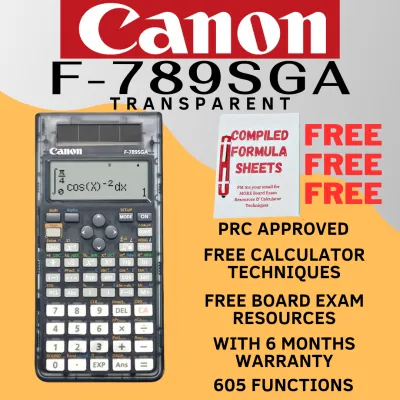
The depth of built-in mathematical functions determines whether a calculator can handle advanced college-level coursework. The Canon F-789SGA boasts an impressive array of over 600 functions, including matrix calculations up to 4×4, vector calculations, equation solvers, and complex number calculations. This extensive feature set makes it highly competitive with CASIO’s top-tier non-programmable models, which typically offer between 400 and 550 functions depending on the specific generation.
For students of advanced mathematics, physics, and engineering, the ability to perform numerical integration, differentiation, and summation directly on the calculator is invaluable. Both the Canon F-789SGA and advanced CASIO models support these operations. However, the ease of inputting these equations can vary. CASIO’s interface often simplifies the input of limits and variables, while Canon’s system provides a highly structured approach that some users find exceptionally logical once mastered.
Processing speed becomes noticeable when executing complex operations, such as solving high-degree polynomial equations, calculating large matrices, or running statistical regressions. While both brands handle standard arithmetic instantaneously, advanced CASIO models with updated processors may complete complex numerical integrations slightly faster than older calculator architectures. When evaluating processing speed, observe how quickly each device returns a result for a definite integral or a large matrix inversion, as minor delays can accumulate during timed examinations.
Power Sources and Build Durability
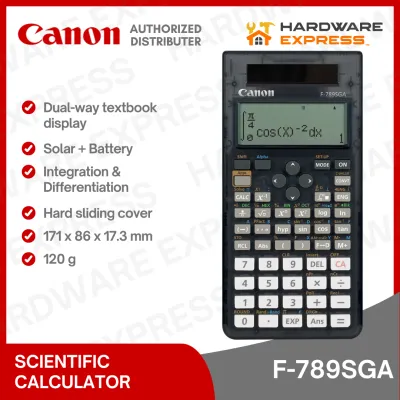
A calculator must be reliable enough to last through years of daily use, long commute times in tropical weather, and high-stakes exams. The Canon F-789SGA features a dual-power system, utilizing both solar energy and a backup battery. This configuration ensures that as long as there is sufficient ambient light, the calculator runs on solar power, preserving the internal battery for low-light environments. Many advanced CASIO models also utilize this dual-power setup, which is highly recommended for students who cannot risk their calculator dying in the middle of an exam.
Physical durability is especially important in the humid, tropical climate of the Philippines, where moisture and heat can affect electronic components over time. Both brands provide protective slide-on hard cases that shield the screen and keyboard from scratches, dust, and impact when tossed into a crowded backpack. Canon highlights the use of recycled materials in the casing of the F-789SGA, which appeals to environmentally conscious students, while maintaining a sturdy, drop-resistant build.
To maximize battery life, both Canon and CASIO calculators incorporate automatic power-off features that shut down the device after several minutes of inactivity. When the battery eventually needs replacement, the process should be straightforward. Check the back of the calculator to see if the battery compartment is easily accessible with a standard small screwdriver, or if it requires complete disassembly of the casing, which can increase the risk of damaging internal components.
Evaluating Price, Value, and Authenticity
Budget is a primary consideration for most Filipino students and their families. Generally, the Canon F-789SGA is positioned as a highly cost-effective option, often priced lower than CASIO models with comparable function counts. While a basic CASIO scientific calculator might cost around ₱600 to ₱900, advanced models that match the Canon’s capabilities can range from ₱1,200 to over ₱1,800. The Canon F-789SGA frequently sits comfortably in the middle of this range, offering advanced features at a price point that is highly competitive, making it an attractive value proposition.
Due to the high demand for scientific calculators in the Philippines, counterfeit products are a significant issue in the local market. Fake calculators are commonly sold at unusually low prices on online marketplaces, street markets, or unauthorized retail stalls. These counterfeit devices often suffer from poor build quality, inaccurate calculation results, faded screen contrast, and high failure rates. Using a counterfeit calculator during an exam is a massive risk, as it may malfunction or provide incorrect answers.
To protect yourself from counterfeits, look for key red flags before purchasing. Authentic calculators feature crisp, high-contrast key printing, responsive buttons, and official brand packaging with holographic security stickers. When shopping online, only purchase from official brand stores, authorized distributors, or highly rated, verified local stationery retailers. Investing a bit more to buy from a reputable source ensures you receive a genuine product backed by a manufacturer’s warranty, giving you peace of mind throughout your academic career.
Final Decision Framework: Which Calculator Should You Choose?
To make your final decision, evaluate your specific academic requirements, budget constraints, and personal preferences against the strengths of each brand.
Choose the Canon F-789SGA if:
- You are working within a strict budget but require advanced mathematical functions, such as matrix, vector, and equation solving.
- You prefer a dual-power system (solar and battery) to ensure maximum reliability during long study sessions and exams.
- You appreciate eco-friendly product designs, as this model incorporates recycled materials into its physical construction.
- You want a highly capable, non-programmable calculator that offers an exceptional balance of features and affordability.
Choose a CASIO model if:
- Your specific curriculum, university department, or review center heavily utilizes CASIO-specific button layouts and instructional guides.
- You require the highest possible screen resolution and contrast, such as those found on the advanced ClassWiz series, for reading complex formulas.
- You prefer a highly intuitive, icon-based menu system that simplifies navigation between different mathematical modes.
- You are looking for a specific entry-level model for basic high school math where advanced functions are unnecessary.
Before finalizing any purchase, always verify the specific rules of your educational institution or professional licensing board. If you are preparing for a PRC board exam, double-check the most recent official list of approved calculator models. Ensuring your chosen calculator is fully compliant with these regulations is the single most important step in protecting your academic and professional future.
Frequently Asked Questions (FAQ)
How do I know if a scientific calculator is allowed for PRC board exams?
To determine if a scientific calculator is permitted for Professional Regulation Commission (PRC) board exams in the Philippines, you must consult the latest official memorandum or resolution issued by the PRC. The commission maintains a strict list of allowed and prohibited calculator models to maintain exam integrity. Generally, any calculator that features programmable memory, graphing capabilities, or an alphabetic keyboard that allows for text storage is strictly prohibited.
The PRC periodically updates its whitelist of approved calculators, adding new compliant models and removing older ones. It is highly recommended to visit the official PRC website or consult your board exam review center for the most current list before purchasing a calculator. Additionally, many examinees choose to bring a basic, non-programmable scientific calculator that is universally accepted as a reliable backup on examination day, ensuring they are prepared regardless of any last-minute rule changes at the testing center.

Community discussion
Share your experience or ask a question. Comments are reviewed before publication.