
When choosing between the Casio DX-120ST, the Casio fx-991, and the Casio fx-350, the decision hinges entirely on your primary tasks rather than finding a single superior device. The Casio DX-120ST is a dedicated desktop business calculator built for rapid arithmetic, tax computations, and high-volume office data entry. In contrast, the Casio fx-991 and fx-350 are scientific calculators engineered for complex mathematical equations, statistical analysis, and academic coursework. Understanding how these tools differ in form factor, input style, and internal programming will prevent you from purchasing a model that is either overly complex or functionally insufficient for your daily requirements.
For professionals working in fast-paced retail environments, corporate offices, or accounting departments, speed and physical comfort are paramount. A compact scientific calculator with small, crowded buttons can slow down repetitive data entry and lead to costly input errors. Conversely, a student sitting for an engineering or advanced mathematics exam will find a desktop business calculator completely useless, as it lacks the trigonometric, logarithmic, and algebraic functions required to solve complex problems.
By analyzing the specific design philosophies behind these three models, you can identify which calculator aligns with your workflow. Whether you are managing a business budget in Philippine Pesos (₱), analyzing laboratory data, or preparing for high school algebra exams, selecting the correct tool ensures efficiency and accuracy. Let us explore the distinct capabilities of each model to help you make an informed decision.
Products mentioned in this guide

Prices are valid at publication and may change. Please refer to the product page for the latest price.
Understanding the Core Difference: Desktop vs. Scientific Calculators
The fundamental divide between the Casio DX-120ST and the fx-series lies in their target audience and functional architecture. The DX-120ST is classified as a desktop business calculator, which means its hardware and software are optimized for commercial arithmetic. It excels at processing simple, sequential calculations very quickly, such as adding up long lists of expenses, calculating markups, or applying tax rates. Its internal processor is designed to handle basic operations with high precision, but it does not understand algebraic hierarchy or complex mathematical syntax.
On the other hand, the Casio fx-991 and fx-350 are scientific calculators built to interpret and solve multi-step mathematical expressions. These devices utilize algebraic input logic, allowing users to enter entire formulas containing parentheses, fractions, exponents, and variables. The calculator processes the entire expression at once, adhering strictly to the mathematical order of operations. This capability is essential for scientific, engineering, and advanced academic applications where formulas cannot be easily broken down into simple, step-by-step addition or multiplication.
Comparing a desktop calculator to a scientific calculator is not a matter of comparing features side-by-side, but rather evaluating distinct use cases. A desktop model prioritizes physical ergonomics, speed, and specialized business keys on a spacious layout. A scientific model prioritizes computational depth, formula memory, and mathematical versatility within a highly portable frame. Attempting to use one in place of the other often results in frustration, as the physical design and button layouts are tailored to entirely different working postures and cognitive tasks.
Casio DX-120ST: Office and Business Capabilities
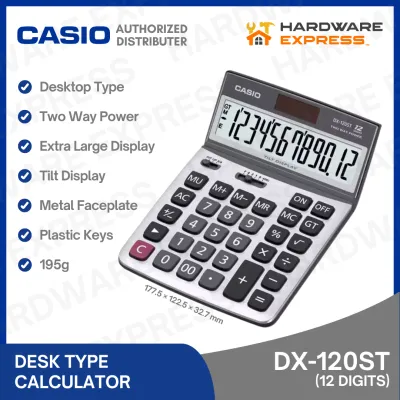
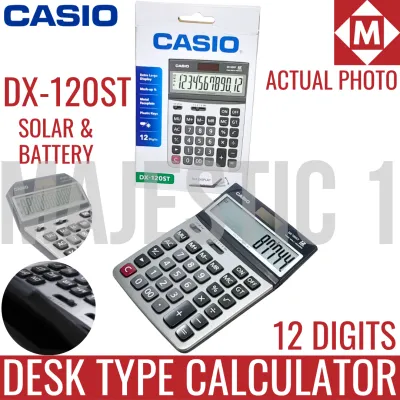
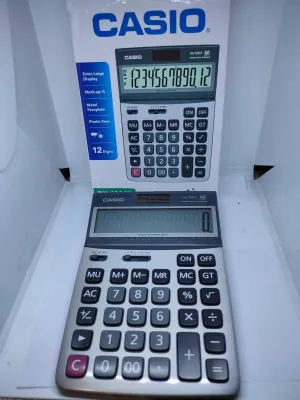
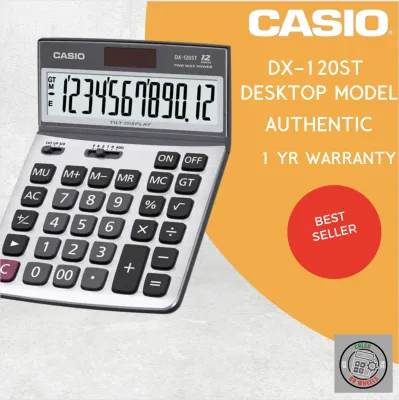
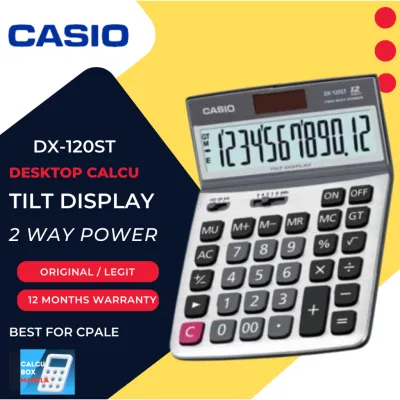
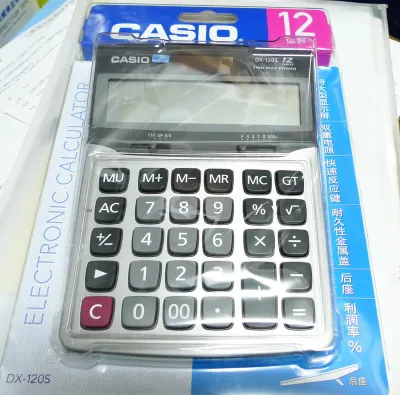
The Casio DX-120ST is engineered specifically for stationary desk use, featuring a robust physical design that prioritizes user comfort during long hours of data entry. One of its most prominent features is the large, angled liquid crystal display (LCD) that minimizes glare from overhead office lights. This angled screen allows you to read figures clearly without needing to lean over the device, which is a common cause of neck strain in busy office environments. The stable, non-slip rubber feet on the base prevent the calculator from sliding around on smooth wooden or glass desks.

The key layout of the DX-120ST is optimized for rapid, blind touch-typing, resembling the numeric keypad of a standard computer keyboard. The keys are large, contoured, and spaced widely apart to prevent accidental double-presses. They offer a deep, tactile travel distance that provides immediate physical feedback, allowing office workers to input long columns of figures with high confidence. Additionally, the inclusion of a dedicated double-zero (“00”) key significantly accelerates the entry of large currency values, making financial calculations much faster.
In terms of software, the DX-120ST features specialized business functions that simplify daily financial tasks. It includes dedicated tax calculation keys that allow you to store a local tax rate and apply or deduct it with a single keystroke. The markup (“MU”) key simplifies profit margin calculations, enabling retail managers to quickly determine selling prices based on cost and desired margins. The device typically utilizes a dual-power system, combining a solar panel with a small backup battery to ensure uninterrupted operation even in dimly lit office corners. Users should verify the exact battery type and power specifications on the product packaging before purchase.
Casio fx-991 and fx-350: Academic and Engineering Functions
The Casio fx-series represents a completely different class of computing tools, designed to accompany students and technical professionals through rigorous academic and scientific journeys. Both the fx-991 and the fx-350 share a core set of scientific functions, including trigonometric calculations, logarithms, factorials, and basic statistical analysis. They are built with a slim, pocket-friendly form factor and come with a hard slide-on cover to protect the screen and keys from damage when carried in a crowded school backpack.
However, the capabilities of these two models diverge significantly when it comes to advanced mathematics. The Casio fx-991 is a high-tier scientific calculator that typically features a natural textbook display, which renders fractions, square roots, and formulas exactly as they appear in textbooks. It is equipped to handle advanced operations such as numerical integration, differentiation, matrix calculations, vector analysis, and complex number calculations. This makes the fx-991 highly suitable for university-level engineering, physics, and advanced mathematics courses where these complex tools are daily requirements.
In contrast, the Casio fx-350 is a mid-tier scientific calculator designed primarily for high school and early college students. It covers all standard scientific functions, such as fractions, permutations, combinations, and basic statistical deviations, but lacks the advanced calculus and matrix engines found in the fx-991. The fx-350 is often preferred by educators for introductory courses because it provides all the necessary mathematical tools without the added complexity or higher cost of an advanced engineering calculator. When purchasing either model, it is crucial to check the specific sub-model variation (such as the ClassWiz series or older editions) on the manufacturer’s packaging, as features and display resolutions can vary.
Key Specifications and Usability Comparison
To help you visualize the differences between these three distinct calculators, the following table contrasts their physical designs, display capabilities, and primary functional attributes. Use this matrix as a general guide to match each model’s specifications with your daily workflow requirements.
| Feature / Specification | Casio DX-120ST | Casio fx-991 | Casio fx-350 |
|---|---|---|---|
| Primary Use Case | Office administration, retail, accounting, and basic business arithmetic | University engineering, advanced physics, calculus, and complex mathematics | High school mathematics, general science, and introductory statistics |
| Display Type | Large, single-line angled desktop display with clear digit separators | Multi-line natural textbook display or high-resolution dot matrix | Standard multi-line display with clear mathematical notation |
| Key Layout | Large, widely spaced tactile keys with a dedicated "00" key and business shortcuts | Compact, multi-function keys with secondary shift functions for scientific formulas | Compact, simplified scientific key layout for intuitive student use |
| Advanced Math Functions | None (limited to basic arithmetic, percentages, and square roots) | Calculus (integration/differentiation), matrices, vectors, and equation solvers | Basic algebra, trigonometry, logarithms, and single-variable statistics |
| Power Source | Dual power (solar panel with battery backup; check label for details) | Dual power or battery-only (varies by specific sub-model and edition) | Battery-powered (typically uses standard AAA or button cell batteries) |
Please note that Casio frequently updates its product lines with new sub-models, design revisions, and regional variations. Always inspect the physical product box or the official manufacturer’s specification sheet to verify the exact power source, display resolution, and built-in functions before finalizing your purchase.
Decision Framework: Which Casio Calculator Fits Your Needs?
Selecting the right calculator requires a clear understanding of your daily environment and the specific mathematical tasks you perform. If your work is primarily desk-bound and involves managing office budgets, calculating retail markups, processing invoices, or handling general bookkeeping in Philippine Pesos (₱), the Casio DX-120ST is the most practical choice. Its large, comfortable keys and angled display are designed to reduce physical fatigue and input errors during repetitive, high-volume arithmetic tasks.
If you are a university student majoring in engineering, physics, chemistry, or mathematics, or a practicing professional in a technical field, you should choose the Casio fx-991. The advanced computational engines of the fx-991, including its ability to solve matrices, vectors, and calculus equations, are indispensable for higher-level academic and professional work. Its natural textbook display also makes it much easier to verify complex formulas before executing a calculation, saving valuable time during exams or laboratory sessions.
For high school students or those taking introductory college courses in algebra, geometry, or basic statistics, the Casio fx-350 offers an excellent balance of functionality and simplicity. It provides all the essential scientific tools required for standard curricula without overwhelming the user with advanced engineering features they may never use. This simplicity makes it easier to master, helping students focus on learning mathematical concepts rather than navigating a complex device interface.
Before purchasing any scientific calculator for academic use, it is vital to verify the specific guidelines of your school, university, or national examination board. Many testing centers and educational institutions maintain strict lists of approved calculator models to prevent academic dishonesty. Some exams may permit the fx-350 while banning the more powerful fx-991 due to its equation-solving capabilities, while desktop models like the DX-120ST are almost universally prohibited in formal mathematics exams due to their size and lack of scientific tracking.
Frequently Asked Questions (FAQ)
Can I use the Casio DX-120ST for university math exams?
Generally, the Casio DX-120ST is not permitted in standardized university mathematics or science examinations. Desktop calculators are designed for business and office environments, and their large physical footprint can clutter exam desks. Furthermore, because they lack scientific functions like trigonometry and logarithms, they cannot assist you with the advanced formulas tested in university-level math courses. Always consult your course syllabus or the official examination board guidelines to find the list of approved scientific calculators before your test date.
Do these Casio calculators require battery replacements?
Yes, all three models will eventually require battery maintenance, though their power management systems differ. The Casio DX-120ST typically utilizes a dual-power system that runs on solar energy under normal room lighting and switches to a backup battery in darker environments, extending the overall lifespan of the internal cell. The scientific models, such as the fx-991 and fx-350, rely more heavily on battery power due to their complex processors and multi-line displays. To ensure reliable performance, refer to the specific sub-model’s user manual for instructions on battery types, replacement procedures, and safe disposal.

Community discussion
Share your experience or ask a question. Comments are reviewed before publication.