
Selecting the right scientific calculator is one of the most critical decisions a student or professional can make, directly impacting exam performance and daily study efficiency. The Casio scientific calculator lineup is structured into distinct tiers to serve different academic stages, with the fx-82, fx-570, and fx-991 representing the entry, mid, and advanced levels respectively. Choosing the ideal model requires balancing your current coursework requirements, future academic plans, and institutional exam regulations. While the top-tier model offers the most comprehensive feature set, buying more computing power than your syllabus permits can be an unnecessary expense or even lead to exam-hall disqualification.
Understanding the Core Tiers: fx-82, fx-570, and fx-991
The Casio scientific calculator ecosystem is designed to grow alongside a student’s academic journey, starting with the foundational fx-82 series. This entry-level model is engineered primarily for junior high school students and those taking general education mathematics. It focuses on essential arithmetic, basic trigonometry, and introductory statistics, providing a clean, uncluttered interface that helps beginners master core mathematical concepts without being overwhelmed by advanced programming or calculus functions.
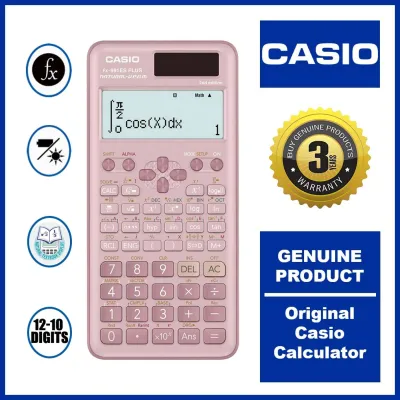
Stepping up to the mid-tier, the fx-570 series serves as a bridge between high school mathematics and early college-level sciences. This model introduces more complex computational capabilities, making it highly suitable for senior high school STEM tracks and introductory university courses in physics, chemistry, and algebra. It retains a battery-only power design in most iterations but significantly expands the internal library of scientific constants, metric conversions, and equation-solving functions.
Products mentioned in this guide
Prices are valid at publication and may change. Please refer to the product page for the latest price.
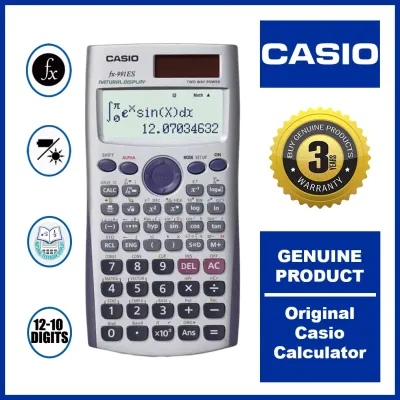
At the pinnacle of Casio’s standard scientific lineup sits the fx-991 series, a powerhouse designed specifically for engineering, advanced calculus, physics, and professional board exam preparation. The fx-991 is distinguished not only by its massive array of advanced mathematical functions—including matrix calculations, vector analysis, and numerical integration—but also by its dual-power system. This system combines a solar panel with a traditional battery, ensuring the calculator remains functional under various lighting conditions and reducing the risk of sudden power failure during critical examinations.
Understanding these physical and operational differences is key to making an informed purchase. While the fx-82 relies solely on a single AAA or button-cell battery, its power consumption is remarkably low, often lasting years under normal use. The fx-570 offers similar battery-only reliability but handles heavier computational loads. The fx-991’s solar panel acts as the primary power source in well-lit classrooms, seamlessly switching to the backup battery only when ambient light drops, which provides peace of mind during long, high-stakes testing sessions.
Key Feature Comparison: Matching Functions to Your Syllabus
To determine which calculator aligns with your academic requirements, you must look closely at the specific mathematical operations your syllabus demands. The entry-level fx-82 handles standard fractions, percentages, basic trigonometry, and single-variable statistics with ease. However, if your curriculum introduces systems of linear equations, quadratic equations, or matrix algebra, the fx-82 will fall short, requiring you to perform these complex calculations manually.

The fx-570 and fx-991 models step in to solve these advanced problems, offering dedicated equation solvers that can handle simultaneous equations with multiple variables as well as polynomial equations. Furthermore, these higher-tier models feature robust matrix and vector calculation modes, which are indispensable for college algebra, physics, and structural engineering courses. If you regularly work with matrices or perform vector dot and cross products, these models are essential tools.
Calculus support is another major dividing line between these devices. The fx-991 and fx-570 models feature numerical integration and differentiation capabilities, allowing you to find the definite integral of a function or the derivative at a specific point directly on the screen. The fx-82 does not support calculus operations. Additionally, the higher-tier models offer advanced probability distributions, such as normal, binomial, and Poisson distributions, which are crucial for college-level statistics and data analysis.
A defining characteristic of modern Casio calculators is the Natural V.P.A.M. (Visually Perfect Algebraic Method) display, which is present across these tiers but varies in resolution and layout. This technology renders fractions, exponents, logarithms, and square roots exactly as they appear in textbooks. This visual consistency reduces input errors and helps you understand the structure of complex formulas. While the fx-82 utilizes a clear, readable screen, the advanced fx-991 often features a higher-resolution LCD that can display more detailed tables, spreadsheet-like grids, and even QR codes for visualizing graphs on a smartphone.
| Feature / Function | Casio fx-82 | Casio fx-570 | Casio fx-991 |
|---|---|---|---|
| Basic Arithmetic & Trig | Supported | Supported | Supported |
| Natural V.P.A.M. Display | Supported | Supported | Supported |
| Equation Solver | Not Supported | Supported | Supported |
| Matrix & Vector Math | Not Supported | Supported | Supported |
| Numerical Calculus | Not Supported | Supported | Supported |
| Power Source | Battery Only | Battery Only | Solar & Battery Dual Power |
Choosing by Academic Level and Exam Regulations
Aligning your calculator choice with your current academic level prevents both under-preparation and unnecessary spending. For junior high school students and senior high school students in non-STEM tracks, the fx-82 is typically the most practical choice. It covers all standard curriculum requirements, from algebra to basic geometry, without introducing complex menus that can distract from learning foundational concepts.
For senior high school students enrolled in STEM (Science, Technology, Engineering, and Mathematics) tracks, the fx-570 is often the sweet spot. STEM coursework frequently involves physics formulas, chemistry stoichiometry, and pre-calculus, all of which benefit from the fx-570’s expanded constant library and equation-solving capabilities. It provides the necessary computational depth without the higher price tag of dual-power models.
University students pursuing degrees in engineering, mathematics, physics, or chemistry will almost certainly require the advanced capabilities of the fx-991. The demanding nature of engineering calculus, thermodynamics, and electrical circuit analysis makes the fx-991’s matrix, vector, and integration functions non-negotiable. It serves as a reliable companion through years of rigorous coursework and laboratory reports.
However, academic utility is only half the equation; you must also strictly adhere to exam regulations. In the Philippines, professional licensure examinations administered by the Professional Regulation Commission (PRC) have strict guidelines regarding permitted calculator models. While the fx-991 and fx-570 are highly popular, specific board exams (such as Civil Engineering or Electrical Engineering) frequently update their lists of allowed non-programmable calculators to prevent academic dishonesty. Always verify the latest official PRC resolutions or consult your university department before purchasing a calculator specifically for board exam preparation.
Budget and Value: Is the Premium Worth It?
When evaluating the cost of these calculators, it is helpful to view them as long-term academic investments. The fx-991 commands a premium price due to its advanced microchip, high-resolution display, and dual-power solar integration. If you are on a tight budget, saving a few hundred ₱ by opting for the fx-82 or fx-570 is a sensible decision, provided your current and near-future coursework does not require advanced calculus or matrix functions. Paying for features you will never use offers no practical academic value.
Conversely, if you plan to transition into a STEM college program, buying the fx-991 early can save you money in the long run. Purchasing an fx-82 in junior high, only to replace it with an fx-570 in senior high and eventually an fx-991 in college, results in a higher total expenditure than upgrading directly when the academic need arises. Assess your educational trajectory carefully to determine if investing in the premium model now will prevent a secondary purchase later.
Because of the high demand for these calculators, counterfeit units are common in online marketplaces and unauthorized physical stalls. Counterfeit calculators often suffer from poor build quality, inaccurate calculations, and sudden screen failures during exams. To ensure you are purchasing an authentic device, buy only from official brand stores, authorized stationery shops, or reputable department stores.
When inspecting a calculator, look for key indicators of authenticity. Genuine Casio calculators feature crisp, high-contrast LCD screens, responsive keys with clear, centered printing, and a solid plastic casing that does not creak under pressure. Many authentic models also come with a holographic security sticker on the packaging and a manufacturer’s warranty card. Taking a few minutes to verify these physical details protects your investment and ensures your calculator performs reliably when you need it most.
Final Decision Guide: Which Model Fits Your Profile?
To finalize your decision, match your current academic profile and immediate goals to one of the following recommendations:
- Choose the fx-82 if: You are in junior high school, studying basic algebra and geometry, or preparing for exams that strictly limit advanced functions. It is the most budget-friendly, straightforward option for mastering foundational mathematics.
- Choose the fx-570 if: You are a senior high school STEM student or a college freshman in a non-engineering science track. It offers a robust suite of scientific, statistical, and equation-solving functions without the added cost of a dual-power system.
- Choose the fx-991 if: You are an engineering, physics, or mathematics major, or if you are preparing for advanced university calculus and professional board exams. Its comprehensive matrix, vector, and numerical calculus tools, combined with solar-power reliability, make it the ultimate academic tool.
- Verify first if: You are purchasing a calculator specifically for standardized national tests or professional licensure exams. Always cross-reference the model number with the latest permitted device lists from your school or the local examination board before completing your purchase.
Frequently Asked Questions (FAQ)
Are Casio scientific calculators allowed in Philippine board exams?
Yes, many Casio scientific calculators are permitted, but they must comply with strict guidelines set by the Professional Regulation Commission (PRC). The PRC strictly prohibits programmable calculators or those with built-in text storage capabilities to maintain exam integrity. Because the list of allowed models is updated periodically to reflect new technology, you must check the latest official PRC guidelines for your specific engineering or professional discipline before bringing a calculator to the testing center.
How can I tell if a Casio calculator is original?
An authentic Casio calculator can be identified through several physical and functional checks. Original models feature high-quality plastic molding with no rough edges, highly responsive keys that register inputs smoothly, and a clear LCD screen with excellent contrast even at sharp angles. Additionally, genuine packaging usually includes a holographic security sticker and an official warranty card. You can also perform a built-in diagnostic test by pressing specific key combinations (typically Shift, 7, and On simultaneously) to verify the internal system and screen pixels.
Do I need a solar-powered scientific calculator?
While a solar-powered calculator is not strictly mandatory, it offers significant advantages for students facing long, high-stakes examinations. The dual-power system of the fx-991 series uses solar energy as the primary power source under classroom lights, preserving the backup battery for low-light conditions. This setup ensures the calculator will not suddenly die during a crucial exam. However, if you only use your calculator for light, intermittent homework sessions, a battery-only model like the fx-82 or fx-570 is perfectly adequate and highly reliable.

Community discussion
Share your experience or ask a question. Comments are reviewed before publication.