
Selecting the right scientific calculator is a crucial decision for your academic journey, especially if you are pursuing a track in science, technology, engineering, or mathematics. The tool you choose will accompany you through long study sessions, weekly quizzes, and high-stakes examinations. Among the most popular options available today are the CASIO fx-991EX and the CASIO fx-570ES PLUS. Both models are highly regarded for their reliability, but they cater to different academic needs, user preferences, and budgets.
To make the right choice, you must look beyond the physical buttons and understand how each model handles complex mathematical operations, displays equations, and manages power. While one model offers a high-resolution display and advanced spreadsheet capabilities, the other provides a classic, reliable interface that has supported students for generations. Your decision should ultimately align with your specific coursework requirements, your comfort with modern digital interfaces, and the strict guidelines set by your school or national examination boards.
Which Calculator Fits Your Academic Level?
Your current academic level and future career path serve as the primary guides when choosing between these two scientific calculators. If you are currently enrolled in junior or senior high school under a general science curriculum, your daily math tasks likely center on basic algebra, trigonometry, and introductory statistics. For these subjects, the CASIO fx-570ES PLUS offers a robust set of features that easily covers your syllabus without overwhelming you with unnecessary complexity. It is a highly practical choice for students who need a dependable tool for standard equations and do not require advanced computational power.
Products mentioned in this guide
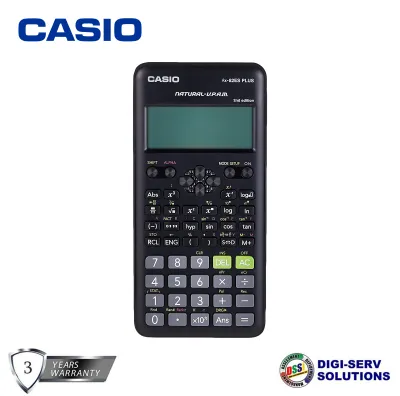
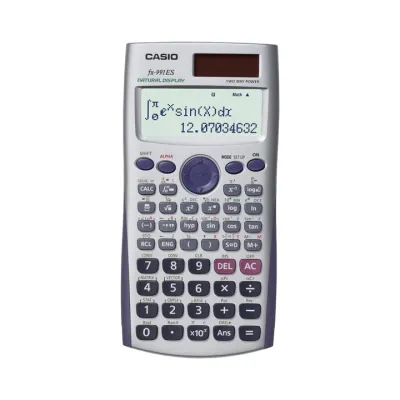
Prices are valid at publication and may change. Please refer to the product page for the latest price.
Conversely, if you are entering a university engineering program, an advanced mathematics major, or a specialized statistics course, your academic demands will quickly outgrow basic tools. The CASIO fx-991EX is designed specifically to handle these higher-level challenges, offering advanced matrix calculations, vector operations, and complex equation solvers. Choosing this model ensures that you will not need to upgrade your calculator halfway through your college years when faced with multi-variable calculus or advanced physics problems.
While the fx-991EX represents a slightly higher upfront investment, often priced around ₱1,500 to ₱2,200 depending on the retailer, the fx-570ES PLUS is generally more budget-friendly, typically retailing between ₱1,000 and ₱1,400. However, before letting the price tag dictate your purchase, you must perform a critical verification step. Always check the official list of permitted calculators provided by your school, university department, or national exam board. Some advanced courses or board exams restrict specific models, making it essential to confirm compliance before spending your budget.
Display and Interface: How They Affect Daily Use
The way a calculator displays information directly impacts your speed and accuracy during timed exams. The CASIO fx-570ES PLUS utilizes the classic Natural V.P.A.M. (Visually Perfect Algebraic Method) display, which allows you to input and view fractions, exponents, and square roots exactly as they appear in your textbooks. This screen technology is highly readable under standard classroom lighting, though its lower dot-matrix resolution means that complex formulas with multiple nested fractions can sometimes look slightly pixelated or cramped.

In contrast, the CASIO fx-991EX features a high-resolution LCD screen that represents a significant leap forward in display technology for scientific calculators. This high-definition screen allows for much finer lines, clearer text, and more detailed mathematical symbols, which greatly reduces eye strain during long study sessions. The increased resolution also enables the calculator to display more information at once, such as complete tables of values or multi-line equation steps, without forcing you to scroll constantly.
This difference in screen technology also changes how you navigate the calculator’s various modes. The fx-570ES PLUS relies on a traditional text-based menu system where you press a mode key and select from a numbered list of options. The fx-991EX introduces an intuitive, icon-based menu interface similar to what you might find on a basic smartphone or computer application. This visual layout makes it much easier to find specific functions, such as matrix mode or vector mode, without having to memorize complex key combinations.
To determine which interface suits you best, it is highly recommended to perform a hands-on user experience check. If possible, visit a local stationery store or authorized electronics retailer to test the button layout, screen contrast, and menu logic of both models in person. Pay close attention to how easy it is to read the screen from different angles and how responsive the keys feel under your fingertips. If an in-store trial is not possible, watching official video demonstrations can provide valuable insight into how quickly each calculator processes inputs and navigates between different mathematical modes.
Matching Functions to Your Coursework
Aligning your calculator’s built-in capabilities with your specific syllabus is crucial for academic success. Both the CASIO fx-570ES PLUS and the fx-991EX handle standard scientific functions with ease, including basic trigonometry, logarithmic calculations, statistical analysis, and numerical integration or differentiation. If your coursework is limited to these fundamental areas, either model will serve you well throughout your studies.
However, for students tackling advanced technical coursework, the fx-991EX offers several specialized features that can save significant time during exams. One of its most notable additions is the built-in spreadsheet function, which allows you to perform basic data entry, formula calculations, and statistical analysis directly on the calculator’s screen. Additionally, the fx-991EX can handle larger mathematical structures, such as 4×4 matrix calculations and 4-variable simultaneous equations, whereas the fx-570ES PLUS is typically limited to 3×3 matrices and 3-variable equations.
The fx-991EX also excels in advanced probability distributions, offering dedicated modes for binomial and normal distributions that are highly useful for college-level statistics and engineering data analysis. It also includes a convenient QR code generation feature; by pressing a few keys, you can display a QR code on the calculator’s screen, which can then be scanned with a smartphone to visualize your equations or data plots on a web browser. This interactive feature is highly beneficial for students who want to verify their algebraic graphs or statistical curves visually.
To avoid paying for features you will never use, or conversely, finding yourself without a critical tool during a mid-term exam, carefully cross-reference each calculator’s official function list with your course syllabus. Ask your professors or upperclassmen which functions are frequently utilized in your specific program. If your curriculum heavily emphasizes advanced linear algebra, complex number analysis, or probability, investing in the more advanced capabilities of the fx-991EX is highly advisable.
Power, Build, and Daily Durability
A scientific calculator is a long-term investment that must withstand the physical demands of daily student life. The power source of your calculator is a key factor in its overall reliability and maintenance requirements. The CASIO fx-991EX features a dual-power system, utilizing a built-in solar panel alongside a traditional button battery. This setup ensures that the calculator runs on solar energy when ambient light is sufficient, conserving the battery power for low-light environments and significantly extending the overall lifespan of the internal battery.
On the other hand, the CASIO fx-570ES PLUS typically relies solely on a single AAA battery or a button cell, depending on the specific regional variant. While a single-battery configuration is highly reliable and easy to replace, it does not benefit from solar backup, meaning you must be more vigilant about carrying a spare battery, especially before major exams. Regardless of the model you choose, always check the manufacturer’s battery compartment instructions to ensure safe replacement, proper polarity alignment, and to avoid damaging the internal circuitry with leaking batteries.
In terms of physical build, both calculators are housed in durable plastic casings designed to protect the delicate LCD screen and internal components from accidental drops. They both come equipped with a slide-on hard cover that shields the keypad and screen when the device is tossed into a crowded backpack. In tropical climates with high humidity, like the Philippines, dust and moisture can easily find their way into the gaps between the keys; keeping the hard cover on when the calculator is not in use is a simple but highly effective way to prevent key stickiness and prolong the device’s operational life.
Evaluating Value and Avoiding Counterfeits
When deciding which model to purchase, you must carefully weigh the premium cost of advanced features against your actual academic needs. If your coursework only requires basic scientific calculations, purchasing the fx-570ES PLUS offers excellent value, allowing you to save money for other essential school supplies like notebooks, pens, and textbooks. However, if you anticipate needing advanced matrix, vector, or spreadsheet functions in the near future, investing in the fx-991EX from the start is more cost-effective than buying a simpler model now and being forced to upgrade later.
Because these two models are incredibly popular among students and professionals, the market is unfortunately flooded with counterfeit and substandard replica calculators. To ensure you are purchasing an authentic, reliable device that will perform accurately during exams, always buy from authorized office supply chains, official brand stores, or reputable campus bookstores. These retailers source their inventory directly from authorized distributors, ensuring that your calculator is covered by an official manufacturer’s warranty.
Be highly suspicious of unusually low prices on online marketplaces or e-commerce platforms. If a listing offers a brand-new fx-991EX or fx-570ES PLUS at a fraction of its standard retail price, it is highly likely to be a counterfeit, refurbished, or non-warranty unit. Counterfeit calculators often suffer from poor build quality, unresponsive keys, dim screens, and, most dangerously, calculation errors that can ruin your exam scores. Many authentic CASIO calculators now feature a holographic sticker on the packaging or a built-in QR code verification system on the screen that allows you to confirm authenticity online; always perform these checks immediately after purchase.
Frequently Asked Questions (FAQ)
Are both calculators allowed in board exams?
As a general rule, non-programmable scientific calculators are widely permitted in high school and university exams, but specific model approvals vary significantly depending on the examining board. For instance, in the Philippines, the Professional Regulation Commission (PRC) maintains a strict list of allowed calculator models for various professional licensure examinations, and this list is subject to periodic updates. Similarly, the Department of Education (DepEd) and individual universities may have their own specific guidelines regarding which models are permitted in the classroom. To avoid any last-minute panic or having your calculator confiscated at the exam room door, always check the latest official guidelines from your specific examination authority well in advance of your test date.
What is the difference between the fx-570ES PLUS and the fx-991ES PLUS?
The CASIO fx-570ES PLUS and the fx-991ES PLUS are closely related models that share almost identical mathematical functions and internal processing capabilities. The primary difference between these two models lies in their power source and physical design. The fx-991ES PLUS features a dual-power system (solar panel and battery), making it slightly thinner and lighter, while the fx-570ES PLUS relies solely on a single battery power source, resulting in a slightly different battery compartment design. Because their core mathematical features overlap so heavily, your choice between them should be based on your preference for solar power backup and local retail availability. Always verify the exact specifications and function count on the official product packaging or specification sheet to ensure you are getting the exact variant you need.

Community discussion
Share your experience or ask a question. Comments are reviewed before publication.