
Selecting the right scientific calculator for Senior High School (SHS) in the Philippines depends on your academic track, budget, and school-specific guidelines. While CASIO is an established global standard with a wide range of models, the D2000C offers an alternative option that appeals to budget-conscious students. To make the right choice, you must evaluate the mathematical functions required by your curriculum, verify local exam compliance, and compare physical usability features.
Rather than relying on brand reputation alone, students should look closely at the exact specifications of each device. A calculator that works perfectly for a general education track might fall short in advanced STEM classes. This guide provides a practical framework to help you compare the D2000C against various CASIO scientific calculators, ensuring you select a reliable tool for your studies.
Understanding the Contenders: D2000C vs CASIO Lineups
Before comparing specific features, it is essential to understand the market positioning of these two options. The D2000C is a specific scientific calculator model often positioned as an affordable, entry-level alternative. It aims to deliver the core utility required for general high school mathematics, making it a popular choice for those seeking cost-effective school supplies.
Products mentioned in this guide
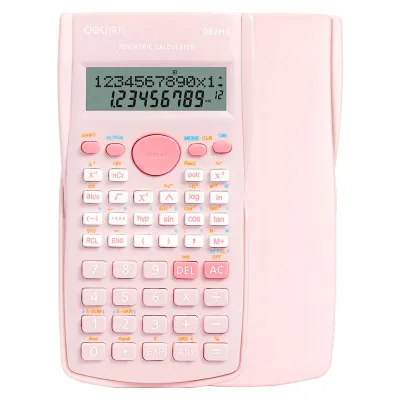
Prices are valid at publication and may change. Please refer to the product page for the latest price.
In contrast, CASIO is a globally established brand with a diverse and extensive lineup of scientific calculators. Rather than being a single model, CASIO offers multiple series designed for different educational levels. These range from the classic, entry-level MS series to the mid-range ES Plus series, and up to the advanced ClassWiz series. Each series features distinct processing speeds, display resolutions, and functional capacities.
Because of this structural difference, you cannot simply compare “the D2000C” to “CASIO” as a whole. Instead, you must compare the D2000C’s specific technical sheet against the exact CASIO model number you are considering. A basic CASIO model may have a similar feature set to the D2000C, while an advanced CASIO model will offer significantly more complex computational capabilities. Identifying your specific academic requirements is the first step in determining which tier of calculator is appropriate for your studies.
Core Functions for Senior High School STEM and ABM Tracks
The mathematical demands of Senior High School vary greatly depending on your chosen track. STEM students regularly encounter pre-calculus, basic calculus, general physics, and advanced chemistry. ABM students, on the other hand, focus heavily on business mathematics, statistics, and fractional calculations. Therefore, the functional capacity of your calculator must match your specific syllabus.

Natural Textbook Display
One of the most critical features to verify is the display style. A natural textbook display allows the calculator to show fractions, exponents, surds, and algebraic expressions exactly as they are written in standard textbooks. This visual layout reduces input errors and makes it much easier to verify your steps during complex multi-step calculations. When evaluating the D2000C or a CASIO model, check the product packaging or user manual to confirm if it supports this multi-line, natural display format, or if it uses the older, single-line linear display format.
Advanced Mathematical Capabilities
For STEM students, a calculator must go beyond basic arithmetic. You should verify whether the device can perform matrix calculations, vector calculations, and solve simultaneous or quadratic equations. Advanced CASIO models, such as those in the ClassWiz series, typically include dedicated modes for these operations, allowing you to input matrices up to a certain dimension or solve polynomial equations directly. If you are considering the D2000C, carefully inspect its function list to ensure it supports these specific algebraic and calculus operations before committing to the purchase.
Keystroke Logic and Menu Navigation
The ease with which you can access different functions plays a major role during timed classroom quizzes and exams. Some calculators rely on complex key combinations, requiring you to press multiple shift keys to access secondary or tertiary functions. Other models utilize an intuitive, icon-based menu system that simplifies navigation. When comparing devices, observe the button layout and the labeling above the keys. A clean, well-organized interface will help you work faster and minimize keystroke mistakes under pressure.
Exam Compliance and School Restrictions in the Philippines
In the Philippines, educational institutions and national regulatory bodies maintain strict guidelines regarding the types of calculators permitted in examination rooms. Purchasing a highly advanced calculator is of little use if you are barred from bringing it into your exams. Therefore, verifying compliance is a non-negotiable step in your buying journey.
School and Classroom Policies
Individual senior high schools, both public and private, often establish their own specific calculator policies. Some teachers prohibit calculators that feature programmable memory, graphing capabilities, or text-storage functions to maintain academic integrity. Before buying either the D2000C or a CASIO model, consult your subject teachers or review your course syllabus. They can provide a list of approved model numbers or specify the exact technical limitations your device must adhere to.
National Examination Standards
While the Department of Education (DepEd) oversees high school exams, many schools align their calculator rules with the Professional Regulation Commission (PRC) guidelines used for college board exams. This alignment helps students become accustomed to using exam-compliant tools early in their academic journeys. When shopping, look for official compliance lists provided by your school or check the manufacturer’s documentation. Genuine models often state their exam-approved status clearly on the packaging or on the official brand website.
Build Quality, Power Sources, and Daily Usability
A scientific calculator is an investment meant to withstand daily transport in a crowded backpack and constant use on small classroom desks. Physical durability and operational reliability are key factors that determine the long-term usability of the device.
Power Source Configurations
When evaluating power options, look for models that feature a dual-power system. A dual-power calculator utilizes a solar panel as its primary energy source under sufficient classroom lighting, switching seamlessly to a backup button battery when light levels are low. This configuration ensures that your calculator will not suddenly shut down during an important exam. Single-battery models, while functional, require more frequent battery replacements and carry a higher risk of unexpected power failure.
Physical Durability and Protection
The physical construction of the calculator should be robust enough to handle accidental drops. Inspect the quality of the plastic casing and the fit of the protective slide-on hard cover. A well-designed hard case shields the sensitive liquid crystal display (LCD) and the key matrix from pressure and impact when stored inside your bag. Additionally, check the responsiveness of the keys; they should offer clear tactile feedback without sticking or requiring excessive force to register an input.
Screen Clarity and Ergonomics
Classroom lighting in the Philippines can vary from bright fluorescent bulbs to dimly lit rooms during rainy afternoons. A high-contrast screen with adjustable contrast settings is highly beneficial for reducing eye strain. Furthermore, look for design details such as non-slip rubber feet on the base of the calculator. These small features prevent the device from sliding off slanted school armchairs, protecting it from unnecessary falls.
Evaluating Price, Authenticity, and Long-Term Value
Balancing your budget against the functional needs of your school track is essential when choosing between the D2000C and various CASIO models. Understanding the pricing landscape and the risks of counterfeit products will protect your investment.
Price Tiers in the Philippine Market
The D2000C generally occupies a highly competitive, budget-friendly price tier in ₱, making it an attractive option for families looking to minimize school supply expenses. CASIO calculators span a wider pricing spectrum. Entry-level CASIO models are priced competitively, while their advanced, feature-rich counterparts represent a more significant upfront investment in ₱. You must weigh whether the advanced features of a higher-priced model are truly necessary for your current and future academic plans.
The Risk of Counterfeit Products
The Philippine market has a notable presence of counterfeit scientific calculators, particularly on online marketplaces and informal retail stalls. Counterfeit calculators often look nearly identical to genuine models but suffer from poor build quality, inaccurate mathematical algorithms, and unreliable battery life. To ensure you are purchasing an authentic device, avoid deals that seem unrealistically cheap. Purchase exclusively from authorized office supply chains, major department stores, or official brand flagship stores on reputable ecommerce platforms.
Warranty and Lifespan Considerations
A genuine scientific calculator from an established manufacturer typically comes with a warranty and is built to last for several years. If you plan to pursue a college degree in engineering, science, or business, investing in a durable, high-quality calculator during senior high school can save you money in the long run. A reliable device can easily transition with you from high school to university, eliminating the need to purchase a second calculator later on.
Final Decision Framework: Which Calculator Should You Buy?
To make your final decision, systematically evaluate your academic track, budget, and school requirements using a clear set of conditions.
When to Choose CASIO
Opt for a CASIO scientific calculator if you are enrolled in the STEM track and require advanced features such as matrix operations, vector calculations, and complex equation solving. CASIO is also the preferred choice if your school has an explicit list of approved models that includes their specific series, or if you want the peace of mind that comes with a globally recognized standard. The abundance of online tutorials and peer familiarity with CASIO interfaces also makes learning how to use the device much easier.
When to Choose the D2000C
Consider the D2000C if you are in a non-STEM track, such as HUMSS or GAS, where the mathematical requirements are focused on general algebra and basic statistics. It is an excellent choice if you are working within a strict budget and have verified that its specific functional capabilities fully cover your classroom syllabus. Ensure you confirm with your teacher that the D2000C is permitted in your specific classroom before finalizing your purchase.
Final Verification Steps Before Buying
Before handing over your ₱ or clicking the checkout button on an ecommerce platform, perform these final checks:
- Ask your math and science teachers for their specific list of prohibited or required calculator features.
- Verify the exact model number on the packaging to ensure it matches your school's guidelines.
- Check the seller's credentials to guarantee you are buying a genuine, warranted product rather than a counterfeit.

Community discussion
Share your experience or ask a question. Comments are reviewed before publication.