
Quick Answer: Which Pencil Grade Gives Better Control and Shading?
Choosing between hard and soft graphite pencils in a drawing kit is not a matter of finding a single superior tool, as both grades serve entirely different, complementary roles on the drawing paper. Hard pencils, designated by the letter “H,” offer maximum control and precision, making them the ideal choice for clean linework, architectural drafting, and faint initial sketches that need to be easily erased. Their firm cores resist wearing down, allowing you to maintain a sharp point for fine details without frequent interruptions.
Soft pencils, designated by the letter “B,” are the undisputed champions of shading, depth, and tonal variety. They deposit rich, dark graphite onto the paper with minimal pressure, making them perfect for blending, creating smooth transitions, and rendering deep shadows. While a complete drawing kit should ideally contain a balanced progression of both grades, your immediate choice depends on your artistic focus: choose hard grades when your priority is structured precision, and reach for soft grades when you want to build expressive, high-contrast values.
The Graphite Grading Scale Explained
To make the most of any drawing kit, you must understand the standardized graphite grading scale that manufacturers use to categorize pencils. This scale primarily revolves around the letters “H” and “B,” which stand for “Hard” and “Black” (or soft) respectively. Sitting directly in the middle of this spectrum is the “HB” pencil, which represents a balanced blend of hardness and darkness, similar to a standard school writing pencil, along with the “F” pencil, which stands for “Fine” and sharpens to a highly durable point.
Products mentioned in this guide
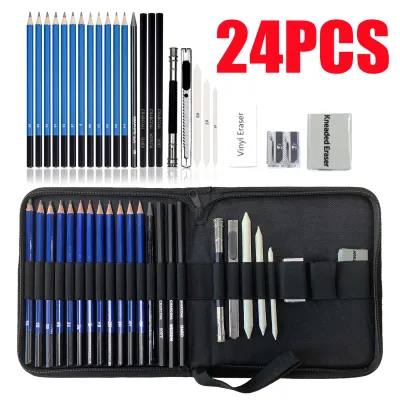
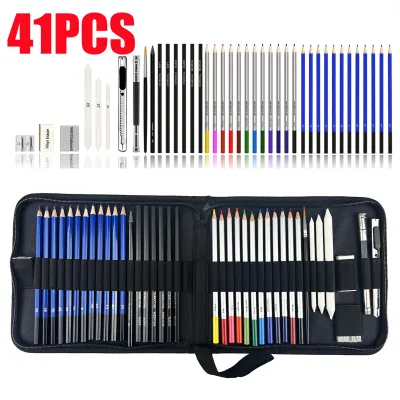
Prices are valid at publication and may change. Please refer to the product page for the latest price.

At a physical level, the performance of these pencils is determined by the ratio of clay to graphite in the core. Pencil leads are made by mixing powdered graphite with a clay binder and firing them at high temperatures. A higher proportion of clay results in a harder, lighter pencil core because the clay holds the graphite particles tightly together, preventing them from transferring easily to the paper. Conversely, a higher proportion of graphite relative to the clay binder produces a softer, darker core that crumbles easily under light friction, leaving a dense layer of dark particles on your drawing surface.
Standard drawing kits typically offer a curated range of these grades to give artists a versatile toolkit. A common kit might range from 2H or 4H on the harder side, up through HB, and extend down to 6B or 8B on the softer side. The numbers accompanying the letters indicate the intensity of the pencil’s specific characteristic. For example, a 6H pencil is significantly harder and writes much lighter than a 2H pencil, while a 6B pencil is far softer and deposits a much darker, richer black than a 2B pencil.
Hard Graphite Pencils (H Grades): Mastering Precision and Control
Hard graphite pencils are the foundation of technical drawing, detailed illustration, and structural sketching. Because the core contains a high concentration of clay, it resists wear and maintains a needle-sharp point for an extended period of drawing time. This exceptional point retention gives you unmatched control over line weight and placement, ensuring that your lines remain crisp, uniform, and predictable from the first stroke to the last.
These characteristics make H-grade pencils indispensable for specific stages of the creative process and particular drawing styles. If you are laying down the initial perspective lines, grids, or structural outlines of a drawing, a 2H or 4H pencil allows you to sketch freely without creating dark, distracting marks. They are also the preferred tools for fine hatching, cross-hatching, intricate textures like individual strands of hair or delicate fabric weaves, and precise scientific or architectural rendering where accuracy is paramount.
However, working with hard pencils carries distinct risks and limitations that you must manage carefully. The most significant risk is paper indentation, often referred to as “grooving” or scoring. Because H-grade cores are physically hard, applying excessive downward pressure in an attempt to make a darker mark will compress and damage the paper fibers rather than depositing more graphite. This creates permanent physical grooves in the paper that cannot be erased and will show up as unwanted white lines when you attempt to shade over them later with softer pencils.
Furthermore, the tonal range of hard pencils is strictly limited to light and medium grays, meaning you cannot achieve rich, deep blacks no matter how many layers you apply. In terms of erasability, light strokes made with an H pencil lift away cleanly with a standard vinyl eraser. However, if you have pressed too hard, the clay binder can burnish or polish the paper surface, locking the faint graphite into the damaged fibers and making it nearly impossible to remove completely without leaving a ghost image.
Soft Graphite Pencils (B Grades): Maximizing Shading and Depth
Soft graphite pencils are designed to deliver expressive depth, rich contrast, and painterly textures. Because these cores contain a high ratio of graphite to clay, they are incredibly responsive to the artist’s touch, releasing a generous amount of dark pigment onto the page with almost no physical pressure. This ease of transfer allows you to transition smoothly from soft, smoky mid-tones to intense, velvety blacks, giving your artwork a sense of three-dimensional volume.
If your artistic style leans toward portraiture, still life, or dramatic landscapes, B-grade pencils will be your primary tools. They are exceptional for rendering smooth skin tones, deep shadows, and reflective surfaces, as well as filling in large areas of dark value quickly. The soft, crumbly nature of the graphite makes it highly receptive to blending tools, such as paper stumps (tortillons), chamois cloth, or even dry brushes, allowing you to create seamless gradients and soft-focus effects.
Despite their beautiful tonal capabilities, soft pencils present unique control challenges that require a mindful approach. The soft core wears down rapidly, losing its sharp point after only a few strokes and requiring frequent sharpening if you need to maintain any level of detail. Additionally, soft graphite does not bind tightly to the paper, resulting in a high smudge risk. In warm, humid environments, such as the tropical climate of the Philippines, the natural moisture and oils from your hands can easily smear loose graphite across your drawing, ruining clean borders; using a sheet of scrap paper under your drawing hand or wearing an artist’s smudge glove is highly recommended.
Erasability is another area where soft pencils behave differently than their hard counterparts. Because soft graphite sits primarily on top of the paper’s texture rather than being pressed deep into the fibers, it is highly receptive to being lifted away. A kneaded eraser is particularly effective here, as you can press it onto the shaded area to lift the loose graphite particles cleanly, allowing you to create bright highlights. However, if you apply heavy layers of soft graphite and rub them vigorously, you can burnish the layer, creating a shiny, metallic barrier that resists further erasing or layering.
Hard vs. Soft Pencils: Practical Comparison for Artists
To help you quickly evaluate which pencil grade to reach for during your creative sessions, the table below highlights the key practical differences across major performance dimensions:
| Feature | Hard Pencils (H Grades) | Soft Pencils (B Grades) |
|---|---|---|
| Tonal Range | Light silver to medium gray | Medium gray to deep, velvety black |
| Point Retention | Excellent (stays sharp for long periods) | Poor (blunts quickly under light use) |
| Smudge Risk | Very low (graphite binds tightly to paper) | High (loose particles smear easily) |
| Paper Indentation | High risk if excessive pressure is applied | Low risk (core glides smoothly over fibers) |
| Blending Capability | Poor (can look scratchy or uneven) | Excellent (blends smoothly with stumps or cloth) |
| Primary Use Case | Technical drawing, outlines, fine details | Shading, deep shadows, expressive sketching |
Understanding how these pencils interact with your drawing surface is crucial to achieving the best results. The “tooth,” or texture, of your paper plays a massive role in how graphite is deposited. Soft B-grade pencils require a paper with a moderate to heavy tooth to physically shave the graphite off the core; on extremely smooth surfaces like Bristol board, soft pencils can slide without depositing their full dark potential. Hard H-grade pencils, on the other hand, perform exceptionally well on smooth surfaces where precision is key, but they can easily tear or fray highly textured, soft papers if used with a heavy hand.
To build a professional-looking drawing with depth and clarity, you should employ a strategic layering technique. Always begin your artwork by using hard pencils (such as a 2H) to establish your proportions, perspective lines, and basic light mapping. Once your structure is secure, gradually transition to medium grades like HB and 2B to build up your mid-tones and establish form. Finally, apply your softest pencils (such as 4B to 6B) only in the deepest shadow areas to lock in the contrast; starting with soft pencils first can saturate the paper’s tooth early on, preventing you from adding clean details or building structured layers.
Decision Framework: Which Pencils Should Your Drawing Kit Include?
When evaluating a new drawing kit or assembling your own custom collection of tools, you should match the pencil selection to your specific workflow, preferred drawing style, and the environmental conditions of your workspace. Use the following guidelines to make an informed choice:
- Choose Hard (H) Pencils if: Your work is focused on technical drafting, architectural layouts, detailed botanical illustrations, or clean comic book inking prep. These grades are also ideal if you prefer working on ultra-smooth paper and need to ensure your initial guidelines can be completely erased without leaving a trace.
- Choose Soft (B) Pencils if: Your artistic style is expressive, painterly, or focused on high-contrast realism, such as portraiture or dramatic still-life drawings. These grades are perfect if you enjoy blending techniques, working on medium-to-rough textured paper, and want to achieve deep, rich values that give your work dimension.
- Choose a Mixed Kit if: You want complete creative versatility. A well-designed mixed kit allows you to transition seamlessly through the entire drawing lifecycle, using the hard pencils for initial mapping, medium grades for structural shading, and soft grades for the final dark accents.
Before purchasing any pre-packaged drawing kit, verify the logical progression of the included pencil grades. A high-quality kit should offer a sensible, step-by-step sequence of grades—such as 2H, HB, 2B, 4B, and 6B—rather than jumping straight from an extreme 9H to an extreme 9B, which leaves you without the crucial mid-tones needed for smooth transitions. Additionally, check that the pencils are encased in durable, high-quality wood like incense cedar, which protects the fragile graphite cores from shattering internally when dropped or when exposed to fluctuating tropical humidity.
In terms of cost, basic student-grade drawing kits in local art shops generally range from ₱150 to ₱400, offering a reliable starting point for beginners. If you are looking for professional-grade performance with superior break resistance, highly refined clay-to-graphite mixtures, and consistent grading, expect to invest between ₱800 and ₱2,500+ for premium imported kits. Testing a small selection of individual pencils from a brand before committing to a large, expensive set is always a wise approach to ensure the graphite matches your personal drawing pressure and style.
Frequently Asked Questions (FAQ)
Can I use soft pencils for initial sketching?
Using highly soft pencils like a 4B or 6B for your initial sketches is generally not recommended because they pose a high risk of smudging as you work across the page. Additionally, the dark, heavy lines deposited by soft graphite can be difficult to erase completely, often leaving dark smudges that can ruin the clean look of your final piece. It is highly recommended to start your structural outlines with a harder grade, such as a 2H or H, which leaves faint, crisp lines that erase easily without damaging the paper texture.
Why do some professional drawing kits skip the HB pencil?
While the HB pencil is the universal standard for writing and basic schoolwork, some highly specialized professional artist kits skip it to focus entirely on the functional extremes of the grading scale. Professional artists often prefer to use distinct tools for distinct tasks, relying on hard H grades for crisp, light precision and soft B grades for deep, dark shading. In these workflows, the middle-ground HB grade can feel redundant, though it still remains a highly popular and useful tool for general mid-tone rendering and quick thumbnail sketching.
Does the brand of the drawing kit affect the hardness scale?
Yes, the graphite grading scale is not perfectly standardized across all manufacturers, meaning a 2B pencil from one brand may feel and look different than a 2B from another. Generally, European brands tend to run slightly harder and lighter across the scale, while Japanese brands are known for producing pencils that run noticeably softer, darker, and smoother for the same designated grade. When switching to a new brand, it is always best to draw a quick tonal scale on a piece of scrap paper to familiarize yourself with how that specific manufacturer’s grades behave.

Community discussion
Share your experience or ask a question. Comments are reviewed before publication.