
Selecting the ideal Deli whiteboard marker requires matching the marker’s physical tip design and ink characteristics to your specific writing surface and environment. Whether you are presenting in an air-conditioned boardroom, teaching a large classroom, or organizing a family schedule on a small refrigerator calendar, the right marker ensures clear visibility and effortless cleanup. By focusing on observable features like tip shape, ink drying indicators, and surface compatibility, you can avoid common issues like ghosting, faint lines, or premature drying.
Understanding Deli Whiteboard Marker Tip Shapes and Ink Formulations
The physical shape of the marker tip directly dictates how your writing appears on the board and how easily it can be read from a distance. Deli offers two primary tip configurations: the bullet tip and the chisel tip. Each serves a distinct visual purpose and suits different writing styles.
A bullet tip features a rounded, symmetrical point that produces a consistent line width regardless of the angle at which you hold the marker. This consistency is highly beneficial for standard handwriting, detailed diagrams, and long-form notes where uniform letter sizing is critical for readability. Because the line width remains constant, bullet tips are excellent for close-up reading and smaller writing surfaces where variable line weights might cause letters to bleed together.
Products mentioned in this guide
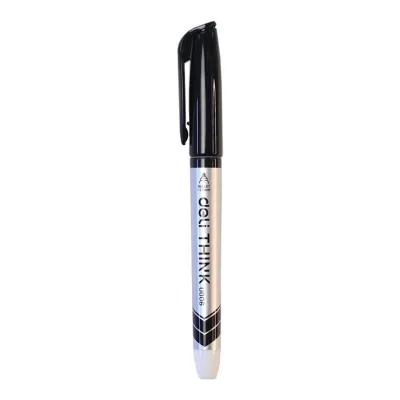
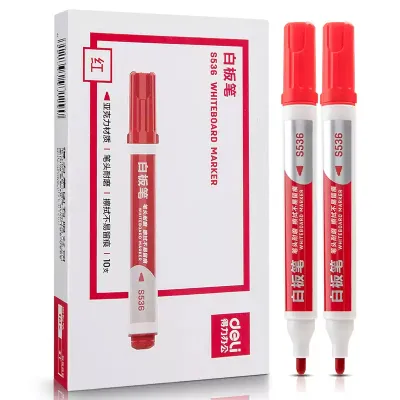
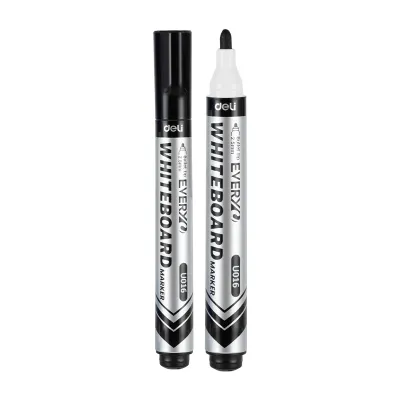
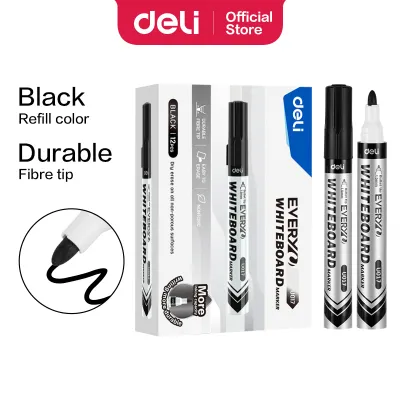
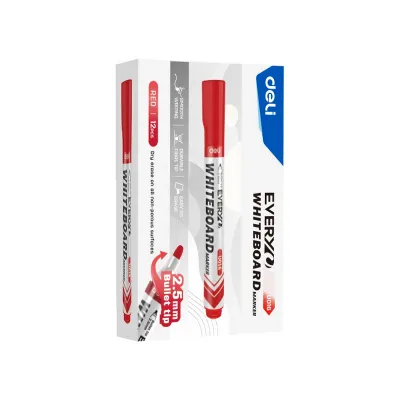
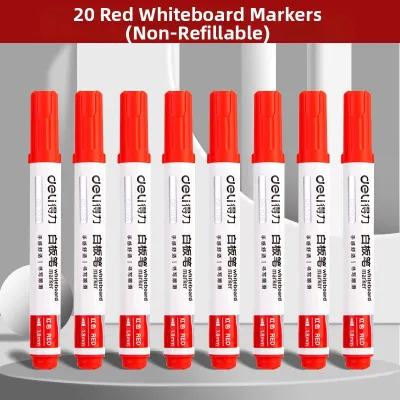
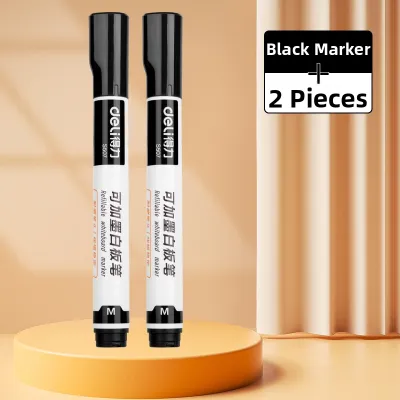
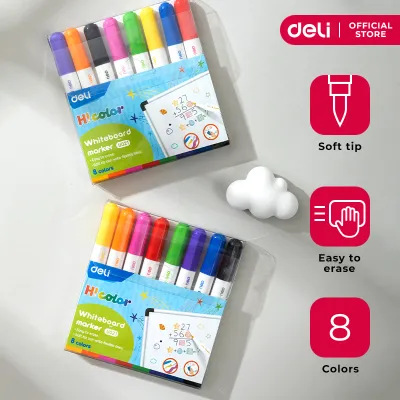
Prices are valid at publication and may change. Please refer to the product page for the latest price.
Conversely, a chisel tip features an angled, flat edge that allows you to vary your line width simply by changing the angle of your hand. By using the broad flat edge, you can create thick, bold strokes that are highly visible from the back of a large room or conference hall. Using the sharp point of the chisel tip allows for fine, precise lines, making it a versatile tool for calligraphic writing, underlining key points, or drawing complex charts. Controlling a chisel tip requires a bit more practice to maintain consistent lettering, but its adaptability makes it a favorite for dynamic presentations.
Beyond the tip, the ink formulation determines how the marker behaves during and after writing. When browsing Deli’s lineup, you should carefully inspect the packaging labels for specific performance indicators, particularly regarding odor, drying speed, and erasability.
Low-odor formulations are essential for enclosed spaces, such as meeting rooms or small classrooms where ventilation might be limited. Standard whiteboard marker inks often contain strong solvents that can cause discomfort during prolonged use. Checking the packaging for explicit “low-odor” or “non-toxic” designations helps ensure a comfortable writing environment for both the presenter and the audience.
Drying speed is another critical factor, especially in tropical climates where high humidity can affect how liquids evaporate. A quick-drying ink prevents accidental smudging as your hand moves across the board, which is particularly helpful for left-handed writers. To verify this, look for quick-dry indicators on the marker casing or packaging, which suggest the ink is designed to set almost instantly upon contact with a non-porous surface.
Easy-erase properties rely on the ink’s ability to dry into a cohesive, dry film rather than bonding with the board surface. When the ink dries, it should release cleanly when wiped with a dry eraser or microfiber cloth, leaving no residue behind. This dry-wipe capability is typically highlighted on the product label and is crucial for maintaining the longevity of your whiteboard.
Color opacity and contrast are vital for ensuring your message is legible under various lighting conditions. Standard whiteboards require high-contrast colors like deep black, dark blue, and rich red to remain readable from a distance. When selecting a marker set, check the packaging for color swatches or opacity claims.
For specialty surfaces like dark-colored boards or modern glass whiteboards, standard inks may appear translucent or faint. Glass boards, in particular, reflect light and can make thin or low-opacity inks difficult to read. In these scenarios, look for markers specifically labeled for glass or those boasting high-pigment formulas. Testing the contrast on a small section of your specific board is the most reliable way to ensure the colors stand out clearly against the background.
Matching Marker Variants to Your Specific Environment
In professional office environments and corporate conference rooms, presentations must be sharp, professional, and easily legible for all participants. For these settings, prioritizing high-contrast colors and chisel tip markers is highly recommended.

The bold lines produced by a chisel tip ensure that key performance indicators, project timelines, and brainstorming notes can be read clearly from the back of a large boardroom. Stick to classic, high-contrast colors such as black and dark blue for the main body of your text, and use red or green sparingly to highlight action items or urgent deadlines. This structured color coding keeps presentations organized and visually engaging.
Additionally, because office meetings often involve prolonged brainstorming sessions, choosing markers with a larger ink reservoir or refillable designs can prevent the frustration of a marker running dry mid-meeting. Ensure the markers are stored horizontally in a tray to keep the ink evenly distributed across the tip, ready for immediate use.
Classroom environments demand versatility, durability, and high visual engagement to keep students focused. Teachers often write extensive, long-form notes and draw detailed diagrams, making a combination of bullet and chisel tips highly effective.
Bullet tips are ideal for daily lesson plans and detailed math or science equations, where precise, uniform characters prevent confusion. The consistent line width helps students copy notes accurately from their desks. Meanwhile, multi-color marker sets are invaluable tools for educators. Using a variety of colors allows teachers to differentiate parts of speech, highlight steps in a process, or separate different concepts on a crowded board.
In busy school settings, markers are subjected to heavy daily use and are frequently left uncapped for short periods. Selecting variants that feature dry-safe technology—which prevents the tip from drying out quickly even when left uncapped during a lecture—can significantly extend the lifespan of your classroom stationery.
For home use, personal planning, and family organization, the requirements shift toward compact sizes, fine tips, and space-saving storage. Home whiteboards, such as weekly meal planners, magnetic fridge calendars, or daily to-do lists, are typically much smaller than those found in offices or schools.
Large chisel tips are often too bulky for these compact surfaces, as they quickly crowd the limited writing space. Instead, opt for fine bullet tips or ultra-fine markers that allow you to write detailed schedules and small text clearly within tight calendar grids.
Compact marker sets that feature built-in magnetic caps and small felt erasers are incredibly convenient for home environments. These allow you to stick the markers directly onto your refrigerator or magnetic board, keeping them within arm’s reach and reducing clutter. Since home use is often sporadic, choosing smaller sets prevents unused markers from drying out over long periods of inactivity.
Verifying Whiteboard Compatibility and Marker Condition
Before using any new Deli whiteboard marker, it is essential to verify that the marker is fully compatible with your specific board material. Whiteboards are manufactured from various materials, including melamine, painted steel, porcelain-on-steel, and tempered glass, each reacting differently to marker inks.
Review the marker packaging for compatibility statements, looking for terms like “suitable for all dry-erase surfaces” or specific mentions of glass board compatibility. Simultaneously, consult your whiteboard manufacturer’s care and maintenance guidelines. Some high-end porcelain or glass boards require specific ink formulations to prevent permanent staining, and using the wrong marker can void the board’s warranty or ruin its surface coating.
To prevent permanent damage or unsightly staining, always perform a simple, safe test in an inconspicuous area of your whiteboard before writing on the main surface. This is especially important for older boards that may have lost their protective topcoat, or for specialty glass and painted surfaces.
Select a small, hidden corner of the board—such as the very bottom edge or a spot usually covered by a frame. Draw a small line or a few characters using the marker, and let the ink dry completely for a few minutes. Once dry, attempt to erase the mark using a standard dry whiteboard eraser or a clean microfiber cloth.
Observe the results closely. The ink should wipe away cleanly with minimal pressure, leaving no faint outlines, shadows, or “ghosting” behind. If the ink leaves a persistent stain or requires heavy scrubbing to remove, stop using that specific marker variant on that surface immediately, as continued use will degrade the board’s usability.
When unboxing new Deli whiteboard markers, performing a few quick physical checks ensures they are in optimal condition and ready for reliable use. Inspecting the markers before your first presentation can prevent unexpected dry-outs or messy leaks.
First, check that the marker caps fit tightly and securely. A loose cap allows air to enter, which can dry out the solvent-based ink in a matter of hours. You should feel or hear a distinct “click” when snapping the cap back onto the marker body, indicating an airtight seal.
Next, inspect the marker body and tip for any signs of ink leakage or pooling, which can sometimes occur during transit due to temperature or pressure changes. If the marker requires priming or shaking—common for paint-style or liquid-ink markers—follow the manufacturer’s instructions printed on the barrel. Typically, standard dry-erase markers do not require shaking and are ready to write immediately, but verifying the specific instructions on your Deli model ensures proper ink flow from the very first stroke.
Frequently Asked Questions (FAQ)
How do I revive a dried-out whiteboard marker?
If a whiteboard marker has been left uncapped and has dried out, you can often revive it using simple, physical methods that utilize gravity and capillary action. The most reliable, non-destructive method is the gravity storage technique. Place the marker tip-down in a cup or holder and leave it undisturbed for 12 to 24 hours. This allows the remaining ink solvents inside the reservoir to slowly migrate back down to the tip, re-saturating the fibers.
Avoid the temptation to inject water, rubbing alcohol, or other household solvents into the marker tip. While this might temporarily restore color, unauthorized liquids can permanently break down the chemical formulation of the dry-erase ink. This can result in runny ink that bleeds across the board, damages the whiteboard’s protective surface coating, or becomes incredibly difficult to erase, leading to permanent staining.
Can I use standard whiteboard markers on glass surfaces?
Standard whiteboard markers can be used on glass surfaces, but their performance and visibility will vary depending on the color contrast and the room’s lighting. Glass boards are highly reflective and lack the solid white backing of traditional boards, which can make standard, semi-translucent inks appear faint or difficult to read from a distance.
To ensure clear legibility on glass, look for markers that feature highly opaque, high-pigment ink formulations, which are often specifically labeled for glass board use. Always check both the marker packaging and your glass board manufacturer’s guidelines before use. Some glass boards have specialized coatings that require specific cleaning agents or dry-wipe markers to prevent ghosting, so verifying compatibility beforehand is key to maintaining a pristine writing surface.

Community discussion
Share your experience or ask a question. Comments are reviewed before publication.