
To choose the right hole size and dimensions for sakura beads, you must match the bead’s internal hole diameter to the thickness of your stringing material while ensuring the bead’s overall physical scale aligns with your jewelry design. Sakura beads, with their five-lobed cherry blossom shapes, present unique dimensional considerations compared to standard round beads. Because these decorative beads are often used as focal points in bracelets, necklaces, and earrings, selecting the correct physical specifications prevents structural failures like frayed cords, broken wires, or beads that sit awkwardly in your finished piece.
Understanding Overall Dimensions and Visual Proportions
When shopping for sakura-shaped beads, reading the dimensions requires a bit more care than evaluating simple round beads. Standard listings typically provide three primary measurements: length (or height), width, and thickness (depth). Because a cherry blossom shape features five distinct petals, the width usually measures the widest distance from one petal tip to another, while the length indicates the vertical span. Thickness represents the front-to-back depth of the bead, which is particularly important if you want the bead to sit flat against the skin or a flat surface.
Irregular or handmade beads, such as those crafted from lampwork glass, porcelain, or hand-molded polymer clay, often exhibit slight dimensional variations. A batch of 12mm glass sakura beads might vary by a fraction of a millimeter from bead to bead. Understanding these variations is essential when planning symmetrical designs, such as matching pairs of earrings.
Products mentioned in this guide
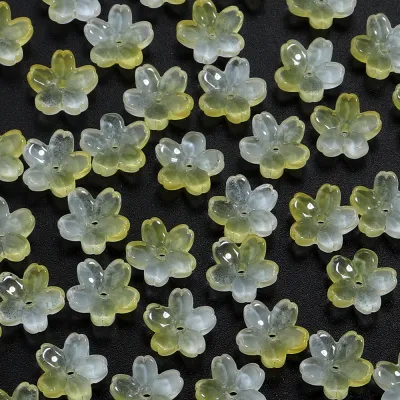
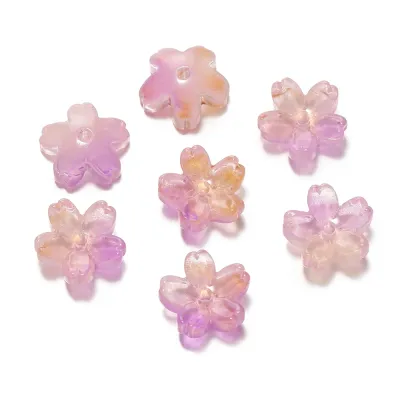
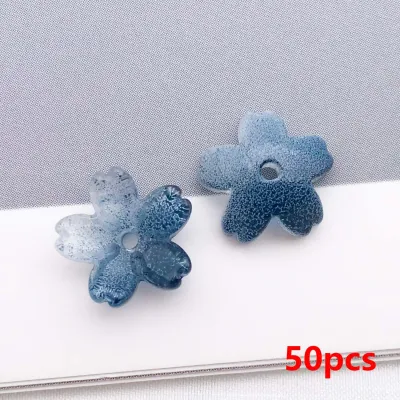
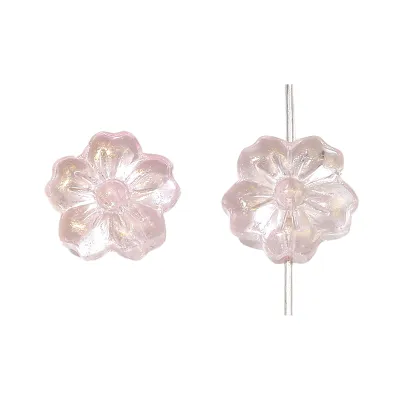
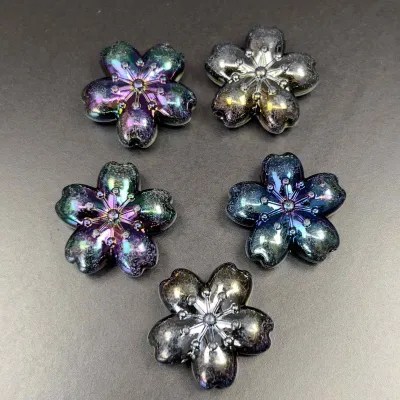
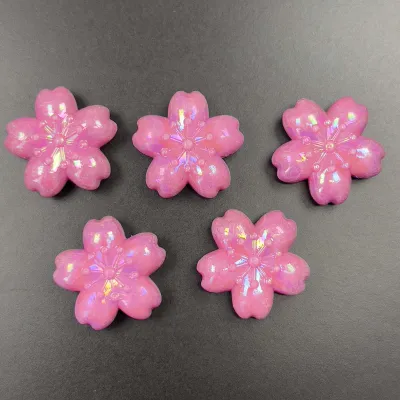
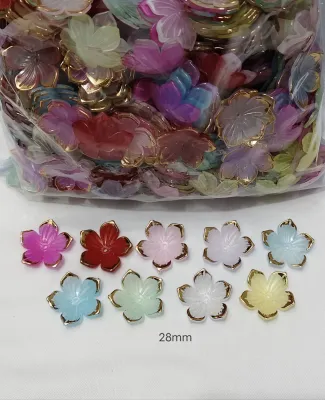
Prices are valid at publication and may change. Please refer to the product page for the latest price.
The overall size of the bead dictates its visual weight and dictates what kind of jewelry project it can support. Smaller sakura beads, ranging from 6mm to 10mm, are excellent for delicate, lightweight bracelets or subtle spacer accents. Larger beads, measuring 14mm to 20mm or more, carry significant visual weight and are best reserved for statement pendants, focal pieces on necklaces, or bold drop earrings. In warm, humid tropical environments, choosing lightweight, smaller beads can make daily wear much more comfortable, preventing heavy jewelry from clinging or pulling uncomfortably.
Fortunately, certain dimensions matter less depending on how you plan to string them. If your design allows the sakura bead to sit flat against a surface, the exact depth or thickness becomes a secondary concern. Instead, focus primarily on the face dimensions—length and width—to ensure the flower silhouette is scaled correctly for your project.
Matching Hole Diameter to Your Stringing Materials
The fundamental rule of successful bead stringing is that your stringing material must be noticeably thinner than the bead’s hole diameter. If the hole is too tight, the friction of the cord rubbing against the sharp inner edges of the bead will eventually cause the material to wear down and snap. Conversely, if the hole is excessively large, the bead will wobble, tilt, or slide over your securing knots and crimp beads.

You must also account for design techniques that require extra physical clearance. If your pattern involves passing the stringing material through the same bead multiple times—such as in woven beadwork or when creating a secure loop at the end of a strand—the hole must be wide enough to accommodate double or triple the thickness of your wire or thread. Similarly, if you plan to hide a knot or a crimp bead inside the sakura bead’s entry point, you will need a larger hole diameter to allow the hardware to slide inside smoothly.
Matching your materials to the manufacturer’s specified hole size requires a systematic approach. Consider these common combinations:
- Elastic Cord: Often used for stretch bracelets, polyurethane elastic cord typically ranges from 0.5mm to 1.0mm in thickness. For a 0.8mm elastic cord, look for sakura beads with a hole diameter of at least 1.0mm to 1.2mm to allow easy threading and to accommodate the knot.
- Flexible Beading Wire: Miniature multi-strand steel wires coated in nylon are incredibly strong. A standard 0.019-inch (approx. 0.48mm) wire pairs beautifully with bead holes of 0.8mm or larger, leaving plenty of room for double-passing near clasps.
- Nylon and Silk Thread: Excellent for knotted pearl-style necklaces, these threads are very thin but require space for knots. A bead hole of 0.8mm is generally highly compatible with standard jewelry threads.
- Thin Metal Chains: If you plan to slide sakura beads directly onto a finished chain, the end ring or the chain links must be smaller than the bead's internal diameter. A 1.5mm to 2.0mm hole is usually necessary for direct chain stringing.
The smoothness of the wire passage and the resistance of the bead to friction depend heavily on the specific material combination, such as glass on copper wire or resin on elastic cord. To prevent unexpected wear, perform a simple trial by sliding a single bead back and forth along a scrap piece of your chosen stringing material to check for rough edges or snagging before committing to a full design. Forcing a thick wire or cord through a tight, abrasive glass or ceramic hole is a recipe for structural failure.
Hole Orientation: Top-Drilled vs. Center-Drilled
The direction and placement of the hole through a sakura bead fundamentally change how the bead behaves in your jewelry design. Manufacturers generally drill these floral shapes in one of two ways, and mixing them up can ruin your intended layout.
Top-drilled beads feature a hole that runs side-to-side through the upper portion of a single petal, or front-to-back near the top edge. This orientation allows the bead to hang vertically, swinging freely like a pendant, charm, or drop component. Top-drilled sakura beads are ideal for dangling earrings, focal drops on necklaces, or adding dimensional charms to the edge of a bracelet.
Center-drilled beads have a hole drilled straight through the middle, either running from one side to the other across the center of the flower, or front-to-back directly through the heart of the blossom. This allows the bead to sit flat and align continuously along a string, wire, or headpin.
Choosing the correct orientation prevents frustrating design mistakes. For example, if you attempt to build a standard continuous bracelet strand using top-drilled sakura beads, the flowers will hang awkwardly downward rather than sitting flat against the wrist. Always match the drill style to the structural mechanics of your piece.
Pre-Purchase Verification and Wire Wrapping Considerations
To avoid sizing errors and material mismatches, always verify the measurement units listed by the seller. Craft suppliers on online marketplaces often mix metric (millimeters) and imperial (inches) measurements. A bead described as “0.5 inches” is roughly 12.7mm, which is vastly different from a 5mm bead. Always convert measurements to a single standard unit before finalizing your purchase.
For wire wrapping projects, the wire gauge must comfortably fit through the hole without scraping the interior. Furthermore, the overall dimensions of your sakura bead dictate the total length of wire required. A larger, thicker 15mm glass blossom will require a significantly longer piece of wire to wrap securely around its perimeter than a delicate 8mm resin bead.
Finally, rely strictly on the seller’s written specification sheets and dimension diagrams rather than estimating the size from product photos. Close-up photography can make a tiny 4mm bead look massive, leading to disappointing surprises when your package arrives.
Frequently Asked Questions (FAQ)
Can I safely enlarge the hole of a glass or resin sakura bead?
Attempting to enlarge the hole of a glass or resin bead carries a high risk of cracking, chipping, or completely shattering the material. If you must attempt it, first verify the material type. For glass or ceramic, use a specialized diamond-tipped bead reamer or drill bit, keeping the bead fully submerged in water to cool the tool and suppress dust. If the material is unknown or highly fragile, it is much safer to exchange the beads for a larger-holed variety.
How do I choose the right wire gauge for wire wrapping these beads?
In wire wrapping, a higher gauge number indicates a thinner wire. For small sakura beads with hole diameters around 0.8mm, a 22-gauge or 24-gauge wire is highly suitable as it passes through smoothly. Always match the wire gauge to the bead’s hole diameter so the metal slides through without forcing, which prevents kinking the wire or scraping the bead’s interior.

Community discussion
Share your experience or ask a question. Comments are reviewed before publication.